
Table of Contents
In investing, sustainability and success depend on the decisions you make. Usually, decision-making involves weighing the pros and cons of an action. For example, when buying shares, you evaluate their potential growth and dividends and the price you’ll have to pay.
However, if you trade quickly and impulsively, you may misjudge both the future benefits and the actual cost of the trade. The visible costs may seem small and include only a fee or a slightly unfavorable price. But the real costs can be higher and harder to see. You may spend extra time and energy on analysis, place your capital in the wrong place, or disrupt your long-term plan.
If you would like to be in pole position as an investor, it’s reasonable to consider what you’re giving up in order to get something else. Sometimes, tradeoffs are higher than you initially thought they were.
What Is Opportunity Cost?
When investors think about costs in trading, they usually focus on the price of buying an asset and commissions. However, it’s also important to consider the opportunity cost. Every action demands limited resources, including money, time, attention, risk, and emotional energy. If those go into one trade, they cannot be used somewhere else.
The opportunity cost of a resource is the value of the next-highest-valued alternative use of that resource. It’s the value you give up when making a choice in favor of something.
The cost of such intangible but still non-renewable and often overlooked things may not be obvious at first glance. But it must be taken into account because you can accurately assess the advantages and disadvantages if you are aware of the true value of what is sacrificed.
Examples of Opportunity Costs
You face opportunity costs each time you choose one option over another. They are inextricably linked with the thought, “I could alternatively do something else.” Here are a couple of scenarios:
Example 1. A clothing store owner may choose to scale by renting and outfitting a second sales space.
- Pros: They will be able to show and sell a greater number of products, earn more, increase brand awareness, and reduce queues at the main store.
- Apparent costs: They will spend money on renting or buying real estate, equipment, hiring, and training.
- Opportunity costs: They give up on time, effort, and money that could be spent on developing the main store, launching another business, doing something for the family, etc. Other uses of limited resources become unavailable.
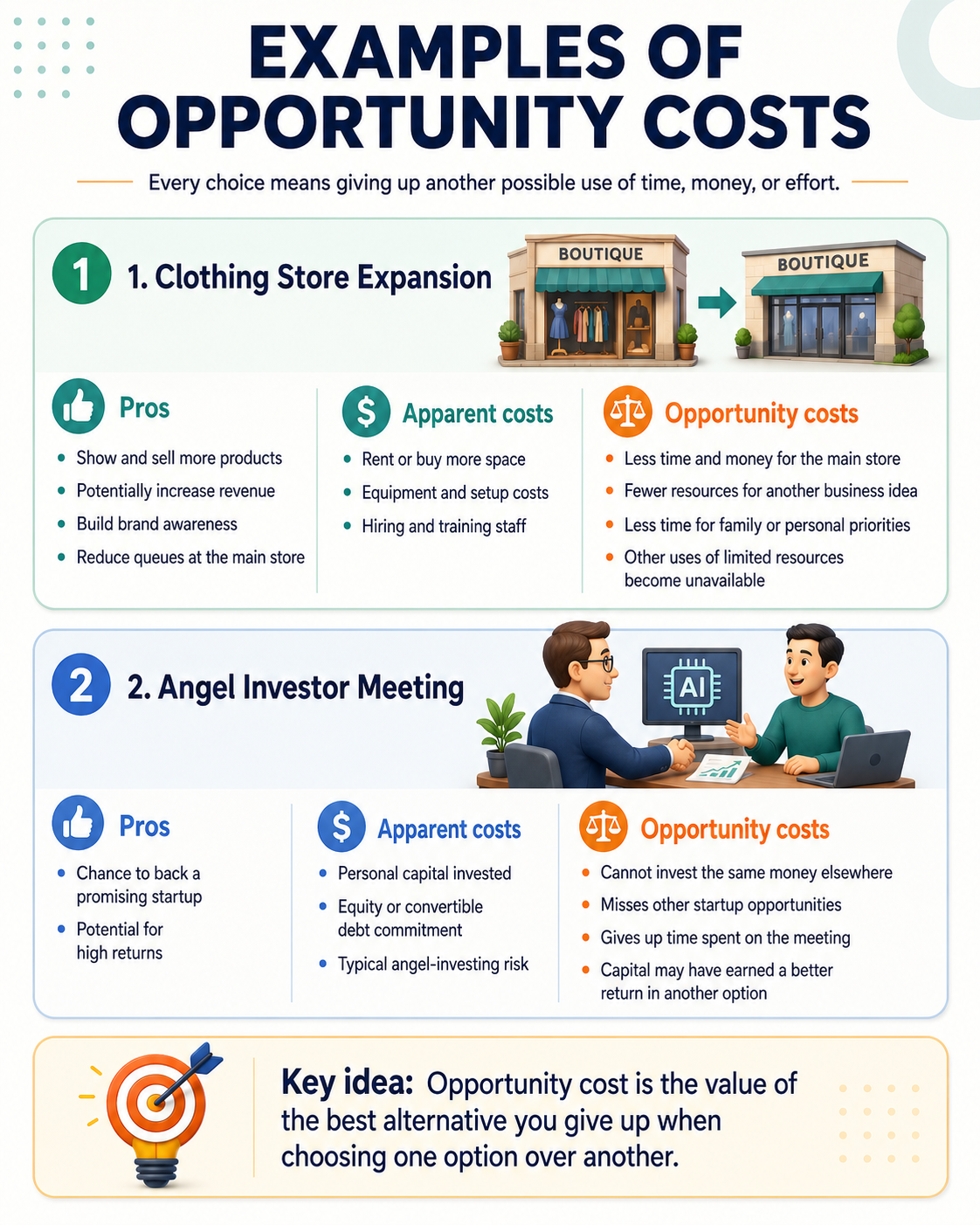
Example 2. An angel investor named Jack plans to meet with a representative of an AI startup to negotiate financing.
- Pros: Jack has an opportunity to back a promising company and potentially earn a high return on their investment.
- Apparent costs: Jack will use his personal money, invest it in the company for a share or convertible debt, and incur some risks typical of business angels.
- Opportunity costs: Jack will no longer be able to invest his money elsewhere, even at a better interest rate. He also cannot use those very funds to sponsor medical or tech startups. Plus, he won't be able to recover the time he spent on a meeting.
Why Opportunity Cost Matters in Trading
Occasionally, tradeoffs turn out to be more significant than you initially believed. It may seem like buying a stock or cryptocurrency right now is a profitable and good idea. But even if the deal is financially sound and brings you profit, it may have a huge hidden cost.
It's not just about winning or losing money. An impulsive trade can pull an investor away from a better plan, create bad habits, or use capital that has a stronger alternative use. It can make you ignore your risk tolerance and take away too much of your attention.
Example of opportunity costs in trading. The trader decides to sell some fixed-income assets to buy risky stocks for $1,000.
- Pros: Should the price of stocks increase, they will profit from it. Compared to receiving small fixed coupons, the benefit can be larger.
- Apparent costs: The trader loses stable payouts and reduces the balance of the portfolio.
- Opportunity costs: The trader loses the opportunity to buy ETFs, bonds, or commodities for that $1,000. They might devote too much time to analyzing new stocks, break the investment schedule, face increased stress from monitoring new assets, and lose portfolio stability.
The Visible Cost vs. The Hidden Cost of an Impulsive Trade
You need to understand what the explicit and opportunity costs are and how they differ, as this helps conduct a more balanced and transparent analysis of your actions and make decisions based on facts and figures. If you know what you are giving up, you can reduce both the number of impulsive trades and the impact of their consequences. We've included easy-to-see direct costs and opportunity costs in the table.
Impulsive Trades Feel Cheaper Than They Are
Impulsive trades often happen because traders focus on the immediate triggers. For example, the desire to buy or sell an asset without detailed analysis may be motivated by a sharp jump in prices, a red candle, a headline in the news, someone's advice, or FOMO.
Importantly, an impulse-driven trade rarely feels expensive at the moment. The brain tends to notice the possible gain and ignore what is being given up. Plus, since trade costs are often broken into separate pieces, traders may consider the fee minor or a worse entry price acceptable.
Fear of missing out, overconfidence, and revenge trading make transactions less logical and consistent while making them seem "low-risk." They eat up a part of your budget and force you to rush through your decisions without taking the time to calculate your expenses.
According to Barber and Odean’s well-known study, the most active individual investors earn about 6.5% less per year than the market due to overtrading.
So, you need to know that a trade is not cheaper just because it’s urgent or its visible cost is low. The full cost includes slippage, spread, missed alternatives, and the value of the time and attention spent on a decision.
The First Opportunity Cost: Capital Stuck in the Wrong Trade
You can easily calculate losses from entering too late or exiting too early and fees from frequent portfolio rebalancing. However, you should also pay attention to one more drawback—missed gains from holding a stronger asset or following clear long-term investment economics.
When money is placed into an impulsive trade, it cannot be used for a better opportunity. It simply becomes unavailable. Later, you might not have enough money to purchase other assets based on the primary investment plan, fundamental and technical analysis, or for another important reason. The money has already been spent; this is your sunk cost.
In particular, this hurts traders with small and tight budgets who cannot afford multiple expensive investments. But even if you have a budget for several impulsive trades, a bad or unclear transaction can reduce flexibility and even produce a visible loss afterwards.
Example. A trader buys a token during a pump. They do so because the price is moving fast. It seems that if they don't buy the asset urgently, they may miss out on the benefits. But this could turn out badly:
- A sudden risky trade may turn out to be less rewarding than anticipated.
- Capital becomes tied to a reactive decision. It’s not available for a planned setup.
- The price could rise speculatively, have no bearing on reality, and then crash sharply.
The Second Opportunity Cost: Attention Spent on Noise
Your attention is also a scarce resource. It’s hard for people to multitask and effectively keep an eye on thousands of indicators. Studies show that people can only hold about 3–5 items in mind at once, and switching between tasks reduces accuracy and speed.
So, if you take impulsive trades often, you’ll have to deal with many short-term moves. This implies more monitoring, chart-checking, and second-guessing. A lot of time-bound duties cause stress, anxiety, and mental fatigue.
The opportunity cost is the focus that could have gone into implementing your plan, achieving your goals, and reviewing risks. If you don’t stay disciplined, there’s an additional hidden cost of not investing available time in research, planning, or skill development.
The Third Opportunity Cost: Risk Budget Wasted Too Early
Every investor has a limited risk budget. This refers to the amount of uncertainty, drawdown, and volatility you can realistically tolerate before decisions become uncomfortable or unsustainable.
If emotional trades are too risky, there may be less room left for higher-quality opportunities later. That’s why impulsive trades can be costly even when the position size is small. They consume part of your risk capacity early, often without a strong edge. By the time a better setup appears, you may already be emotionally drained or unable to take the trade with confidence.
A Brazilian study (2020) found that 97% of day traders who persisted for more than 300 days lost money, showing how quickly active trading can exhaust your risk budget. A simple way to keep your portfolio in line with your risk tolerance is to define your limits across positions and strategies in advance and account for them when making any trades, especially the emotional ones.
The Fourth Opportunity Cost: Breaking Your Own Strategy
Usually, you build a portfolio following your time horizon and risk tolerance. Based on them, you set a targeted asset allocation, for example, 10% cash, 30% stocks, 60% bonds. Impulsive trades, ill-conceived rebalancing, and irrational capital injections change the allocation. They can break the balance.
Moreover, they can undermine your ability to further create that balance. Emotional, quick decisions come with loss of patience, overtrading, and poorer diversification. They simultaneously reduce your ability to compound returns because money is deployed too early or too often and weaken your decision-making system because you break your rules.
A productive strategy becomes useless if it is not followed consistently, stop-loss rules are ignored, or risk management is emotional. Research shows that emotions and biases impair investment decisions. The opportunity cost is the loss of discipline and consistency. Losing the habit of following a plan can cost more than a failed trade.
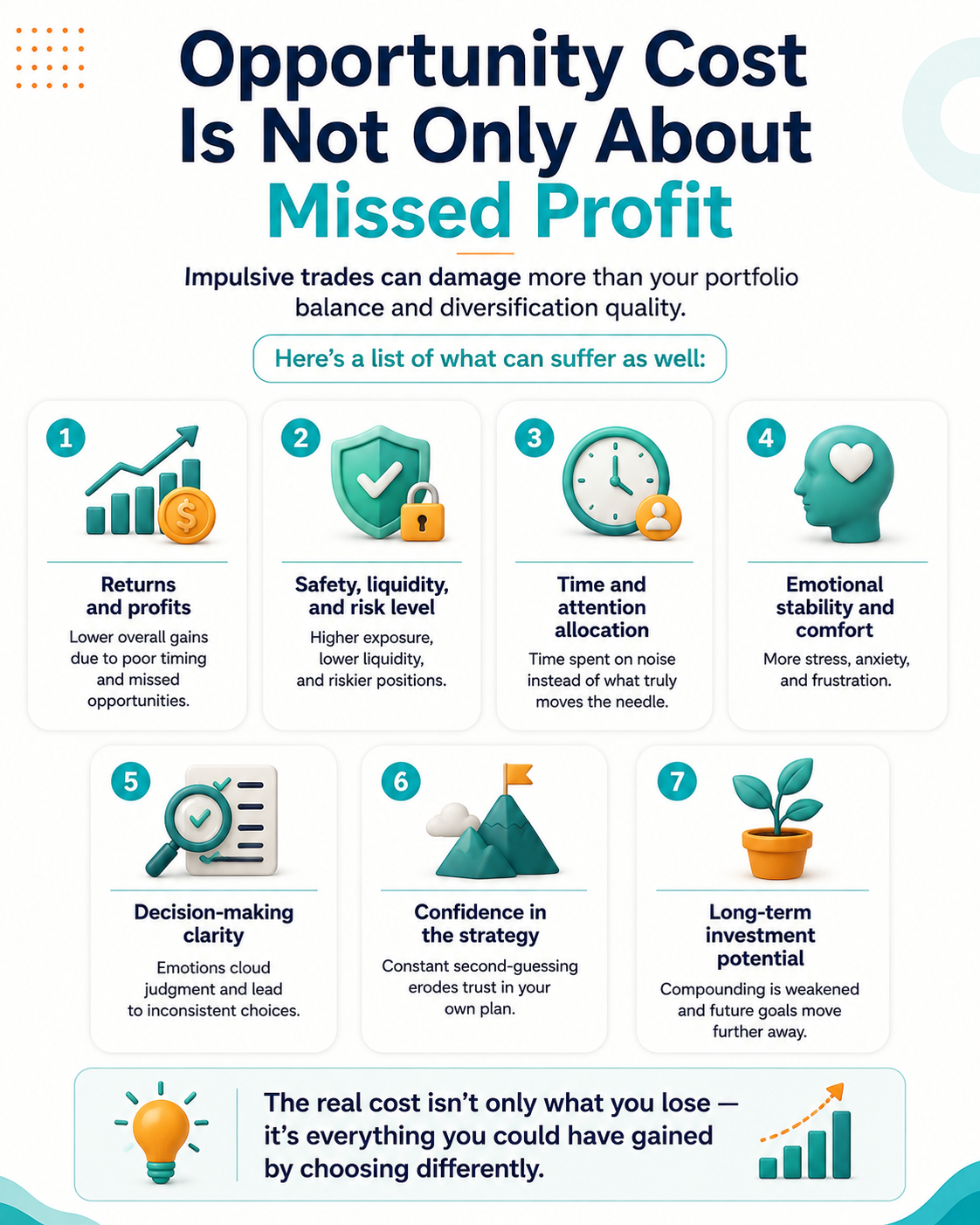
Opportunity Cost Is Not Only About Missed Profit
As described, impulsive trades can damage more than your portfolio balance and diversification quality. Here’s a list of what can suffer as well:
- Returns and profits;
- Safety, liquidity, and risk level;
- Time and attention allocation;
- Emotional stability and comfort;
- Decision-making clarity;
- Confidence in the strategy;
- Long-term investment potential.
When Doing Nothing Has Lower Opportunity Cost
Sometimes a better alternative is not making another trade but rather staying in cash, reducing exposure, or doing nothing. This may well be a smart investment decision. For example, you can avoid buying risky assets due to their hype-based rise and preserve capital. You can also ignore suspicious products, save your peace of mind, and devote your time to something more useful. So, the best choice may be to patiently wait.
How to Build Opportunity Cost Into Your Trading Plan
The main problem with calculating intangible and psychological opportunity costs is that there is no formula. Investors have to identify individual risks for each specific case and evaluate them separately. It can be laborious but is very useful.
The good news is that you can make a basic action plan and follow it to make the decision-making and cost calculation faster. To do so, define trading rules:
- When to trade, when not to trade;
- Maximum risk per idea;
- Position sizing rules;
- Maximum number of trades per day or week;
- Invalidation criteria and exit rules (take-profit, stop-loss);
- Journal rules, pause rules, and emotional state checks.
Impulsive trades are especially expensive if you repeat them. Many similar hasty decisions in a row reduce investment efficiency and may divert capital from more profitable opportunities. To avoid this, slow down before entering a position and analyze your core plan and reasons for the trade. A pause and clear rules can reduce impulsive behavior.
The Trade You Do Not Take Also Matters
Impulsive trading is dangerous because a trade can make you lose money and it can quietly replace better choices. A strong trader does not ask only whether a trade can work but also what they are giving up by taking it. In other words, good decision-making means accounting for both the visible cost of a trade and the hidden cost of the alternative you abandon.
To trade more wisely, define in advance how much loss and uncertainty you can realistically handle and how much of your money and risk budgets each trade is allowed to use. Write your rules and strategies down and don’t let emotions control your financial future. That way, every decision will be measured by whether it deserves the risk, attention, and capital it consumes so that it is more logical and reasonable.
Disclaimer: The content provided in this article is for educational and informational purposes only and should not be considered financial or investment advice. Interacting with blockchain, crypto assets, and Web3 applications involves risks, including the potential loss of funds. Venga encourages readers to conduct thorough research and understand the risks before engaging with any crypto assets or blockchain technologies. For more details, please refer to our terms of service.