
Table of Contents
DEX. Lending protocol. Perp. Liquidity pool.
These terms circulate constantly in crypto, usually without anyone explaining how they connect. This guide fixes that.
DeFi is short for decentralized finance, and the name gives away the point of it. Traditional finance runs on banks, brokers and clearing houses to make anything happen. DeFi is built to route around most of that middle layer. Code takes their place instead, and code doesn't eliminate risk so much as relocate it. Governance choices, infrastructure and your own wallet security now stand between you and your money, rather than a bank's compliance department.
Consider this a map rather than a pitch. What does a DEX actually do? How do lending protocols move money? Where do derivatives fit? Which risks show up at each stage? The rest of this guide answers each in turn.
DeFi in One Sentence - and What "Decentralized" Actually Means
What is DeFi, in a single sentence? Financial applications that run on public blockchains through smart contracts, rather than through a bank or broker.
Here's the thing about that definition: the word "decentralized" is carrying more weight than it usually gets credit for. Some parts of a DeFi protocol really are decentralized. A smart contract, once deployed, runs entirely onchain, and anyone can go read the code. Other parts often aren't, at least not yet. That doesn't mean everything around it is equally open. The front-end website might be controlled by one team. Governance might sit with a small multisig. The oracle feeding it price data might come from a single provider. An admin key might still be able to pause the whole system.
None of that automatically makes a protocol untrustworthy. It does mean the honest question isn't "is this DeFi protocol decentralized?" It's which parts of it actually are, and which parts still depend on someone you haven't met.
The Building Blocks Under Every DeFi App
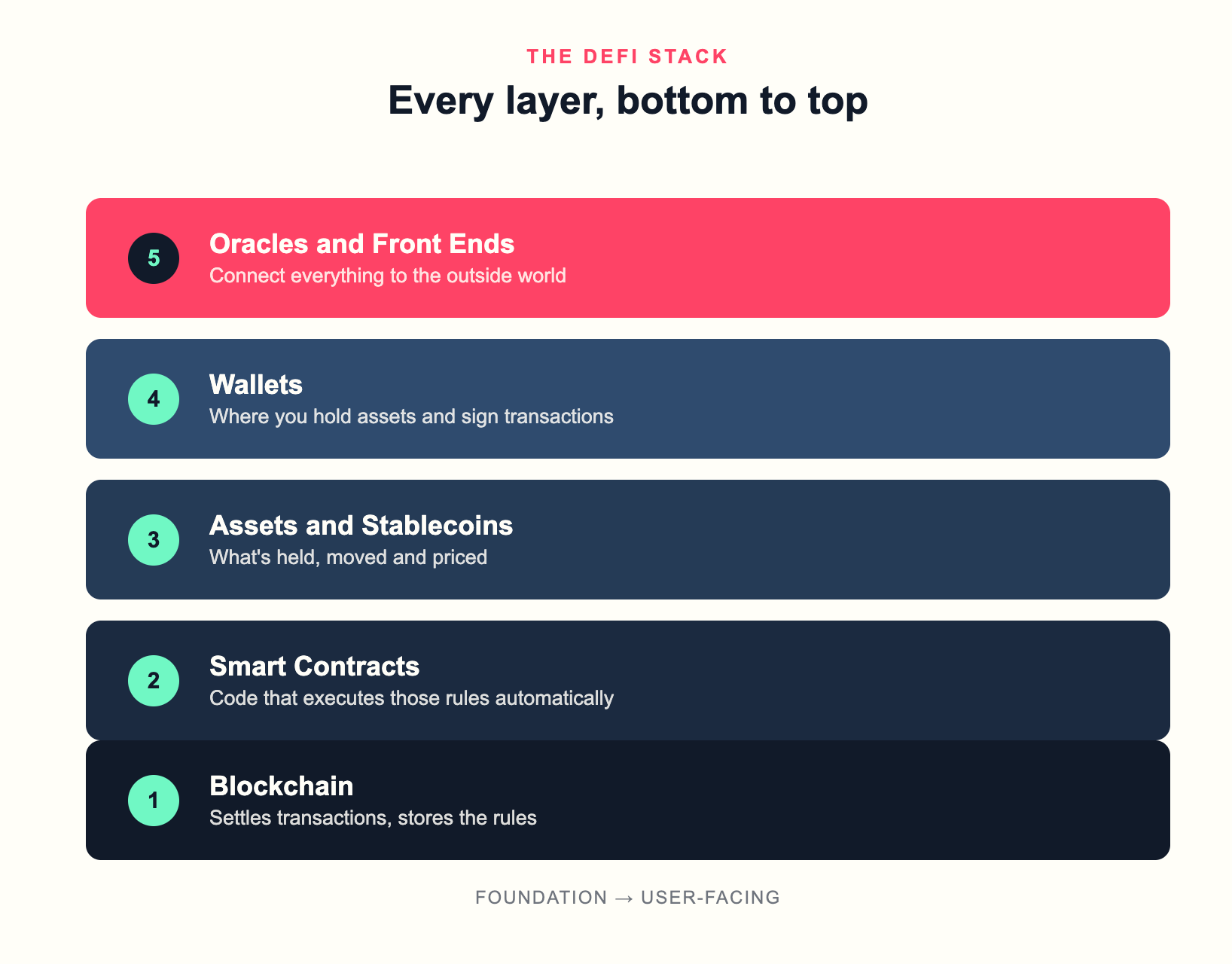
Every decentralized finance product is built from the same handful of layers, however different they look on the surface. Blockchain sits at the bottom. Smart contracts run on top of that. Then come assets and stablecoins, wallets, and finally the oracles and front ends that connect everything to the outside world.
Blockchains and Smart Contracts
A blockchain settles transactions and keeps a record of the rules behind them. Smart contracts write those rules into code. Once the conditions are met, they run by themselves, with no one on the other end to approve, delay or walk anything back afterward. That's what "no chargeback, no undo button" actually means in practice.
One thing worth being clear on: code being visible isn't the same as code being safe. Anyone can technically read a smart contract's source. Very few people can audit it well enough to catch every flaw, and that gap is where a lot of DeFi's biggest losses have come from.
Wallets, Tokens and Stablecoins
A crypto wallet is how you hold assets and authorise transactions in DeFi. Self-custody means you, not an exchange, control the private key that proves ownership and signs every action.
Stablecoins do a lot of the heavy lifting inside DeFi. They're pegged to an asset like the US dollar, and protocols often use them as the unit of account or as collateral for loans.
There's a separate risk to flag here: token approvals. Approving a smart contract to spend your tokens is different from, and just as important as, keeping your seed phrase safe. An unlimited approval left open on an old contract is a common way people lose funds.
Oracles and Bridges
Smart contracts have no way to see the outside world by default. Oracles solve that: they feed in external data, most commonly asset prices, so a lending protocol or a derivatives platform can know what something is actually worth at a given moment.
Bridges move assets and information between blockchains, since most chains don't talk to each other natively.
Both are essential infrastructure, and both are common failure points. A manipulated price feed or a compromised bridge can cause damage well beyond the protocol it hits first, as this guide's risk section shows a little further down.
A Simple Map of DeFi Protocols by User Goal
Rather than listing every category of DeFi protocols in the abstract, it helps to sort them by what you're actually trying to do.
DeFi Protocols by Goal
DEXs: Swapping Without a Central Order Desk
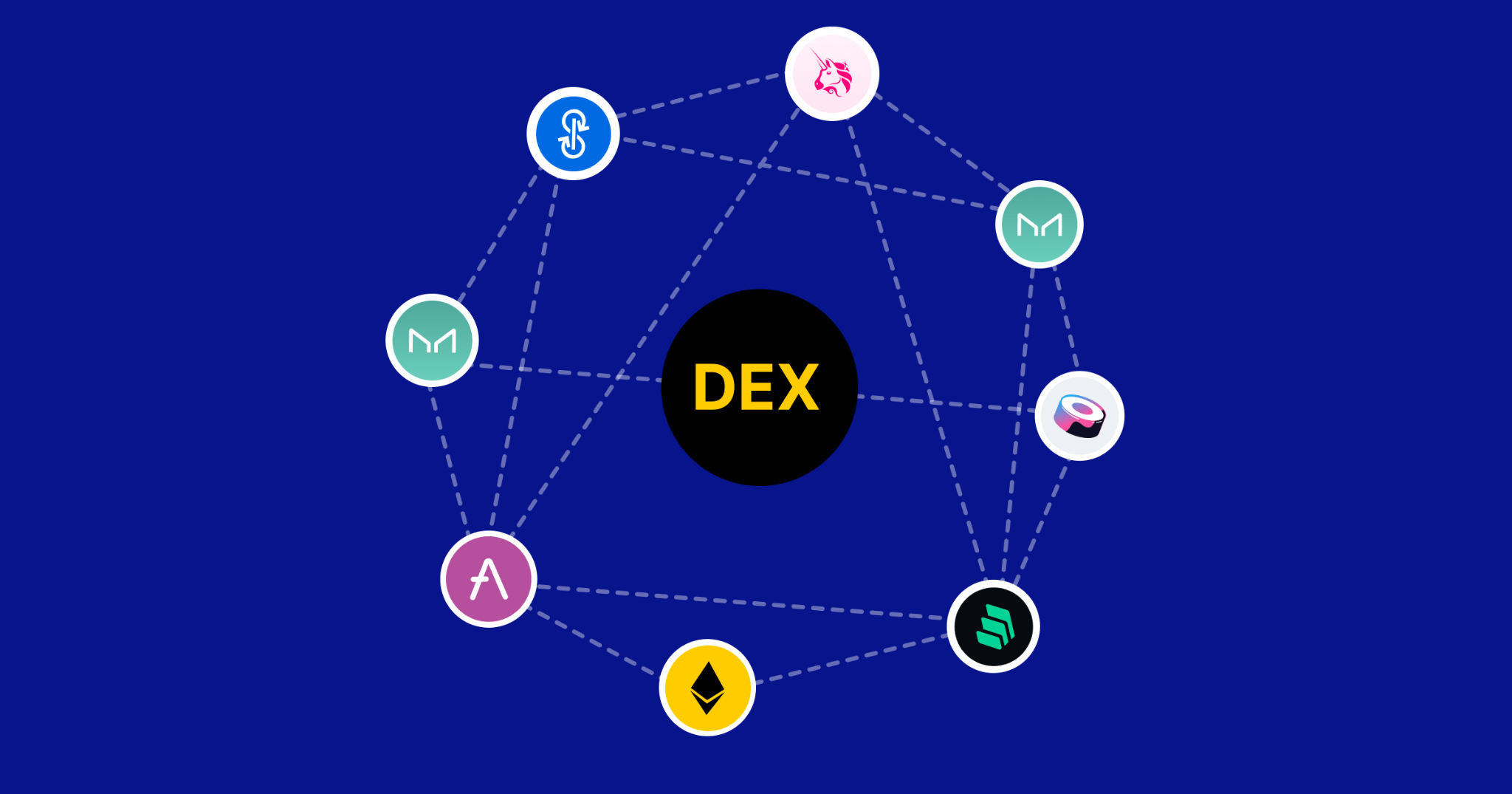
A decentralized exchange swaps one token for another without a company matching buyers and sellers behind the scenes. There's no order book in the traditional sense. Most DEXs price trades through automated market makers, or AMMs, using liquidity pools instead.
Anyone can add tokens to a pool and earn a share of trading fees, which is what makes someone a liquidity provider.
Uniswap remains the largest DEX by most measures of trading volume, and Curve is widely used for the specific case of swapping one stablecoin for another with minimal slippage.
It’s important to separate the following in your head: the trading interface you click through isn't the same thing as the liquidity pool underneath it. Aggregators like 1inch scan several pools at once and split your trade across them to get a better price, rather than routing everything through a single DEX. Every swap comes with the same two costs to watch: slippage on the trade itself, and the token approval you grant beforehand.
Lending and Borrowing: Pooled Liquidity and Collateral
DeFi lending works by matching two different kinds of users inside the same pool. Suppliers deposit crypto and earn interest on it. Borrowers deposit collateral and draw a loan against it.
Rates adjust automatically based on how much of a pool's liquidity is currently borrowed. Borrow more relative to what's supplied, and rates rise to attract more suppliers.
Nearly every lending protocol requires overcollateralisation, meaning you deposit more value than you borrow. Aave and Compound are the names you'll see most often here, purely as recognisable examples rather than a recommendation.
If your collateral's value falls too close to your loan value, the protocol liquidates your position automatically - no phone call, no grace period. That automation is the trade-off for a lending market that never sleeps and never asks who you are.
Derivatives: Perpetuals, Options and Synthetic Exposure
DeFi derivatives let you gain exposure to an asset's price without holding the asset itself. A perpetual contract, or "perp," tracks an underlying price indefinitely, using funding payments to keep the contract's price in line with the market.
These products typically involve collateral, leverage and, again, oracles feeding in the price data everything depends on.
Hyperliquid currently handles the largest share of on-chain perpetuals trading, with dYdX a well-established alternative.
The honest framing here matters: derivatives aren't a shortcut to easy profit. Leverage cuts both ways, and liquidation can happen fast when a market moves against a position. Oracle accuracy matters here more than almost anywhere else in DeFi derivatives, since a bad price feed can trigger liquidations that shouldn't have happened at all.
Yield, Asset Management and Insurance
A few more categories of decentralized finance protocols round out the map. Staking wrappers let you earn staking rewards while keeping a tradeable token in hand. Yield aggregators and automated vaults move deposited crypto between strategies to chase better returns, so you don't have to manage it manually. Cover protocols offer a form of insurance against specific DeFi failures, like a smart contract exploit.
These are worth knowing exist, though this isn't the place for a full platform-by-platform ranking.
Four Typical DeFi Journeys
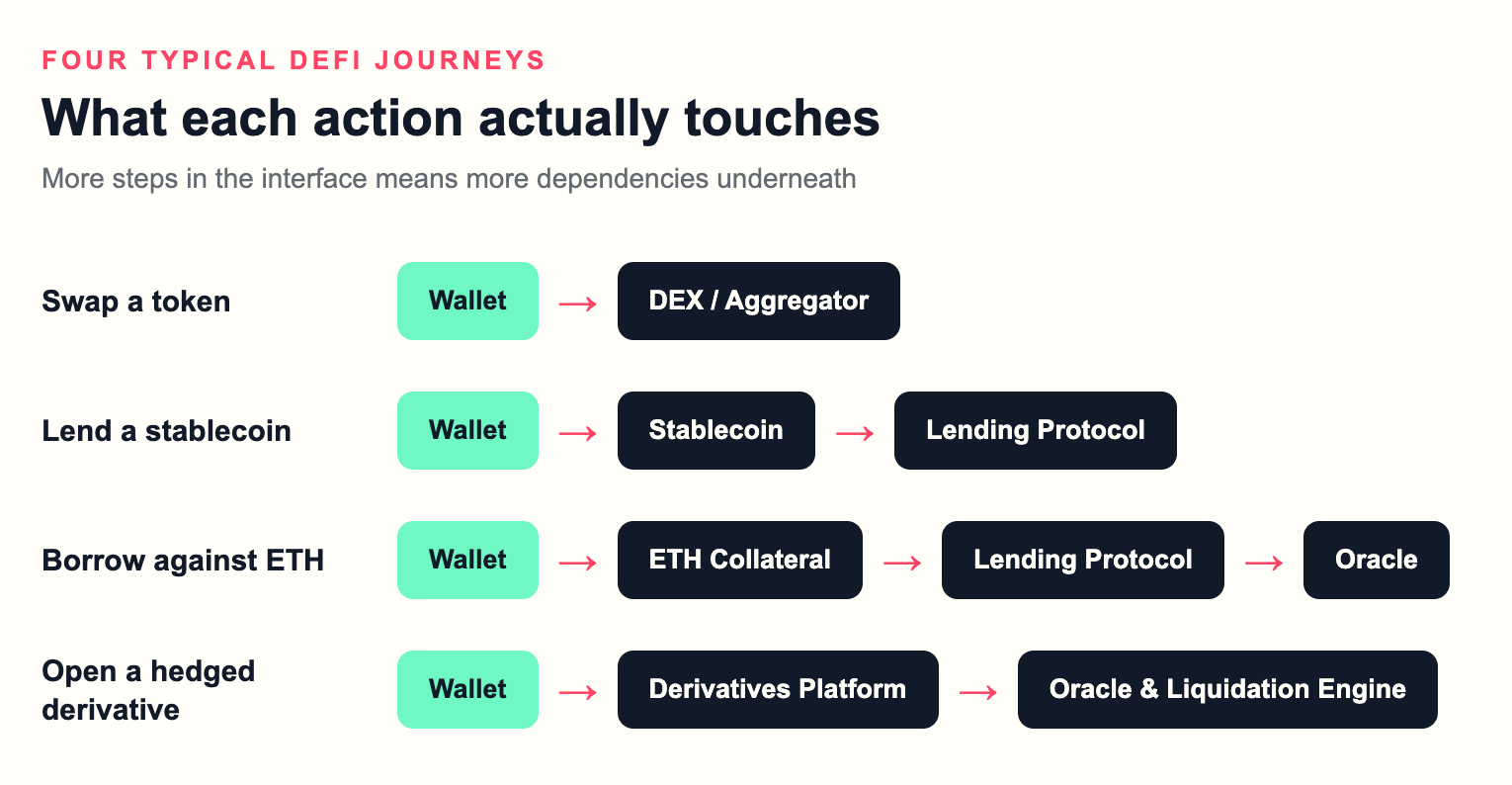
Reading about decentralized finance in the abstract only gets you so far. Four common actions show what's actually involved underneath.
Swapping a token starts with connecting a crypto wallet and approving the token you want to spend. From there, the trade executes through a decentralized exchange or an aggregator. Two things have to work correctly for this to go smoothly: the wallet, and whichever DEX handles the swap.
Lending takes one more step than swapping does. Connecting a wallet and approving a stablecoin are the same first moves as swapping a token. What changes is the destination. Instead of an exchange, the deposit goes to a DeFi lending protocol, where it sits and earns interest rather than changing hands once and being done. A third party enters the picture at this point too, separate from the wallet and the protocol: whoever actually issues the stablecoin being deposited.
Borrowing against ETH adds another layer again. Deposit ETH as collateral, then borrow against it. The protocol needs to know what that ETH is worth in real time to do this safely, and that job falls to an oracle: a fourth dependency working quietly in the background.
Opening a hedged derivative looks simplest of all from the interface: deposit collateral, open a position. Underneath, a DeFi derivatives platform's own oracle and liquidation engine take over from there, managing the trade without you needing to do anything else.
Every one of these "simple" actions touches more infrastructure than it looks like from the interface.
Why DeFi Products Can Be Combined
DeFi protocols are built to be composable, which is a fancy way of saying a token or position minted in one protocol doesn't have to stay there. It can be picked up and used inside a completely different one. The community nickname for this is "money legos": protocols that snap together like building blocks rather than operating as sealed silos.
That has a real upside. Developers don't need to rebuild lending, trading and price feeds from scratch every time; they can plug into existing DeFi protocols and build something new on top.
It also has a cost. A failure in one piece can spread to everything built on top of it.
That's not hypothetical. In April 2026, a liquid restaking protocol called Kelp had its cross-chain bridge exploited for around $292 million in rsETH, a token representing already-staked ETH. The attacker deposited the stolen rsETH as collateral on Aave and other lending protocols, borrowing roughly $236 million against tokens that were never legitimately theirs. Within 48 hours, DeFi's combined total value locked had dropped by more than $13 billion, as the incident rippled well beyond the protocol it started in.
DeFi vs CeFi: Who Holds the Assets and Enforces the Rules?
DeFi and CeFi, short for centralized finance, aren't really competing to solve the same problem the same way. They're solving it with different assumptions about where trust should sit. Neither is inherently the safer choice.
The right model comes down to two questions: how much control do you actually want, and how much responsibility are you genuinely comfortable holding yourself?
The Risk Map Behind the Product Map
Every layer covered so far comes with its own risk, and it's more useful to tie each one to the specific layer it lives in than to talk about "DeFi risk" as a single vague thing.
DeFi Risk Map
2026 has been a rough year for headline DeFi security incidents. Solana's largest perpetuals exchange, Drift Protocol, lost roughly $285 million in April after its admin controls were compromised, not through a code bug. Combined with wider market conditions, DeFi's total value locked fell from around $115 billion in January 2026 to roughly $70 billion by June.
None of this makes DeFi risks unmanageable. Audited code reduces uncertainty without eliminating it, and understanding which risk applies to which layer is more useful than a single blanket warning.
How to Read a Protocol Page Without Being an Auditor
You don't need to read Solidity to do basic due diligence on a decentralized finance protocol. A handful of observable signals go a long way.
Reading a Protocol Page
None of this is a pass or fail score. It's a set of observable signals that, together, tell you roughly how much trust you're placing, and in whom.
Conclusion
Back to the map this guide opened with. Across these DeFi protocols, DEXs exchange assets, DeFi lending protocols move collateral and liquidity, derivatives create price exposure without ownership, and infrastructure like oracles and bridges connects all of it together.
Decentralized finance's benefit is programmable, permissionless access to financial tools that used to require an application form and a waiting period. The cost is a stack of DeFi risks, both technical and financial, that sit closer to the surface than they do in traditional finance, simply because there's no institution standing between you and the outcome.
Understanding where each risk sits, rather than avoiding DeFi altogether or diving in blind, is really the whole point of a map like this one.
Disclaimer: The content provided in this article is for educational and informational purposes only and should not be considered financial or investment advice. Interacting with blockchain, crypto assets, and Web3 applications involves risks, including the potential loss of funds. Venga encourages readers to conduct thorough research and understand the risks before engaging with any crypto assets or blockchain technologies. For more details, please refer to our terms of service.