
Table of Contents
When most people talk about setting up recurring crypto payments, they usually picture something pretty basic, like manually clicking "send" on a chunk of stablecoins from their wallet on the first of every month.
But if you’ve ever paid for a Spotify or Netflix subscription or run a real business, you know that true recurring billing is a completely different thing.
We cannot disagree that in the traditional Web2 world, we are being spoiled by standard banking infrastructure. For this reason we have high expectations, we expect automatic charges that just work, friendly reminders before our card gets hit, instant cancellations, easy refunds, and clear, human-readable error messages if a payment fails.
Move over to crypto next door, and that smooth ride turns into a serious course. Because blockchains weren't natively built to let companies automatically "pull" money from an account, everything gets complicated when you think about it.
Suddenly, you're juggling wallet connections, shifting network fees (gas), token approvals, custody parameters, failed transactions that still drain your gas, and all these are completely irreversible transfers where a single typo means your funds may vanish into the void forever.
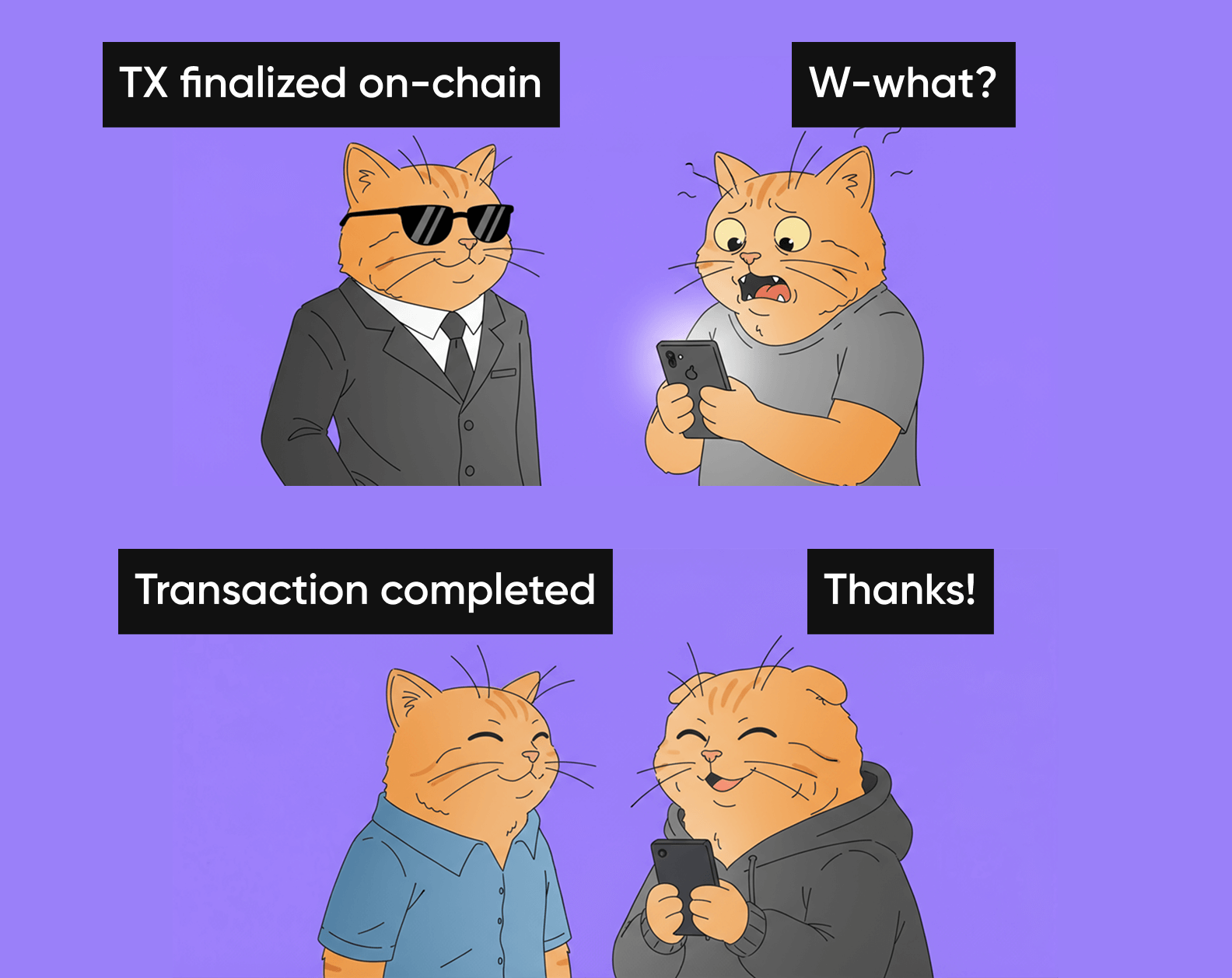
Stablecoins have a massive advantage when it comes to moving money globally without the usual bank delays, but nobody is going to use them if the process feels like a chore, No one likes to chore - especially not on your own money.
What then can be done? Eliminate the chore, without hiding the actual on-chain risks you take on when you connect your wallet.
Why Recurring Payments With Stablecoins Are a UX Challenge
A stablecoin does a great job of fixing crypto’s wild price volatility, but it doesn't automatically fix the headache of actually using it. Just because a digital dollar stays worth a dollar doesn't mean the payment experience is smooth.
As good as it sounds to have crypto without the volatility, users still have to play detective every time they pay for something. They have to double-check which specific token is being accepted, which blockchain network the transaction is running on, and who is actually initiating the charge.
On top of that, basic questions turn into guesswork: "Can I easily cancel this? What happens if I don't have enough cash in my wallet when the bill hits? And where do I even go to see a clean history of what I've been charged?"
A stable price does not equal a stable user experience. Take away the price flag, and you’re still left with all the clunky technical friction of Web3, which is not very pleasant.
How Stablecoin Recurring Payments Differ From Card Subscriptions
Consider your credit card subscription on Spotify, Netflix or Youtube. When you link your card to these payment systems, you essentially hand the merchant a key to your front door and trust them not to rob the place. It’s a "pull" model, when the time arrives, they knock, take the exact amount they promised, and your bank handles the heavy lifting while you sleep.
But with Crypto, you can't sleep on it cus no bank is doing the heavy lifting for you, mostly because blockchains are built like paranoid fortresses.
A merchant can't just reach into your wallet and grab funds, no matter how much you owe them. Instead, you have to actively sign a transaction or grant explicit permission to a smart contract to move the money on your behalf.
This shifts the entire User Experience (UX) to your shoulders. Because there’s no cozy central bank playing referee, you can't just "set it and forget it" without some serious prep work.
You wear the hats of setting spending limits, getting billing reminders, revoking permissions, or figuring out why a transaction failed. They have to be manually coded into the app, or you're stuck doing the housekeeping yourself.
What Users Need to Understand Before They Subscribe
You would agree with me that before you click approve, you shouldn't have to guess what a smart contract is about to do with your money. You should know it and be sure of it.
A good checkout page needs to show you the essentials at a single glance, the exact amount, the token, the network, the billing schedule, and the network fees. You also need to know the next payment date, who is getting your money, how to cancel, and what happens if the price goes up later.
Nobody wants to scroll through technical data just to buy a subscription. Common, who would want to sign up for something that they are not sure of?
A clear checkout experience should be one that can show the user three crucial set of details :
Amount, token, and network
When a subscription is paid in a stablecoin, the displayed price alone is not enough. Seeing "$10 a month" on a screen doesn't mean much. You need to know exactly what you are paying with, is it USDC on Base versus USDT on Tron.
If you accidentally send funds on the wrong blockchain, you will not only incur paying an incorrect fee, you will also lose your money permanently.
Fees and total payment cost
A good recurring payment UX should show you the real price tag, which means including any extra network fees, platform cuts, or conversion costs. You need to see upfront whether you are paying a completely flat rate or if your wallet balance will fluctuate slightly each month to cover the cost of the blockchain transaction.
Payment frequency and next charge date
You should never have to guess when your wallet is going to be hit. The app needs to lay out a clear schedule, the exact date of the next charge, the period it covers, whether you’ll get a heads-up warning first, and what happens if your balance hits zero on billing day. All this needs to be clearly stated.
Consent and Control: The Core UX Problem
If a gym overcharges your credit card, you can just call your bank, file a dispute, and get your money back. In Web3 If a smart contract drains your wallet, those stablecoins are gone for good.
For this reason, a great payment interface must answer one important question before the user clicks a single thing: "Can this service take more money than I expect?"
Recurring payment UX should be able to build trust. How? The design needs to hand complete control back to the user. Instead of forcing them to blindly sign a vague on-chain transaction,
if the app forces you to blindly sign a confusing transaction, it fails. The design needs to put you in the driver’s seat so you know exactly what you are allowing the merchant to do. What are some indicators of a trustworthy recurring payment UX?
Spending limits
Levels of anxiety spike as soon as you realise you would be giving "Unlimited" access to your tokens. It would be super assuring if you could see where the cutting line is exactly. Instead of asking for a blank check, your UI (User interface) should feature hard, visible caps that are transparent and tell you exactly what the limit is.
- Per-Payment Cap: The maximum amount allowed for a single billing cycle (e.g., If it is Max EUR 15.00 per month, it should be that).
- Periodic Limits: A hard ceiling on accumulated charges within a specific timeframe (e.g., monthly or quarterly totals).
- Lifetime Allowance: A total spending cap after which the smart contract approval automatically revokes, requiring a manual renewal.
Having this visualisation clear, users can confidently approve a subscription knowing their wallet cannot be drained beyond the stated amounts.
Easy Cancellation
Where is your control if you do not have the right to leave whenever you want? How easy it is for you to cancel a subscription, A user’s trust in a service is often solidified during the cancellation process. If canceling a Web3 subscription is way more complicated than even how you subscribed for it, it creates resentment and damages the platform's reputation.
Subscription dashboard should display active permissions, the date and amount of the next charge, and a prominent, jargon-free revoke button. Once canceled, the interface must provide immediate visual confirmation that the on-chain permission has been successfully severed, reassuring the user that no further funds can be drawn.
Approval Transparency
Approvals should under no circumstances be hidden with technical jargon. The interface should be in plain and simple language. Straight and direct. It should communicate an idea exactly as it is in a way that a user should not second guess what that means because of complex blockchain terminologies.
It should be clear which contract is receiving the permission you are giving, and what this permission is going to do.
What Happens When a Payment Fails?
It is thus simple: If the system fails, tell the user why in one sentence, and explicitly show them the button that fixes it. In recurring payments, errors are unavoidable. A good interface should be built to troubleshoot and solve the issue without giving the user a panic attack.
Whether due to fluctuating insufficient balance, wrong network, not enough gas, wallet disconnected, approval expired,contract error or platform issue, a great user experience doesn't pretend errors won't occur, it handles them gracefully by diagnosing the exact issue and giving the user a friction-free path to fix it.
How to Design Notifications and Reminders
Because blockchain transactions are often irreversible, proactive communication cannot be traded for or replaced with confusing actions or hard language.
In blockchain users cannot rely on a bank to dispute an accidental charge, so notifications must act as the system's early warning mechanism.
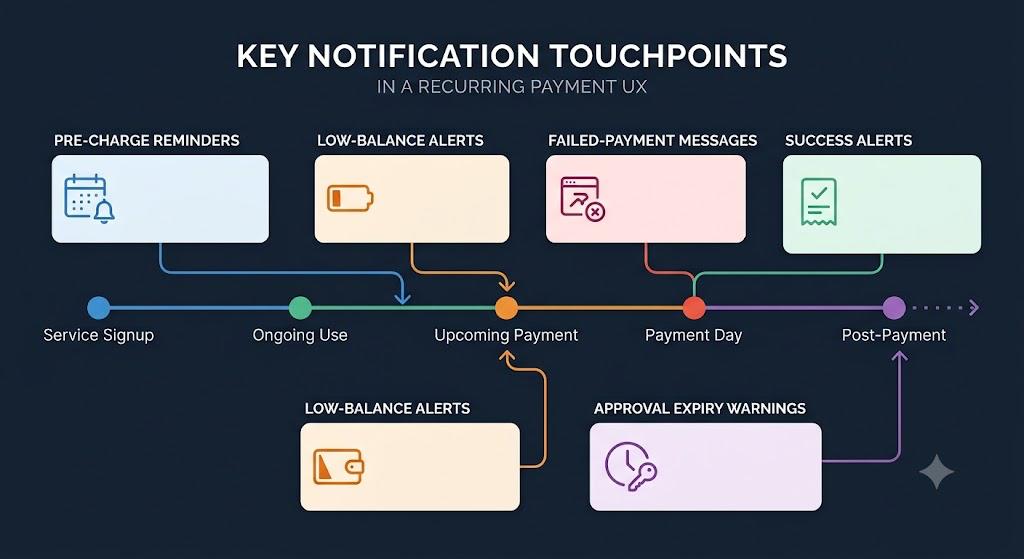
Key Notification Touchpoints
Even the most disorganised person likes to know what's going on, would like to be kept informed most especially on movements on his assets. A good recurring payment UX should have at least these points on notification in its purchase cycle.
- Pre-Charge Reminders: Sent 2 to 3 days before an upcoming deduction. This gives users plenty of time to review the charge, ensure their wallet is funded, or cancel the service if they no longer need it.
- Success Alerts: Immediate confirmation right after a successful payment. This should include the amount deducted and a clean, direct link to the transaction receipt or on-chain explorer.
- Approval Expiry Warnings: Sent well before a smart contract allowance lapses or hits its pre-set spending cap. This prompts the user to renew their permission so their service isn't abruptly interrupted.
- Low-Balance Alerts: A proactive warning if the system detects the user's wallet doesn't have enough stablecoins or gas tokens to cover the next upcoming charge.
- Failed-Payment Messages: Immediate, actionable alerts sent if a transaction drops, instantly directing the user back to the app to fix the issue.
The tone of the message also should be considered. This matters a lot because no one is out here to play about their money. The tone should be calm and clear, without panic nor rush. It should be see-through with no hidden technical details.
Custodial vs Self-Custody Recurring Payments
As every other ownership in crypto, you already know you will need to choose. Is it going to be custodial or self-custody?
A custodial flow where the platform manages the keys and a self-custody flow, where the user retains absolute ownership of their wallet.
A custodial setup mirrors a traditional subscription, offering comforts like account recovery, invisible automatic payments, dedicated customer support, and fewer technical actions even though users must accept the risk of trusting the platform with their funds.
In contrast, a self-custodial setup puts the user in absolute control with maximum transparency and zero platform risk, but introduces more friction, requiring manual wallet signatures, smart contract approvals, gas fee management, and total personal responsibility for security.
Where Stablecoin Recurring Payments Can Make Sense
Where traditional finance fails, Stablecoins save the day, especially when you mix international users, crypto-native tools, or the need for instant, 24/7 settlement.
A good example is instead of waiting days for legacy banks to clear cross-border wires or dealing with predatory currency conversion fees, automating with stablecoins keeps your revenue beautifully borderless, instant, and operational every single day of the year.
This is to say if your business operates globally, lives in the Web3 space, or just hates unnecessary middleman fees, switching to stablecoin automation is the ultimate operational flex.
Here is where they make most sense:
- Global Teams & Payroll: Effortless payroll, contractor payouts, and recurring cross-border invoices without the multi-day banking delays.
- Web3 & Decentralized Commerce: Seamless DAO payments, automated treasury operations, and native B2B services built directly for the crypto ecosystem.
- Digital Content & Communities: Frictionless SaaS subscriptions and creator memberships that allow global fans to subscribe instantly without regional credit card blocks.
- Borderless Giving: Automated, recurring donations that send maximum value straight to the cause, skipping international banking tolls.
UX Risks Designers Should Not Ignore
No matter how flawless and successful your transactions are, a sloppy interface will quickly create a ground for mistrust. Because blockchain transactions are often irreversible and have less tolerance for errors, the expectations are incredibly high for users.
It’s up to designers to build a proper safety space by neutralizing these major UX flaws:
- Hidden Approvals: Masking smart contract permissions behind raw cryptographic hex data instead of plain, readable language.
- Unclear Fees: Obscuring network gas costs or platform cuts until the user is already at the final confirmation step.
- Wrong Network: Failing to clearly signal which blockchain the payment is running on, leading to confusing transaction errors.
- No Easy Cancellation: Overcomplicating the cancellation flow or hiding the button to revoke the smart contract allowance.
- Cryptic Failure States: Displaying raw developer error codes instead of explaining what went wrong and how the user can fix it.
- Phishing Vulnerability: Designing generic payment links that leave users vulnerable to malicious, look-alike wallet drainers.
- Lack of Refund Flow: Offering zero UI guidance or obvious support channels for resolving mistaken or duplicate on-chain charges.
- Unclear Custody Model: Leaving the user completely guessing about whether they retain self-custody or if the platform holds their keys.
- Poor Transaction History: Providing a laggy or missing ledger that fails to give immediate visual confirmation of past deductions.
Conclusion: Recurring Payments Need More Than a Stable Token
At the end of the day, Stablecoins are like a cheat code for automated payments, bringing predictable prices, borderless transfers, and 24/7 settlement into one. But a stable token is only half the battle.
If your UX treats user consent, network choices, failed payments, and cancellation like an option, users will run for the hills.
Ultimately good Web3 subscription UX just means making every financial risk completely transparent before anyone signs off on their money.
Disclaimer: The content provided in this article is for educational and informational purposes only and should not be considered financial or investment advice. Interacting with blockchain, crypto assets, and Web3 applications involves risks, including the potential loss of funds. Venga encourages readers to conduct thorough research and understand the risks before engaging with any crypto assets or blockchain technologies. For more details, please refer to our terms of service.