
Table of Contents
There’s an opinion that novice and conservative investors should avoid volatile assets. These are considered high-risk. Therefore, many market participants associate volatility with something negative and dangerous.
However, it is not entirely correct to equate volatility and risk. Volatility is a characteristic of an asset, market, or sector that indicates dramatic return changes over a short period of time. It simply shows how widely returns move. The concept of investment risk is much broader. It reflects the possibility that an asset will not meet its purpose or may cause loss.
Below we explain what the difference between volatility and risk is. We’ll discuss why volatility can be a risk indicator but not the only criterion to judge an investment product. Learn how to handle various price fluctuation levels and create a solid portfolio.
How Volatility Is Measured
You always can google reputable financial portals and read about assets that experts consider volatile. This way you will receive a list of investment products, pre-sorted by the sharpness of return changes. For example, you will learn that tech stocks and cryptocurrencies are highly volatile, while real estate and cash are more stable.
However, it is a good approach to analyze everything yourself, rather than trusting publications. So, it’s worth understanding how volatility is measured.
To define the annualized dispersion of investment returns, economists use this formula:
σ = √[ Σ(Ri – R̄)² / N ]
They calculate the square root of the average squared deviation from the population mean. Here, Ri is the individual return for period i, R̄ is the mean (average) return, and N is the total number of observations. In practice, analysts often use the sample version with n–1 in the denominator for historical data. Variance (σ²) is simply the standard deviation squared.
How to Understand Volatility vs Risk
Market volatility does not last forever and can vary greatly over time. Plus, the same asset can show different fluctuation levels depending on the period and dataset you have to calculate it. But imagine that you used the formula above and determined the standard deviation of four investments: the Tesla stock, the S&P 500 index, a crypto asset, and a treasury bond. Here’s what you should have gotten and what it means.
Historical vs Implied Volatility
There are two types of volatility investors encounter:
- Historical volatility explains how much an asset actually fluctuated in the past;
- Implied volatility explains how volatile the market can be in the future.
Usually, the figure calculated from past returns helps investors set expectations of the investment product’s future volatility. But volatility alone is never a complete forecast of loss. You should not avoid popular stocks just because their returns change. Adding them to your portfolio can suit your strategy quite well.
Volatility vs Risk: Investment Risks Beyond Price Swings
Volatility can be a risk indicator, but it’s not a scary thing, and it’s not the only reason why an investment product may cause trouble or not fit your strategy. Portfolio risks are factors that carry a downside risk and can make your investment result in a loss.
Volatility, Drawdown and Permanent Loss Compared
Changes in returns are often associated with two more important signals for investors: permanent loss and drawdown. The first one is related to volatility indirectly. Namely, fluctuations can show capital impairment or business failure, but a stable asset can still fail suddenly. For example, there may be fraud, delisting, or unpredictable bankruptcy.
Drawdowns are more closely related to market volatility, as they show how bad the worst drop was. The largest peak-to-trough percentage decline, however, does not tell whether losses are recoverable, whether this will repeat, and why the drop initially happened.
Here’s an original example our Venga expert prepared to show why drawdown and recovery matter as much as volatility. Imagine you want to buy one of two assets, both of which have annual volatility of ~18% over 5 years.
As you can see, the investment risk of Asset A is mainly related to recoverable drawdown, while that of Asset B includes permanent capital depreciation that cannot be signaled by volatility or drawdown before restructuring. That is why if you only measure volatility, you can't confidently judge the health of your portfolio or the risk of loss.
How Expected Return, Volatility and Risk Are Related
Volatility can partially or indirectly indicate the riskiness of an asset and suggest which products are suitable for different investor types. It’s believed that conservative assets are liquid products with 2–5% returns and minimal volatility, while aggressive assets are volatile instruments with returns of 8–12% or higher.
The higher the expected return is, the more aggressive products you need to try to achieve it. For example, with crypto, you have a better chance of getting +30% ROI than with CDS or bond funds (although this is not guaranteed), but the risk of loss also increases.
When High Volatility Can Be a Serious Risk
Market volatility is not considered evil. Still, assets with frequently varying returns can prevent investors from achieving their goals and harm their portfolios. This happens when a product like a stock or an ETF does not meet your risk profile and time horizon.
For example, volatility can clash with your constraints if a short deadline forces selling after a drop and you lock in losses. Alternatively, swings can trigger margin calls and forced liquidation. Even with a long horizon, if you can't put up with deep drawdowns, you can panic and start selling, turning temporary decline into irreversible damage.
Risk Tolerance and Capacity
The same volatility can have different consequences for two people with varying risk profiles. You have to take into account your risk capacity and your risk tolerance. Capacity is the financial ability to handle sharp return and price volatility, while tolerance means emotional readiness to do so. Sometimes you can afford high volatility, but you just don’t want to. And sometimes you are willing to take on more risk, but your funds are limited, so you should not do this. Think about this before making financial decisions.
When Low Volatility Can Hide Investment Risk
The absence of fluctuations or minor changes in returns may indicate that the asset is also not okay. Low volatility can be an outcome of stale prices, liquidity risk, and credit quality deterioration. An asset may have negligible or near-zero profitability, or it may slowly become cheaper due to inflation. It also happens that you cannot sell a low-volatility product at the current price due to poor liquidity and are forced to accept large discounts.
A Two-Investment Comparison
The Venga expert shared this comparison to help you understand when a stable-looking asset is problematic:
The first asset has obvious and continuous risks, while the problems with the second one are concealed until exit or a repricing event. Neither is universally safer. The volatile asset may not suit a short-term investor, and the stable one is not ideal for those who need liquidity without a downside risk.
Volatility and Risk in Crypto
Investing in cryptocurrencies is risky. Tokens, coins, protocols, and NFTs are volatile, and that is not the only concern. They also carry specific risks like chain exposure, sector exposure, bridge and wrapped asset exposure, platform and custody exposure, etc. Read more about crypto risk management in our full guide.
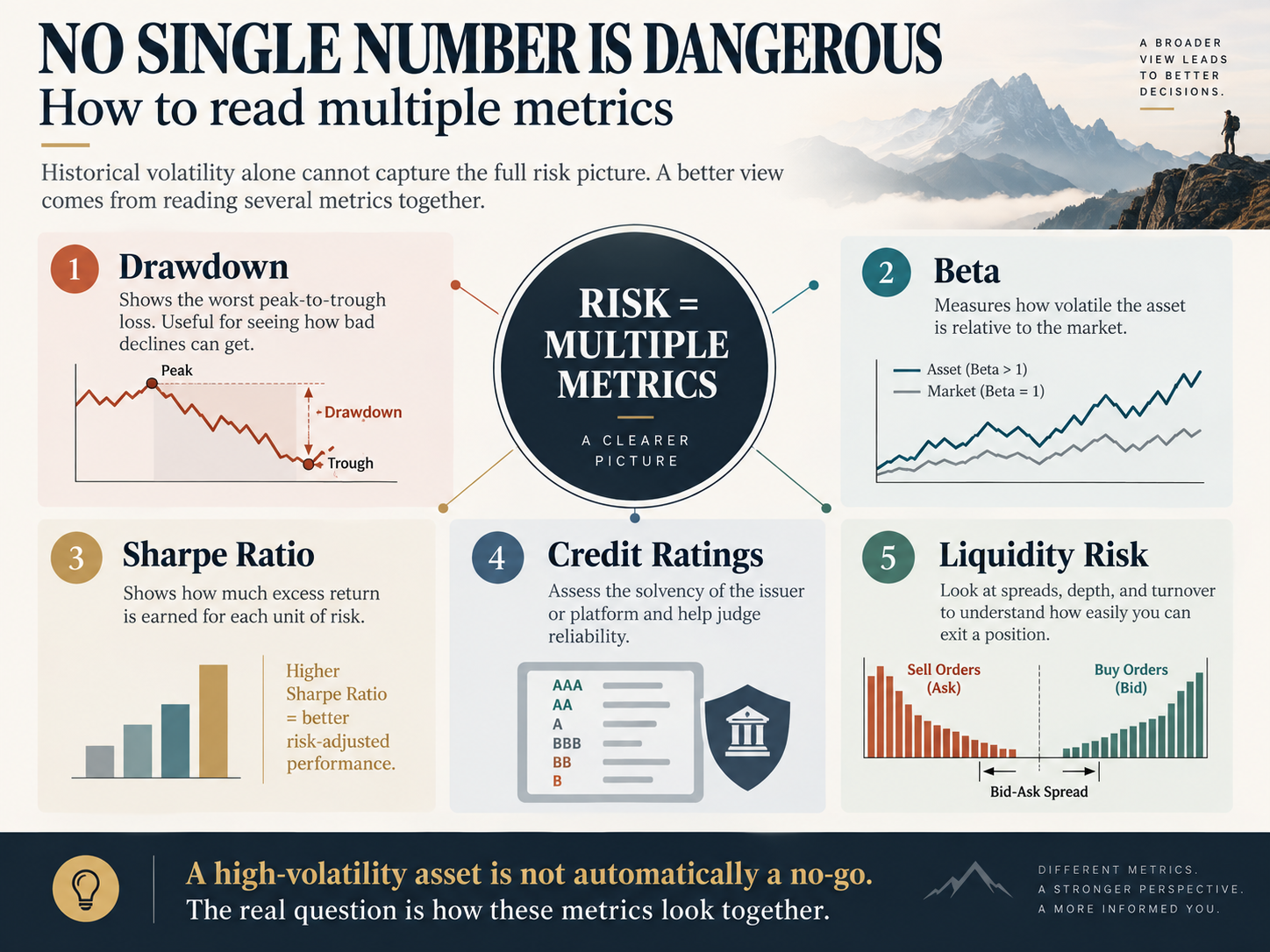
No Single Number Is Dangerous: How to Read Multiple Metrics
Historical volatility alone cannot capture the full risk picture. If it’s high, it’s not necessarily a no-go asset. Experts recommend analyzing several factors simultaneously to get a real idea:
- Analyze the drawdown to determine the worst loss from peak to trough.
- Measure the beta to learn the volatility of asset returns relative to the market.
- Calculate the Sharpe ratio to find out the excess return generated per unit of risk.
- Find credit ratings that assess the solvency of the issuer or platform to choose reliable options for money placement.
- Learn more about liquidity risk, as well as measures like spreads, depth, and turnover, to know how easily you can exit a position when you need to.
Volatility Is a Measurement, While Risk Is a Decision Context
Now you know how volatility and risk are different. Volatility does not fully capture many of the ways an investment can go wrong. It is a feature of an asset or market that indicates big return changes. Sometimes it is related to risks, such as time horizon, credit, concentration, and currency, and sometimes it is not. It does not make an asset good or bad. Moreover, an asset with either high or low volatility may not be a proper option for investing if it has some other serious problems.
Calculating the volatility of an asset can be useful, as it can tell you which products are suitable for your investment strategy and willingness to take risks (capacity and tolerance). Still, it should not dictate the choice of investment products alone. It is worth considering other factors, risks, and your preferences to ensure that your portfolio is balanced.
Disclaimer: The content provided in this article is for educational and informational purposes only and should not be considered financial or investment advice. Interacting with blockchain, crypto assets, and Web3 applications involves risks, including the potential loss of funds. Venga encourages readers to conduct thorough research and understand the risks before engaging with any crypto assets or blockchain technologies. For more details, please refer to our terms of service.