
Table of Contents
If you are creating an investment portfolio, you are probably considering projected returns, setting goals, and defining your time horizon. That’s fine, but there’s one more thing to know about—how liquid your chosen assets are. Liquid investments involve less risk and can help you create a well-balanced portfolio.
Liquidity is a measure of how quickly an asset can be converted into cash without having to lower the price to attract buyers. If it is sold instantly without forcing you to accept a lowball offer, it is liquid.
In contrast, illiquid investments are difficult to sell even at a discount. And if an investor can’t get to their money when they need it, a product becomes inconvenient or risky.
What Is Investment Liquidity?
The term refers to how easily an asset can be bought or sold at a market price. An asset can be anything: securities like stocks and bonds, currencies and cryptocurrencies, business property, real estate, or collectibles.
When there is high liquidity, you can usually get cash faster and lose less money. The most easily traded securities are popular stocks. Currencies of countries with developed and stable economies, like USD and EUR, are also very liquid.
When there is low liquidity, you may have to wait longer, get less money when you sell, or have trouble exiting a position. Tangible assets such as a house or fine art are relatively illiquid. To convert them into cash profitably, you may have to wait for years.
Where does the liquidity come from? It is determined by the balance of supply and demand. The higher the demand, the easier it is to sell the asset at the current price. Hence, it is influenced by the activity of market participants and the popularity of a particular asset.
How to Tell if an Asset Is Liquid?
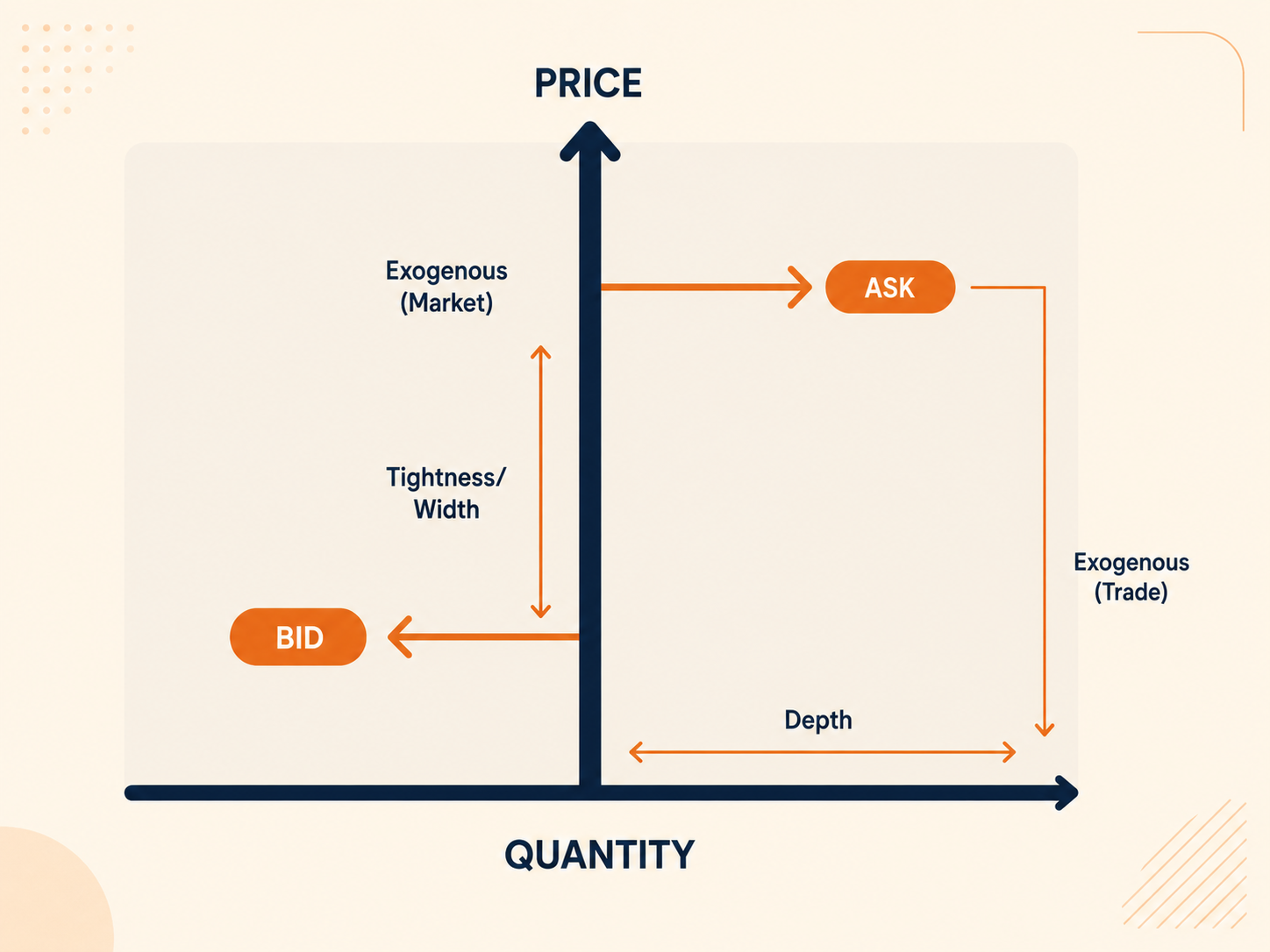
Let’s take securities as an example. The more famous and stable a company is, the higher the demand for its stocks. Traders and investors buy and sell them often, so frequency of transactions and trading volumes are high. Meanwhile, the spread, which is the difference between the maximum purchase price and the minimum sale price, gets lower.
Other Types of Liquidity
The term “liquidity” is widely used by investors and economists. It describes the properties of money, markets, securities, and entire organizations.
Market Liquidity
Market liquidity depends on trading volume, bid-ask spreads, and participant numbers on a particular market. The national stock market is characterized by higher market liquidity, and a city’s real estate market will be much less liquid. This value of markets for derivatives, contracts, or commodities often depends on their size.
Accounting Liquidity
Accounting liquidity measures the ability of a company to repay debts using available cash and assets close to cash, such as inventories or accounts receivable. It’s defined by comparing liquid assets to current liabilities. High liquidity of accounting records indicates balance sheet sustainability and reduces the risk of bankruptcy.
Why Is Liquidity So Important for Investors?
Investors consider this metric when developing a strategy, as their liquidity needs vary depending on their goals, risk tolerance, and investment amounts.
Often, high asset liquidity is a good thing with the following advantages:
- It gives you quick access to cash if you need to cover unexpected expenses.
- It reduces pressure during market volatility, as you can meet needs without dumping assets.
- It provides flexibility when plans change, as you can easily sell your assets to seize other lucrative opportunities.
- It makes an investment approach more stable and realistic.
On the contrary, a lack of liquidity can force you to sell at the wrong time or prevent you from acting quickly when needed. That is why conservative investors with short-term goals add a higher share of liquid assets to their portfolios.
However, these advantages do not necessarily mean that you should only buy and hold assets that are easy to offload. A useful rule is to keep enough cash to cover near-term needs, but not so much that it drags on returns.
Liquid products usually offer lower yields. Too much liquidity can lead to missed growth, because money sits in low-return assets instead of being invested productively. So, aggressive investors may choose less liquid assets if they have a stable financial position.
How Does Liquidity Affect Investment Decisions?
Liquidity is not just another feature of an investment instrument. It is as important as potential profitability and timing. In fact, two assets can have the same expected returns but differ greatly in terms of financial stress, risk, and flexibility, depending on how easily you can access your money.
So, we suggest that you pay attention to liquidity when picking products for a portfolio based on your current needs.
- For near-term or uncertain goals and planned expenses, choose assets that are more stable and easily convertible into cash, as you may need to sell them quickly.
- Long-term investments may include illiquid assets, as you will be holding them for a longer period and do not need to sell them immediately.
- To reduce portfolio risk, select assets that can be quickly sold at a market price if circumstances change. Consider building a solid emergency fund.
- For higher yields, consider less liquid investments, as inflation can erode the real value of idle cash and low-return products.
What Makes Some Investments More Liquid Than Others?
Some assets are easier to sell quickly at a fair price than others. This happens for various reasons and depends greatly on the type of asset. For example, for currencies and gold, factors like accessibility, hype, or the need for a safe haven contribute to their liquidity.
When it comes to real estate, geography, the year of construction, and the quality of renovation are important. And for equities, corporate bonds, ETFs, funds, and commodities, there are some common factors that determine liquidity:
- Market size
- Number of buyers and sellers
- Trading frequency
- Withdrawal rules and lock-up periods
- Specific restrictions
- Economic conditions
- Market sentiment
- Regulatory environment
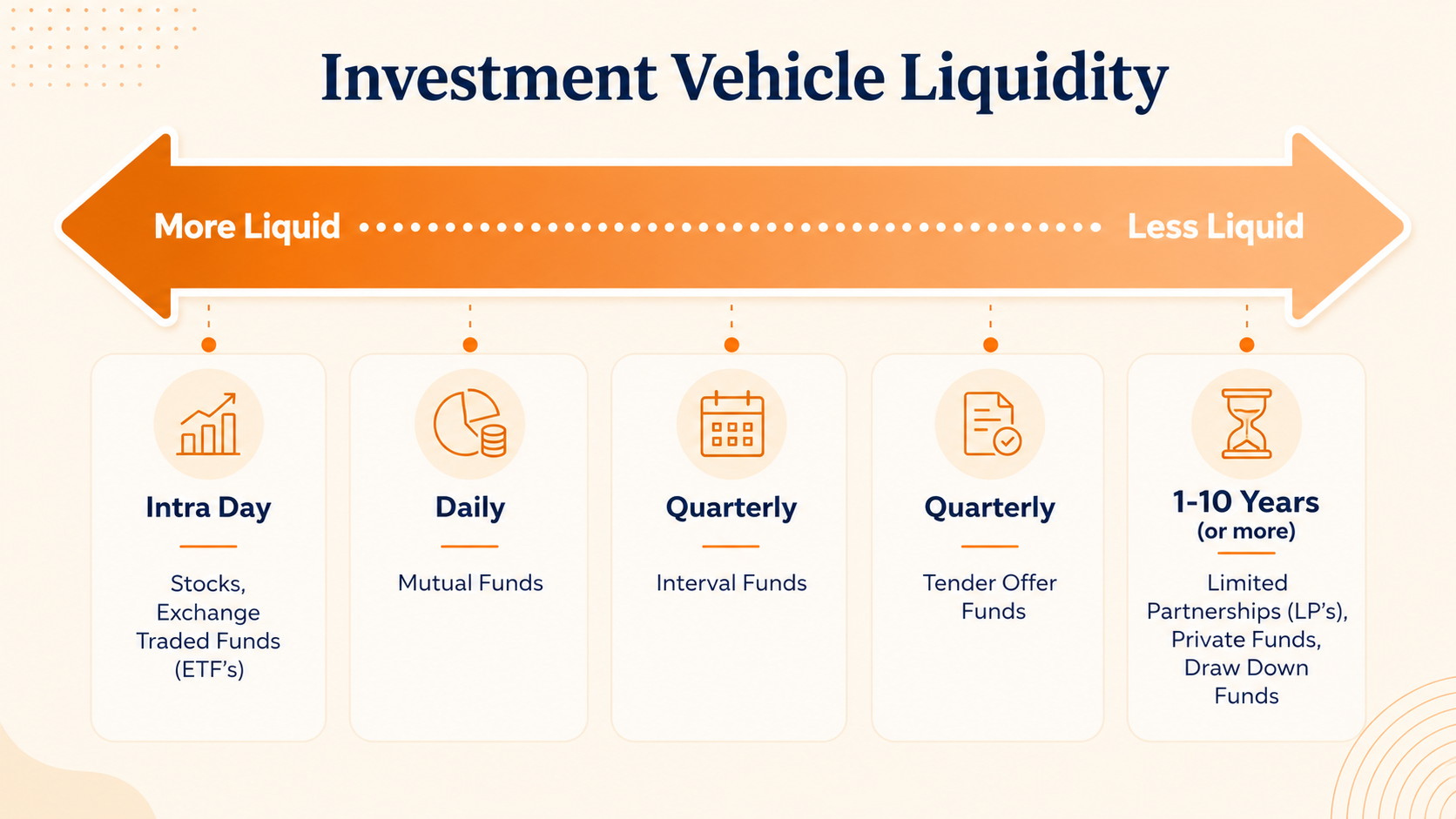
Major stock exchanges with massive trading volumes have constant activity, making it simple to buy or sell assets. Also, more participants mean you can always find a match.
Frequently traded assets, such as blue-chip stocks, are converted to cash in a matter of seconds. The demand for cash and equivalents is almost endless. And non-standard variations, such as rare currencies or shares of private companies, can take days or weeks.
The product terms also matter. Certain funds or CDs block access, for example, for 6–12 months, and may charge penalties for early exit. Plus, they might limit sales, add approval steps, or cap withdrawal amounts, which lowers liquidity.
When the market goes down, the liquidity of some asset types may decrease as investors become more risk-averse. Conversely, if investors are hesitant to invest, the liquidity of assets may decrease even in favorable economic conditions. What’s more, if regulations and requirements change, some assets may become more difficult to buy or sell.
Which Investments Are More Liquid, and Which Are Less?
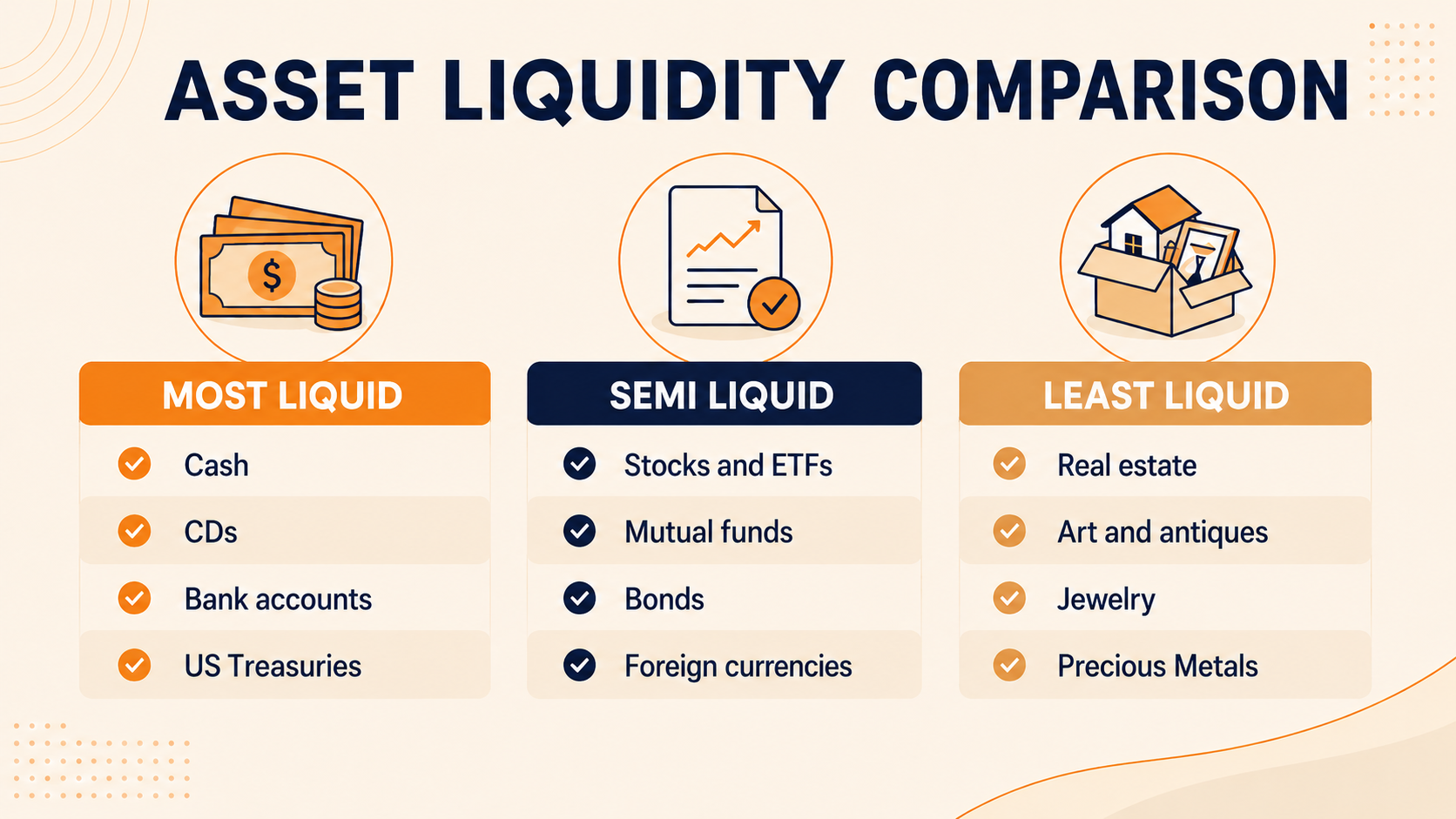
Assets can be put into one of three groups based on how liquid they are:
- Fast-selling assets: cash, publicly traded liquid stocks, and major ETFs.
- Slow-selling assets: corporate bonds, smaller ETFs, and some mutual funds.
- Hard-to-sell assets: real estate, private equity, and hedge funds with restrictions.
Cash equivalents, time deposits, money market funds, Treasury bills, major forex pairs, and government bonds are also easily traded, while rare works of art and securities that are traded over the counter may be of interest to only a few people.
The least liquid investments are venture capital and startups. They might not be sold for years because of contract rules, a lack of a public market, or the need for approval.
What Risks Come With Low-Liquidity Products?
Buying an asset with a lack of liquidity carries several risks. They are not just theoretical but can have a strong and unpleasant effect on your financial health. These are:
- Inability to exit quickly and missing opportunities
- Selling at a discount and locking in big losses
- Dependence on platform or fund conditions
- Increased stress during market downturns
- Volatility, as small trades cause price swings due to thin volume
- The risk of overestimating your ability to hold long-term
Interestingly, low liquidity can increase the vulnerability of assets to price manipulation. When there is low trading volume in securities, an investor with a large amount of money can manipulate the price of an asset by intentionally raising or lowering it. Exchanges and governments closely monitor such activities.
However, low liquidity can come with higher potential returns, less price noise, and a diversification edge with unique exposure. Sometimes it helps to negotiate, as fewer buyers mean you can make deals with discounts. It is not always bad but requires deliberate use and is not suitable if you may need your money unexpectedly.
How Can Investors Manage Liquidity More Effectively?
One of the ways to efficiently handle liquidity is to separate funds based on their purposes and invest them in different instruments. You can form emergency reserves, assign 20–30% to highly accessible products for the short term, and achieve your medium-term and long-term goals using less liquid but high-yield options.
We also suggest building a cash buffer. Store six to twelve months' worth of living expenses or business operating costs in easily accessible locations, such as money market funds or high-yield savings. Here, always review withdrawal terms, lock-up periods, and penalties. Skip anything blocking exits for too long.
Another piece of advice is avoiding situations where too much capital is locked in illiquid products. Cap locked capital at 15–20% of your total portfolio to prevent overcommitment. Diversify assets by liquidity levels and rebalance regularly to minimize risks.
Why Should Investors Always Think About Liquidity?
Investment liquidity should never be overlooked. It’s crucial, just like returns and risk. To deal with this element of sound investing, you should learn what it means, where it comes from, and what instruments tend to have higher or lower liquidity levels.
- Investment liquidity measures the speed and efficiency of asset-to-cash conversion. It’s defined by market size, number of buyers and sellers, asset popularity, trade volume, economic conditions, and other factors.
- High demand, big markets, and frequent trades create liquidity. Lock-ups, limits, strict withdrawal rules, and niche appeal create barriers.
- Cash, stocks, top ETFs, money market funds, and major forex pairs are generally liquid. Real estate, private equity, collectibles, and hedge funds are illiquid assets.
- For short-term goals, choose assets that are easily convertible into cash. For a longer time horizon, lower liquidity is fine, but only if it does not create issues.
The right investment choice is the one that ensures quick access to funds without significant losses whenever it is necessary. Because a strong portfolio is not only one that can grow but also one that can be managed without pressure or financial constraints.
Disclaimer: The content provided in this article is for educational and informational purposes only and should not be considered financial or investment advice. Interacting with blockchain, crypto assets, and Web3 applications involves risks, including the potential loss of funds. Venga encourages readers to conduct thorough research and understand the risks before engaging with any crypto assets or blockchain technologies. For more details, please refer to our terms of service.