

Table of Contents
Buying more coins? Not the same thing as diversifying a crypto portfolio, even though plenty of people treat it that way. That is the short version, and it trips up more investors than almost any other idea in this space.
If all your assets fall together, lean on the same narrative, or share the same liquidity problems, your portfolio can look spread out while acting like a single bet. Ten tokens is not automatically safer than one.
Risk, correlation, liquidity, position size: that's what actually matters. The coin count? Barely relevant once those four are sorted. No two people's crypto diversification strategies look quite the same, but the logic underneath barely changes.
What Is Crypto Diversification?
Spreading exposure across different assets, risk levels, and use cases, that is crypto portfolio diversification in a nutshell. It is not stacking everything behind one token, one story, one bet.
The goal is not to guarantee a profit. Nothing does that in crypto. The goal is to stop a single mistake, a single crash, or one broken sector from taking down your entire portfolio. In short, it is risk management, not a growth hack.
Why “Owning Many Coins” Is Not Real Diversification
Here is a mistake that catches out a lot of investors: holding fifteen or twenty tokens and assuming that counts as diversified.
Look closer, though, and those tokens often depend on the same thing. Maybe they are all small-cap altcoins. Maybe they all live on one blockchain, or ride the same hype cycle.
When Bitcoin drops, liquidity dries up and risk appetite disappears across the board, and assets like these tend to fall together. That happened hard in May 2022, when the Terra/LUNA collapse wiped out tens of billions of dollars and dragged down a wide range of tokens that had nothing to do with Terra beyond sharing the same market mood.
The number of tokens in your portfolio is not the same as diversification.
That is the one idea worth remembering above everything else in this article.
What Real Diversification Should Consider

Not a headcount, that is the first thing to get straight about diversification. More a handful of strategies running at once than one single rule to follow. Each one deserves a closer look on its own.
Market cap and maturity
Most crypto portfolios lean on Bitcoin and Ethereum for a reason: longevity. They have survived enough crashes by now to have earned the core spot, fair or not.
Smaller, newer crypto assets can offer more upside. They can also disappear, trade thinly, or swing hard in ways Bitcoin rarely does anymore. Not wrong to hold either end. They just play different roles.
Crypto sectors and use cases
A portfolio doesn't have to live in one sector, and crypto doesn't exactly run short of them. Ethereum and Solana get most of the attention on the Layer 1 side. Arbitrum and Base tend to come up for scaling. Uniswap and Aave are usually the first names people learn in DeFi, and Chainlink quietly handles the infrastructure and oracle work most people never think about.
Stablecoins, gaming tokens, privacy coins, tokenised real-world assets, the categories keep multiplying. A single piece of news, a regulatory shift, a wave of new adoption, any of these can hammer one sector while the rest barely notice.
Mistaking a handful of trendy narratives for actual diversification, that is the trap most people fall into here. Chasing whatever sector is hot without checking the fundamentals behind each project just swaps one kind of concentration for another.
Correlation between assets
Two tokens can look nothing alike and still move in the same direction. That usually comes down to sharing a blockchain, an investor base, or a market cycle, not to how similar they seem on the surface.
A portfolio that falls together was never really diversified. Real diversification looks like something else entirely.
Checking how assets have historically moved relative to each other is a better test of diversification than counting how many you own.
Liquidity and exit risk
A digital asset can look fine sitting in a portfolio, right up until you actually try to sell it. That's when problems show up.
A token that can't be sold in size without heavy slippage won't help you in a downturn, however well it did before that. Getting out matters just as much as the price does when it comes to liquidity. Trading volume, exchange support, and any token unlock on the horizon are all worth a glance before calling a position safe.
The Role of Bitcoin and Ethereum in a Diversified Crypto Portfolio
Practical reasons explain why so many crypto portfolios lean on Bitcoin and Ethereum as core holdings. Both are more liquid, more recognised, and more deeply woven into the rest of the market than almost anything else in crypto.
That said, neither one is “safe” in any absolute sense, and nobody is required to hold them. More than once, Bitcoin has dropped 60 to 80 per cent from its highs. Ethereum's chart is not exactly different.
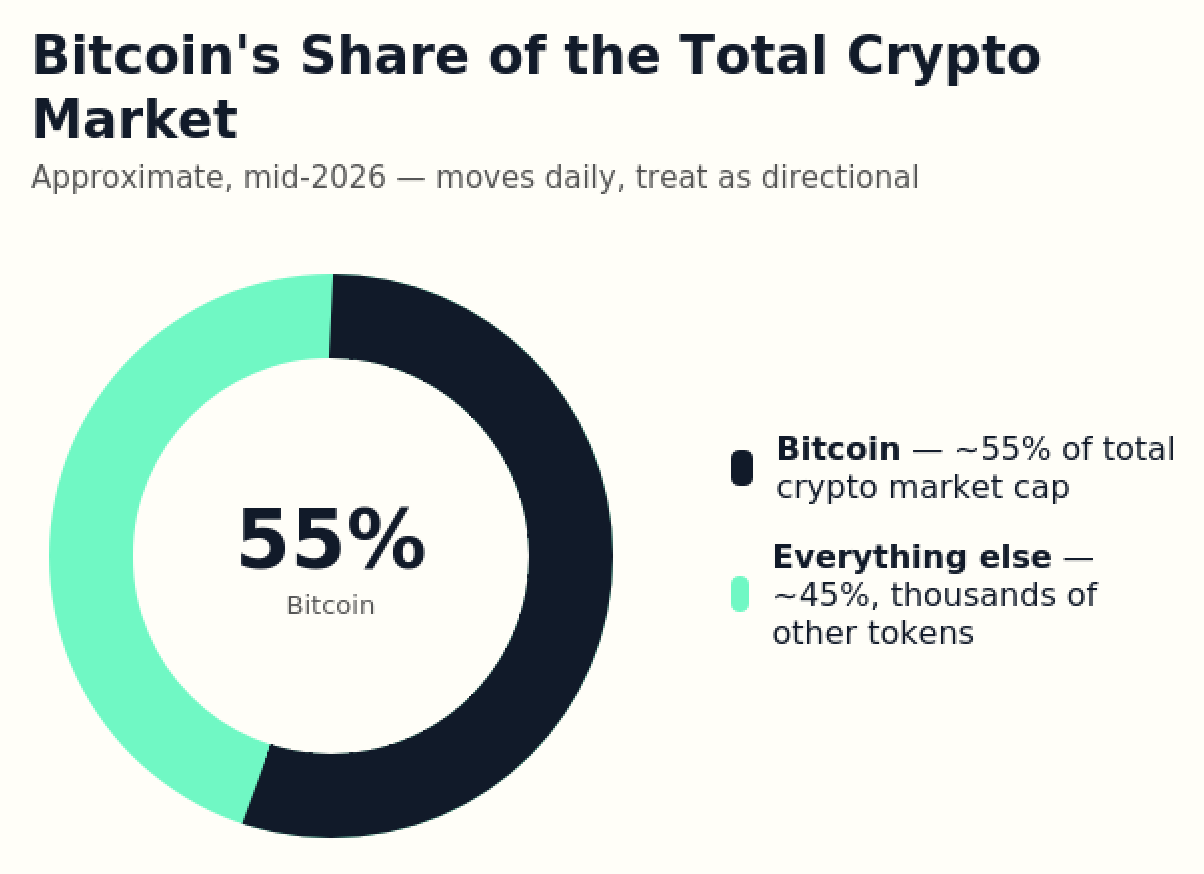
More than half of the total crypto market cap still belongs to Bitcoin alone, as of mid-2026. When it moves, most other tokens feel it too, whether you're holding it directly or not. Leaning on core assets calms a portfolio down compared with a stack of small-cap tokens, but calm is relative here. They're still volatile, just less so.
Where Stablecoins Fit Into Diversification
Stablecoins do a different job to everything else in a crypto portfolio. Instead of chasing growth, they provide liquidity: dry powder for buying dips, a temporary place to sit during a downturn, and a convenient tool for rebalancing.
Stablecoins are not risk-free cash, though. They carry their own risks: issuer risk, reserve quality, depeg risk, custody risk, and regulatory risk. They reduce price volatility. They do not remove risk altogether.
Should You Diversify Beyond Crypto?
If every pound or dollar you own sits in crypto, even a perfectly balanced crypto portfolio is still one big bet on a single, highly volatile asset class.
Some investors diversify only within crypto. Others spread across traditional assets too: cash, ETFs, bonds, commodities, or tokenised real-world assets.
Institutional investors tend to treat crypto this way by default. Many professional allocators keep digital assets to somewhere between 1 and 5 per cent of total holdings, using it to improve overall risk-adjusted returns rather than as the whole portfolio. Retail investors do not need to copy that number exactly, but the underlying logic, that crypto is one asset class among several, holds regardless of portfolio size.
Diversifying within crypto and diversifying your overall wealth are two different exercises. One does not replace the other, and there is no single right way to combine them.
How to Build a More Balanced Crypto Portfolio
This is where the theory turns into strategies you can actually act on.
Start with risk tolerance and time horizon
Before allocating a single pound, it helps to be honest about three things: how much risk you can genuinely stomach, how long you plan to hold, and the maximum share of your overall wealth you are comfortable putting into crypto at all.
These answers will look different for almost everyone, and that is fine. There is no single diversification strategy that works for every investor.
Split your portfolio into layers
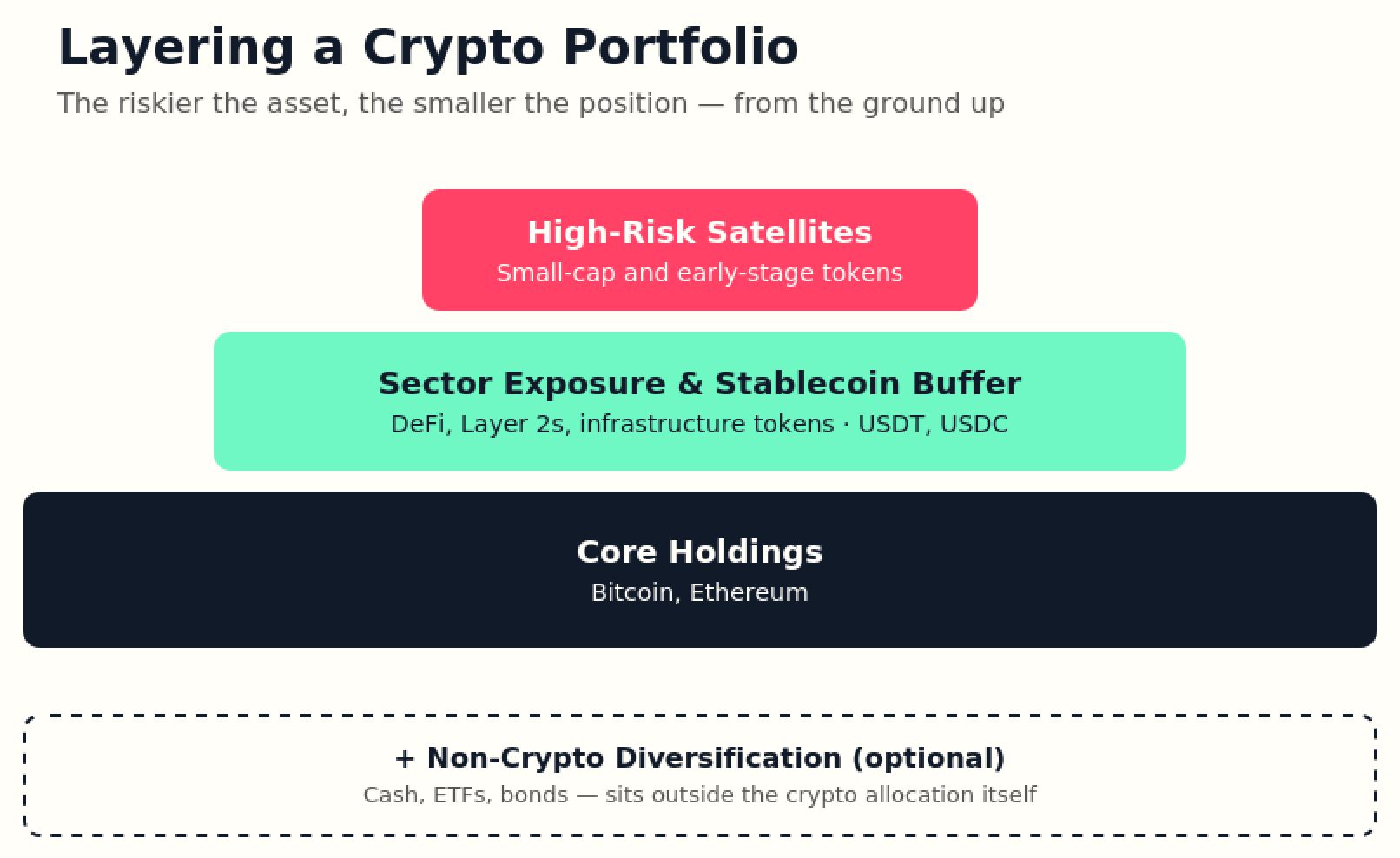
From there, think of the portfolio in layers. Core holdings anchor the bottom. Move up and there's room for sector bets and a stablecoin buffer. The smaller, riskier experiments sit right at the top, where they belong.
Basic rule of thumb: the riskier it is, the smaller the position, particularly if a severe drawdown would actually keep you up at night.
A rough anchor point, borrowed from traditional investing: Benjamin Graham’s suggestion of 10 to 30 holdings for adequate diversification translates reasonably well to crypto, even though the risk profile is different. It is a guide, not a rule.
A Simple Framework for Layering a Crypto Portfolio
Common Mistakes in Crypto Diversification
A few patterns come up again and again when a crypto portfolio looks diversified but is not.
Holding too many similar altcoins that all lean on the same trend. Mistaking a hot sector for genuine diversification. Ignoring how closely assets are correlated. Overlooking liquidity until it is too late to matter.
Letting small-cap exposure creep up without noticing. Skipping stablecoins entirely, even as a buffer. Never rebalancing, so one position quietly takes over. Buying an asset for no better reason than it being “different”.
Poor diversification is good at faking safety. On paper it looks careful, right up until the market turns and it suddenly trades like one enormous concentrated bet.
Why Rebalancing Matters
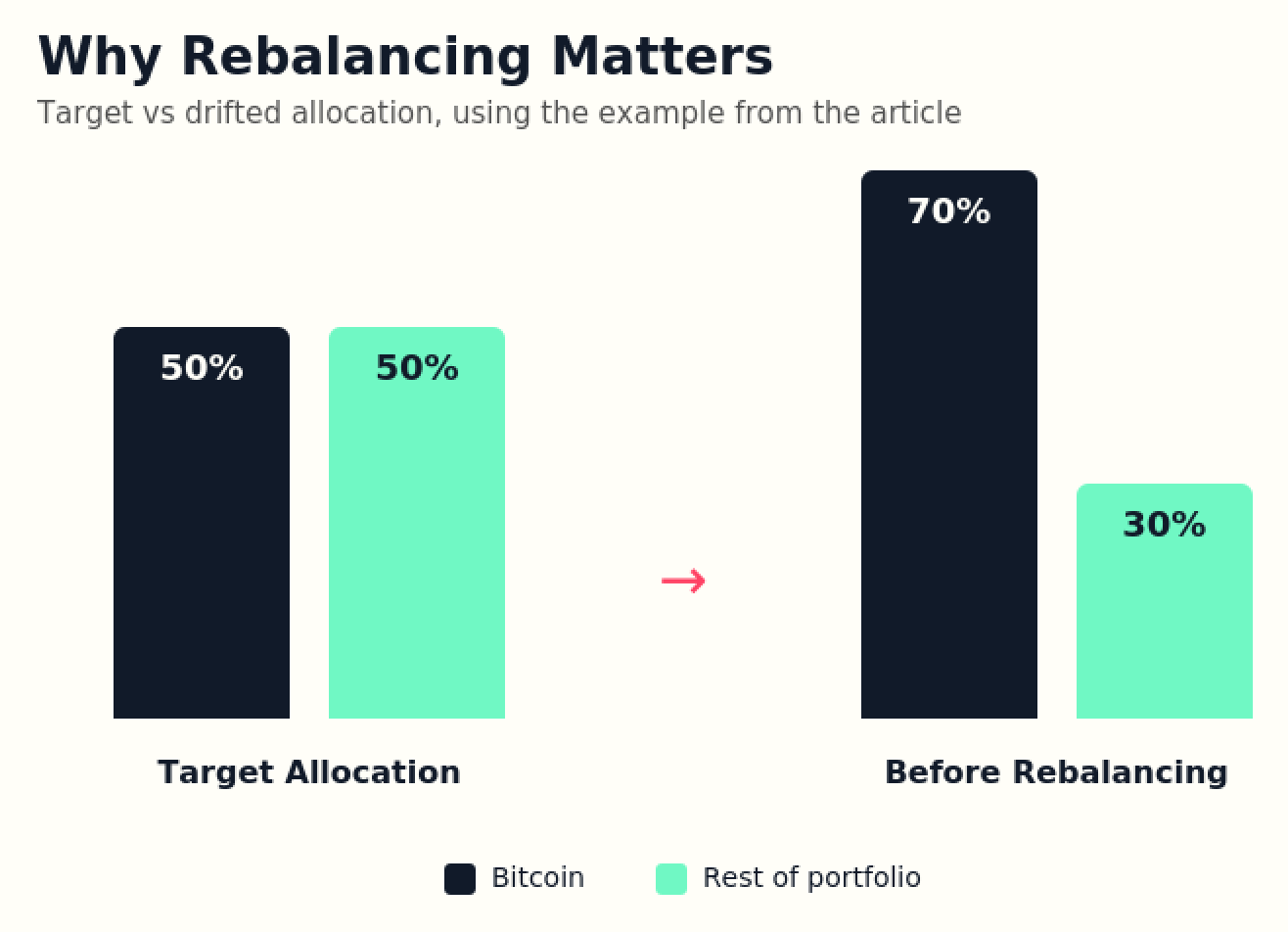
Portfolios drift. Leave one alone for a while and it rarely still looks like the plan it started as, one asset ran hot, another dragged, the stablecoin cushion shrank, and somewhere in there a risky position quietly grew into a much bigger share than it should have.
Rebalancing is how a portfolio gets pulled back toward the plan it started with. It locks in part of the gains from winners and stops one asset, or one sector, from quietly taking over the entire risk profile.
Say Bitcoin grows to 70 per cent of a portfolio that was meant to sit at 50 per cent. In practice, that means selling part of the position and spreading it back across the other layers.
How to Check If Your Crypto Portfolio Is Truly Diversified
Not sure if a portfolio is actually diversified? Here's a short checklist worth running through:
- The share sitting in Bitcoin and Ethereum versus everything else
- What proportion is in altcoins, and what proportion is in stablecoins
- Whether one sector makes up too much of the total portfolio
- How correlated the main holdings actually are
- Whether there is enough liquidity to exit positions without heavy slippage
- Which token unlocks are coming up
- What happens to the portfolio if Bitcoin falls 40 to 50 per cent
- Whether the whole portfolio quietly depends on one narrative
Answering these honestly says more about diversification than counting tokens ever will.
Conclusion: Real Diversification Is About Risk, Not More Tokens
Owning as many coins as possible was never the goal behind real diversification strategies in crypto.
What matters is the risk each asset adds, how positions interact with each other, and whether they can actually be sold when needed. Where each one fits into the wider portfolio matters just as much.
A properly diversified crypto portfolio has structure, limits, liquidity, and rebalancing rules. A long list of tokens is not a strategy. It just looks like one.
Disclaimer: The content provided in this article is for educational and informational purposes only and should not be considered financial or investment advice. Interacting with blockchain, crypto assets, and Web3 applications involves risks, including the potential loss of funds. Venga encourages readers to conduct thorough research and understand the risks before engaging with any crypto assets or blockchain technologies. For more details, please refer to our terms of service.