
Table of Contents
There have always been three ways to send money abroad: your bank, a correspondent network, or a fintech app promising something quicker. Blockchain and stablecoins aren't a fourth version of the same idea. They move money differently, full stop.
Here's the honest version. Blockchain rails can speed up settlement and make tracking far more transparent. They don't automatically replace your bank or your fintech provider, though. In practice, a hybrid model tends to work best: different rails for different legs of the journey. That's the real story with crypto and cross-border payments right now: not a replacement, an addition.
Why Cross-Border Payments Are Still Hard
International transfers usually pass through several intermediaries before they land. Each one can add a fee, a delay, or both.
FX (foreign exchange) spreads eat into the amount that arrives. Cut-off times mean transfers sent on a Friday afternoon might not move until Monday. Compliance checks, while necessary, add friction on top of all that.
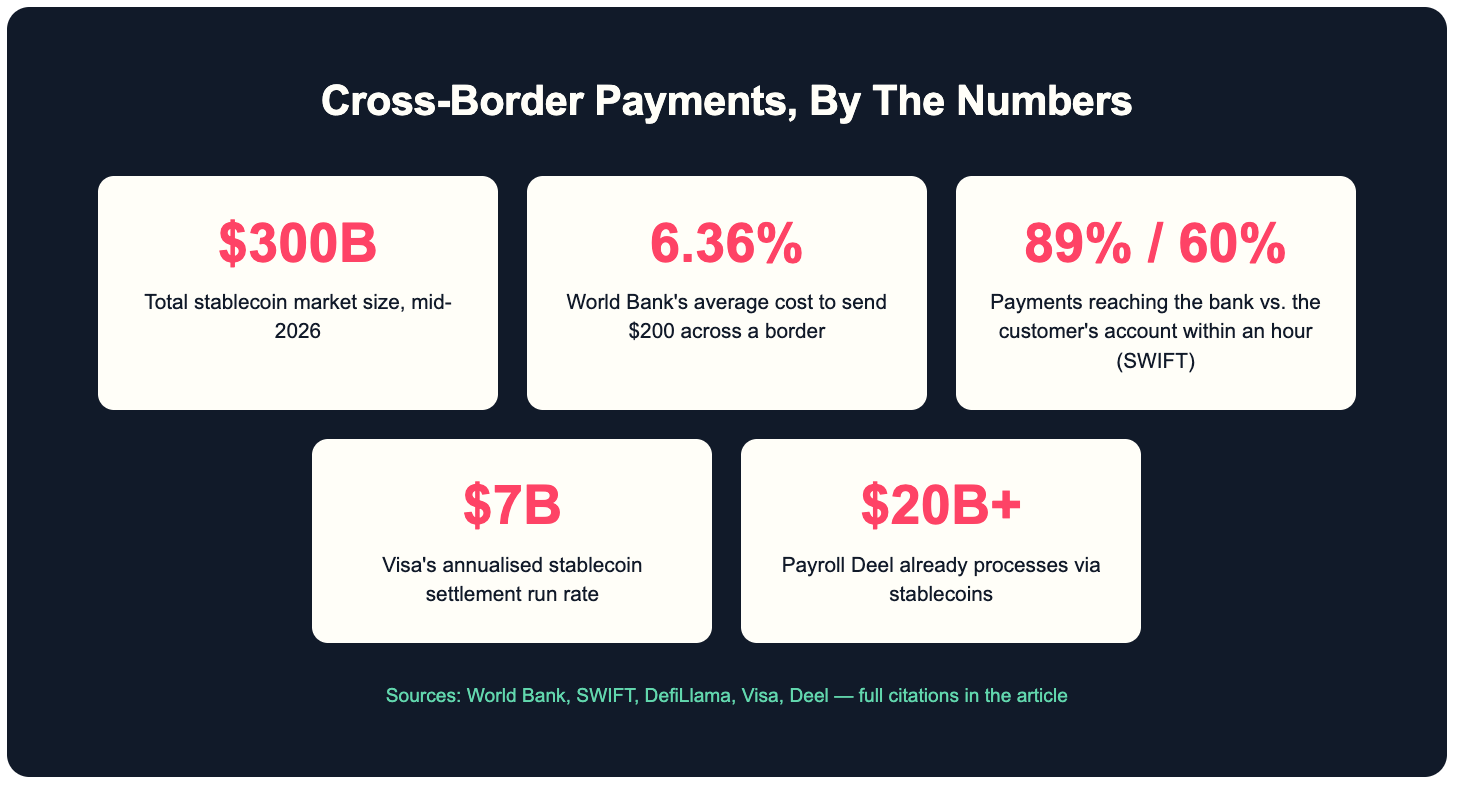
The World Bank's most recent data puts the global average cost of sending $200 across a border at 6.36%. Use a bank specifically, and that average jumps to nearly 15%. Digital-only providers do better, at around 4.6%, but even that's well above the 3% target the UN has been chasing for years.
Speed tells a similar story. SWIFT's own figures show that 89% of payments reach the recipient bank within an hour. Only around 60% of those actually land in the customer's account in that window, because the delay usually sits on the beneficiary side: local clearing, opening hours, one more compliance check.
None of this comes down to "banks are expensive." Blame fragmentation, not any one bank. A payment can still pass through more than one institution before it lands, and each hop can add its own delay and its own fee.
What Does Blockchain Change in Cross-Border Payments?
With blockchain, value doesn't pass through a chain of correspondent banks. It moves across a shared digital ledger instead. That single change has knock-on effects.
Settlement can happen faster, because there's no queue of intermediary banks to pass through. Tracking improves too, since transactions sit on a ledger everyone involved can see. Banking hours stop being a constraint as well.
That said, blockchain only covers part of the journey. Wallets, exchanges, payment providers, on-ramp and off-ramp partners, and compliance processes are usually still needed to move a payment through the wider global payment system and into a form the recipient can actually use.
Always-on settlement and real-time visibility
Blockchain networks don't take weekends or bank holidays off. Every stablecoin transaction leaves a visible trail too, with a timestamp and a status you can check as it happens.
Handy when you're trying to track or reconcile a transaction. It doesn't replace accounting, compliance, or reporting workflows, though; those still have to happen around the transaction, not instead of it.
Programmable payment flows
One-off transfers are only part of what blockchain can do. Automated payouts, treasury operations, and marketplace settlements can run through it without anyone manually clicking approve, and the whole thing can be wired together through an API.
Think of a marketplace that pays a seller out the second a delivery is confirmed, no manual step in between. A payroll platform can trigger salary payouts on a schedule without a finance team pushing the button each time. That kind of automation is harder to build on top of correspondent banking.
Where Stablecoins Fit Into Cross-Border Payments
Bitcoin and Ethereum are the best-known cryptocurrencies, but they move too much day to day to be useful for crypto payments. Nobody wants to invoice a supplier in an asset that might be worth 8% less by the time it settles.
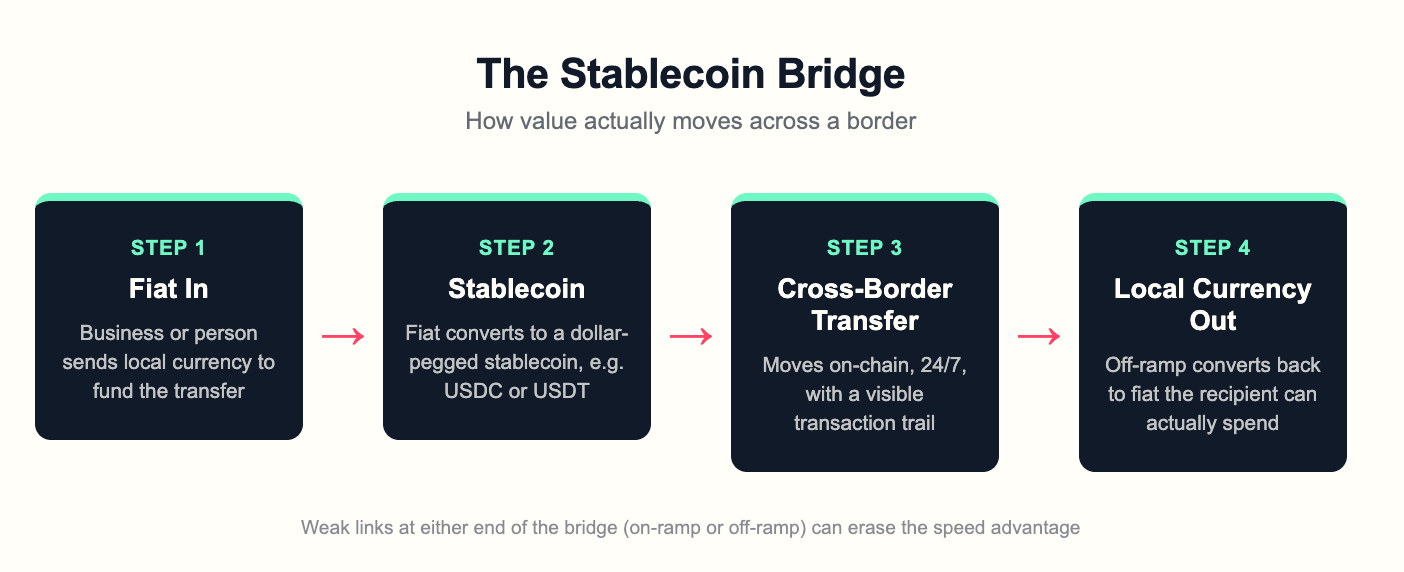
Stablecoins solve that problem. They belong to a category of digital currencies pegged to a fiat currency, usually the US dollar, which makes them a predictable unit of value and a practical bridge asset: fiat in, stablecoin across the border, local currency out.
That bridge is particularly useful when the direct traditional banking route is slow, expensive, or requires prefunding accounts in multiple countries just to keep money moving smoothly. It's also useful for people, not just businesses. In countries with volatile local currencies, holding value in a dollar-pegged stablecoin has become a genuine hedge. Turkey has one of the highest rates of stablecoin purchases relative to GDP of any country, Nigeria ranks among the largest adopters of digital assets worldwide, and demand in Argentina has tracked closely with the country's inflation rate. None of that is a coincidence.
The category has grown into serious infrastructure. Total stablecoin supply sits at roughly $300 billion, with USDT and USDC together making up the vast majority of it. The US passed the GENIUS Act in July 2025. It's the country's first proper federal law for stablecoin issuers, and it's pulled a fair bit of institutional money off the sidelines since.
Banks vs Fintech vs Stablecoins: What Is the Difference?
Here's where the differences actually show up.
Banks bring regulatory familiarity and established trust. Your money moves through an institution regulators already understand, but that familiarity comes with slower processing and less visibility into where a payment actually sits at any given moment.
Fintechs sit in the middle. They improve the interface, offer APIs, handle local payouts well, and give better reporting than a traditional bank. Most still depend on banking partners behind the scenes, though, which limits how far they can push speed and coverage on their own.
Stablecoin rails offer the fastest settlement and the most transparency, plus properly global reach. Unlike more volatile cryptocurrencies, the value itself isn't the risk here; the infrastructure around it is. In exchange, you take on network risk, custody risk, depeg risk, issuer risk, and off-ramp risk, all of which need managing properly rather than assumed away.
Banks vs Fintech vs Stablecoins: Quick Comparison
When Blockchain Payments Can Be Better Than Traditional Transfers

Blockchain and stablecoin rails shine on payments that can't wait: something needs to settle at 2am on a Sunday, or somebody needs to see exactly where the money is in real time. Not every transfer needs that. Plenty do.
Supplier payments in high-friction corridors are a good example. So are contractor payouts, remittances, marketplace settlements, treasury movement between subsidiaries, and B2B (business-to-business) payments where the traditional route means prefunding accounts around the world.
This isn't theoretical any more. Deel now runs stablecoin payroll through its mainstream HR platform, processing it alongside more than $20 billion in payroll it already handles. Visa's stablecoin settlement volume is running at an annualised rate of roughly $7 billion, and the company now supports over 130 stablecoin-linked card programmes across more than 50 countries.
The numbers back this up more broadly too. BCG and Allium Labs put real-economy stablecoin payments somewhere between $350 and $550 billion in 2025, with B2B settlement accounting for roughly 40% of that. EY-Parthenon ran a separate survey and found that 41% of corporates already using stablecoins were saving at least 10% on cross-border B2B costs.
When Banks or Fintech May Still Be Better
Blockchain isn't the right answer everywhere, and pretending otherwise would do you a disservice.
If the recipient needs local fiat immediately, a bank or fintech route is usually simpler. If your business isn't set up for digital asset custody, or the regulatory picture in a given market is unclear, that's a real cost, not a technicality to wave away.
Chargebacks, legal protection, dispute handling, and familiar reporting formats also still favour traditional rails in plenty of situations. A consumer who's paid the wrong amount by card has recourse. A consumer who's sent stablecoins to the wrong wallet address usually doesn't.
Blockchain tends to be strongest exactly where existing cross-border rails are painful, rather than where local payments already work fine. Paying your local supplier down the road doesn't need a blockchain. Paying a supplier in another country, in another currency, on a corridor your bank barely covers, might.
Some industry estimates put stablecoins' realistic share of the total cross-border payments market somewhere between 5% and 10% over the next few years. That's a meaningful shift in payments infrastructure, as opposed to a complete takeover.
The Real Cost: Fees, FX, Liquidity, and Hidden Friction
It's tempting to compare cross-border options purely on network fee, but that misses most of the actual cost.
Network fees vary a lot by chain. Solana transfers cost fractions of a cent. Tron carries most global USDT volume and typically costs somewhere between $0.20 and $3, depending on network conditions. Ethereum mainnet costs more than both, often landing between $0.50 and $15.
And that's before anything else gets added. Transfer fees, FX spread, platform fees, conversion costs, liquidity depth, withdrawal fees, compliance overhead, and operational setup all stack on top of it. A $1 network fee means very little if the off-ramp on the other end charges 3% to convert into local currency.
Sometimes the on-chain leg is cheap but the off-ramp is expensive. Sometimes a fintech costs more per transaction but saves enough time on reporting and local payout to make up for it anyway. The only honest way to compare is to look at the whole route, start to finish, not just the part that happens on-chain.
Operational Challenges of Blockchain Cross-Border Payments
Even where blockchain is clearly the faster option, it comes with its own admin. On the technical side, there's on-ramp and off-ramp availability, local currency conversion, network compatibility, wallet management, and liquidity fragmentation to sort out. On the compliance side, there's anti-money laundering (AML) and know-your-customer (KYC) checks, accounting treatment, custody, and user education.
Blockchain solves part of the settlement problem. It doesn't remove the business processes sitting around the payment, and treating it like it does is how projects run into trouble.
On-ramp, off-ramp and local payouts
Sending a stablecoin is only the middle of the journey, not the whole thing. Before that transfer happens, someone needs to buy or receive the stablecoin. After it happens, it usually needs converting into local currency.
If either side of that route is weak, the speed advantage blockchain offers can disappear before the money reaches anyone. A same-day on-chain transfer followed by a three-day local bank clearance isn't really a same-day transfer at all.
Compliance, reporting and custody
Every blockchain transaction needs to tie back to something: an invoice, a customer, a vendor, the right tax treatment. Someone has to run the AML check and make sure it all reconciles internally too. And somebody needs to own the harder question: who controls the wallets and keys, what the approval limits are, and what actually happens if something goes wrong.
Regulation around digital assets is moving fast enough that these decisions need revisiting regularly. The EU's Markets in Crypto-Assets (MiCA) transitional period ended on 1 July 2026, just a couple of weeks ago. Several major exchanges pulled USDT for EU users before the deadline even hit, since it never got the right authorisation. USDC and EURC got theirs, so they're still available. Worth asking yourself: will the stablecoin you're holding today even be usable in your key markets next year?
Custody carries its own risks too. When Silicon Valley Bank collapsed in March 2023, USDC briefly lost its dollar peg, because part of its reserves had been sitting there. It recovered within days, but "stable" clearly doesn't always mean "risk-free."
Hybrid Models: Why the Future May Not Be One Rail
Cross-border payments are probably heading towards orchestration across multiple rails rather than a full replacement of banks by blockchain.
A company can fund through a bank account, settle the cross-border leg through stablecoins, and pay the recipient in local currency through a fintech or local payout partner. Each rail does the part it's actually good at, and the customer never needs to know how many rails were involved.
This isn't a fringe idea. It's where the biggest players in payments are placing real money on digital assets. Mastercard acquired stablecoin infrastructure firm BVNK for $1.8 billion in 2026 (the deal is still awaiting regulatory approval as of writing), and Stripe paid $1.1 billion for Bridge the year before. Neither company bet that much on a technology they expected to sit on the sidelines. Traditional banks are moving too, with several European institutions now testing shared stablecoin settlement infrastructure of their own rather than waiting to see how it plays out.
Conclusion: Blockchain Is a New Payment Rail, Not a Universal Replacement
Blockchain and stablecoins do speed things up, and they make the whole process far easier to track. That matters most on the corridors that are already painful to use, where the traditional route drags, costs too much, or falls apart somewhere in the middle.
None of that makes banks and fintechs obsolete. Fiat access, compliance, local payout, and familiar user experience aren't going anywhere, and blockchain doesn't remove the need for any of them.
The better question isn't "stablecoins or banks?" It's which rail actually solves this corridor, this recipient, this currency, and this reporting requirement best. Most businesses moving real money across borders will end up using more than one answer.
Disclaimer: The content provided in this article is for educational and informational purposes only and should not be considered financial or investment advice. Interacting with blockchain, crypto assets, and Web3 applications involves risks, including the potential loss of funds. Venga encourages readers to conduct thorough research and understand the risks before engaging with any crypto assets or blockchain technologies. For more details, please refer to our terms of service.