Table of Contents
Are you trying to invest in cryptocurrency but you aren't sure where to start? Out of the thousands of crypto projects out there, how do you choose the best crypto project or the top crypto project? What are the steps you can take to compare crypto projects? Choosing crypto projects is kind of like choosing eggs. Some go bad quickly, but you aren't always sure which ones will, so you have to do your research to understand them better.
Well, it might not be exactly like choosing eggs at the store, but there are some similarities. Anyway, here is a detailed article about how to compare crypto projects.
Crypto projects cannot be compared only by token price, hype or promises. If you go only based on those metrics, you will be more likely to lose money. A simple framework is needed: utility, adoption, risks, tokenomics, liquidity and governance. This kind of analysis does not guarantee profit, but it helps users evaluate projects more effectively.
Why Comparing Crypto Projects Is Difficult
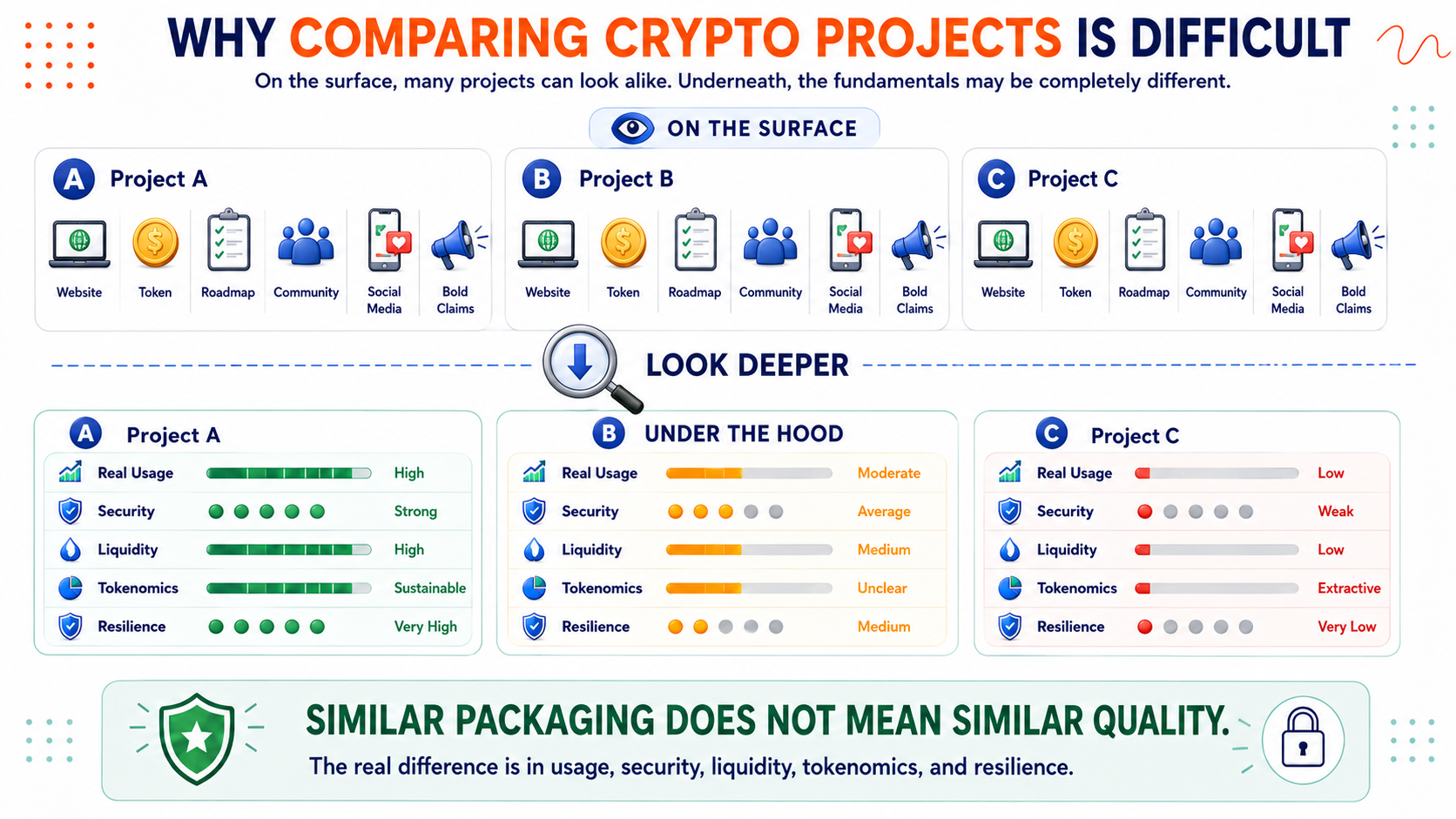
Show that on the surface, projects often look similar: a website, token, roadmap, community, social media and bold claims. However, not everything is always exactly as it appears. The crypto projects may not be similar at all. Behind the similar initial appearance, there may be very different levels of real usage, security, liquidity, tokenomics and resilience.
Start With Utility: What Problem Does the Project Solve?
The first question you should ask is why the project exists and what problem it solves. You need to understand whether a blockchain or token is needed to solve this problem, who benefits from the project, and whether there is a real use case. If it's just a marketing story and there is no real need for the project, it's not worth the investment. Some crypto projects look nice on the outside but they don't really solve a problem or they are solving a problem that many other projects are also trying to solve.
Think of it this way. When you were young, did you want the same old toy that everyone else already had for a long time, or did you want the shiny new toy that was just released and did something cool? It's kind of like that. There are lots of crypto projects out there, but not all of them are solving a unique and necessary problem to solve. Some are just copying earlier projects or just marketing really well without any utility or reason for existing.
Why Does the Token Need to Exist?
The token needs to have a clear role: fees, staking, governance, incentives, collateral, access or another functional use. If the project can work without the token, then there is no real need for the token to exist at all. This is the reason you should study its value more carefully. If the token is useless, the project itself could possibly be useless as well.
Compare Adoption and Real Activity
Adoption is not the number of followers on X or Telegram. Just because someone follows a project does not mean that they are an active, engaged user of the project. It is better to look at active users, transactions, TVL (Total Value Locked), repeated product usage, developer activity, integrations and real demand. It's also important to note that some metrics can be inflated or misinterpreted, so make sure you are looking at the real data and do your research.
User Adoption
Here are some ways you can evaluate product usage: active wallets, number of actions, retention, volumes and transaction frequency. These are all visible to anyone who wants to check out this information.
Developer and Ecosystem Adoption
For L1, L2, infrastructure and protocol projects, it is important to look at developers, applications, tooling, grants, integrations and ecosystem activity. This information can tell you if the developer knows what they are doing for one, and if the ecosystem is being adopted at a good rate.
Compare Risks Before Looking at Upside
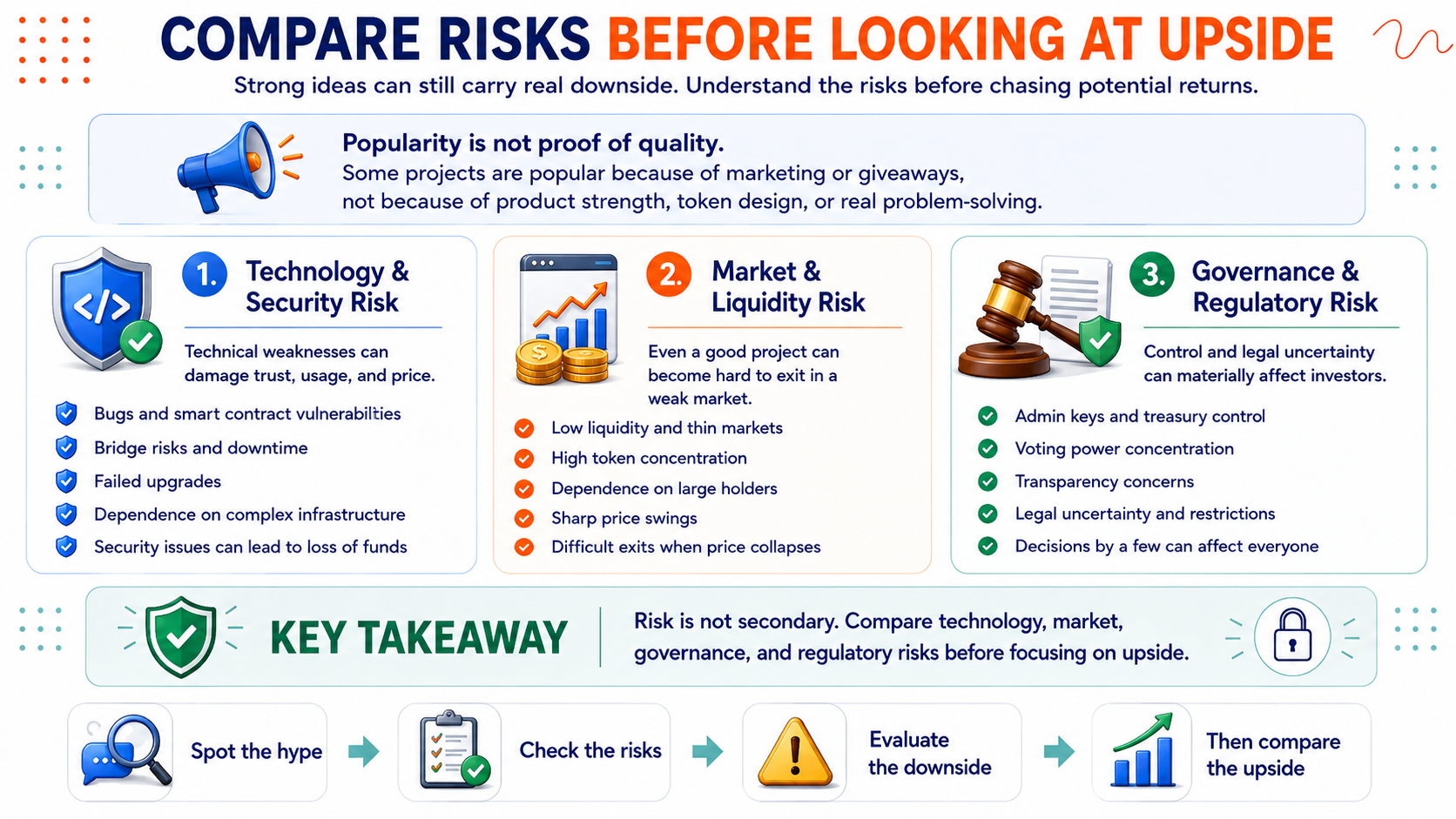
Risk is not a secondary part of the analysis or something that is unimportant. Even projects with strong ideas can have technology, market, regulatory or governance risks. It's important to understand the risks you are taking on when investing in cryptocurrency projects before you make the investment or letting yourself get too focused on the potential upside of the investments. Popular crypto projects aren't always the best ones to invest in. Sometimes they are, but sometimes they are only popular because of marketing or giveaways and not because of their product or token or the problem they are solving.
Technology and Security Risk
Technology and security risk includes bugs, smart contract vulnerabilities, bridge risks, downtime, failed upgrades and dependence on complex infrastructure. Any of these technology and security issues can cause risk to investors and some can cause you to lose money. If there is a problem with the project, it can impact user sentiment and price.
Market and Liquidity Risk
Low liquidity, a thin market, high token concentration and dependence on large holders can strongly affect the price and the ability to exit a position. You don't want to get stuck holding the bag when the token collapses or price drops significantly. Be aware of these market and liquidity risks. Doing so can help you protect your investments.
Governance and Regulatory Risk
It is important to look at admin keys, treasury control, voting power, transparency, legal uncertainty and possible restrictions for different types of tokens and crypto projects. The way crypto projects are governed can greatly impact your investment in them and can cause problems if there is something strange about the governance. For example, if voting power is concentrated among a select few people, they can independently make decisions that impact everyone's investments without all of the token holders' input.
Regulatory risks exist also for some projects. There might be legal issues that the crypto project is undergoing or restrictions that impact your investment. Be aware of all of these potential issues.
Compare Tokenomics
Tokenomics is not only price, market cap or total supply, but the whole system of incentives: supply, distribution, unlocks, emissions, utility and value capture. It's important to look at the whole picture when researching a crypto project's tokenomics, not just price, market cap, or total supply.
Supply and Inflation
Circulating Supply is the best approximation of the number of assets that are circulating in the market and in the general public's hands. Total Supply is the total amount of coins in existence right now, minus any coins that have been verifiably burned. The max supply is the best approximation of the maximum amount of coins that will exist in the forthcoming lifespan of the cryptocurrency, minus any coins that have been verifiably burned. Emissions refers to the rate at which new tokens enter the market. It's important to note that high future emissions can put pressure on price, even if the current market cap looks attractive.
Distribution and Unlocks
The people who own the tokens are the: team, investors, foundation, treasury, and community. Vesting and the unlock schedule matter when addressing future market pressure because when a project unlocks 10-20% of its total supply in a single event, the newly circulating tokens create selling volume that can cause prices to go down for days or even weeks.
Value Capture
A token does not always benefit from a project's growth. A product can be popular, but the token itself does not always receive direct value from that activity. In other words, just because the project is popular does not mean that the price will go up.
A Simple Crypto Project Comparison Framework
Common Red Flags When Comparing Projects
There are a few common signs of a weak project: unclear utility, promises of guaranteed returns, weak liquidity, high token concentration, empty activity, no audits, an unrealistic roadmap, aggressive marketing and a community focused only on price. If the project doesn't seem to have a valid reason for existing, it's not a good project. If it has never been audited or has a roadmap that nobody could ever achieve, it's not a good project. If the team is aggressively marketing towards potential token holders, it's not a good project. Finally, if the community for the project is only focused on price and not what the project is aiming to achieve, it's not a good project.
Conclusion
Comparing crypto projects should be systematic. A strong project usually has clear utility, real signs of adoption, transparent risks, reasonable tokenomics and a clear role for the token. You want the project to have a real, compelling reason for existing and preferably to be doing something unique in the space that others aren't already doing. But even a good framework does not remove risk completely — it simply helps users ask the right questions. If you ask the right questions you will be more likely to find strong crypto projects.
Disclaimer: The content provided in this article is for educational and informational purposes only and should not be considered financial or investment advice. Interacting with blockchain, crypto assets, and Web3 applications involves risks, including the potential loss of funds. Venga encourages readers to conduct thorough research and understand the risks before engaging with any crypto assets or blockchain technologies. For more details, please refer to our terms of service.