
Table of Contents
Every investment costs something to buy, hold and eventually sell. Investment fees are the direct and indirect charges you pay for that, whether the money leaves your account visibly or gets quietly deducted inside a product before you ever see it.
Some investment fees are obvious. A commission on a trade, an annual account charge. Others sit inside the price of what you bought and never appear on a statement at all.
Below you will find investment fees explained from a Spain and EU angle, because that is where the product documents and tax rules apply for most readers here. If your search results throw up American terms like Form CRS or 12b-1 fees, those come from a different disclosure system. More on that later.
Why Small Fees Can Matter Over Time
Investment fees do two things. They take money now, and they remove that money from the pot that could have earned something later.
The second part is the one people underestimate.
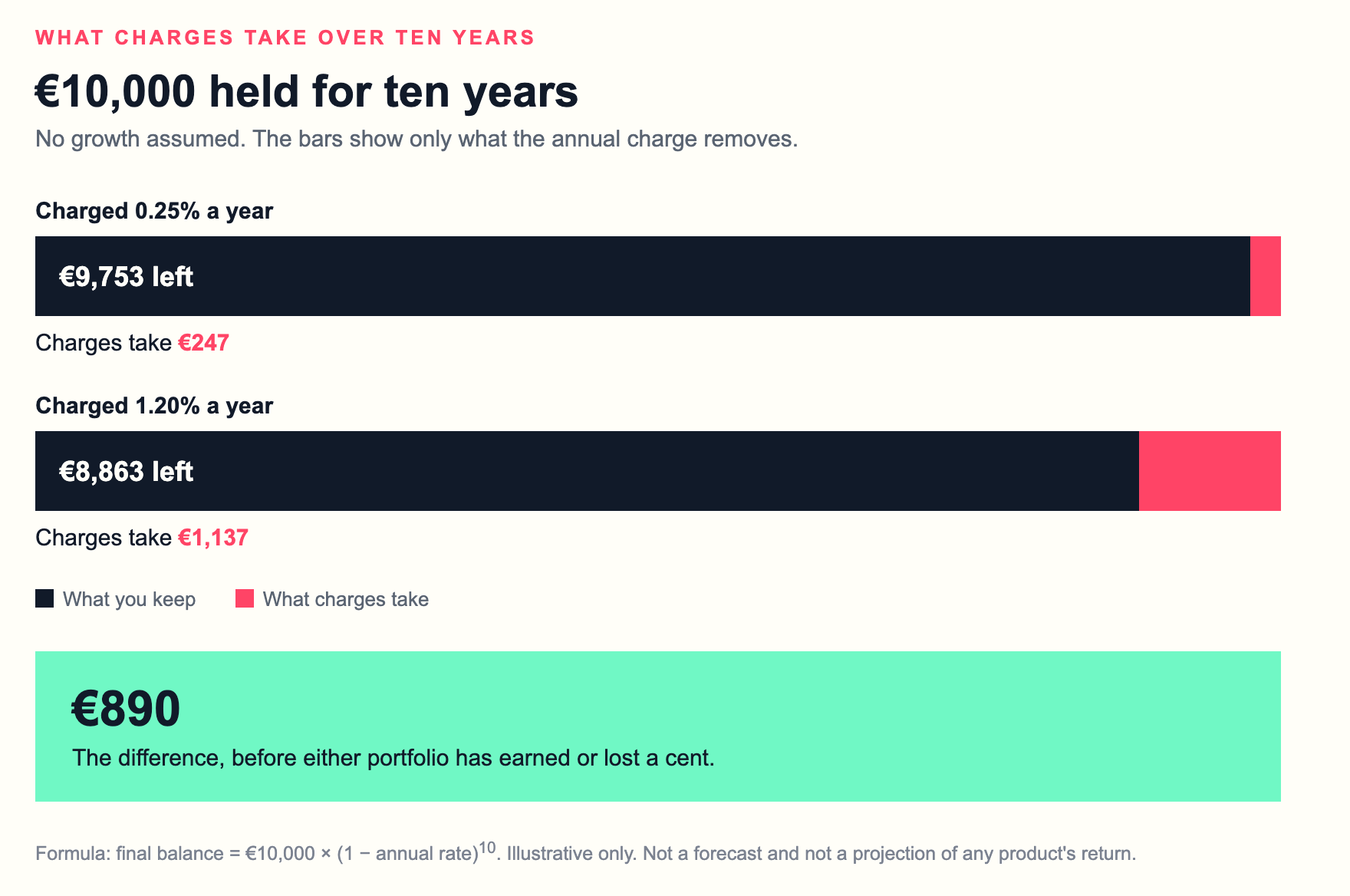
Here is a comparison with no growth assumed at all, so nothing below implies a likely return. Take €10,000. Leave it alone for ten years. Deduct the annual charge at the end of each year from whatever is left.
Formula: final balance = €10,000 × (1 − annual rate)¹⁰
At 0.25% a year, charges take €247 over the decade. You finish with €9,753.
At 1.20% a year, charges take €1,137. You finish with €8,863.
Same money, same ten years, nothing else different between them. The gap is €890, and that is before either portfolio has earned or lost a cent.
Just under a percentage point a year sounds like rounding. Over ten years on €10,000, it is €890.
Add growth to the picture and the gap widens, because the larger charge also eats into whatever those deducted euros would have gone on to earn.
The Main Types of Investment Fees
Rather than listing every charge alphabetically, it helps to sort them by when they arrive.
- At the point of entry. Subscription charges, purchase commissions, and the spread built into the price you get. Paid once, at the start.
- While you hold. Management fees, ongoing charges inside a fund, custody, platform and account fees. These repeat every year, whether the investment does well or badly.
- On the way out. Redemption charges, selling commissions, withdrawal and transfer fees.
Cutting across all three is a second distinction. Some charges you pay directly, and they show up on your statement. Others get deducted inside the product before the price you see is even published.
That second group is where hidden investment fees tend to live. Although ‘hidden’ usually means disclosed somewhere you did not look, rather than concealed.
How Fees Differ by Investment Product
Different products stack their investment costs differently. A share has almost nothing built into it and everything at the point of trade. A managed portfolio is close to the reverse.
The table below asks the same four questions of each product. Not every provider charges every line, so treat it as a map of where to look rather than a bill.
Account, Advice and Management Fees
These are the charges tied to the service rather than to the product itself.
Flat account fees are the simplest of the lot. A fixed euro amount per year, regardless of how much you hold. On a small balance a flat €50 stings; on a large one it barely registers.
Percentage charges work the other way round. An advice or portfolio management fee of 0.80% a year is calculated on the value of what you hold, so it grows as your money grows.
Always check what the percentage is applied to. Usually it is the portfolio value averaged over the period, but the base is set out in your contract.
Custody charges cover holding your securities. Some Spanish banks apply them and some do not, and the rates vary widely between providers.
Inactivity fees appear if you go quiet for long enough. Worth knowing about before you open an account rather than after.
One Spanish detail that catches people out. Discretionary portfolio management and investment advice both carry 21% IVA (impuesto sobre el valor añadido, the Spanish equivalent of VAT). Order execution is exempt. So a management fee quoted at 0.80% before tax actually costs you 0.968% once the IVA lands. Some providers quote the figure with tax already included, so it is worth checking which you are looking at.
Fund and ETF Costs
The expense ratio is the number most people look at first, and as a starting point that is fair enough.
An expense ratio, sometimes labelled the ongoing charges figure or the total expense ratio, is the annual cost of running the fund shown as a percentage of its assets. It covers the manager’s charge, administration, custody and audit. It comes out of the fund’s price daily, so it never arrives as a bill.
Spanish law caps what a fund can charge. The management fee cannot exceed 2.25% of assets, or 18% of results, or 1.35% plus 9% where a fund uses both bases. Depositary fees are capped at 0.2%. Subscription and redemption charges are capped at 5% each. The CNMV sets out these limits in full.
Those are legal ceilings, not typical figures. Actual charges land nowhere near them.
During 2026 a broad global index ETF typically charged somewhere between 0.12% and 0.20%. A handful went lower. The cheapest sat close to 0.05%.
But an expense ratio does not capture everything. Portfolio transaction costs, which the fund pays when it buys and sells its holdings, sit outside it. So do performance fees and any entry or exit charge.
For any specific product, the current KID and prospectus are the only figures worth quoting. Fees change, and old numbers travel a long way on the internet.
Trading, Spread and Currency Costs
Trading fees and the spread are different animals, and only one of them appears on your contract note.
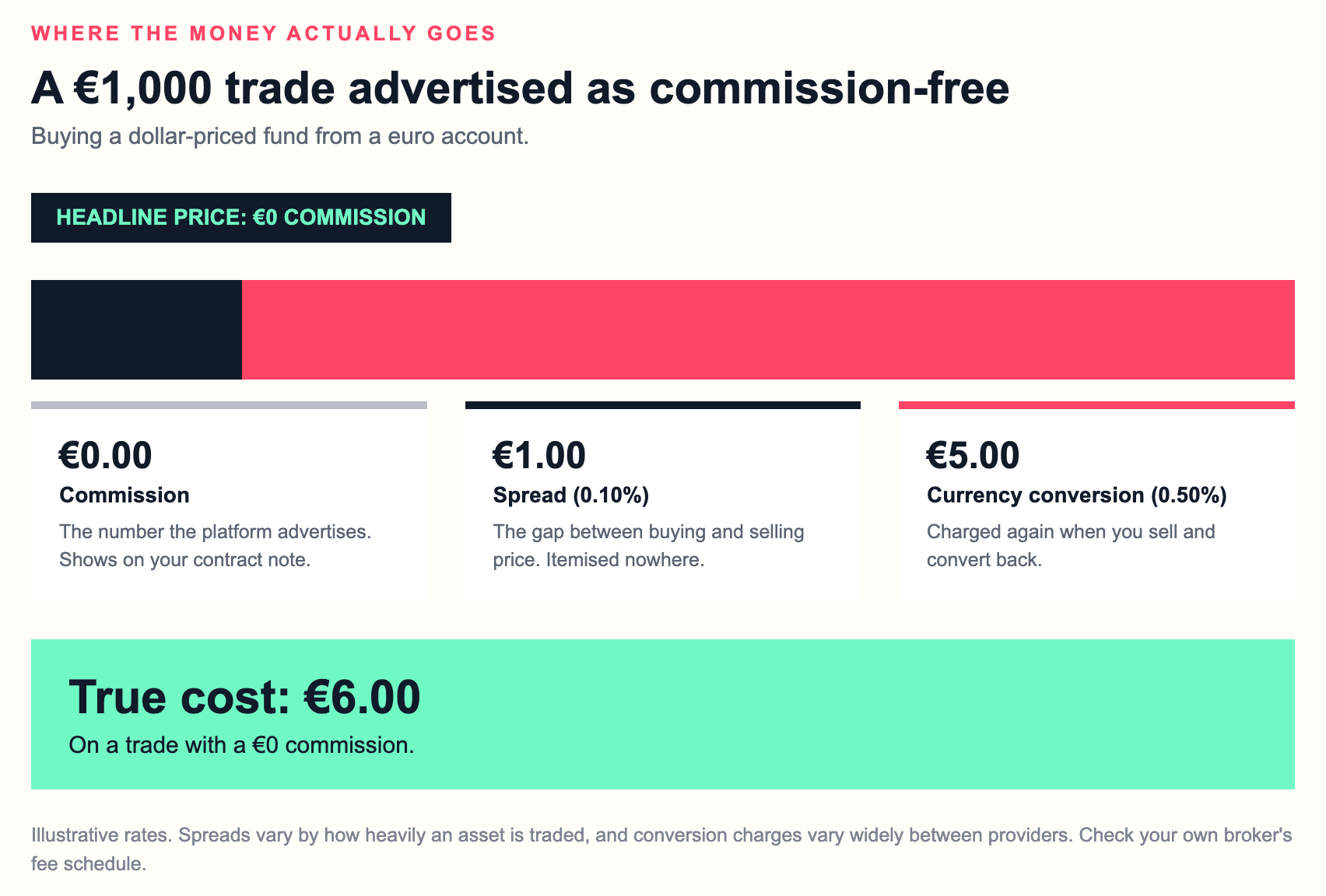
A commission is what the broker charges to execute your order. Brokerage fees have fallen hard over the past decade, and plenty of platforms now advertise zero commission on certain trades.
That does not make the trade free.
The spread is one of the more common hidden investment fees. It is the gap between the buying price and the selling price at the same moment. Buy and immediately sell, and you lose that gap. On a liquid ETF it is a rounding error. On a thinly traded bond it can dwarf whatever commission you saved.
Order size matters too. Push a large order into a thin market and the price moves against you as it fills. This is called market impact.
Then there is foreign exchange. Buy a fund priced in dollars from a euro account and the platform converts for you, charging as it goes. A currency conversion fee of 0.15% is competitive. Plenty of brokers and most banks charge considerably more, and the currency conversion fee applies again when you sell and convert back.
Crypto Transaction and Network Costs
Crypto adds a layer that traditional products do not have. The network itself charges you.
Buying through a platform usually involves a fee, a spread, or both. The fee is stated up front; the spread is the difference between the platform’s price and the wider market price.
Moving crypto off a platform triggers a network fee, paid to the blockchain rather than to your provider. This one moves with congestion. The same transfer can cost cents one day and considerably more the next.
Withdrawal charges, payment method costs (card payments typically cost more than a bank transfer) and any fees on staking or earning products stack on top of that.
Where Fees Are Disclosed in Spain and the EU
Investment fees are documented rather than mysterious. The paperwork exists, and providers are required to hand it over.
- The KID (key information document) is the short summary for packaged retail products. Since 1 January 2023 it has replaced the older UCITS KIID across the EEA for retail investors. It shows costs over different holding periods and carries a reduction-in-yield figure, which estimates how much the total cost trims from your annual return.
- The prospectus is the long version, with fee caps and calculation methods spelled out properly.
- The fee schedule (folleto de tarifas) is your provider’s own price list. Spanish firms have to make it available and hand it to clients at the start of the relationship.
- Ex-ante cost disclosure comes from MiFID II. Before you buy, the firm must give you an aggregated cost figure covering both the product and the service. You can request an itemised breakdown of it.
- Contract notes and periodic statements confirm what you actually paid, after the event.
One note for anyone reading English-language search results. American pages reference Form CRS, 12b-1 fees and sales loads, all set out on the SEC’s investor education site. Those are US disclosures under a different regime. The underlying concepts overlap, but the documents do not.
Taxes Are Costs to the Investor, but Not Product Fees
Tax reduces what you keep. It is not a fee, though, because no provider receives it, and it belongs on its own line when you compare investment costs.
In Spain, investment income and gains fall into the savings base, the base del ahorro. The 2026 rates match 2025.
Your first €6,000 of savings income is taxed at 19%. The next slice up to €50,000 goes at 21%. After that it steps to 23% up to €200,000. Then 27%. Then 30% once you pass €300,000.
Dividends and interest usually arrive with 19% already deducted. Spain counts that against what you eventually owe.
What you actually keep depends on your residence, your account, the product and your own circumstances. Rates change and regional rules differ.
Every figure above is dated to 2026. Check the Agencia Tributaria before relying on any of it. For crypto specifically, our guide to crypto taxes in Spain goes through the reporting rules in detail.
How to Compare the Total Cost of Two Investments
Setting one percentage against another rarely tells you much about real investment costs. What you want is the total cost of holding the same amount, for the same period, behaving the same way.
Here is that framework applied. Same €10,000, same ten years, no growth assumed.
Product A charges 2% on entry, 1.20% ongoing, and 1% to exit. Total cost over the decade: €1,401.
Product B costs roughly 0.30% to buy once brokerage fees, spread and conversion are counted, 0.20% ongoing, and 0.30% to sell. Total cost: €257.
Five and a half times the difference, on identical money over an identical period.
Tax sits outside both figures, because it depends on your gain rather than on either provider.
Fees That Depend on Behaviour or Circumstances
The same product can charge two people very different investment fees.
- How often you trade – Structures with high trading fees punish frequent activity. Buy monthly and a fixed €5 order fee on a €100 purchase is 5% before you own anything.
- How long you hold – Entry charges spread thin over decades and hurt badly over months. Ongoing charges do the opposite.
- Which currency you use – Buying a euro-denominated share class sidesteps the conversion entirely.
- How big your orders are – Fixed fees favour large orders; percentage fees are indifferent.
- When you leave – Some products apply a charge for early exit.
A pricier-looking product sometimes wins on overall investment costs. A fund with a higher expense ratio but no per-trade commission can beat a cheap ETF if you are buying small amounts every month. That is not a recommendation, only arithmetic worth running for your own case.
The cheapest product on paper is not always the cheapest product for you.
How Much Return Is Needed to Recover a Fee?
Here is a question worth asking before buying anything. How much does this need to earn just to get me back to where I started?
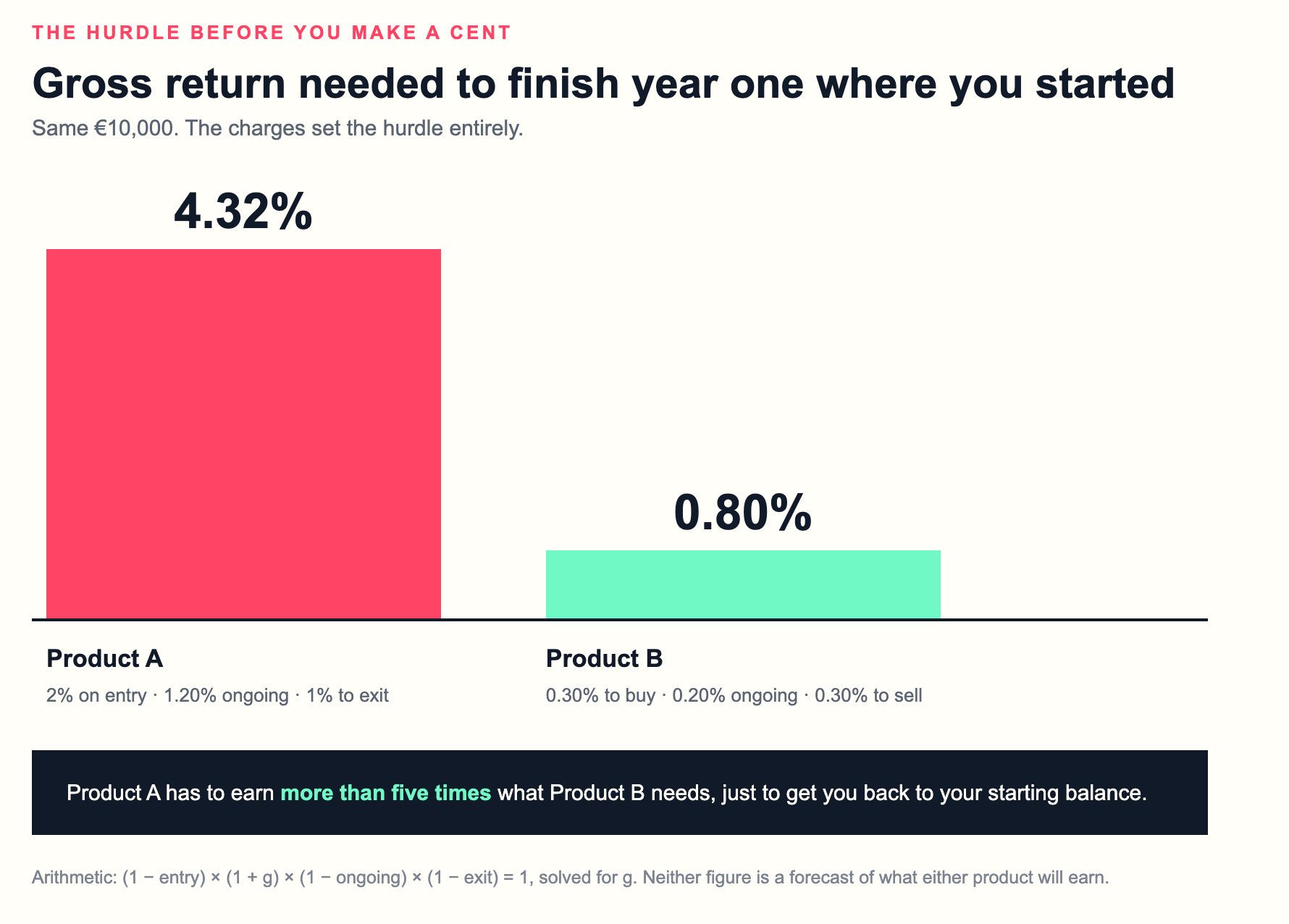
Take Product A from above. It charges 2% on entry, 1.20% ongoing, and 1% to exit.
The arithmetic: (1 − 0.02) × (1 + g) × (1 − 0.012) × (1 − 0.01) = 1, solved for g.
To finish year one holding exactly what you put in, Product A needs a gross return of 4.32%.
Product B, at 0.30% to buy, 0.20% ongoing and 0.30% to sell, needs 0.80%.
Neither number is a forecast. Nothing here predicts what either product will earn. It measures the hurdle, and the charges set the hurdle entirely.
Limits of Fee-Only Comparisons
Low cost is not the same thing as low risk.
A cheap fund can still lose money. Market risk, credit risk, liquidity risk and the way a product is structured all sit outside the fee table. A badly diversified portfolio at 0.10% can do more damage than a sensible one at 0.80%.
Custody matters too. Where your assets are held, and how well protected they are if the provider fails, has nothing to do with what you are charged.
To verify a current figure, go to the KID or prospectus for products, the fee schedule for services, and your own contract notes for what you actually paid. Check the date on each one.
Conclusion: Compare the Full Cost Over the Intended Holding Period
The useful comparison unit is not a percentage. It is the total cost of holding the same amount, for the period you actually intend to hold it, behaving the way you actually behave.
That number takes about ten minutes to work out, and it answers the question you were really asking.
Investment fees matter. They are also the easiest thing to measure, which is partly why they get more attention than risk, access and whether the product suits what you are trying to do. Those are harder to put a number on, and no less important for it.
The figures in any guide, this one included, carry a date. The current documents are the ones that count.
Disclaimer: The content provided in this article is for educational and informational purposes only and should not be considered financial or investment advice. Interacting with blockchain, crypto assets, and Web3 applications involves risks, including the potential loss of funds. Venga encourages readers to conduct thorough research and understand the risks before engaging with any crypto assets or blockchain technologies. For more details, please refer to our terms of service.