

Table of Contents
Have you ever spotted a great price on an item online, clicked "Checkout," and realized the total shifted slightly before you confirmed? In the crypto world, something very similar happens when you make a trade, and it is known as slippage. (Slippage is the gap between the price you expected and the price you actually received)
Simply put, slippage is the difference between the price you expect when submitting an order and the actual average price at which your trade gets executed.
Because crypto markets move in real time, slippage can work in two ways:
Negative Slippage : You get a slightly worse price than expected, (paying a bit more to buy, or getting a bit less when you sell). This is what traders usually watch out for, as it quietly eats into your money.
Positive Slippage : The price moves in your favor before the trade finishes, getting you a better deal than you planned (buying cheaper or selling higher).
The Gap Between a Quote and a Fill
To see how slippage plays out in real numbers, let’s look at a simple example:
Imagine you place a market order to buy a token, expecting to pay $100. By the time your transaction confirms, the order actually settles at an average price of $101.50.
- Dollar Difference: An extra $1.50 per unit.
- Percentage Difference: A $1.50 increase represents 1.5% negative slippage.
On a single small buy, $1.50 might not seem like much. But scale that up to larger trades or multiple transactions over time, and that 1.5% gap can quietly take a noticeable bite out of your capital.
This just goes a long way to show that the screen price is an observation rather than a promise for unlimited size. The rate you see is simply the most recent trade or the best current offer, not a guarantee that every token you want is available at that exact number.
How Slippage Happens in an Order Book
Looking under the hood of a traditional order book will help us understand why slippage occurs.
When you place a market order, the exchange automatically matches your trade against the best available prices until the entire order is complete.
Imagine you want to buy 10 tokens with a market buy order. Here is how the available sellers (the "ask" side of the book) might look:
Thin Depth Near the Best Price
The example above highlights the role of market liquidity and order depth. The highest price on an exchange often has only a small pool of tokens.
If your order is bigger than the amount available at the best price, it will automatically use the next available prices. This means you may pay a worse price simply because your order is too large for the available liquidity at the top of the order book.
Price Movement While the Order Is Reaching the Market
Slippage also happens due to simple timing. In the fraction of a second between you tapping "Buy" and your order reaching the matching engine, the market itself can shift.
- Volatility & Breaking News: Sudden news or large trades can cause prices to move very quickly. The price may jump from one level to another before your order is filled.
- Competing Orders: Other traders or trading bots may buy or sell at the best price just before your order goes through. When this happens, your order may be filled at the next available price.
- Stop Orders: A stop-loss order becomes a normal market order once it is triggered. If the price is falling quickly, your order may trigger at your chosen price but actually be filled at a lower price.
How Slippage Appears in an AMM Swap
If you use a decentralized exchange (DEX), there is no traditional order book. Instead, trading happens against an Automated Market Maker (AMM) powered by a liquidity pool.
Simply put, a liquidity pool holds a paired reserve of two tokens (for example, Token A and Token B) governed by a mathematical pricing curve (like the constant product formula xy=k).
When you make a swap, you add one token to the pool and withdraw the other. This action changes the ratio of the reserves, which automatically adjusts the exchange rate.
In DeFi swaps, execution differences come from two distinct elements:
- Price impact (the price shift caused directly by your own swap size).
- Price slippage (the price movement caused by external trades and network delays before your transaction is confirmed on-chain).
Price Impact Comes From Your Trade
Price impact is the change in price caused by your own trade. The larger your trade is compared with the pool’s liquidity, the more the reserve ratio changes and the worse your execution price becomes.
Slippage is different: it is the price change that happens between submitting your transaction and its confirmation, often because of other trades or market activity.
In a nutshell, price impact comes from your trade while slippage comes from price movement before your trade confirms.
Slippage Tolerance Sets an Execution Limit
Slippage tolerance sets the worst price you are willing to accept. For an exact-input swap, it sets the minimum amount of tokens you will receive, while for an exact-output swap, it sets the maximum amount you are willing to spend.
If the price moves beyond your set limit, the transaction simply cancels (reverts) so you avoid a bad trade. Keep in mind that because the network still processed your request, you will still be charged the blockchain gas fee even though the swap didn't go through.
Slippage Is Not the Spread, Fee or Gas Cost
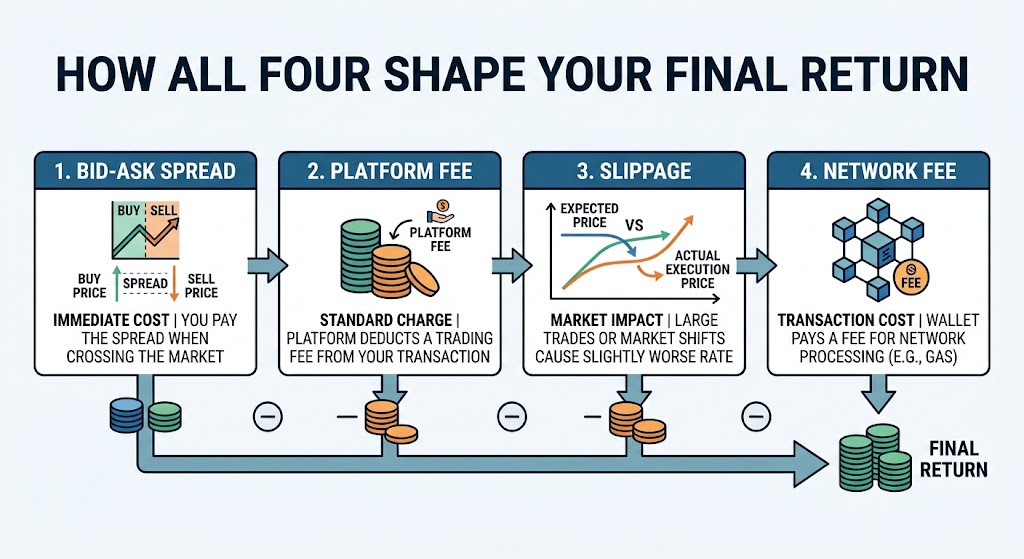
It is tempting to look at a completed trade and term every little deduction into a crypto trading fee. But behind the scenes, slippage, spreads, and network charges are completely different animals taking a bite of the deduction.
Understanding who receives what, and why each cost exists in the first place helps you accurately evaluate the true cost of a trade:
All four dynamics work simultaneously each time you place a trade especially in Decentralised finance.
Calculate the Real Cost of Slippage
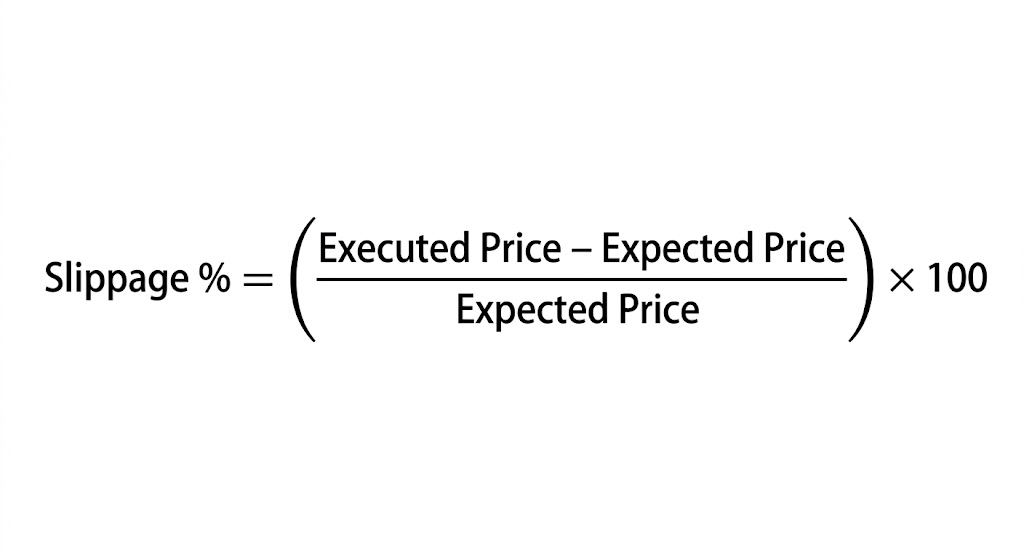
Calculating slippage is pretty straightforward. The math depends on whether you are buying or selling:
Example: A $5,000 Trade in Action
Let’s see how slippage stacks up alongside spreads and fees on a $5,000 market buy order:
Suppose a token is quoted with a mid-market price of $50.00. You place an order for 100 tokens ($5,000 expected value).
- Bid-Ask Spread: The lowest asking price on the book is actually $50.10 (a 0.20% spread cost = $10.00).
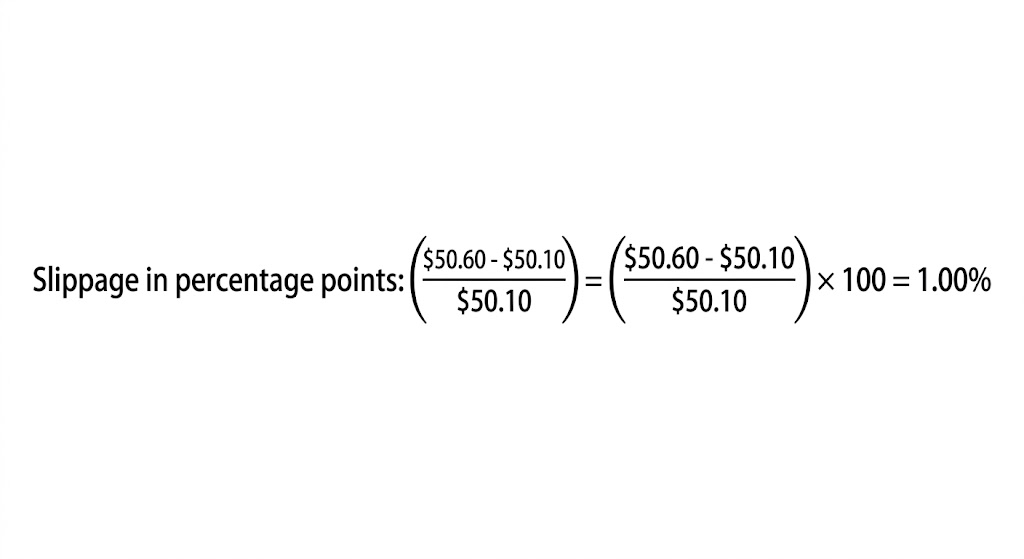
- Slippage: Because 100 tokens exceeds the depth at $50.10, your order walks the book and fills at an average price of $50.60.
-Slippage in percentage points:
-Slippage cost: 100 tokens $0.50 price drift = $50.00.
- Platform Trading Fee (0.25%): Applied to the final trade volume ($5,060 0.25%) = $12.65.
Breaking down the final bill
In this scenario, pure slippage accounted for 1.00 percentage point ($50.00) of extra cost.
However, your total execution drag factoring in spread, slippage, and platform fees was $72.65 (or roughly 1.45% on top of your target entry). Separating these numbers ensures you know exactly how much came from the exchange fee versus pure market friction.
What Increases Slippage
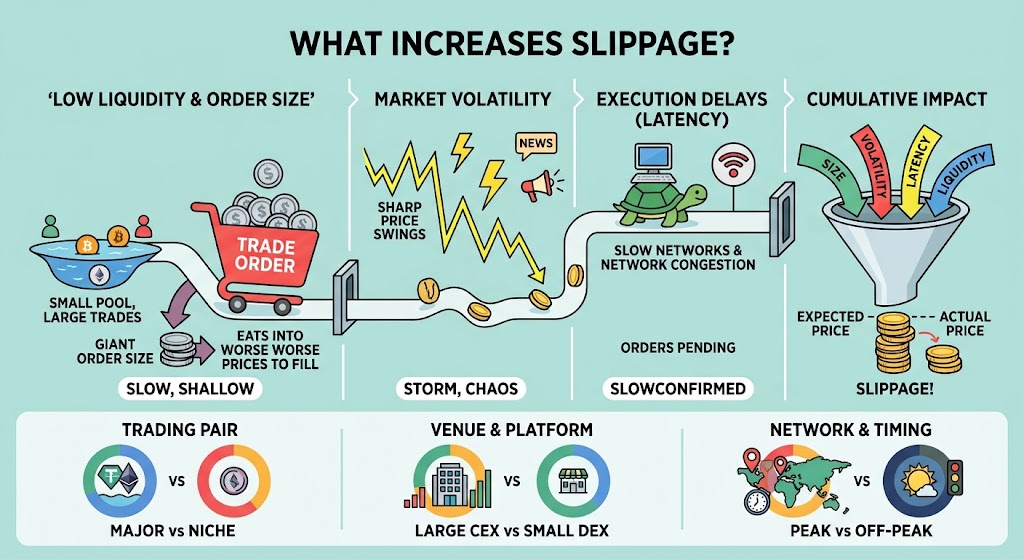
Slippage is usually affected by four main factors:
- Order Size: Buying or selling more tokens than are available at the top price forces your trade into worse price levels.
- Low Liquidity: Thin order books or small liquidity pools mean even modest trades can move the price.
- Market Volatility: Fast price swings during breaking news or sudden rallies shift quotes before your order lands.
- Delays & Network Congestion: Slow routing or congested blockchains leave your order pending longer, giving prices more time to drift.
Because of these variables, the exact same token can experience completely different slippage depending on how and where you trade it:
- Trading Pair: Swapping against major pairs like USDT or ETH generally offers much deeper liquidity than trading against smaller, niche tokens.
- Venue & Platform: High-volume centralized exchanges have denser books than small decentralized pools, which can mean drastically different price impacts.
- Network & Timing: Peak global market hours (like overlapping US and European sessions) offer tighter execution than off-peak hours, while high on-chain gas traffic can slow down confirmations and widen price drift.
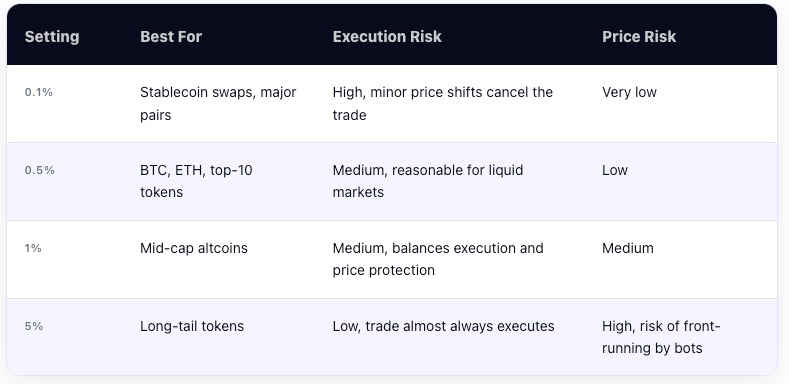
Why a Very High Slippage Tolerance Is Dangerous
Setting a very high slippage tolerance gives the market too much wiggle room. It tells the platform you are willing to accept a much worse price.
This leaves you exposed to sharp market drops or MEV bots that front-run your trade and deliberately push the price up to your maximum limit.
Setting an ultra-tight tolerance isn't always the answer either. Even a normal micro level price change can cancel your trade. Because you still pay blockchain gas fees on every failed attempt, several rejected swaps in a row can quickly cost you more than the slippage you were trying to avoid.
The key is finding a balanced limit that guards against bad fills without causing failed trades.
The Uniswap help documentation recommends starting at 0.5% for most liquid pairs and adjusting upward only for low-liquidity tokens.
Ways to Reduce Execution Uncertainty
While you can't eliminate market movements entirely, a few practical habits can help keep slippage to a minimum:
- Check Order Book Depth: Before tapping confirm, peek at the available liquidity near the current price to ensure there's enough volume to absorb your order.
- Use Limit Orders: Instead of market orders, use limit orders to name your exact price, your trade will only fill at that price or better.
- Trade Highly Liquid Pairs: Stick to high-volume pairs (like BTC/USDT) where dense order books naturally buffer against big price swings.
- Avoid High-Volatility Windows: Step aside during major news drops, token listings, or erratic market spikes when quotes shift unpredictably.
- Compare Routes & Aggregators: In DeFi, using a DEX aggregator can automatically route your trade through the most efficient liquidity pools for the best price.
- Reduce or Split Trade Sizes Carefully: Breaking a large order into smaller chunks prevents you from instantly wiping out the top of the order book.
Market Orders, Limit Orders, and Intent-Based Swaps
Different order types handle price certainty and execution speed in completely different ways and the kind that you use will influence your fill:
Market Orders.
Prioritize speed over price. Your trade executes immediately, but you accept whatever prices are available on the book, leaving you open to slippage.
Limit Orders.
Prioritize price over execution. You set the exact price (or better) you are willing to accept. Your price is protected, but if the market never reaches your level, your order will simply sit unfilled.
Intent-Based Swaps & Quoted Routes.
Instead of sending an order directly into a pool, you declare your desired outcome (e.g., "Swap 1 ETH for at least 3,000 USDC"). Third-party solvers or aggregators compete to fulfill that request. If they can meet or beat your minimum guaranteed outcome under the platform's rules, the trade settles, if not, it doesn't execute at all.
Because every exchange and decentralized protocol handles order matching and cancellation rules differently, always double-check the specific execution policies of the platform you are using before trading.
When Slippage Matters More Than the Headline Fee
It is easy to choose an exchange based solely on whoever advertises the lowest trading fee. However, a platform with a tiny headline fee but thin order books can easily end up costing you more overall.
Let's look at a $10,000 buy order across two hypothetical exchanges:
In this specific scenario, Venue B delivers a significantly better net result despite having triple the advertised platform fee. Headline fees only tell part of the story, execution quality and available depth determine what you actually pay out of pocket.
Conclusion
We could be tempted to think that slippage is a hidden fee, it is not. It's simply the small gap that can appear between the price you see and the price you actually get infuenced by trade size, available liquidity, real-time market movement, and market design.
While you can't control how the broader market moves, you can protect your returns by looking beyond the screen quote. By evaluating the entire trade route, understanding order book depth, setting balanced tolerances, and picking the right order type, you can make sure your final fills match your expectations.
Disclaimer: The content provided in this article is for educational and informational purposes only and should not be considered financial or investment advice. Interacting with blockchain, crypto assets, and Web3 applications involves risks, including the potential loss of funds. Venga encourages readers to conduct thorough research and understand the risks before engaging with any crypto assets or blockchain technologies. For more details, please refer to our terms of service.