
Table of Contents
Cognitive biases are predictable mental shortcuts that influence how people notice, interpret, and respond to information. Crypto markets are full of them: prices can swing dramatically within hours, information is often fragmented, social media exerts influence, and participants frequently must decide with incomplete data.
Why Crypto Can Amplify Decision Pressure
Many crypto markets operate continuously, including weekends and holidays. Investors can therefore encounter price movements, news, and social-media activity at any hour. Continuous access can make it harder to establish natural pauses between observing market developments and making an investment decision.
Rapid gains and losses can quickly change attractiveness or risk, but volatility itself does not indicate that an individual investor is prone to making emotional or biased decisions.
The fragmentation of the information received can also create confusion among crypto investors, especially newbies. Information related to cryptography is disseminated through project documentation, blockchain data, exchanges, financial research, and news outlets. These sources may differ in terms of quality, timeliness, and interpretation.
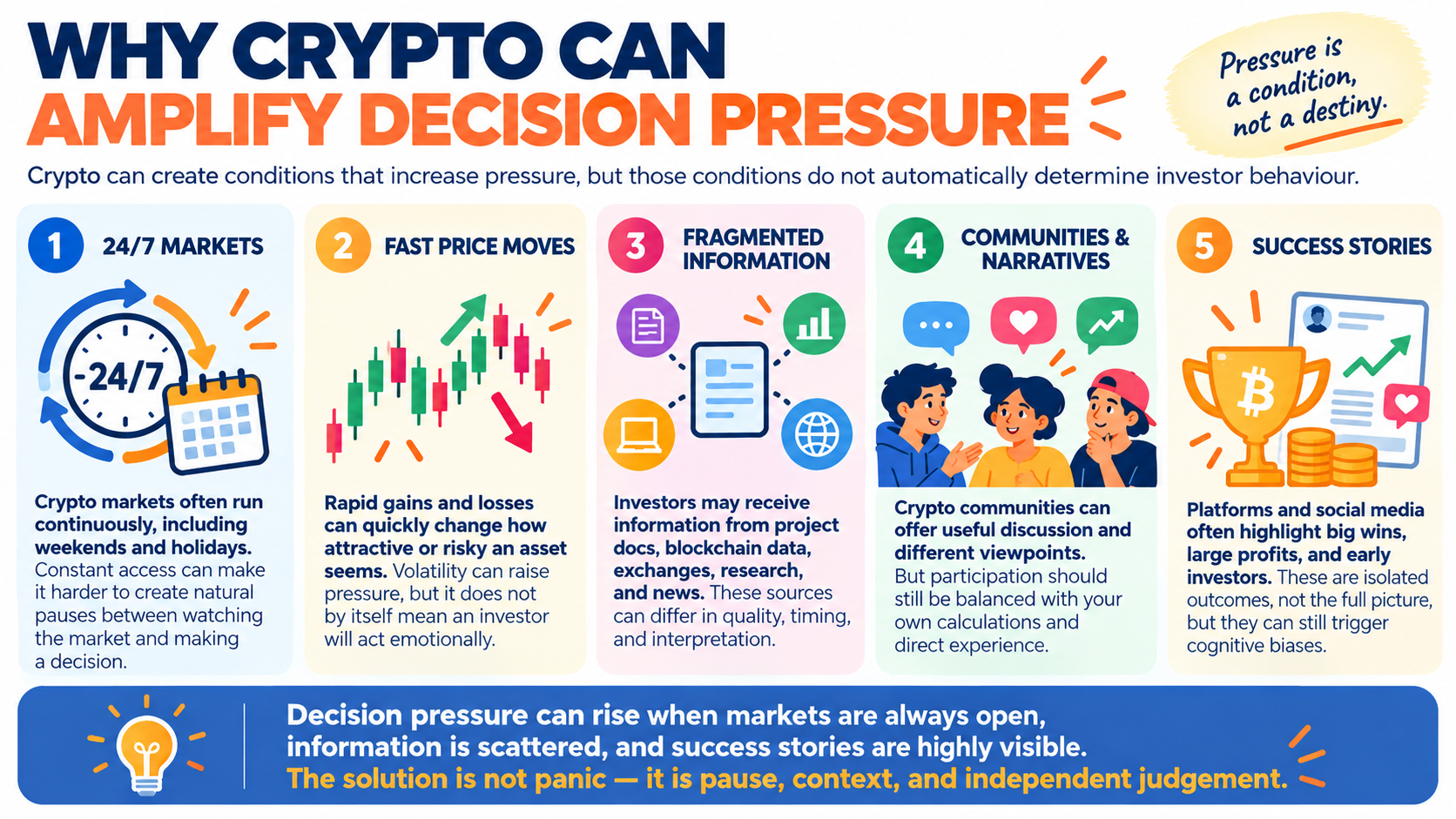
Crypto asset communities can provide useful information, technical discussions, and various viewpoints, as well as introduce investors to established opinions and rapidly spreading stories. Participating in a community should not automatically equate to herd behaviour. However, when being part of it, you shouldn’t forget about reasonable calculations and your own direct experience.
Crypto platforms and social media often focus on successful deals, large profits, and the stories of early investors. Such examples represent isolated results rather than a complete picture of crypto investing. Viewing these stories certainly doesn’t mean that a person will inevitably experience FOMO, take on excessive risk, or develop a tendency toward overconfidence bias. Nevertheless, they often trigger cognitive biases among crypto investors.
Confirmation Bias: Looking Only for Support
Confirmation bias occurs when an investor gives greater attention or credibility to information that supports an existing belief while giving less weight to evidence that challenges it. This does not mean that every holder who prefers positive information is necessarily displaying confirmation bias. Investors may reasonably assess evidence differently, and conflicting information can vary considerably in quality.
Suppose an investor holds a cryptocurrency because they believe its network adoption will increase. They encounter a report showing higher network activity and regard it as evidence supporting their thesis. Later, they read a report highlighting slowing developer activity. Rather than assessing both pieces of information using the same criteria, they immediately regard the positive report as credible and the negative report as unreliable.
Before making or reviewing an investment decision, maintain a simple evidence log with two separate sections:
Recency Bias and FOMO
Recency bias means giving too much attention to recent events and ignoring the past. In crypto investing, this can happen when a cryptocurrency has been rising for several weeks. An investor may think the price will keep going up, because the recent growth feels normal. At the same time, they may pay less attention to earlier periods of price declines, stability, or high volatility. FOMO can add a social dimension to this effect. When investors repeatedly see posts about rising prices, profitable trades, or successful early buyers, those visible examples can create a sense of urgency.
Overconfidence After a Winning Streak
A series of successful trades can make an investor feel more confident in their ability to predict the market. However, overconfidence bias can arise when good results are taken as proof that every decision was well made.
A good outcome does not always mean the decision was sound. An investor may buy cryptocurrency with limited research, take a large position, and still profit simply because the market moves in their favour. The result is positive, but the decision may have involved significant risk. After a winning streak, an investor may increase position sizes or trade more frequently, believing success will continue. This can increase exposure to mistakes, fees and market volatility.
There is also a risk of incomplete attribution. An investor may credit their own skill for successful trades while giving less consideration to factors such as a favourable market environment, unexpected news or simple chance. Reviewing unsuccessful decisions alongside successful ones can provide a more balanced assessment.
Anchoring to a Price or Prediction
Anchoring bias is a perceptual distortion where investors give too much weight to a particular number—such as the price they paid, a coin’s all-time high (ATH), or someone’s public price target—and use it as a reference for judging what the asset is worth today.
We can take a few examples. The most impressive anchoring bias is the purchase price. You buy Bitcoin at $100,000. If it falls to $70,000, you may think, “It’s cheap because I know it can get back to $100,000.” But your $100,000 entry price does not determine Bitcoin’s current or future value.
Another anchoring bias is fixating on all-time highs. So, Ethereum previously reached $5,000, so one might assume $3,000 is a bargain. However, the old ATH is simply a historical price; changing adoption, competition, regulation, or market conditions may make the previous peak less relevant.
Public prediction also should not be taken as an instruction. An analyst predicts a token will reach $10. If you anchor to that target, you may continue holding even after the project's fundamentals deteriorate, because you are comparing everything to the $10 prediction.
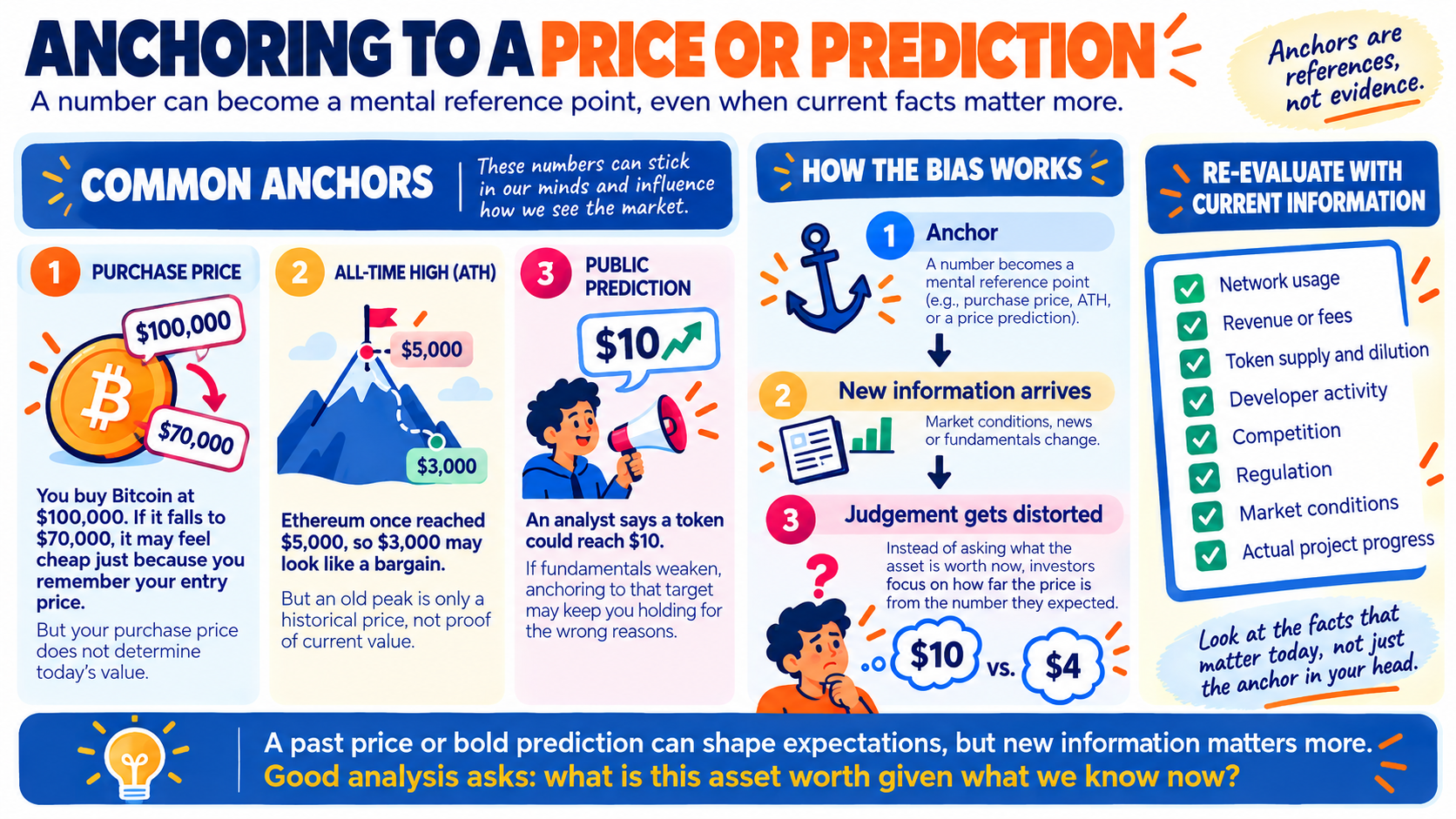
The danger is that the anchor can make investors interpret new information through an outdated reference point. Instead of asking “What is this asset worth given what we know now?”, they ask “How far are we from the price I expected?”
A better approach is to re-evaluate the investment from the current information:
- network usage,
- revenue or fees where applicable,
- token supply and dilution,
- developer activity,
- competition,
- regulation,
- market conditions,
- and the project's actual progress.
New information may matter far more than the price at which you bought or the highest price the asset once reached.
Availability and Authority Bias
These occur when people give too much weight to information that is especially memorable, vivid, recent, or easy to recall. In crypto investing, a dramatic headline, a widely shared success story, or repeated examples of a coin’s price surge can make that information feel more representative or important than it actually is. Less visible evidence—such as failed projects, conflicting data, or long-term performance—may receive less attention simply because it is harder to remember or less frequently discussed.
Authority bias can have a similar effect. Investors may place extra confidence in a claim because it comes from a prominent CEO, analyst, influencer, celebrity, or other confident public figure. A person’s credentials, experience, reputation, or popularity can be relevant context, but they do not prove that a particular prediction or claim is correct.
Sunk Cost and the Endowment Effect
The sunk cost effect occurs when money or resources already spent influence a decision about what to do next, even though those costs cannot be recovered. For example, if you bought a cryptocurrency for $10,000 and it is now worth $4,000, the original $10,000 should not determine whether you continue holding it. That money is already spent. The relevant question is whether owning the asset from today offers an attractive risk-and-return opportunity compared with the alternatives.
Ownership can create a related endowment effect, where people value something more simply because they already own it. An investor may therefore demand a higher price to sell a token than they would have been willing to pay for the same token before owning it.
One way to reduce the influence of these cognitive biases in crypto investing is to evaluate an asset as if it were not already part of the portfolio.
Loss Aversion and the Disposition Effect
Loss aversion describes the tendency to experience losses more strongly than equivalent gains. In crypto investing, this can lead investors to hold a losing position for too long because selling would make the loss feel final. During a sharp market decline, the same cognitive biases can contribute to panic selling, as investors focus on avoiding further losses rather than calmly assessing the asset’s future risk and return. The disposition effect in crypto investing is a related pattern in which investors tend to sell assets that have increased in value relatively quickly while holding onto assets that have fallen in value.
Herd Behaviour and Survivorship Stories
Crypto investing is strongly influenced by herd behaviour: investors often look to the actions and opinions of others when deciding what to buy. Rising prices, large trading volumes, social-media activity, and influencers promoting a particular token can create the impression that “everyone” is making money. These crowd signals can reinforce themselves because more attention attracts more investors, which can push prices higher and make the project appear even more successful.
Richard Lehman, an adjunct professor of Behavioural Finance at UC Berkeley Extension, states, “Herd behaviour tends to cause people to blindly follow others, and it contributes to FOMO, neither of which is considered a rational reason to invest”. This is closely connected to survivorship bias. Investors are much more likely to encounter stories from people who made substantial profits than from those who lost money. As a result, the visible examples may make crypto investing appear more consistently successful than it actually is.
Testimonials and screenshots have important limitations as well. A screenshot showing a large profit does not establish the investor's overall performance. It may show one successful trade while hiding other losses, fees, taxes, leverage, or the amount originally invested. Testimonials are also self-selected, meaning people with dramatic success stories are more likely to post them than ordinary investors with mixed or negative results.
Statements made by influential people require the same level of caution. An influential person may have financial relationships with a project, receive tokens or sponsorship support, or benefit from increased attention, even if subscribers lose money.
How Several Biases Can Reinforce One Another
Herd behaviour and survivorship bias can create a feedback loop of apparent success. Visible winners attract followers, followers generate more attention, and the resulting popularity makes the winners seem representative of the wider market. A more reliable assessment requires looking beyond success stories and considering failed projects, base rates, independently verifiable performance, risks, and the full distribution of outcomes. Of course, this doesn’t mean that all investors follow the same pattern. However, for better understanding these processes, we can present them as an active cycle:
Recent gains → Attention → Authority → Herd confirmation → Conviction/anchoring → Reversal → Loss aversion → Delayed reassessment
The cycle begins with recent gains. A cryptocurrency rises sharply, creating a salient success signal. The price increase attracts attention from investors who might otherwise have ignored the asset. Strong recent performance makes the asset more noticeable and can create the impression that something important is happening. Increased visibility brings in more observers and potential investors.
Social-media engagement, rising trading activity, testimonials, and the number of people discussing or buying the asset can then reinforce the original story. Investors may become anchored to recent highs or to a particular price target.
When the price reverses, the previous high can remain psychologically important. Loss aversion can make realizing the loss especially uncomfortable, potentially encouraging an attempt to “wait until it gets back to” the anchored price.
The cognitive biases do not necessarily occur in this exact order, and they can interact differently across people and market conditions. This model’s purpose is to show how several individually understandable psychological mechanisms can combine into a self-reinforcing process.
A Decision Journal Example
The goal is to make the rationale behind the decision visible and accessible for review. However, this method does not guarantee a higher return.
Bias-Reduction Techniques and Their Limits
Existing methods for eliminating cognitive biases can make the decision‑making process more balanced. However, they should be viewed more as precautionary measures than as guarantees.
When a Bias Label Can Mislead
Keep in mind that bias labels can themselves become a source of cognitive biases. Changing your view after genuinely new, relevant evidence is not automatically panic; sometimes it is exactly what good decision-making requires. Conversely, staying invested despite changed circumstances is not automatically discipline; it can also reflect attachment to an earlier thesis or reluctance to admit that an assumption was wrong.
The same action can be sensible for one person and unsuitable for another. Your objective, time horizon, financial position, and capacity to tolerate and absorb losses all affect what constitutes a reasonable decision.
Ultimately, the aim is not to eliminate every bias or produce perfect decisions. It is to make the reasoning visible, remain open to updating it, and distinguish thoughtful adaptation from impulsive reaction.
Conclusion: Better Decisions Start With Better Questions
A useful way to understand cognitive biases in crypto investing is to group them by what they distort:
- Information biases such as confirmation bias, availability, anchoring, and recency bias can influence what evidence we notice, remember, or give weight to.
- Confidence biases, including overconfidence bias, hindsight, and the illusion of control, can make our judgments feel more certain than the evidence warrants.
- Biases of reactions to gains and losses, like loss aversion, the disposition effect, and recency effects, can shape how we respond emotionally to profits, setbacks, and changing market conditions.
Recognising these patterns can help us ask better questions: What evidence am I overlooking? How confident should I really be? What would change my mind? Am I responding to the situation or simply reacting to a recent gain or loss?
Awareness can improve the decision-making process, but it cannot guarantee a particular outcome, remove uncertainty, market risk, or emotional reactions. The goal is to make assumptions clearer, challenge our own reasoning, and create decisions that can be reviewed and updated as circumstances change.
Disclaimer: The content provided in this article is for educational and informational purposes only and should not be considered financial or investment advice. Interacting with blockchain, crypto assets, and Web3 applications involves risks, including the potential loss of funds. Venga encourages readers to conduct thorough research and understand the risks before engaging with any crypto assets or blockchain technologies. For more details, please refer to our terms of service.