
Table of Contents
Decentralized finance is optional infrastructure, and access does not make it suitable for every person, fund or goal. Just because you have access to something does not always mean that you should use it in every case. It's sort of like just because you have access to a swimming pool doesn't mean you should use it when it is -10 degrees outside in the middle of winter. It's just as important to know when NOT to use DeFi as it is to know when to USE DeFi. When knowledge, time horizon, or tools improve, then you can easily turn "do not use" situations into "use" situations.
The Decision Starts with the Money, Not the Protocol
Money that you need for essentials, emergencies or near-term spending is different from risk capital that you can risk on decentralized finance. It should not be used for decentralized finance. An attractive yield cannot compensate for an inability to tolerate loss, delay or a blocked withdrawal. If you need the money immediately and cannot risk a blocked withdrawal, that is an example of when not to use DeFi. You do not want to encounter DeFi risks with money that you desperately need to be available soon. Let whether you need the money soon be a determining factor for when not to use DeFi and when you can consider using decentralized finance.
Five User Situations That Conflict with DeFi
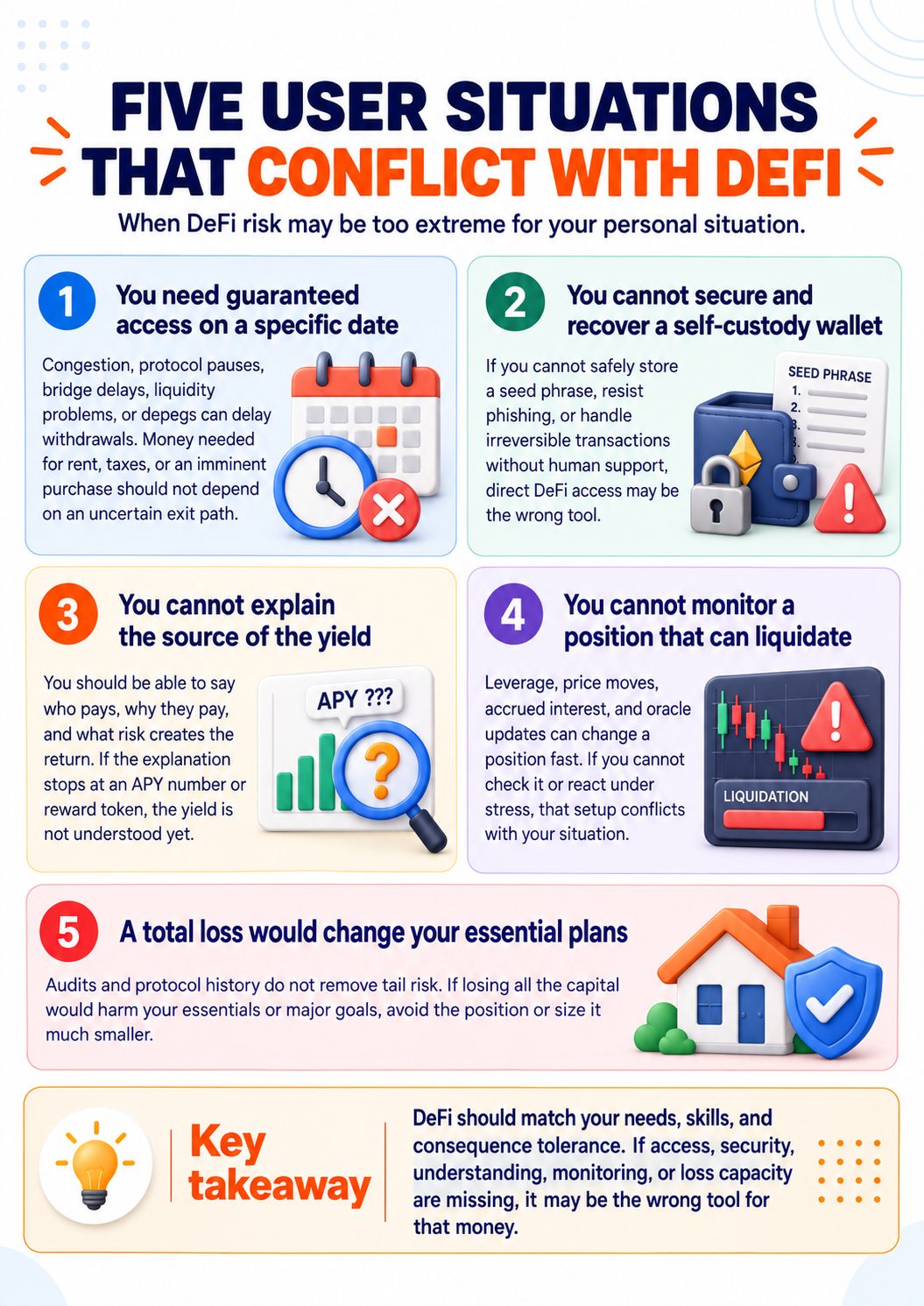
The following scenarios are five situations when you should not use DeFi because the DeFi risks are too extreme. In these scenarios you may not be able to retrieve your money from the protocol in time or other situations that make investing in DeFi and the potential DeFi risks too much for the particular situation.
You Need Guaranteed Access on a Specific Date
Network congestion, protocol pauses, withdrawal liquidity issues, bridge delays and asset depegs can all delay or prevent your ability to withdraw your money on a specific date or time that you need it by. Each of these situations creates an uncertain exit path and funds needed for rent, taxes or an imminent purchase cannot rely on an uncertain exit path. If you need guaranteed access to your tokens on a certain date, you should think twice before investing that money in DeFi.
You Cannot Secure and Recover a Self-Custody Wallet
It's important to keep your seed phrase stored safely offline so that it is protected somewhat from hacking. If you lose your seed phrase though, it may be difficult to recover your wallet. Phishing resistance, or security features that stop attackers from tricking DeFi users into sharing their seed phrases can be helpful, but they are not a complete solution to the problem of attackers and thieves.
If you lose your self-custody wallet, you may be out of luck and unable to recover what's inside of it. Also, once an irreversible signature is validated, it cannot be canceled or edited by a central authority. This means if you made a mistake or sent your crypto to the wrong address, the wallet company or other central authority will be unable to help you. If you require password resets or human support for recovery, direct protocol access may be the wrong tool.
You Cannot Explain the Source of the Yield
You need a plain-language account of who pays, why they pay and what risk creates the return. If the answer ends at an APY display or reward token, it is not understood yet where the yield comes from. You need to do your research to understand where the yield comes from, otherwise you could be taking a lot of unnecessary risk.
You Cannot Monitor a Position That Can Liquidate
Price movements, or how token values change, or accrued interest, the accumulated interest on a financial obligation that has not yet been paid impact liquidation. Oracle updates are the process of bringing real-world data onto a blockchain. Action time is the time between a wallet connecting and a first transaction completing. These each make it so you cannot always protect a leveraged position because they can change the health of your account. A leveraged or borrowed position conflicts with a user who cannot check it or act during stress.
A Total Loss Would Change Your Essential Plans
Audits, insurance claims and protocol history cannot remove tail risk. Position size should be evaluated by consequence, not confidence. If you cannot afford to lose your entire investment and still be ok, you shouldn't make the investment or at least you should make a much smaller one. It's sort of like if you can't afford to get hurt a little by falling off your bike when you are first learning, you should consider trying something else or at least using extra safety wheels so the bike doesn't tip over. The extra safely wheels in investing would be equivalent to making a much smaller investment with money you can afford to lose.
Opportunity Warning Signs That Should Stop the Process
Now we will move from whether the investment fits with you as a user, to situations involving the specific product. Each warning sign should lead to a question or pause before you decide to move forward with the investment.
The Yield Is High and the Source Is Opaque
Organic fees and borrower interest are real returns. Temporary token emissions, leveraged loops, and circular incentives are fake rewards that make yields appear higher. Be wary of things that inflate the price but don't give a clear source.
The Exit Depends on Several Bridges or Wrapped Assets
Trace the route back to the desired asset. A strategy that is easy to enter and hard to unwind has hidden operational and liquidity risk. If it seems to good to be true because it is really easy to enter the strategy, it most likely is, as it may be difficult to exit.
The Protocol Uses Urgency as Evidence
Limited multipliers are rules that restrict how much yield, voting power, or rewards you can get. These along with countdowns, points, and fear of missing out (FOMO) are sometimes used by fake or fraudulent protocols to try to get you to reduce your verification time and invest right away. Time pressure reduces verification and makes copied domains or malicious approvals more effective.
Control, Audits or Contract Addresses Are Unclear
Look for deployed addresses, upgrade rights, admin keys, audit scope and incident history. Deployed addresses are public identifiers assigned to smart contracts. Upgrade rights allow a protocol to be modified after launch. Admin keys are credentials embedded in smart contracts that allow developers and founders to do malicious things like pause operations and drain funds after launch. Audit scope is what security experts check during a review of a project. Incident history is a record of incidents faced by a protocol in the past. These are things like bugs, scams, and smart contract exploits.
If the protocol has missing evidence you should walk away and not invest. Missing evidence should not be replaced by community size or influencer confidence. Just because the project has a large community or your favorite influencer, crypto joe, is talking about it does not mean it is worth investing in. Do your own research.
When the Economics Do Not Justify the Complexity
It's important to calculate gas, swaps, bridge fees, spreads, slippage, taxes and time. It's possible in DeFi that the DeFi risks can outweigh the reward. In this case, the costs of participating outweigh the expected reward you will receive from participating. A high APY can still produce a worse net outcome if the costs of participation are too high.
When “Diversified” Positions Share the Same Failure Point
Here are tables showing how several vaults may depend on one stablecoin, oracle, bridge or lending market.
When a Simpler Tool Matches the Goal Better
Here's a comparison of holding and asset without yield, using a regulated service, using a custodial product, and staying in cash.
A Low-Risk Way to Keep Learning Without Taking the Position
Some good ways to keep learning without taking an actual position are to read transactions, use simulations or test environments, track a protocol with a watch-only address and calculate hypothetical outcomes. Learning does not require depositing a lot of capital. You can still learn without making any investment at all.
What Would Need to Change Before Reconsidering
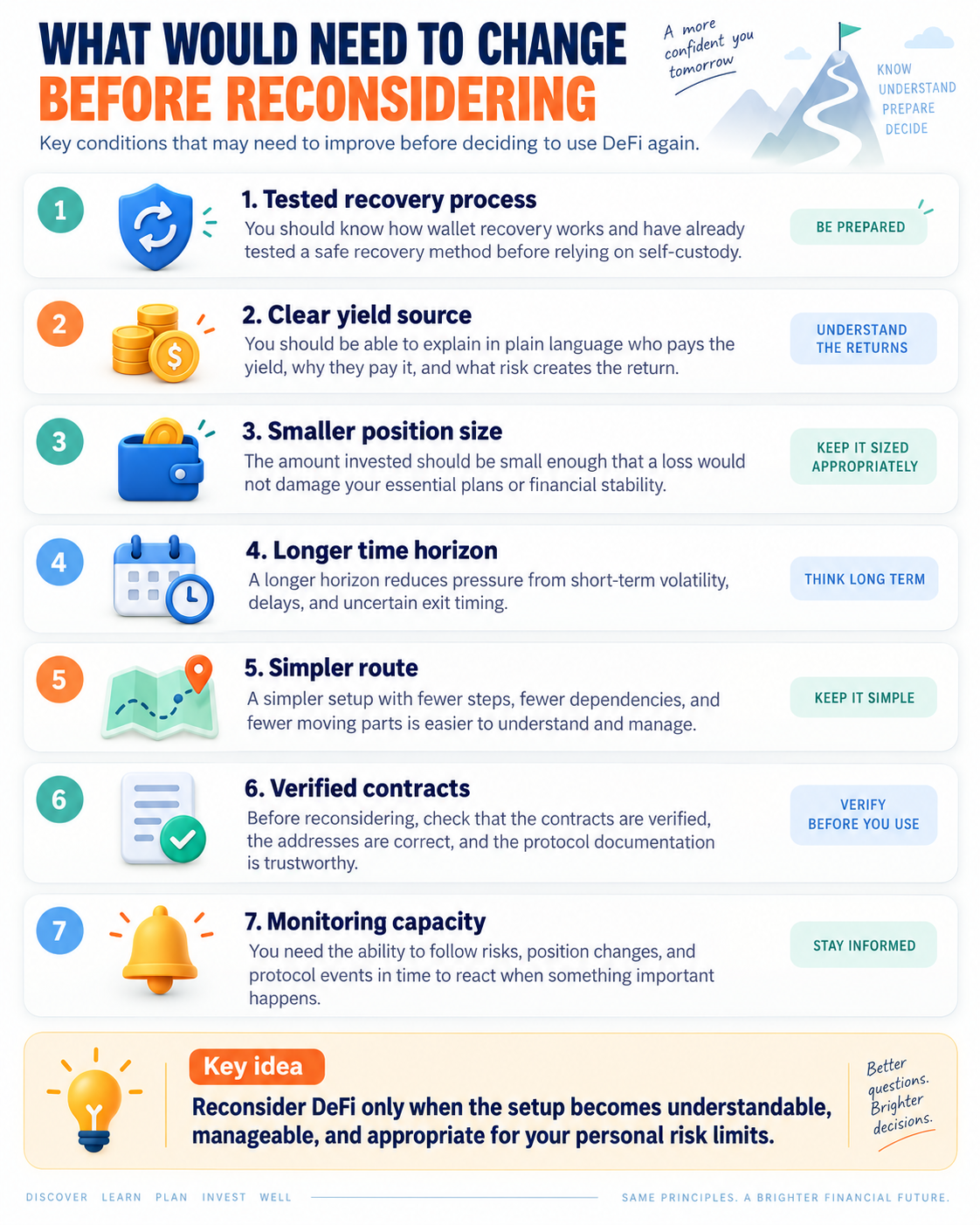
Here are some things that would need to change before considering using DeFi. This is not a definitive list, but rather some things to keep in mind when making the decision. A tested recovery process, a clear yield source, a smaller size investment, a longer horizon, a simpler route, verified contracts and monitoring capacity. By monitoring capacity I mean a system's ability to let users or protocols know about risks or changes in real time. Each of these items should be studied by any investor planning to make a DeFi investment.
Conclusion: Using or Not Using DeFi
DeFi is a bad fit when liquidity needs, recovery expectations, knowledge or monitoring do not match the position. Also, if you need the money soon or immediately, investing in DeFi at that moment is most likely not the right decision for you. The correct decision can be to wait or avoid the DeFi product entirely.
Disclaimer: The content provided in this article is for educational and informational purposes only and should not be considered financial or investment advice. Interacting with blockchain, crypto assets, and Web3 applications involves risks, including the potential loss of funds. Venga encourages readers to conduct thorough research and understand the risks before engaging with any crypto assets or blockchain technologies. For more details, please refer to our terms of service.