

Table of Contents
Airdrop farming is the process of performing eligible actions in the hope of a future token distribution. Crypto points are usually an unpriced, non-transferable claim with discretionary rules, so the correct question to ask is whether uncertain expected value covers all costs and risks. There are no guarantees with airdrop farming and earning crypto points so you have to determine if you think you will earn enough to make the costs of participating and the risks worth it. It's sort of like rock climbing.
There are no guarantees that you will reach the summit of the mountain, so you have to evaluate if the costs (like the gear you bought for your trip) and the risks (it's a bit dangerous at times) are worth it if you might not make it to the top of the mountain anyway. It's kind of like that at least. But at least there isn't the risk of physical injury with airdrop farming like there is with rock climbing. If you do reach the top, there's likely a sweet view just like if you get a lot of crypto points from airdrop farming. That can be an amazing feeling too just like looking at a great view at the top of a mountain!
Points, Airdrops and Campaigns Are Not the Same Thing
There is a difference between crypto points, airdrops, and campaigns in airdrop farming. Tracked points are digital credits given by protocols to users for completing specific actions and interacting with the protocol. Confirmed token allocations are verified amounts of a crypto projects future supply that certain wallets are guaranteed to receive. The difference is these are guarantees, not unverified points.
A retroactive airdrop is a token distribution that rewards users for past interactions with a protocol before the token existed or before an airdrop was announced. Quests are small games or tasks users can complete to earn points or qualify for token distributions. Referral campaigns are when users share invite links to potential new users and receive a percentage of the points or token allocations generated by the people they invited. As you can tell, each of these concepts are distinctly unique, sort of like how every person in the world is unique from each other.
Why Protocols Use Points Before a Token
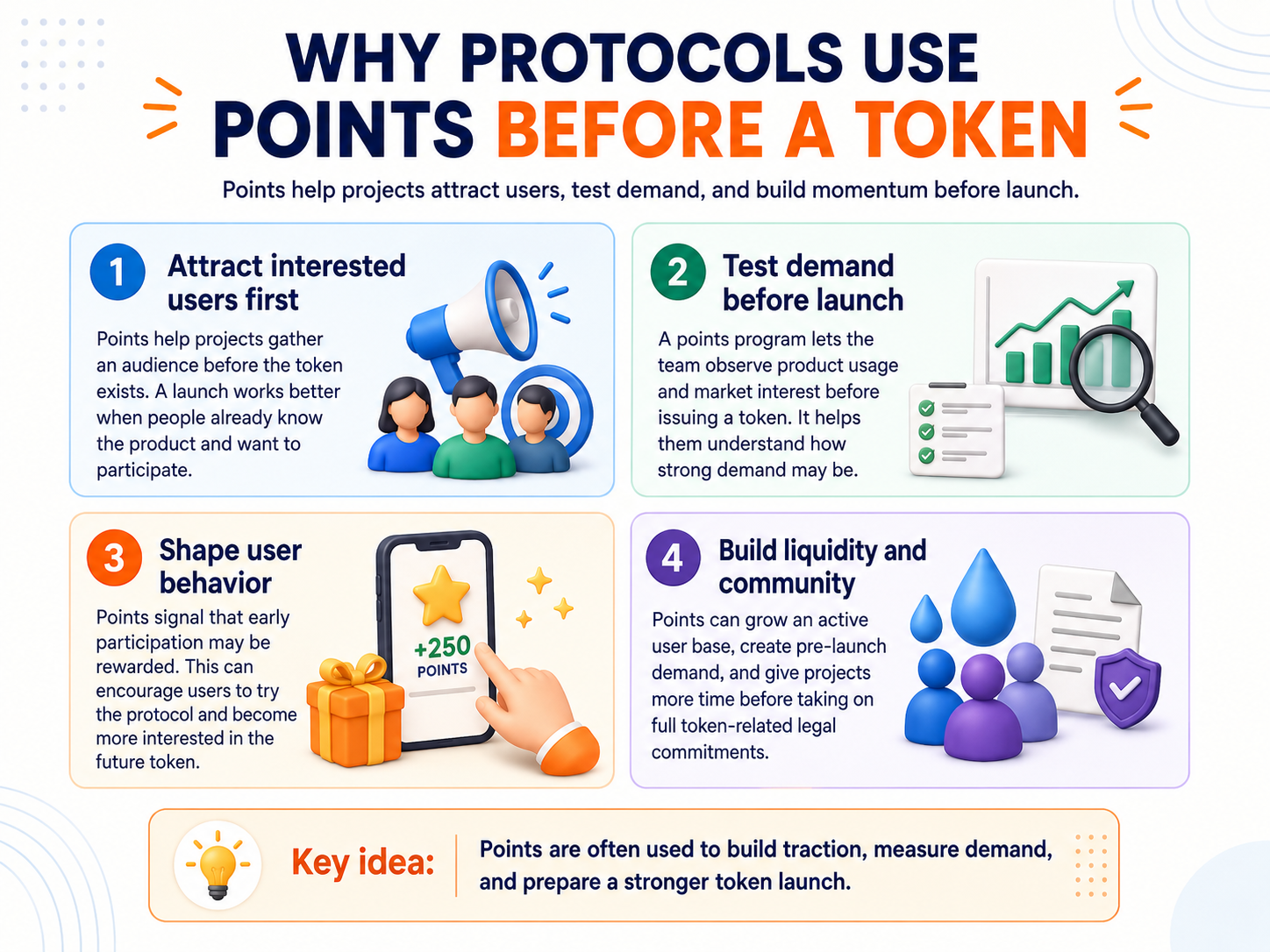
First of all, it allows them to acquire interested users before they even drop their token. Token launches aren't successful without interested users, and if people have never heard of the token when it drops for the first time, the launch will not generate any money for the project to use to continue to build. Second, using crypto points first allows them to test their project and its popularity before launching the token which can help the project team understand how much of a demand there is for the token and the project.
Next, using crypto points helps shape behavior by signaling to users that they can earn with the project before they even have a chance to buy the token. This encourages more people to want to buy the token when it is eventually available. Crypto points also help liquidity by building an active user base and creating demand before the token launch. It can also help delay legal commitments and give projects time to build communities of users first.
A Simple Expected-Value Model for an Airdrop
Think of airdrop farming and points farming and a points program this way: expected reward = probability of eligibility x estimated allocation x estimated token value. Then you need to subtract direct costs, opportunity cost and a risk allowance. By opportunity cost I mean the potential gain forfeited by choosing one investment over another. In airdrop farming, every one of these inputs is uncertain so you need to plan for that and understand the risks involved.
It's sort of like in racecar driving, there are many different risks. Your tires could pop, the engine could overheat or explode, you could crash the car when going super fast. But the outcome if you win is great. So you need to consider all of the risks and whether it is worth it to you considering the chance that you could actually win.
Probability of Eligibility
Probability of Eligibility is a crypto wallet's statistical likelihood of meeting a protocol's criteria to receive free tokens. There may be published criteria that you can view to see if you are eligible but not always. User behavior and where they are located can also contribute to whether the user is eligible. Also keep in mind snapshot timing. Once the snapshot block passes adding funds or interacting with the protocol no longer helps your airdrop allocation. Anti-Sybil rules also impact eligibility by blocking airdrop farmers who are trying to steal rewards, sometimes by acting as more than one person. Protocols can also use their own discretion to determine who is eligible to participate.
Allocation and Dilution
Crypto projects use total token pool, or the total amount or tokens set aside for rewarding early users. Protocols also consider the number of qualifying wallets when determining token allocation. Point weighting involves protocols assigning different importance levels to different user actions. This also is considered when determining how much you get allocated. Caps also "cap" or limit the amount of tokens a single wallet can receive from a crypto airdrop, which also impacts overall token allocation.
In airdrop farming, whales skew token distribution which often causes protocols to implement caps to avoid token dilution of rewards for smaller wallets. Referrals boost token allocation in airdrop farming for a particular farmer by increasing the total points or share of the pool earned. However they expand the total supply distributed, causing dilution as well.
Token Value and Liquidity at Distribution
Fully Diluted Valuation is the total value of a crypto project if every token that will exist were out in the market at a given moment. Circulating supply is the amount of tokens actually released and tradeable in the public market. Unlocks, or when you can actually use your tokens and actual market depth, or how much buy and sell liquidity exists at different price levels impact token value and liquidity at distribution. Each of these mentioned concepts impacts token value and contributes to the price of the token at distribution.
The Costs That a Points Dashboard Does Not Show
When airdrop farming, here are the costs that a points dashboard does not show, displayed in a table.
The Risk Stack Behind Airdrop Farming
Unfortunately there are a number of risks associated with airdrop farming. Here they are in detail.
Protocol and Smart Contract Risk
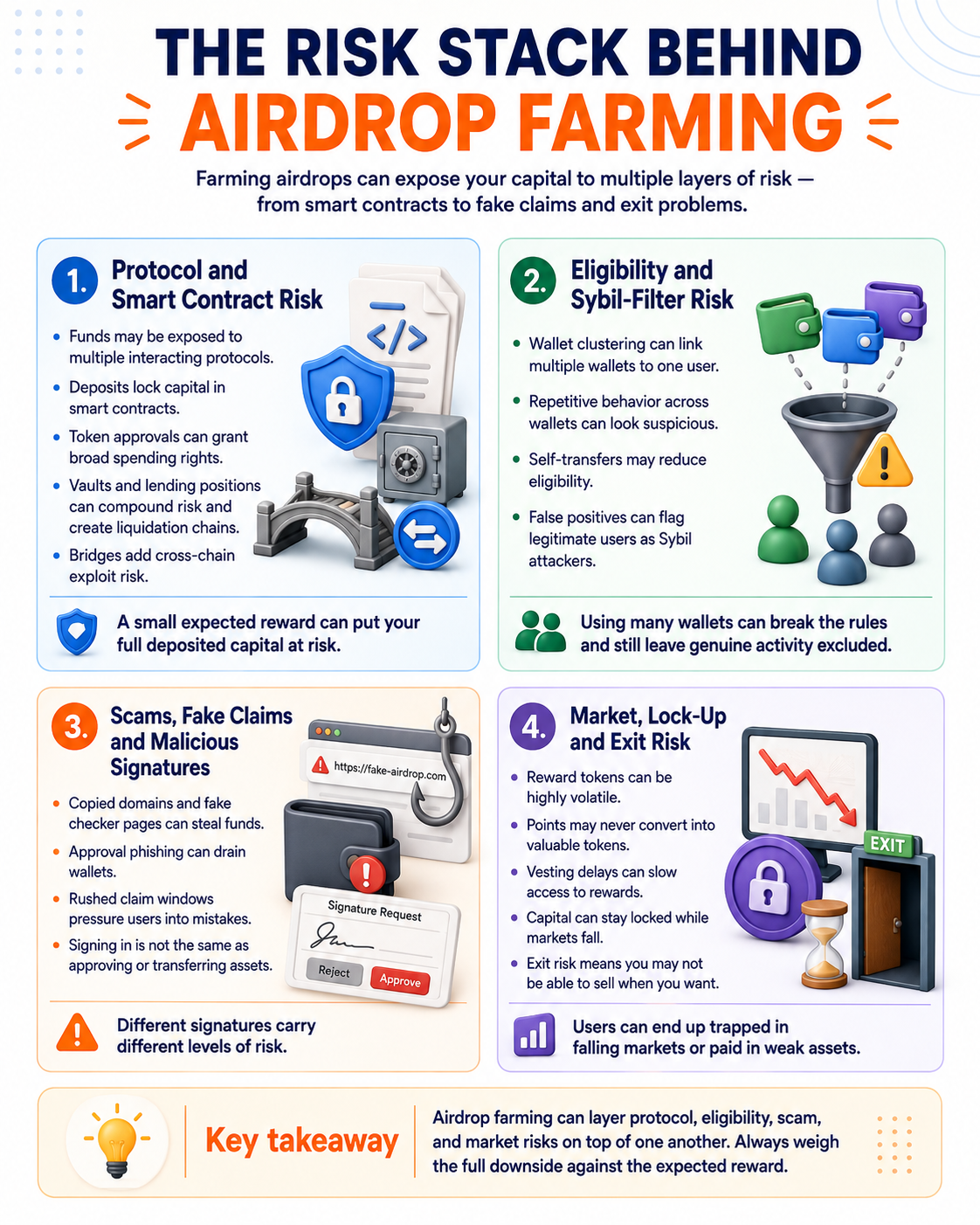
Airdrop farming increases smart contract risk by exposing funds to multiple interacting protocols. Airdrop farming increases smart contract risk by exposing funds to complex, interacting protocols. Deposits lock capital in contracts, token approvals grant unlimited spending rights, vaults compound risks across multiple layers, lending positions create liquidation chains, and bridges introduce cross-chain vulnerabilities to hacks or exploits. A small expected reward can expose the full deposited capital to a contract failure.
Eligibility and Sybil-Filter Risk
Wallet clustering is linking multiple crypto wallets to the same user, which can impact eligibility. Repetitive behavior involves identical on-chain actions across wallets, self-transfers move funds between a user's own addresses, and false positives incorrectly flag legitimate users as Sybil attackers, reducing eligibility and increasing ban risks. Creating many wallets may violate rules and can leave genuine activity excluded.
Scams, Fake Claims and Malicious Signatures
Copied domains, fake checker pages, approval phishing, and rushed claim windows are tactics used by cybercriminals to steal digital assets, drain crypto wallets, and gain access to user credentials. Signing a login message is a very different task from approving or transferring assets and they each have different levels of risk.
Market, Lock-Up and Exit Risk
Volatile reward tokens, delayed vesting, zero-conversion points, and locked capital are risky tactics projects use in airdrop farming. They trap user funds or pay out worthless assets while markets drop. They directly cause Market Risk (price crashes), Lock-Up Risk (trapped funds), and Exit Risk (inability to sell).
Signals That a Points Program Is More Measurable
Things like written terms, transparent scoring, capped seasons, clear snapshots, defined allocation, onchain tracking, credible product use and communication history reduce uncertainty but do not guarantee a valuable airdrop.
Three Campaign Models With Different Trade-Offs
Worked Example: High Points, Weak Expected Return
240,000 is the number the dashboard shows you every day. It sounds like real progress. What it actually converts to is unknown until the snapshot happens.
Wallet Separation and Approval Hygiene
Don't farm airdrops from the same wallet that holds your savings. Before you connect your wallet, make sure you are actually on the real website and interacting with the real contract rather than a copy. Set a specific limit instead of unlimited when making approvals. Never type your seed phrase anywhere. Legitimate airdrops and projects will never ask for it. Keep in mind that wallet separation limits the blast radius but cannot protect funds already deposited in an exploited protocol.
When a Campaign Is Not Worth Continuing
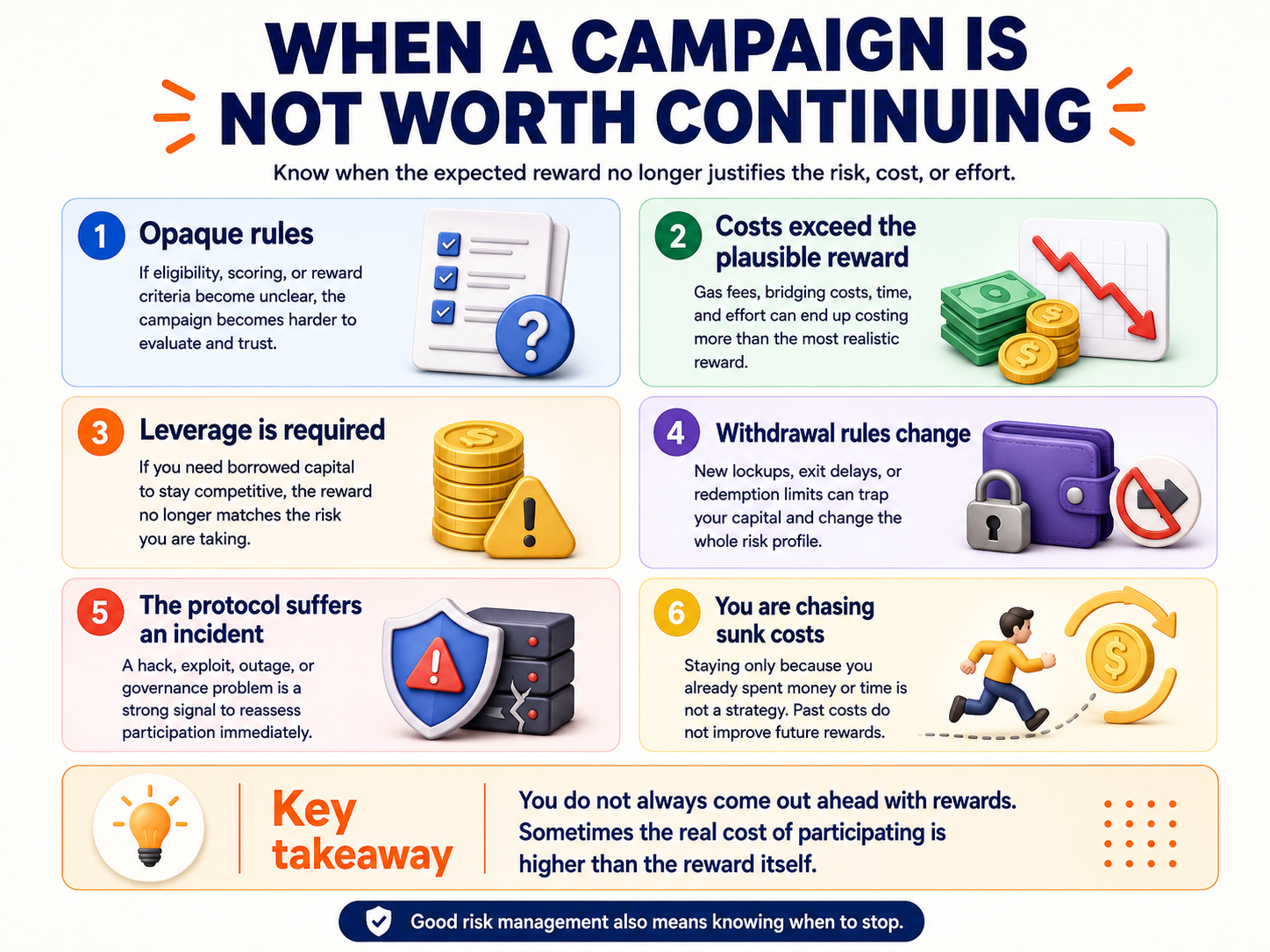
A campaign is not worth continuing when rules become opaque, costs exceed the maximum plausible reward, capital must be leveraged, there are withdrawal changes, the protocol suffers an incident or the user is only chasing sunk costs. You don't always come out ahead with rewards. Sometimes the costs or participating actually exceed the reward.
Airdrop Farming Comes With Risks
Airdrop farming is a speculative claim on a future distribution, not earned income. You aren't guaranteed to earn a specific amount. Evaluate probability, dilution, token liquidity, full costs and security exposure before treating points as value.
Disclaimer: The content provided in this article is for educational and informational purposes only and should not be considered financial or investment advice. Interacting with blockchain, crypto assets, and Web3 applications involves risks, including the potential loss of funds. Venga encourages readers to conduct thorough research and understand the risks before engaging with any crypto assets or blockchain technologies. For more details, please refer to our terms of service.