
Table of Contents
There is some confusion around staking and yield farming so let's correct it right now. Both can distribute crypto rewards, but staking supports blockchain consensus while yield farming supplies capital to DeFi protocols. Quoted APY alone cannot make them comparable.
Staking vs Yield Farming in One Minute
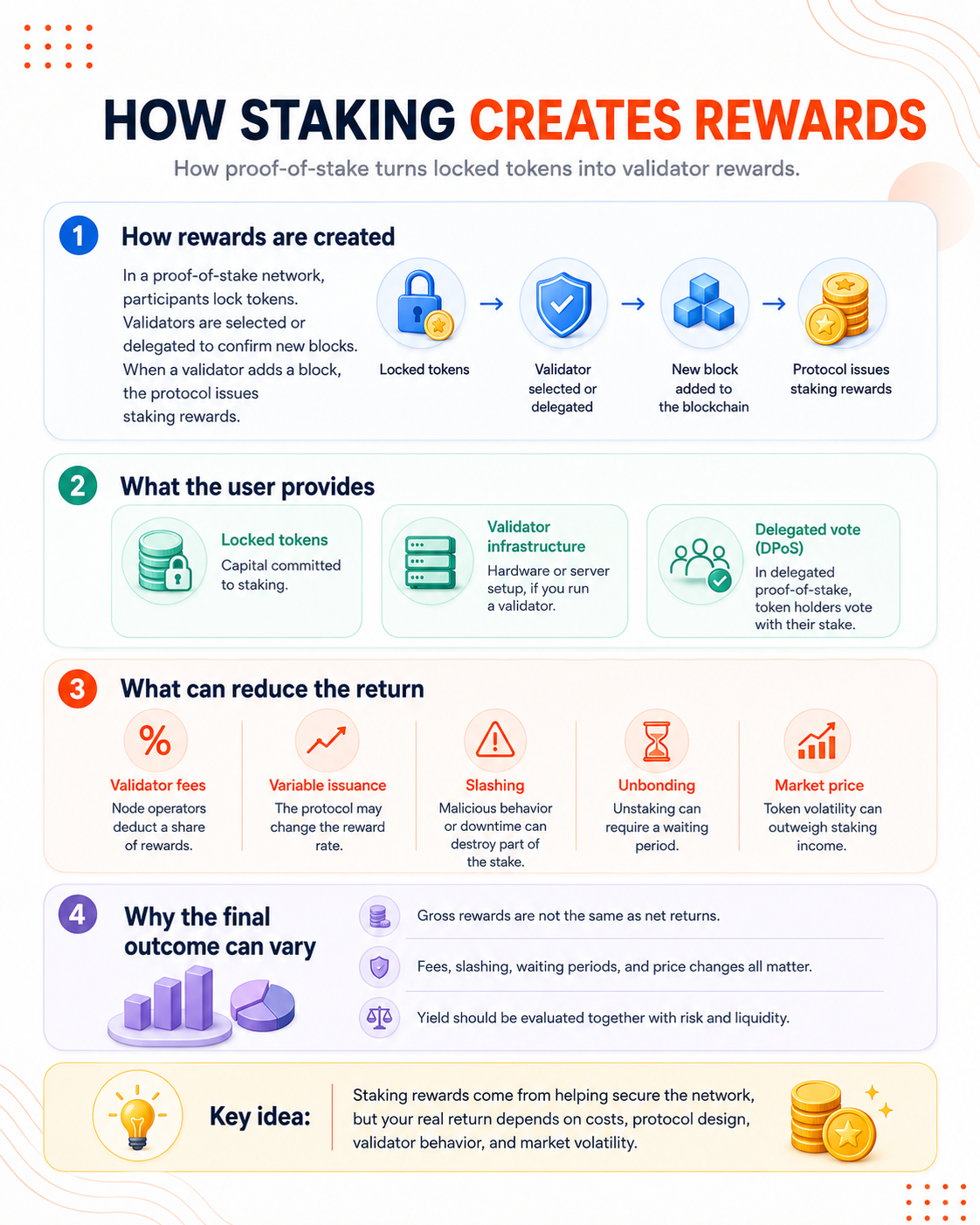
Staking is a key component of proof-of-stake (PoS) blockchain networks. In a proof-of-stake system, participants lock up a specific amount of native tokens in a smart contract to support network operations. The participants are known as validators. The protocol randomly selects or delegates validators to confirm new blocks based on the size of their staked position. When the validator adds the block to the chain, the network issues tokens or transaction fees as a reward.
Yield farming is a system used by DeFi protocols to maintain liquidity. Many decentralized exchanges work as automated market makers (AMMs) and AMMs rely on liquidity pools. To make sure the pools have enough assets for users to trade against, protocols incentivize participants to deposit tokens and the ones who do are called liquidity providers. Then they earn a portion of the trading fees generated by the platform as a reward. Protocols also often provide governance or utility tokens to these liquidity providers as further incentivization.
For staking, the primary risk is slashing. In this instance if a validator acts maliciously or there is extended downtime, the network protocol destroys a portion of the locked tokens. It's sort of like getting punishment for speaking in class without raising your hand. Then some of your privileges (in slashings case, tokens) are taken away. The primary risk of yield farming is impermanent loss which is when token prices shift relative to each other in a pool and part of the value is temporarily or in some cases permanently lost.
Staking is usually considered safer than yield farming but it also has risks (like the one mentioned above). Just like how riding a bike on the sidewalk is generally considered safer than driving a car, but it still has some risks and you can still fall off of your bike and cut your knee.
How Staking Creates Rewards
As mentioned, in a proof-of-stake blockchain consensus mechanism, participants lock their tokens in a smart contract and these participants are called validators. The protocol selects or delegates validators to confirm new blocks based on how much they have staked. When the validator adds a new block to the chain, the network issues tokens as staking rewards.
What the User Provides
In staking, a user provides locked cryptocurrency tokens. They also may provide validator infrastructure which is the virtual or physical hardware setup. Or they may provide their vote as a delegated stake in Delegated Proof-of-Stake which is a bit of a different system. In this system, instead of validating transactions, token holders use their coins as votes. A user may provide any of these depending on the method.
What Can Reduce the Return
There are a few things that can reduce the return in staking. First is validator fees which are deducted from the rewards by node operators. Next is variable issuance which is a design where the rate of tokens created to reward validators changes. Also, if a validator acts maliciously or there is extended downtime, the network protocol destroys a portion of the locked tokens, which as you now know is called slashing.
Then there is unbonding which is the waiting period required when you unstake your tokens. During this unbonding period the price of the cryptocurrency can change, potentially causing you to lose money if the price decreases a lot. Finally, there is the token's market price which can change drastically due to volatility in the market.
How Yield Farming Creates Rewards
We are here to compare yield farming vs. staking. Now it's time to cover yield farming. In yield farming, protocols incentivize participants to deposit tokens to make sure there are enough assets for users to trade against, and the ones who do are called liquidity providers. These liquidity providers earn a portion of the trading fees generated by the platform as a reward. They may get a form of borrower interest which is the fee paid by people who borrow from the DeFi pools. Then there are token incentives which can also be earned. These are extra rewards given to people who lock or lend their tokens.
Liquidity Pools and LP Positions
In Yield Farming, Automated Market Makers (AMMs) rely on liquidity pools, which are smart contracts containing paired assets, to facilitate decentralized trading. Paired assets are two different tokens that you deposit in equal value into a liquidity pool. However, when yield farming, you have to watch out for impermanent loss. Impermanent loss is when token prices shift relative to each other in a pool and part of the value is lost.
Lending and Incentive Programs
Some farming strategies involve lending a single asset, while others stack reward tokens or move funds between protocols. Yield farming is not always only a two-token pool. It can be a single asset or more than two stacked. Inventive programs allow users who lock up or lend their tokens to receive extra farming rewards.
Yield Farming vs Staking: Direct Comparison
Why the Headline APR or APY Can Be Misleading
The headline APR or APY you see on a farm or staking dashboard is really just a snapshot. Rates are variable, recalculated constantly as more capital pours in or out of a pool, so the number you screenshot today can be meaningfully different later.
Many quoted APYs also assume perfect compounding, reinvesting rewards continuously, which almost nobody does once gas costs and time are factored in, so the realized return is usually lower than advertised. Gas costs contribute to all of this too, especially on farms that need frequent claiming or rebalancing. The most important gap is between token yield and fiat-value return: a pool can pay out a genuinely high percentage in its native token while your actual dollar balance decreases.
The Risks Are Different - and Some Are Shared
There are different risks for staking and yield farming as well as some risks that they both share. Here are many of the risks involved with staking and yield farming
Risks More Specific to Staking
One risk associated with staking is slashing. Malicious actions or poor operations by validators can also negatively impact your funds. Lock-up can also be a risk because while your tokens are locked you can't remove them, even if there is a market downturn while they are locked. Network-specific governance can also create risks if there are rules or regulations in place that negatively impact your ability to remove your funds. The security and value of your tokens can be impacted negatively by governance.
Risks More Specific to Yield Farming
Impermanent loss can be a big risk in yield farming. Smart contract exploits, like a hacker finding a but in the code, can cause that hacker to be able to completely drain liquidity pools of tokens. Oracle attacks involve manipulating the data feeds (oracles) that DeFi platforms rely on for price information.
Rug pulls, or hyping a project to get investments from people and then the project leaders draining the funds or selling all of their own shares in the project at once can be a risk as well. This causes the project to fail. Also, with high reward rates, a drop in token price can cause holders of rewards to sell their tokens immediately which can ruin liquidity and pools. Finally, when protocols are linked and something fails in one of them, it can impact all of the other linked protocols creating a cascading effect.
Risks Shared by Both
When tokens fluctuate in price it can cause risks in both staking and yield farming. You also may have to give up control of your crypto assets when you use third-party platforms. Also, a single-point of failure can lead to significant losses. When regulations change, you can also be at risk if the new regulations make it more difficult to earn in crypto or where to shut down a platform you use. Finally, sometimes the rewards you earn from staking or yield farming are not enough to cover your losses, meaning you ultimately lost money.
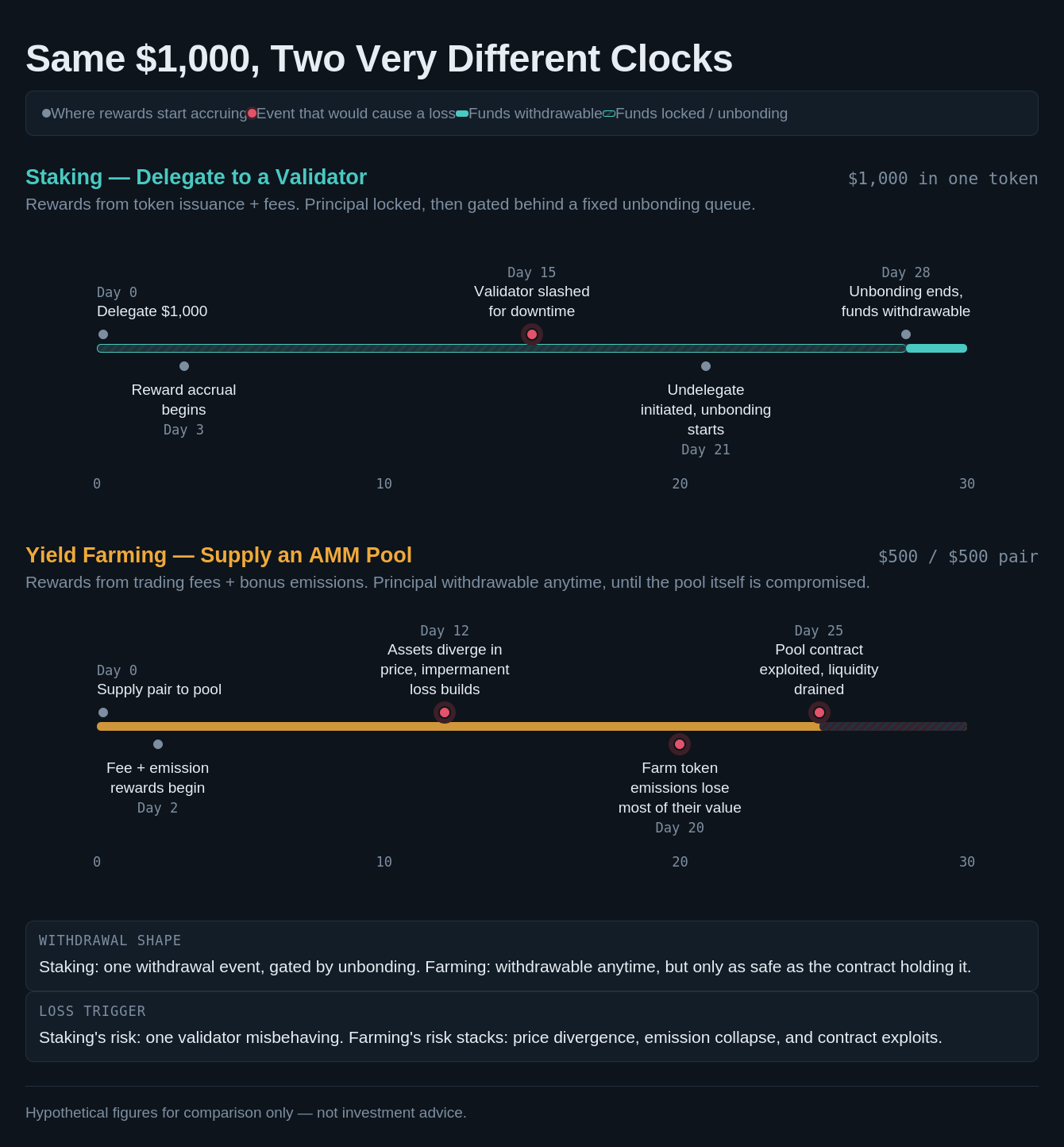
Two Equal Deposits, Two Different Jobs
Here's a hypothetical scenario using the same starting value to help you see the differences between staking and yield farming.
Which Variables Matter More Than the Label?
A long-term holder of a PoS asset may run in to issues with yield farming because their PoS asset is more geared toward staking. A user comfortable monitoring DeFi positions may be adaptable to both staking and yield farming. A user who needs predictable access to their funds may run into issues with staking because their tokens will be staked for much of the time.
Why Neither Method Is a Savings Account
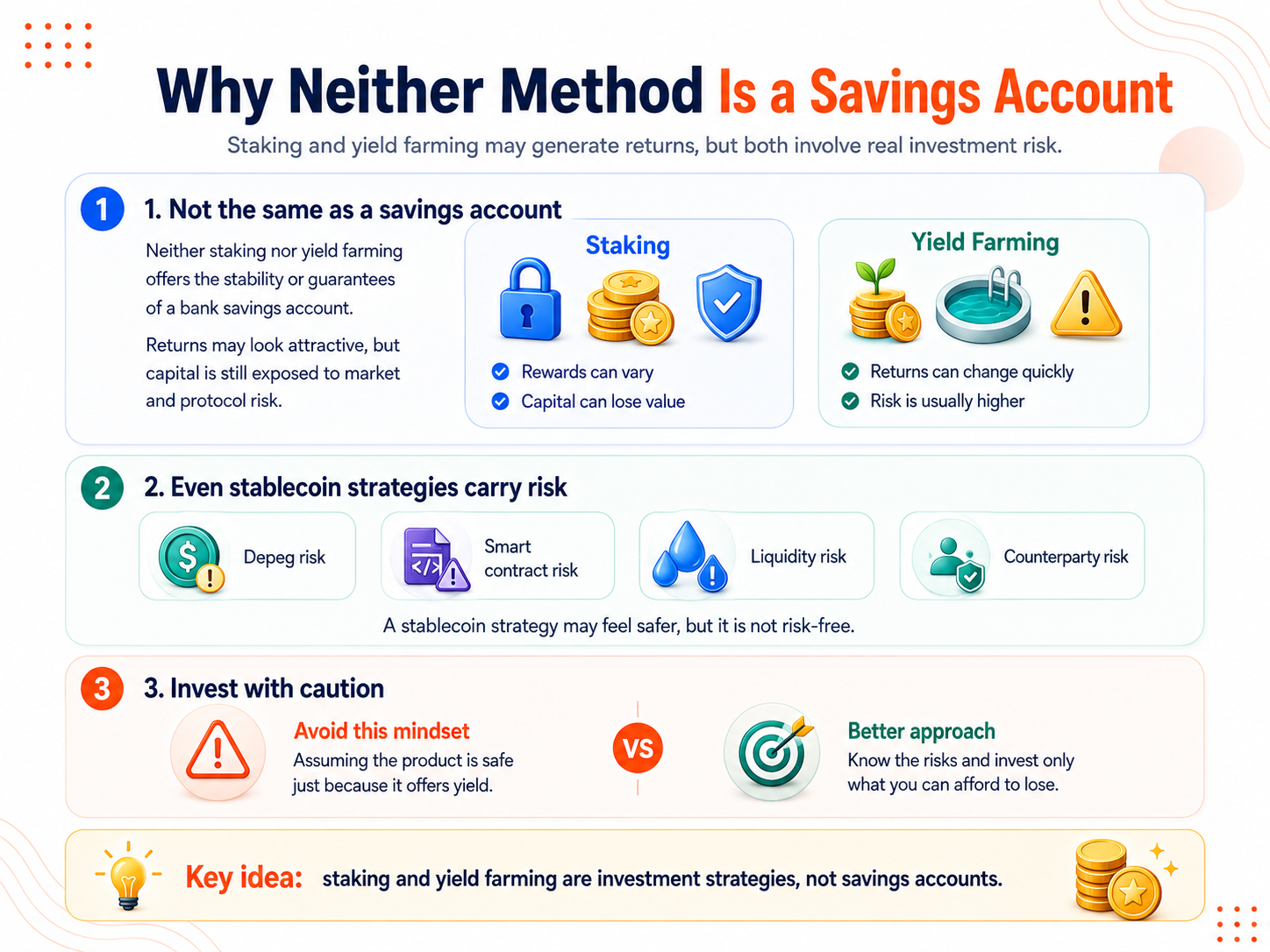
Neither of these methods, staking or yield farming, should be considered as a savings account. Even a stablecoin strategy can include depeg, contract, liquidity and counterparty risk. Be aware of the risks before you invest. Don't be that guy who loses all of his money in a risky investment. Be the other guy who knows the risks and only invests what he can afford to lose.
Conclusion
The real difference between staking and yield farming is that staking is paid for supporting network security; yield farming is paid for supplying useful capital or liquidity. It's important to think about the risk and the potential net return rather than just the advertised APY when staking or yield farming.
Disclaimer: The content provided in this article is for educational and informational purposes only and should not be considered financial or investment advice. Interacting with blockchain, crypto assets, and Web3 applications involves risks, including the potential loss of funds. Venga encourages readers to conduct thorough research and understand the risks before engaging with any crypto assets or blockchain technologies. For more details, please refer to our terms of service.