

Table of Contents
Loss means you had something and sometime later, for some reason, you do not have it anymore. Impermanent loss, therefore, means you have less than you could have had, but the situation can still fix itself before it becomes final.
In Defi, Impermanent loss is the difference between the value of your assets in a liquidity pool versus what the value of those exact same tokens would be worth if you had just held them in your wallet.
In simple words the permanent loss is the comparison of two parts:
- Point A - Depositing your crypto into a Decentralized Exchange (DEX) to earn trading fees.
- Point B - Doing nothing and letting your crypto sit untouched in cold storage.
When the market value of your tokens inside a liquidity pool moves away from the price ratio they had when you deposited them, Point B often outperforms Path A. The gap between those two outcomes is your impermanent loss.
Before going deeper, there is a myth that impermanent loss means that the portfolio is down in absolute terms. Impermanent loss does not mean your overall portfolio is losing money. In reality your portfolio can grow in total monetary value while still experiencing impermanent loss.
How Do You Measure Impermanent Loss?
To measure impermanent loss accurately, you need to set up a proper holding baseline. This baseline asks a simple question: What would my portfolio be worth right now if I had done nothing and just held my original crypto in my wallet?
You should never only consider either the Deposit Value nor only the Withdrawal Value. You would be missing the point if you are only asking: "I deposited €1,000 worth of crypto, and now my liquidity pool position is worth €1,200. Did I win?"
Comparing your starting deposit dollar value to your current withdrawal dollar value answers a completely different question. It only tells you whether your total portfolio value went up or down in fiat terms over time. It tells you if you made money, but it doesn't tell you if providing liquidity was the right move.
If your pool position grew from €1,000 to €1,200, you made €200. But if simply leaving your original tokens in your wallet would have yielded €1,400 over the same period, you experienced a €200 impermanent loss. You made a profit overall, but IL providing liquidity was less profitable than holding.
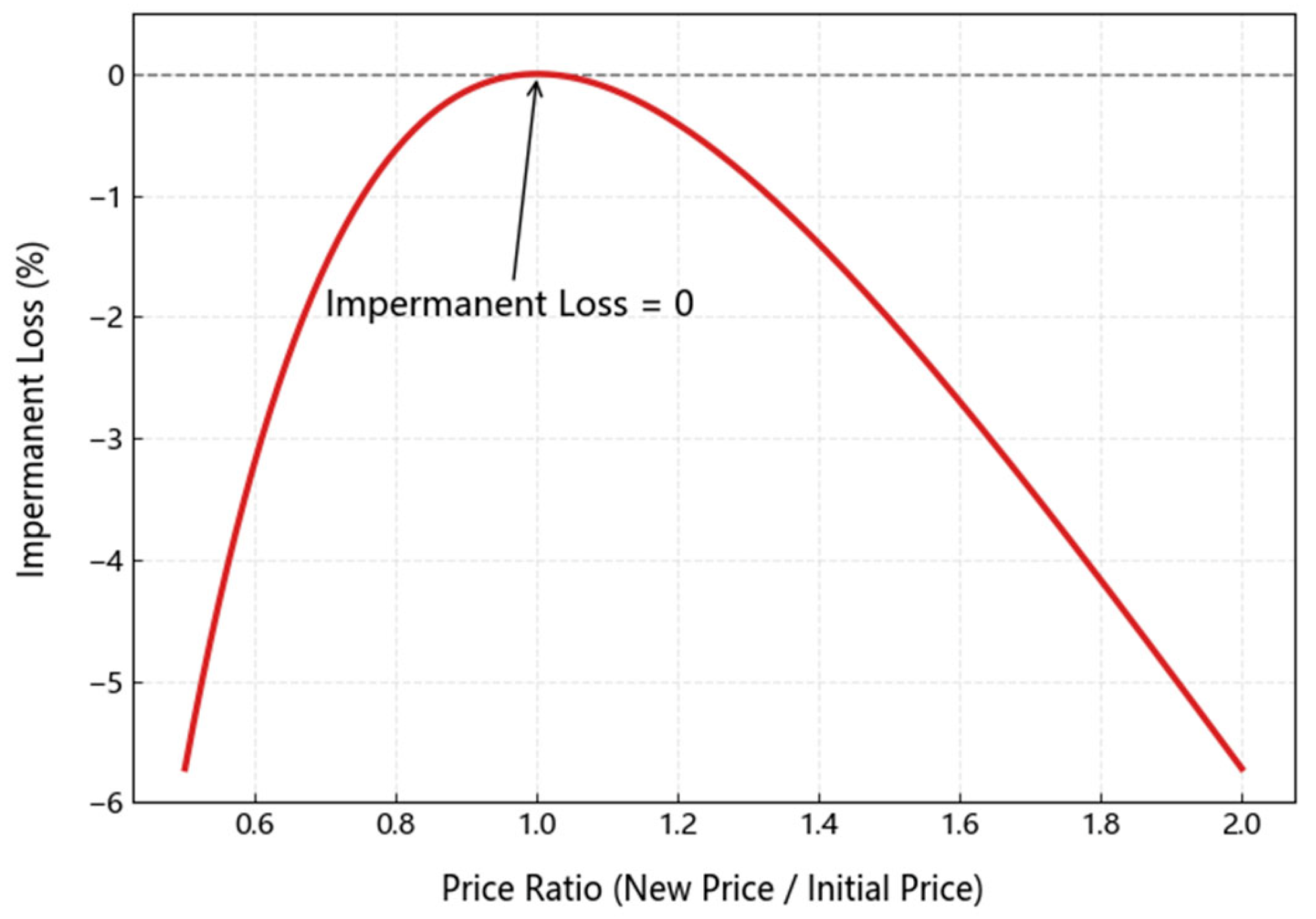
The theory Model of IL. Source: BART-IL: Behavior-Aware Impermanent Loss Optimization for Liquidity Pool-Based Data Trading
Why and How does Impermanent Loss Happens
To understand why the impermanent loss happens, we need to start by knowing what the AMM is and how it works.
An Automated Market Maker (AMM) is a smart contract that lets people trade crypto directly from a liquidity pool instead of matching with another buyer or seller.
When you take the bold decision of providing liquidity, you deposit two assets into a pool, for example, BTC and EURC. The AMM uses the ratio of those two assets in the pool to determine their relative price.
The AMM can be seen in real life as a shop keeper that you have trained to manage your shop with accurate prices anytime and you don't need to be there.
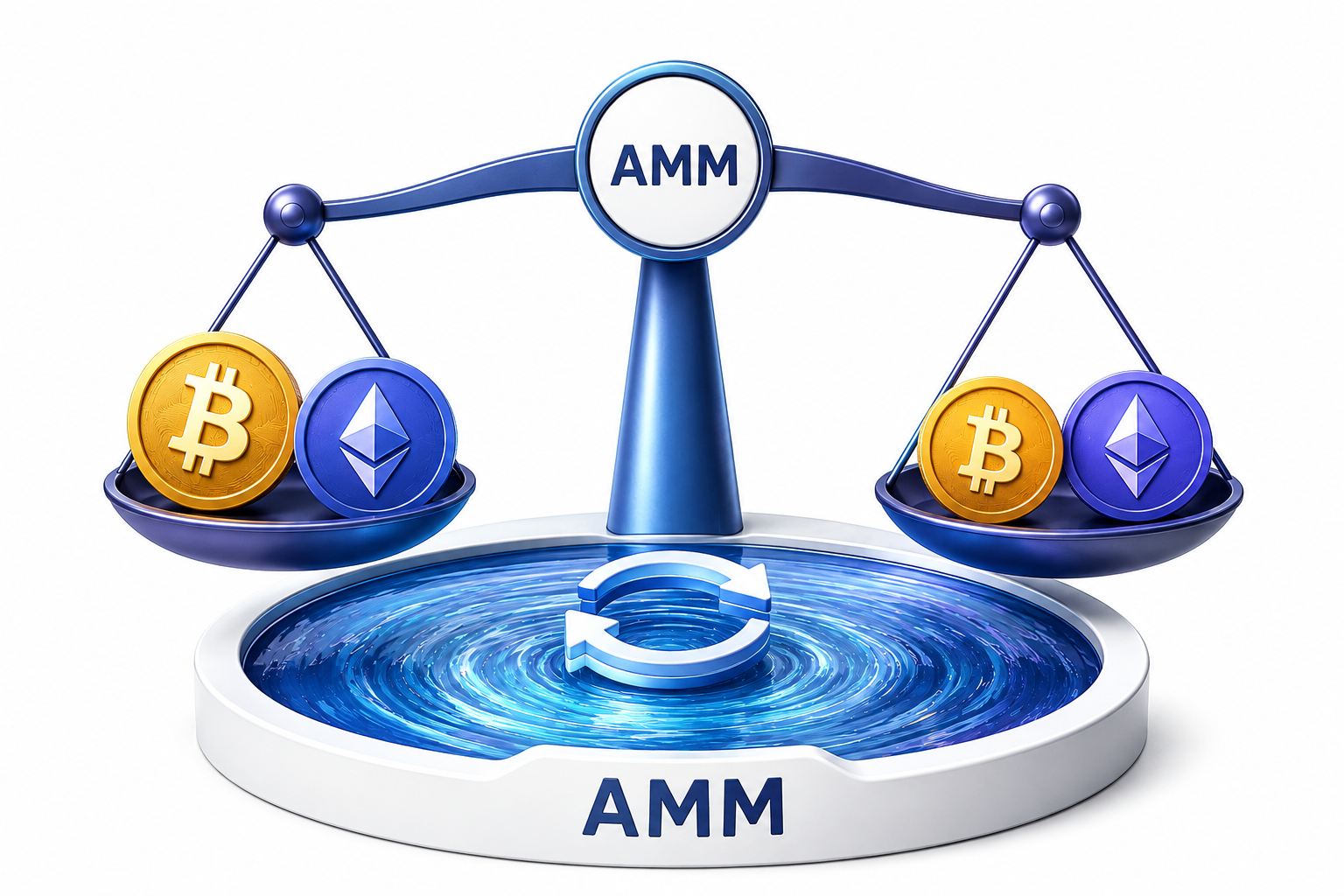
Price Divergence Inside and Outside the Pool
Let us look at this from a real world view. Imagine you provide liquidity to a BTC/EURC pool, where the pool reflects roughly €2,000 per ETH.
And presently, BTC is trading at €2,000 on the wider market.
If the BTC suddenly pumps up to €2,500 on exchanges.
The wider market has already moved, but your pool doesn't magically update its price because someone on another exchange decided BTC is worth more. The pool's reserves still reflect the old ratio when you deposited into the liquidity pool.
So now there is a price gap between the pool and the external market.
And whenever there's a price gap in crypto, someone is usually waiting to collect it.
So what happens next? Here comes the arbitrage traders.
Arbitrage Rebalances the Pool
Arbitrage traders are traders who look for price differences between markets and buy an asset where it’s cheaper, then sell it where it’s more expensive, then pocket the difference.
When BTC becomes more expensive on the open market than inside your pool, arbitrageurs step in immediately:
- They buy the underpriced BTC directly from your liquidity pool with EURC.
- They sell that BTC on external exchanges at the higher market rate to make a profit.
They repeat this process very fast, removing BTC from the pool and depositing EURC into it. As ETH becomes scarce in the pool, this causes internal price rises until it perfectly aligns with the external market.
At this point, the arbitrageurs successfully rebalance the pool's prices, look at what happens to your underlying liquidity position:
the pool traded away your appreciating asset (BTC) in exchange for more of the flat asset (EURC).
As a liquidity provider, you end up holding less of the outperforming token (the one that surged in value) and more of the underperforming token (the one that lagged behind). Had you held your original tokens untouched in a private wallet, you would have kept 100% of the outperforming asset.
The Formula Without Hiding the Assumptions
At this point let us cut down the literature and look at formulas. This will interest you if you are Maths savvy.
For a standard 50/50 constant -product pool, the calculation looks like this:
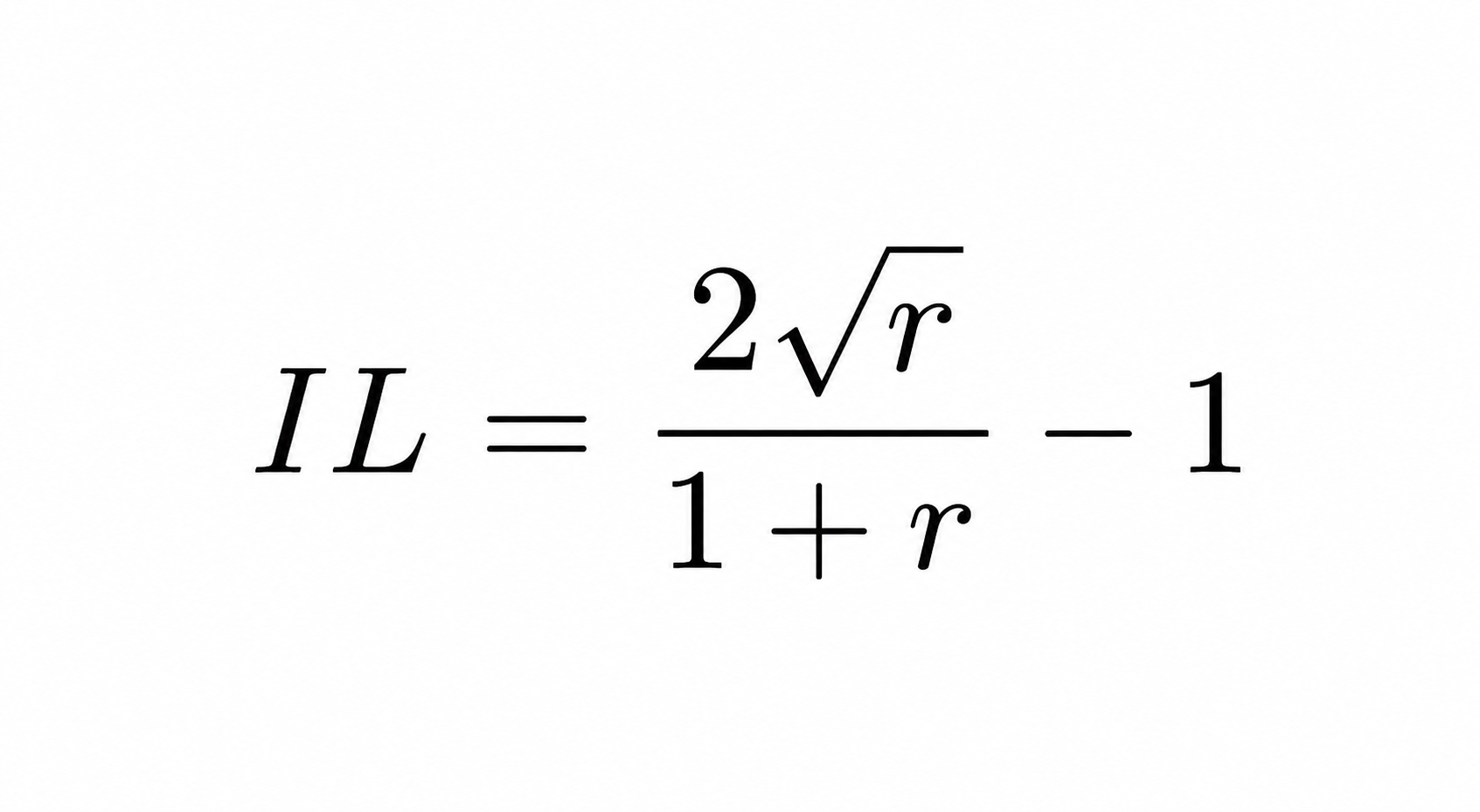
Where:
r is the new price ratio divided by the initial price ratio.
In plain English r tells us how much the relative price between the two assets has changed since you entered the pool.
Note: The formula does not cover every pool design or concentrated-liquidity position, It only assumes a standard 50/50 constant-product and it doesn’t fully capture the mechanics of concentrated-liquidity positions such as those used in Uniswap v3.
Price-Change Table
For a standard 50/50 constant-product pool, the larger the price moves away from its starting ratio, the larger the impermanent loss. Basically, the direction doesn't matter but how far the price moves matters.
A price increase of 2x and a price decrease to 1/2x produce the same impermanent loss. The same applies to inverse ratios: 3× and 1/3×, 4× and 1/4×, 5× and 1/5×, etc.
These percentages represent IL relative to simply holding the two assets, before considering any trading fees or other rewards earned by the LP.
Impermanent Loss Example: ETH Doubles Against USDC
Seeing an example will give us a better view of Impermanent Loss. Imagine you provide liquidity when:
- 1 ETH = 3,000 USDC
- You deposit 1 ETH and 3,000 USDC
- Total starting value = 6,000 USDC
Sometime later, ETH grows x2, to 6,000 USDC
What happens if you simply hold?
If you had done nothing and simply kept your original assets:
- 1 ETH is now worth 6,000 USDC
- You still have 3,000 USDC
So your total would be:
6,000 + 3,000 = 9,000 USDC
What happens inside the LP?
Remember how the Automated Market Maker (AMM) automatically rebalances the pool when prices move? It relies on the standard constant-product formula: x⋅y=k
Where x is the amount of ETH, y is the amount of USDC, and k is a fixed number that must stay constant before and after trades.
When ETH doubles, arbitrage traders buy the now-cheaper ETH from the pool until the pool's price catches up with the outside market.
To satisfy the x⋅y=k equation at the new $6,000 price ratio, the pool rebalances your share so that its cash value is split exactly 50/50 between both assets.
As a result, you end up with less ETH and more USDC:
- 0.7071 ETH (worth 0.7071×6,000=4,242.60 USDC)
- 4,242.64 USDC
Your total liquidity pool withdrawal value would be:
4,242.60 USDC + 4,242.64 USDC = 8,485.24 USDC
Now, let's place both choices side by side:
You would be wondering what this now means, this means two things:
- You still made a solid overall profit: Your initial 6,000 USDC investment grew to 8,485.24 USDC, a gain of +2,485.24 USDC (+41.4%).
- You experienced impermanent loss anyway: Because the x⋅y=k mechanics automatically sold off a portion of your ETH while it was surging, you ended up 514.76 USDC (5.72%) behind the simple "buy and hold" strategy.
This 5.72% gap represents your pure impermanent loss before factoring in any trading fees or rewards you collected along the way.
Three Scenarios That Change the Meaning of the Result
To evaluate whether providing liquidity actually makes financial sense, you need to look at how impermanent loss behaves under different market conditions.
Here are three distinct scenarios that show what impermanent loss will look like for you:
The Price Falls Instead of Rising (Loss on Loss)
Most people hear impermanent loss and think, “Oh, that’s what happens when crypto moons and I don't get all the gains.”
Not quite, Impermanent loss doesn't care whether the price goes up or down. It cares about one thing: how much the two assets move apart in price.
Imagine you deposit 1 BTC (worth €50,000) and 50,000 EURC into a pool, starting with a total value of €100,000
Everything looks perfectly balanced. BTC on one side, EURC on the other. Everyone's happy.
Sometime later, market panic hits and Bitcoin drops by 50% to €25,000:
- If you had held in your wallet: You would have 1 BTC (€25,000) + 50,000 EURC = €75,000.
- Inside the liquidity pool: As traders dump falling BTC into the pool to extract stable EURC, the AMM rebalances your share to 1.414 BTC and 35,355 EURC.
- Your LP withdrawal value: (1.414×€25,000) + €35,355 = €70,705.
Net Difference = €70,705 − €75,000 = −€4,295 (-5.72%)
This means that, in a falling market, you suffer a double blow.
- Absolute Capital Loss: Your portfolio value dropped from €100,000 to €70,705 because the underlying market fell.
- Relative Underperformance (IL): The pool forces you to accumulate more of the collapsing asset (BTC) while selling off your stable asset (EURC). You ended up €4,295 worse off than if you had simply held your original tokens.
A Stablecoin Loses Its Peg
Many investors enter stablecoin pairs (like USDC/EURC or USDT/USD) believing both coins are supposed to stay at €1.00 or $1.00. What could possibly go wrong?
Well, hold your horses. If one stablecoin suffers a structural breakdown and loses its peg, the AMM's automatic rebalancing works directly against you.
Imagine you provide liquidity with:
- 100,000 Token-X, worth €1 each
- 100,000 EURC, worth €1 each
- Total deposit: €200,000
Everything looks beautifully balanced.
Then Token-X has a crisis.
Instead of staying at €1, its price collapses toward €0.10.
That's a 90% drop and now the AMM starts doing what it was designed to do: rebalance the pool.
As Token-X becomes cheaper, traders buy it from the pool and put EURC into the pool in exchange. Your position gradually shifts toward more Token-X and less EURC.
Sounds harmless? Not quite. You're effectively accumulating more of the asset that's falling apart while giving up some of the asset that's still holding its value.
So instead of simply holding your original tokens, your LP position can end up significantly worse off.
It doesn't matter if the asset has the word “stable” in its name. What matters is does the two assets actually remain stable relative to each other?
Trading Fees Exceed Impermanent Loss (Net Profitability)
Impermanent loss gets the spotlight, people leave out the fact that LPs don't provide liquidity for free, they earn a percentage of every swap executed in the pool.
Every time someone swaps tokens through the pool, liquidity providers earn a share of the trading fees. And sometimes, those fees can be large enough to more than make up for the impermanent loss.
Let's say you're providing liquidity to a high-volume trading pair, Over three months, the price moves 50%
The volatile asset increases by 1.5×. That creates approximately −2.0% impermanent loss compared with simply holding the assets.
At this point the pool is extremely busy. Lots of traders are swapping, which means lots of fees are being collected. Your share of those fees adds up to +3.5%.
The simple maths will then be:
Net return = Trading fees − Impermanent loss
3.5% − 2.0% = +1.5%
So despite experiencing impermanent loss, you're actually 1.5% better off than if you had simply held the assets.
And that's the important point: Impermanent loss doesn't automatically mean you're losing money.
Why the Word “Impermanent” Is Misleading
The name makes it sound harmless. “Impermanent” is like a temporary scratch that will heal on its own. It won't.
Unfortunately, crypto doesn't make that promise.
Impermanent loss is really an opportunity cost, and it only disappears under one specific condition.
It only reverses if prices return to start
The loss disappears only if the price ratio between your two tokens returns to where it was when you deposited them. There is no guarantee or market rule forcing a price to go back. If a token trends up or down permanently, your loss becomes permanent, too.
Withdrawing locks in the currency difference
As long as your tokens sit in the pool, the loss is unconfirmed. The second you click Withdraw, that gap turns into a realized loss locking in fewer winning tokens and more losing ones.
Waiting Is Not Free
Leaving your crypto in the pool to "wait out" a price recovery exposes you to extra dangers: The price gap could widen further, making the loss larger or The longer your funds sit in a pool, the longer they face potential hacks, exploits, or depeg risks.
Don't let the name fool you. Impermanent loss becomes very permanent the moment you exit or if the market never looks back.
When Impermanent Loss Matters Most
Impermanent loss isn't equally painful in every pool. Sometimes it's a serious threat to your returns, other times, it's barely worth a raised eyebrow.
Impermanent loss becomes a serious threat to your returns when specific high-risk conditions align:
- Volatile, Uncorrelated Pairs: Pooling two assets that move independently (like a volatile altcoin paired against a stablecoin) creates massive price divergence.
- Large Price Divergence: As price ratios stretch (3x, 5x, or more), impermanent loss scales up rapidly, eating deeper into your capital.
- Low Volume Relative to TVL: If a pool holds millions in Total Value Locked (TVL) but sees very little daily swap volume, fee earnings won't be enough to offset price divergence.
- Short-Lived Incentives: High reward emissions offered by new farms often dry up quickly, leaving you exposed to severe price drops once the farm hype fades.
- Narrow Concentrated-Liquidity Ranges: Bounding capital inside tight price ranges boosts fee yield, but drastically amplifies impermanent loss if the market breaks out of your boundaries.
The High APR Trap
You may see 500% APR and think: “Well, that's obviously better than 5%.” Not necessarily.
In DeFi, sky-high APRs usually signal extreme risk, not free money. Platforms offer huge yields precisely to compensate LPs for taking on extreme volatility or illiquid tokens. If the underlying asset crashes 50%, even a massive APR won't cover your net losses.
When Impermanent Loss Matters Less
On the other side, The risk tends to be lower when:
- The assets are highly correlated: If two tokens tend to move together, their price ratio doesn't change much. Examples include USDC/EURC or certain wrapped versions such as wBTC/BTC. Less divergence generally means less IL.
- The pool generates strong fee income: If lots of traders are swapping through a pool, LPs can collect substantial fees. Those fees can offset some or potentially more than the impermanent loss.
- Liquidity is actively managed: Experienced LPs don't necessarily deposit their assets and forget about them. They may adjust concentrated-liquidity ranges, rebalance positions, or hedge their exposure as market conditions change.
Impermanent Loss would basically mean you accept the risk of price divergence in exchange for earning fees and potentially other rewards.
Concentrated Liquidity Changes the Calculation
Traditional AMMs spread your liquidity across a huge price curve. But modern DEXs let you say, “I only want my capital working within this price range.” That’s concentrated liquidity.
Modern decentralized exchanges allow liquidity providers to deposit capital within a specific price range rather than across the entire price curve from zero to infinity. This design changes how both yield and risk operate.
Bounding your capital into a narrower price range means your funds are utilized much more heavily when trades occur within that window, earning significantly more trading fees per unit of capital than a standard full-range position.
However, because your capital is concentrated across a smaller price span, price movements trigger much faster rebalancing inside the pool. This accelerates inventory shifts and amplifies impermanent loss when the market moves against you.
It is also good to note that If the market price crosses outside your selected range, your capital is converted entirely into the underperforming asset, and your position stops earning trading fees completely until the price returns to your range.
How to Estimate Net LP Return
Calculating actual LP performance requires comparing your total end position against what you would have had by holding, including all operational friction.
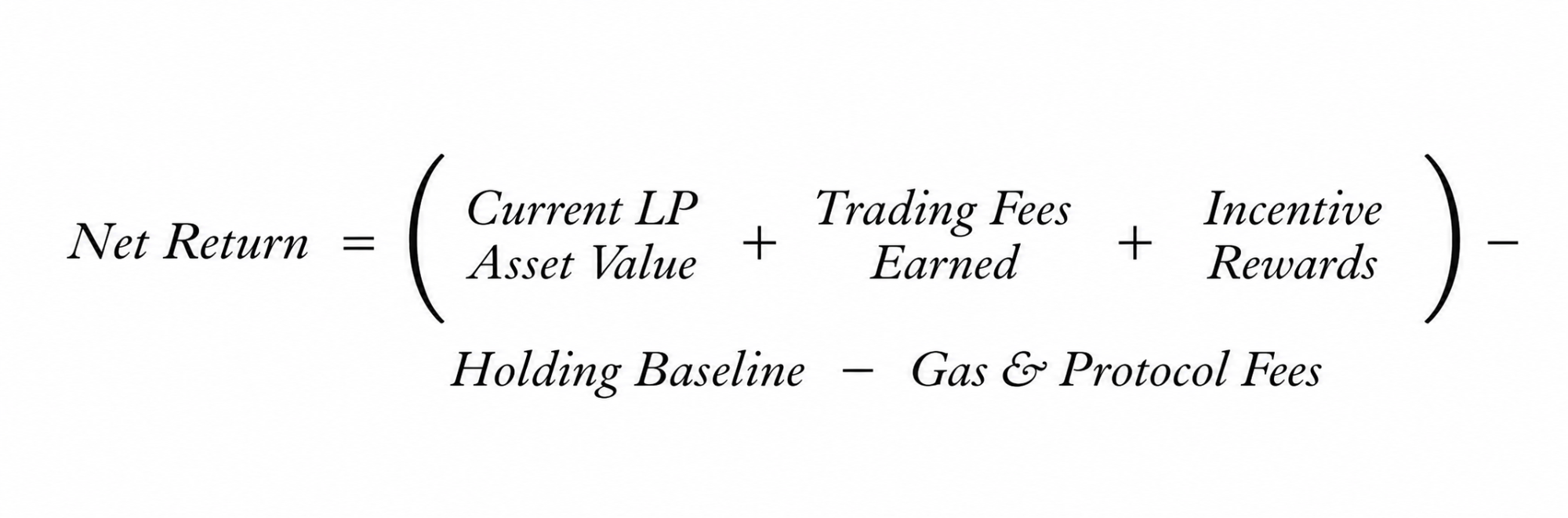
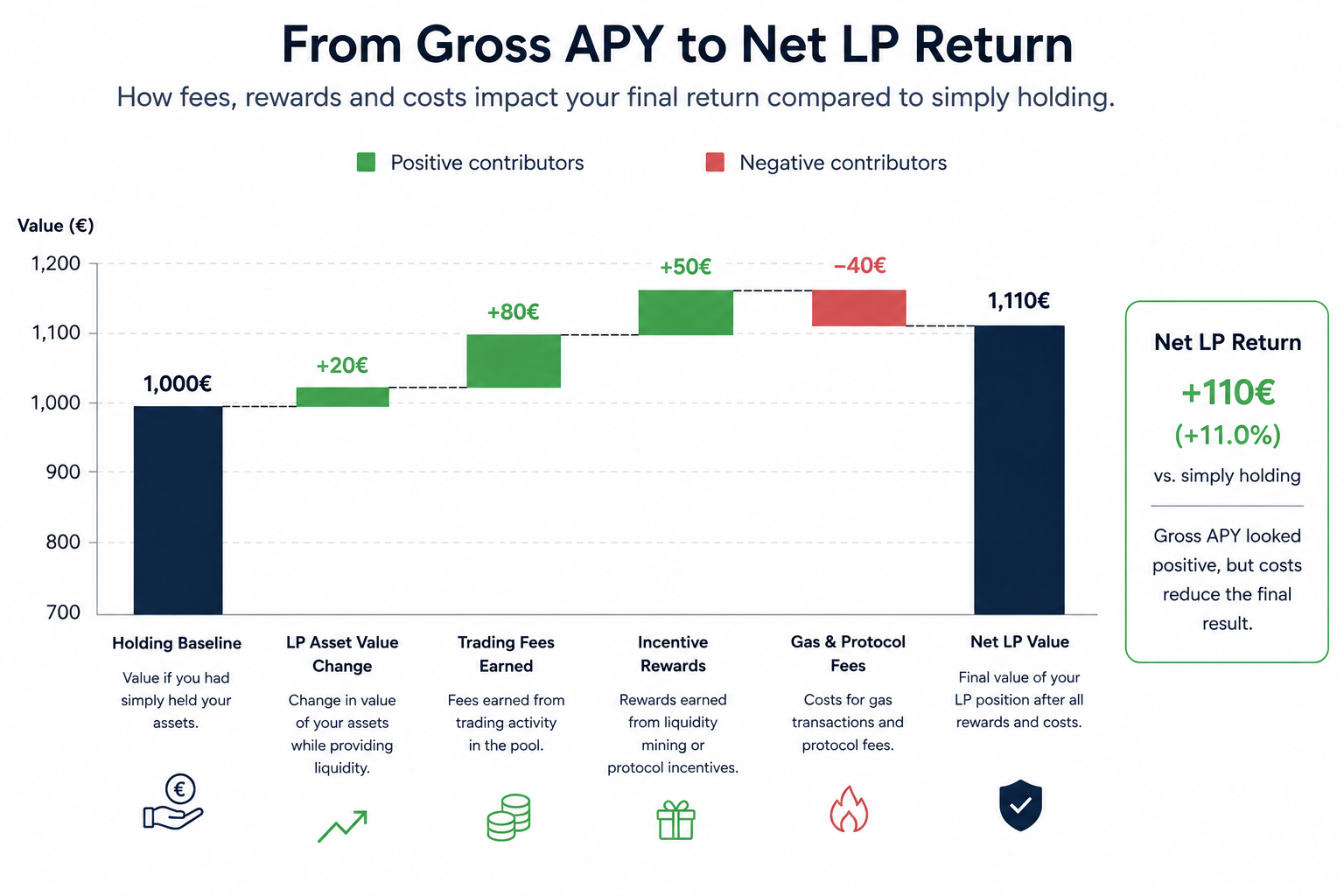
A pool with a high advertised APY can still underperform simply holding. Always compare your LP return to the holding baseline after all fees, rewards and costs.
What an Impermanent Loss Calculator Cannot Tell You
Calculators only show a snapshot based on static price inputs and pool designs. They cannot predict the real-world factors that determine your final profits like:
- Future Trading Volume & Fees: Calculators cannot predict market activity, which determines whether trading fees will actually cover price divergence.
- Reward-Token Volatility: They assume farm incentives hold their value, failing to forecast price crashes in reward tokens.
- Range Rebalancing & Gas Costs: They ignore the network fees spent entering, exiting, or adjusting concentrated liquidity positions.
- Unearned Yield Outside Ranges: They assume continuous fee generation, ignoring periods when prices cross your boundaries and freeze fee collection.
- Smart Contract & Tail Risks: They do not factor in protocol exploits, liquidity freezes, or asset depegging events.
Conclusion
Impermanent loss reflects the performance difference created by an AMM as it automatically rebalances your assets when prices move. Ultimately, it only becomes a problem when that divergence costs more than your net fees and incentives.The real measure will be the LP performance versus simply holding the same assets.
Disclaimer: The content provided in this article is for educational and informational purposes only and should not be considered financial or investment advice. Interacting with blockchain, crypto assets, and Web3 applications involves risks, including the potential loss of funds. Venga encourages readers to conduct thorough research and understand the risks before engaging with any crypto assets or blockchain technologies. For more details, please refer to our terms of service.