
Table of Contents
A developer in Singapore ships a lending protocol. Months later, someone in Berlin builds a vault on top of it, without ever reaching out. The two smart contracts simply speak the same language. That's most of what makes DeFi protocols composable. Pieces built on opposite sides of the planet end up clicking together like Lego bricks pulled from different boxes. This is DeFi composability. Snap enough of these connections together and you get “money legos” – protocols stacked on top of each other to build something none of them could offer alone.
The analogy holds up well, right until it doesn't. Physical Lego bricks don't carry risk. Financial building blocks do. Every piece in a composed DeFi product brings its own permissions, its own market exposure and its own dependency risk, and stacking money legos together doesn't make those risks disappear. It just moves them somewhere less visible.
Here's what's actually happening underneath, and what dependency risk really means once protocols start stacking.
See Composability Inside One User Action
Picture someone moving a single position through three separate DeFi protocols in one sitting. They swap ETH for USDC on a decentralised exchange (DEX). They deposit that USDC into a lending market and receive a receipt token in return, a claim on their deposit that's tradeable and transferable like any other token. Then they drop that receipt token into a vault, which puts it to work earning extra yield on top.
From the user's side, this looks like three clicks. Underneath, it's a chain of smart contracts calling each other, a price feed confirming the swap rate, and at least one approval transaction giving each contract permission to move the user's funds. This is DeFi composability in miniature: three separate smart contracts, none of which know about each other's existence beforehand, working together because they all speak the same token language.
None of these steps needed a phone call to a bank or a form to fill in. That's the appeal of DeFi composability, and it's a small-scale example of DeFi integration happening entirely without a business development team. It's also why a stack of smart contracts gets deep fast.
What Lets the Lego Pieces Connect
Three conditions let money legos snap together this way, and they're worth understanding before looking at what can go wrong.
Public Smart Contract Interfaces
A smart contract is a program that anyone can call, provided they know its functions and follow its rules. Because most DeFi protocols are permissionless, a developer building a new product can plug straight into an existing lending market or exchange without asking for approval or signing a partnership agreement. That's permissionless composability in practice: infrastructure that's open by default, not licensed out case by case. It's also the foundation of interoperability across DeFi – any smart contract that follows the rules can talk to any other.
Shared Token Standards
ERC-20 tokens all move, check balances and approve spending the exact same way, regardless of which token you're actually holding. Because of that, a wallet, an exchange and a lending market can each plug into a brand-new token without writing custom code for it. That's interoperability in action, not a bonus feature bolted on afterwards. Skip these token standards and every single integration needs its own bespoke code on both sides. That's the practical cost DeFi composability avoids across different DeFi protocols. It's worth being clear about what standardisation doesn't do, though. Following a token standard says nothing about whether a contract is well-audited, and it doesn't reduce smart contract risk on its own.
Atomic Execution on the Same Chain
Several contract calls can be bundled into one atomic transaction: either every step succeeds, or the whole thing reverts as if it never happened. A swap, a deposit and a token mint can all sit inside one atomic transaction, which closes off a lot of the settlement risk that comes from doing each step separately. The trade-off is more code and more contract state riding on a single transaction, which brings its own kind of smart contract risk.
Tokens That Represent Positions
LP tokens, lending receipts and vault shares all do the same basic job: they turn a position in one DeFi protocol into a token that another protocol can use as an input. The ERC-4626 standard, now used by vaults across Aave, Yearn V3, Morpho and others, formalised this idea for yield-bearing vaults specifically. Deposit an asset, receive a share token built on the same ERC-20 foundation as everything else, and that share token's value tracks the vault's performance automatically. Whatever a receipt token represents, it inherits the smart contract risk of the position underneath it. A vault share is only as sound as the vault, and the vault is only as sound as wherever it deployed the money.
Three Money-Lego Combinations
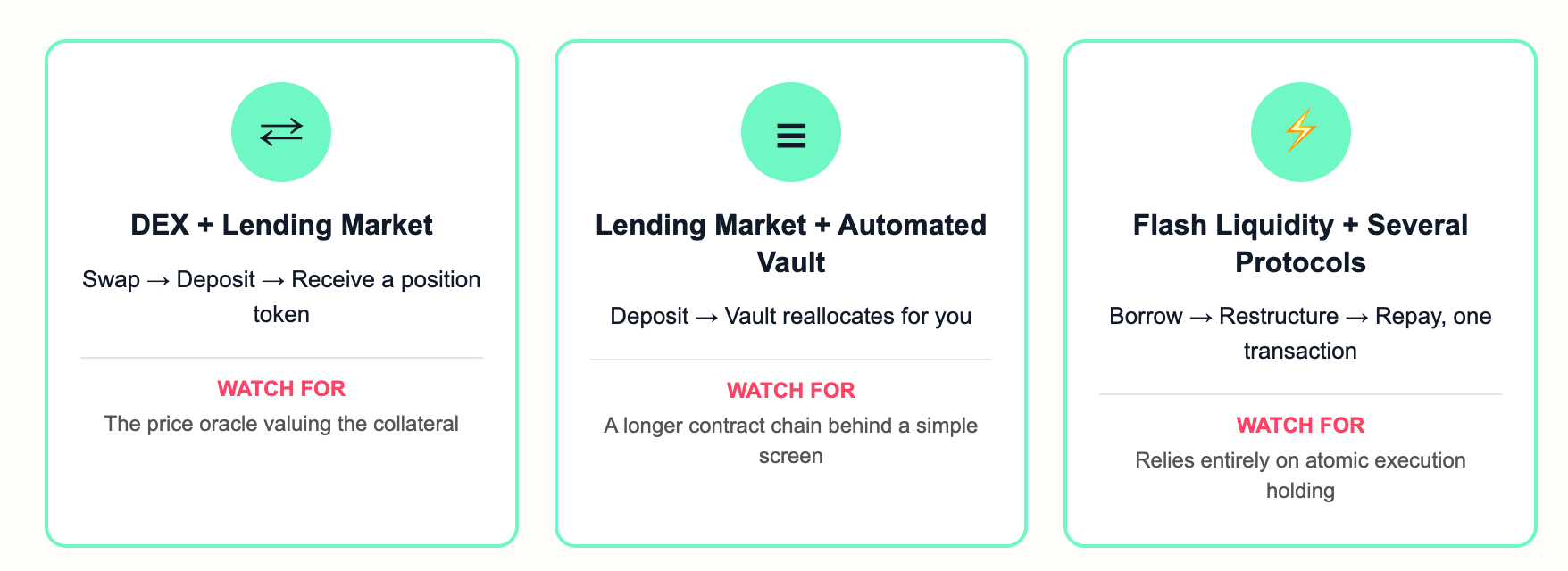
Seeing DeFi composability in the abstract is one thing. Watching money legos play out in an actual combination of DeFi protocols makes both the value and the risk much easier to spot.
DEX + Lending Market
Swap an asset on a DEX, deposit it into a lending market, and walk away with a position token representing that deposit. Simple enough on the surface. That one action now depends on four separate things working correctly: the DEX's liquidity and slippage, the approval transaction that let the lending contract touch the funds, the lending contract itself, and the price oracle the lending market uses to value the collateral. Each one adds its own slice of dependency risk to what looked, a moment ago, like a single simple deposit.
Lending Market + Automated Vault
A vault sitting on top of a lending market doesn't just hold a deposit. It might actively reallocate or rebalance that position across several composable protocols to chase better returns elsewhere. From the user's side, this looks like one simple deposit screen. Behind it sits a longer chain of contracts and management rules than the interface lets on, and none of that complexity is visible unless someone goes looking for it.
Flash Liquidity + Several Protocols
A flash loan is temporary liquidity, borrowed and repaid within a single atomic transaction. No collateral is required, because if the loan isn't repaid before the transaction ends, the entire thing reverts. That structure makes flash loans useful for things like refinancing a loan or swapping out a position's collateral type without needing to hold the capital upfront: borrow, restructure, repay, all in one go. It's one of the more advanced examples of permissionless composability at work, only possible because atomic execution and shared token standards let composable protocols trust each other for the length of a single transaction.
Why Developers and Users Value Composability
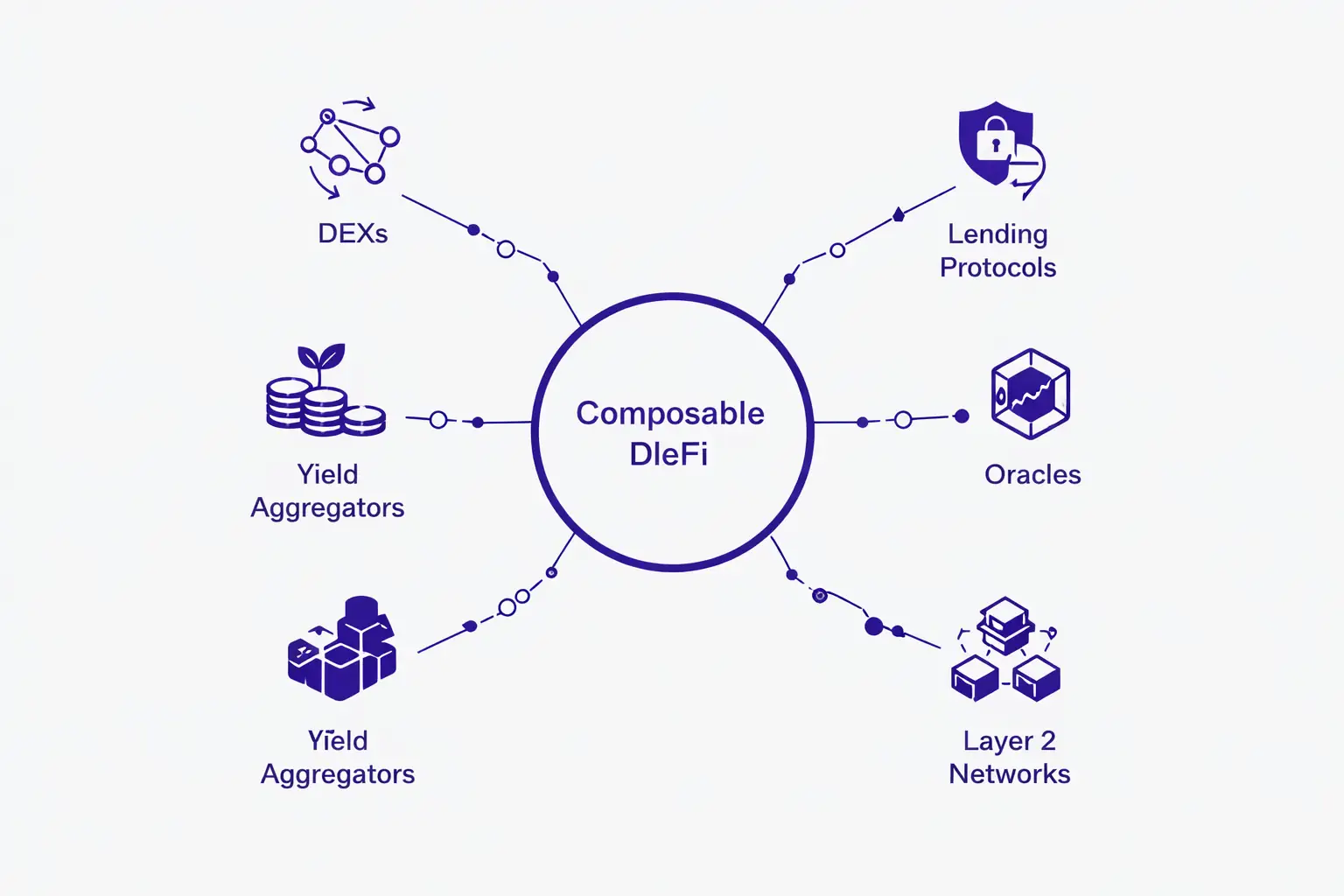
None of this exists just because it's technically clever. DeFi composability changes what's practical to build and what's practical to use.
For developers, not having to build a DEX, an oracle and a lending market from scratch before shipping a single feature cuts months off a product timeline. Reaching for existing money legos instead of writing every layer from zero means existing liquidity can be tapped rather than bootstrapped, and a new protocol can route through several other DeFi protocols to find the best price or the best yield without maintaining that infrastructure itself. For users, that translates into fewer manual steps. One interface can now handle a swap, a deposit and a yield strategy that would once have needed three separate platforms and three separate sets of trust decisions.
Permissionless composability and DeFi integration rarely come from one company connecting its own products. More often it's two composable protocols nobody planned together, built by separate teams, that end up working side by side because the interoperability is worth more to both than staying closed off. Aave never had to approve whoever built on top of it. There was nothing to approve.
The Dependency Graph Behind the Convenience
Every composed product is only as secure as its weakest linked component. Mapping that out as a dependency graph, direct dependencies, the dependencies of those dependencies, and what happens if each one fails, is a useful habit for spotting dependency risk and smart contract risk before trusting a stack of smart contracts with real money.
A Failure Can Propagate Up the Stack
In April 2026, an exploit against a liquid restaking bridge left one widely used receipt token unbacked. That token had been accepted as collateral across several lending markets, so when its backing disappeared, those markets had to freeze the affected positions while users rushed to withdraw. Over roughly 48 hours, more than $13 billion left DeFi's total value locked (TVL), with one major lending protocol alone losing over $8 billion in deposits. None of the smart contracts involved were broken. They were doing exactly what they were built to do. It's just that “exactly as designed” doesn't help much when the asset underneath the design has stopped being what everyone assumed it was – dependency risk rarely announces itself until something upstream fails.
Shared Oracles and Stablecoins Create Correlated Risk
Plenty of DeFi protocols price the same assets off similar oracle data, and plenty rely on the same handful of major stablecoins for liquidity. Spreading a position across several different-looking protocols doesn't remove the shared dependency risk if all of them are ultimately trusting the same price feed or the same stablecoin underneath. Diversifying the interface isn't the same thing as diversifying the risk beneath it.
Upgrades Can Change a Previously Reviewed Combination
A combination of protocols that passed every check on day one doesn't necessarily stay that way. Proxy contracts get upgraded, governance votes change parameters, and new integrations get bolted onto the underlying smart contracts after the original audit was signed off. A composed strategy that was safe at launch is worth checking in on periodically, not filed away as solved.
Same-Chain Composability vs Cross-Chain Workflows
Everything described so far assumes contracts calling each other on the same chain, where atomic execution means a whole sequence either completes together or reverts together. Cross-chain composability works differently. Moving value or data between chains means routing through a bridge or a messaging system, and that step doesn't get the same all-or-nothing guarantee. It adds a separate trust assumption, a delay while the transfer confirms, and the possibility that a transaction completes on one side of the bridge but not the other.
The April 2026 incident mentioned earlier started at exactly this seam, with a bridge rather than the lending markets that ended up absorbing the fallout. Same-chain composability concentrates dependency risk inside the smart contracts themselves. Cross-chain composability spreads that risk across the bridge too. A failure at the bridge lands on the user exactly like a failure inside the smart contracts would. Both freeze funds. Both need explaining before anyone deposits real money. Interoperability between chains comes bundled with that extra infrastructure, whether the marketing mentions it or not.
How a User Can Read a Composed Product
Before depositing into anything promising an attractive return, four questions are worth asking. What tokens are going in? Which smart contracts hold or transform them along the way? What external data, like a price oracle, does the product depend on? And how does the position actually exit if it needs to be unwound quickly?
A high APY (annual percentage yield) doesn't tell you much by itself. Two vaults can advertise the exact same headline number and carry completely different levels of risk underneath. What matters more is how many smart contracts sit behind that yield, which token standards they're built on, and whether any of them are new enough to still be unaudited.
Conclusion
DeFi composability is what happens when financial building blocks are left open for anyone to combine. Money legos make it possible to build in days what might once have taken months, stacking swaps, deposits and yield strategies into single, smooth-feeling interactions. What that stack of smart contracts is built from, and how far the dependency risk reaches, decides how far trouble can travel if one piece underneath ever gives way.
DeFi composability and money legos are unlikely to fade; they're a big part of why DeFi can move as fast as it does. Understanding the stack behind that speed isn't a barrier to using it. It's the difference between choosing a position and stumbling into one.
Disclaimer: The content provided in this article is for educational and informational purposes only and should not be considered financial or investment advice. Interacting with blockchain, crypto assets, and Web3 applications involves risks, including the potential loss of funds. Venga encourages readers to conduct thorough research and understand the risks before engaging with any crypto assets or blockchain technologies. For more details, please refer to our terms of service.