

Table of Contents
Most DeFi stablecoins sitting untouched in a wallet rarely do anything interesting, which is rather the point. Add a stablecoin lending market, a liquidity pool, a vault manager or a leveraged loop on top of that same dollar, though, and things stop being so quiet.
Every one of the stablecoin yield strategies covered here earns its return somewhere: borrower interest, trading fees, protocol incentives, or a funding rate most people have never heard of. DeFi stablecoins like USDC, USDT and DAI sit underneath nearly all of them. The more dependencies a strategy adds, the more can go wrong, and the less predictable the return really is.
Calling a strategy conservative or aggressive isn’t a verdict on how safe it is. It describes the mechanism behind the yield and the path a loss would take if things went wrong. This piece walks through both ends of that spectrum, and everything in between.
At a Glance: Conservative vs Aggressive
Start With the Baseline: Holding a Stablecoin Without Yield
Before comparing strategies, it helps to know what doing nothing actually looks like. Holding a stablecoin in your own wallet, unstaked and undeployed, is the baseline everything else gets measured against.
That baseline isn’t risk-free. You’re still exposed to the issuer: will USDC or USDT actually redeem for a dollar when you need it to? You’re trusting the reserves behind the peg, and you’re responsible for your own wallet security.
What you’re not adding is a stablecoin lending pool, a liquidity position, a vault manager, or a borrowed leg. Every strategy from here stacks something on top of that baseline, and each addition brings its own dependency.
A Risk Ladder of Stablecoin DeFi Strategies
Line up the common stablecoin yield strategies from simple to complex, ranked by how much DeFi risk each one adds, and a pattern appears: each rung adds a dependency, and each dependency is a place something can break.
Treat it as a map of what each strategy actually touches, not a scorecard of good versus bad. How many dependencies a strategy carries is usually a better guide to risk than the APY printed at the top of the page.
Single-Protocol Stablecoin Lending
The simplest form of stablecoin lending is supplying one stablecoin, such as USDC, to an established lending market like Aave V3 or Compound V3. Borrowers post crypto collateral, pay interest, and a share of that interest flows back to you.
Stablecoin yield here moves with utilisation. When plenty of people want to borrow against their ETH or BTC, supply annual percentage yield (APY) rises. When demand cools, it drifts back towards a few percent.
The risk isn’t really in the DeFi stablecoins themselves. It’s in what sits underneath: the lending protocol’s smart contract risk, the quality of the collateral backing other people’s loans, and the governance decisions that set the rules. Established markets tend to sit on the conservative end simply because they’ve been tested for longer.
Stablecoin-to-Stablecoin Liquidity Pools
Providing liquidity to a stablecoin liquidity pool, say USDC paired with DAI on Curve, earns a share of the swap fees traders pay to move between them. Because both assets are meant to trade near a dollar, the pool is designed to stay roughly balanced.
Designed to, not guaranteed to. If one side of the pair depegs, traders rush to swap the weaker asset for the stronger one through your pool, and you end up holding more of whatever just lost its peg. That’s impermanent loss showing up somewhere many people assume it can’t.
A stablecoin-stablecoin pool is genuinely lower-risk than a volatile pair. It isn’t the same as zero risk.
Automated Vaults and Yield Aggregators
Automated vaults, like Yearn V3 or a Morpho-curated stablecoin vault, take the manual work out of chasing yield. Deposit your stablecoin and a strategy contract allocates it across several lending markets or pools, rebalancing as rates shift.
A curator sets the mandate: which protocols the vault can touch, how aggressively it rebalances, what counts as acceptable risk. You’re trusting their judgement almost as much as the protocols underneath, and chasing stablecoin yield this way means accepting that judgement as part of the deal.
That’s the trade-off. Automation removes the busywork of manually moving funds between markets, but it adds a layer. A yield vault lending through five different markets built on DeFi stablecoins carries the combined smart contract risk of all five, not just one.
Leveraged Loops and Recursive Stablecoin Lending
A leveraged loop takes ordinary lending and repeats it. Deposit USDC, borrow USDT against it, swap that USDT back to USDC, deposit again, and repeat. Each cycle multiplies exposure to the spread between what you earn on deposits and what you pay to borrow.
A modest 2% spread can turn into a much higher APY once several loops are stacked. Run the maths on Morpho with roughly 5x leverage on a USDC/USDT market, and a 2% spread can turn into close to 10% on their original capital. Leverage cuts both ways, though.
If the collateral and the borrowed asset are meant to move together but briefly don’t, a leveraged loop can face liquidation exactly when a simple lending position would be fine. More loops mean a smaller gap between working as intended and getting liquidated.
Derivatives, Basis and Delta-Neutral Strategies
At the more advanced end sit delta-neutral or basis strategies. Ethena’s USDe is the best-known example: it holds a long spot position in ETH or BTC and shorts the equivalent amount on a perpetual futures exchange, capturing the funding rate one side pays the other.
Staked as sUSDe, that funding-rate yield has ranged anywhere from the high single digits to over 20% during strong positive-funding periods. It can compress towards nothing, or turn negative, when funding flips.
This isn’t something to run manually off a guide. The risks sit with the protocol managing the strategy: exchange counterparty exposure, execution slippage on the hedge, and stretches of negative funding. They’re worth understanding even if you never touch a perpetual exchange yourself.
Where the Yield Comes From in Each Strategy
Every stablecoin yield strategy pulls from one of a handful of sources, and it’s worth knowing which one you’re actually earning from.
Where Stablecoin Yield Actually Comes From
The first three tend to hold up for as long as the underlying activity continues. The last one lasts only as long as the subsidy budget does.
Why APY Alone Cannot Define Conservative or Aggressive
It’s tempting to label a conservative DeFi strategy by its low APY and an aggressive DeFi strategy by its high one. That shortcut breaks down quickly.
A 4% APY on a thinly collateralised, newly launched stablecoin can carry more risk than a 9% APY on an established, overcollateralised lending market during a period of genuine borrowing demand. The number on its own says almost nothing about where it came from.
What actually separates conservative from aggressive is the source of the yield, how long that source has been paying out, how easily you can exit, whether leverage is involved, and what recovery looks like if the strategy breaks. A strategy earning 6% from real borrower demand on a blue-chip market is a different animal to one earning the same net yield from token emissions on a protocol three weeks old, even with matching headline numbers.
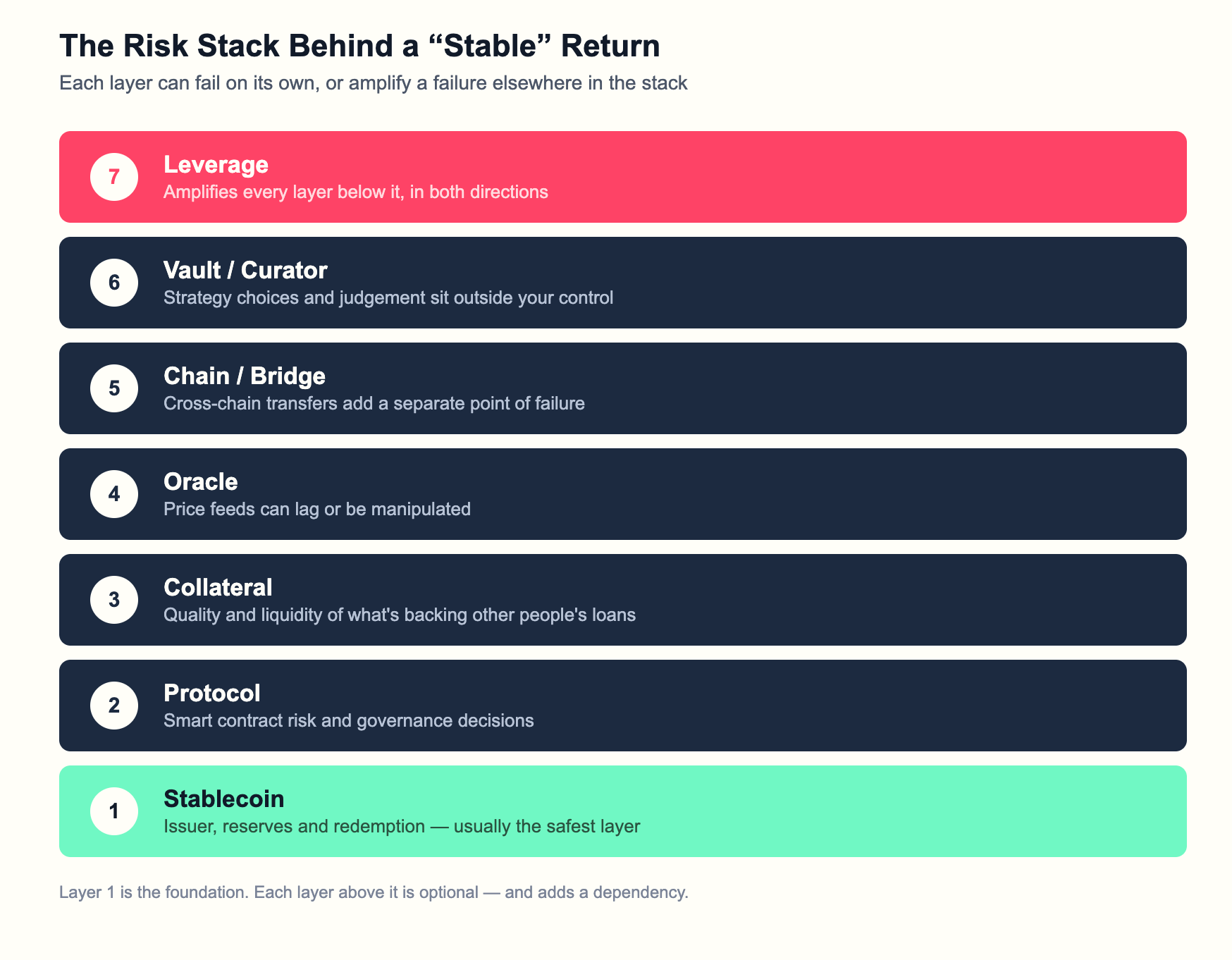
The Risk Stack Behind a “Stable” Return
Stack enough layers on a stablecoin and the word “stable” starts doing more work than it can support. It helps to pull the stack apart layer by layer.
Each layer adds its own DeFi risk, and can fail on its own or amplify a failure elsewhere in the stack. Three layers matter most for everyday stablecoin DeFi strategies.
Depeg Risk and Redemption Risk
A stablecoin’s market price, its redemption value, and your actual ability to redeem it are three different things. Most of the time they line up. In March 2023, they didn’t.
When Circle disclosed that $3.3 billion of USDC’s reserves sat at the failed Silicon Valley Bank, USDC’s market price fell to around $0.87 within hours, even though the underlying redemption mechanism was never technically broken. It recovered within days once US regulators intervened, but for a stablecoin widely considered one of the safest, that gap between “should be worth $1” and “is trading at $0.87” was depeg risk playing out in public.
The lesson: depeg risk isn’t limited to experimental or algorithmic coins. It can reach the most established stablecoin in a portfolio.
Liquidity and Exit Risk
Most lending markets and vaults advertise no lock-up: withdraw whenever you like. That’s true right up until plenty of other people want to withdraw at the same time.
If a lending market is highly utilised, meaning most deposited stablecoins are out on loan, a withdrawal has to wait for a borrower to repay or new liquidity to arrive. A liquidity pool position sitting outside its active price range earns nothing while the market drifts back into range.
No lock-up describes the interface, not a guarantee. In a stressed market, exit liquidity and gas costs both work against you at exactly the moment you want out.
Composability and Hidden Dependencies
A single vault receipt token can quietly depend on a stablecoin issuer, a lending market, a price oracle, a bridge, and a decentralised exchange, all at once. You see one token in your wallet. Underneath, you’re exposed to everything it touches.
This isn’t hypothetical. Yield aggregator strategies that routed deposits into Cream Finance lost roughly $130 million when Cream itself was exploited in 2021. The vault’s own code was fine; the protocol it deposited into wasn’t.
Before committing meaningful capital to any yield vault, it’s worth sketching the actual dependency map. What does this token touch, and what happens to your funds if any one link in that chain fails?
Three Reader Scenarios, Three Different Constraints

Different constraints rule out different strategies before yield even enters the conversation.
Someone who needs their money accessible next month should be wary of anything with withdrawal queues, out-of-range LP positions, or leverage. A leveraged loop or an actively managed vault can be the wrong fit purely on timing, regardless of how attractive the APY looks.
Someone with a longer horizon and the patience to monitor one protocol closely has more room to work with. Single-protocol stablecoin lending or a straightforward liquidity pool suits a reader willing to check in periodically without needing daily attention.
An experienced reader comfortable managing hedges and liquidation risk has access to the full stack, including delta-neutral and leveraged strategies. That comfort has to be genuine: managing a basis trade or a leveraged loop under stress is a different skill from depositing into a lending market and checking back later.
None of these is objectively better. They’re matched to different constraints, not different levels of sophistication for its own sake.
Comparing Net Return Instead of Headline Yield
Headline APY is gross, before the costs that quietly erode it. Transaction costs eat into that gross number before you ever see it: gas, swap fees, vault fees and slippage all take a cut. Add in anything lost to depeg risk or a liquidation, and you’re left with the actual net yield.
The table below sketches roughly how that plays out per strategy; the figures are illustrative, not live market quotes.
The gap between gross and net widens with every layer of complexity a strategy adds. A high headline number on an aggressive strategy doesn’t automatically beat a lower number on a conservative one, once the real costs are counted.
Signals That a Strategy Has Changed Character
A strategy that was conservative six months ago isn’t guaranteed to stay that way, because DeFi risk isn’t static. A handful of signals are worth watching.
Token incentives expiring often means the real yield drops sharply once the subsidy disappears. New, riskier collateral types being added to a lending market change what’s actually backing the yield, even without touching your position. Utilisation spiking towards its ceiling can mean a withdrawal gets stuck behind a queue of borrowers. Liquidity thinning out, or a bridge migration changing how a vault moves funds between chains, both add dependencies that weren’t there at deposit time.
April 2026 was a reminder of how fast this can move. The Drift Protocol and KelpDAO exploits, totalling roughly $580 million between them, knocked Aave’s total deposits down by almost half within days. No individual USDC lending position changed. The environment around it did.
Conclusion
Conservative and aggressive stablecoin DeFi strategies aren’t separated by how stable the coin at the bottom is. The stablecoin itself tends to be the safest part of the whole arrangement. Risk builds up in everything layered on top of it, from the protocols involved to how actively the strategy needs managing.
A conservative DeFi strategy keeps dependencies to a minimum: one protocol, no leverage, established collateral. An aggressive DeFi strategy stacks vaults on lending markets on leverage, chasing a higher net yield in exchange for more places where something can go wrong.
Neither is right or wrong on its own. The unit of account might read “$1” at every layer. Stability at the bottom doesn’t guarantee stability all the way up.
Disclaimer: The content provided in this article is for educational and informational purposes only and should not be considered financial or investment advice. Interacting with blockchain, crypto assets, and Web3 applications involves risks, including the potential loss of funds. Venga encourages readers to conduct thorough research and understand the risks before engaging with any crypto assets or blockchain technologies. For more details, please refer to our terms of service.