
Table of Contents
Even before you enter the crypto space, stablecoins are an asset class you have probably come across. These digital currencies maintain a 1:1 value with a traditional asset, most popularly the U.S. dollars. And, for the average user, every digital dollar is the same. You buy one token, and it stays worth one dollar.
The biggest stablecoins, USDT, USDC, DAI, PayPal USD and more, all target that exact same value. Yet, beneath the surface, things change fast. When we look at USDC vs. USDT, you quickly find differences in how they operate under the hood.
Not all stablecoins share the same design. They differ in where you can trade them easily. They run on different blockchains. Their issuers operate under different rules. Some release full monthly reserve audits. Others publish simplified attestations. Even the redemption steps differ if you want real paper dollars back.
For regular users, these differences carry real-world effects. One token might give you cheaper network fees. Another might offer better regulatory protection. Understanding these differences helps you keep your funds safe and avoid costly network mistakes. Let’s explore how stablecoins work in daily practice.
What Is Tether (USDT)?
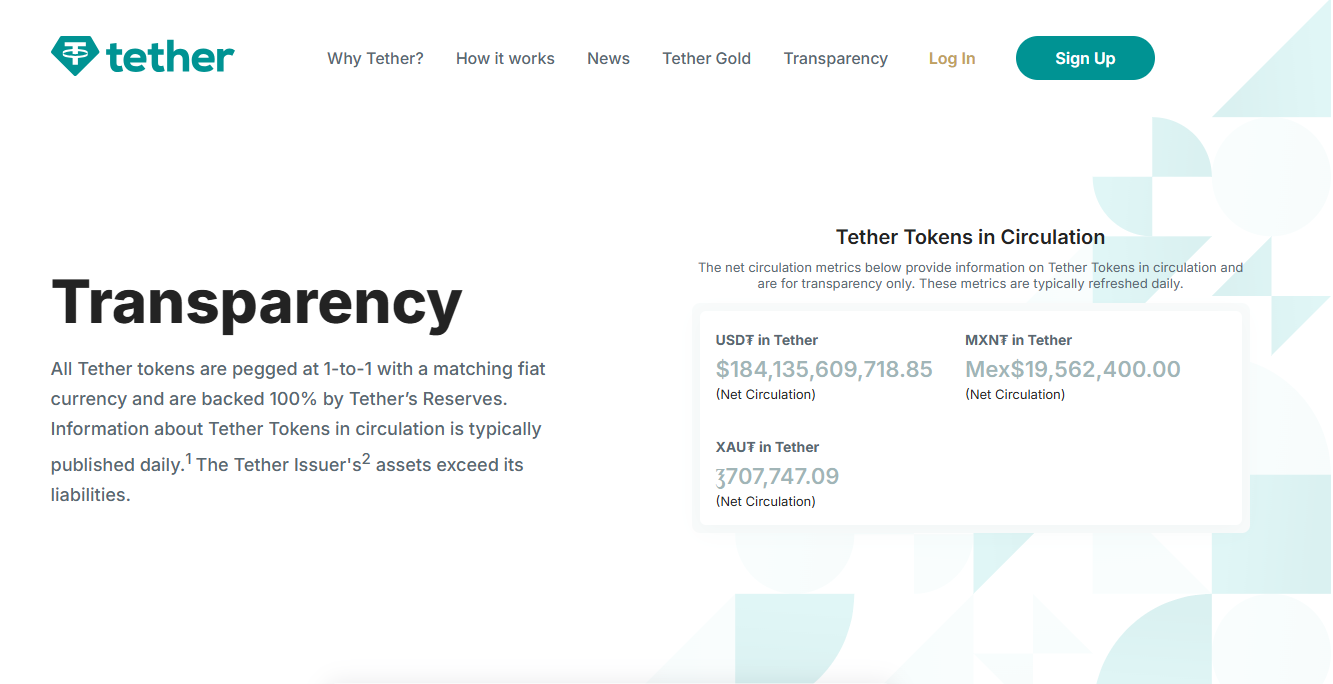
Tether (USDT) is the most popular dollar-backed stable token in the world. Tether Holdings Limited mints, issues and burns USDT tokens on supported blockchains. For millions of traders worldwide, it serves as the primary gateway into digital markets. With a market cap of $184+ billion, USDT acts as a digital stand-in for the paper dollar.
People use USDT mainly because it is everywhere. This resulted in USDT processing over $13.3 trillion in 2025. It has become the default option for spot trading and futures markets. Almost every major crypto exchange lists USDT trading pairs. If you want to trade Bitcoin or Ethereum, USDT usually has the deepest liquidity. That means you can execute large trades with minimal price movement.
You also see Tether used heavily for everyday international money transfers. Merchants in emerging markets often accept it as digital cash. It functions like a global payment rail. You do not need a traditional bank account to hold Tether. You just need a crypto wallet and an internet connection. Its main strength lies in its massive reach and liquidity.
How Does USDT Work?
At its core, USDT is designed to keep a 1:1 value ratio with the USD. Tether Holdings Limited claims to back every circulating USDT token with cash and liquid assets 100%. These assets include short-term Treasury bills, cash deposits, and corporate loans. Market trust keeps the price steady around one dollar.
As an everyday user, you rarely deal directly with Tether Limited. You do not send paper dollars to their corporate office to mint new tokens. Instead, you get USDT from an exchange or P2P market. You buy it from other users or liquidity providers. The market value stays close to a dollar because arbitrage traders exploit small price gaps across markets.
USDT operates on many blockchains, including Ethereum, TRON, Solana, Avalanche, TON, BNB, Algorand, Cosmos, Celo, Aptos, Tezos, Liquid Network and Kaia. Because USDT is minted on these networks, the network has different transfer speeds and network fees.
If you transfer USDT on Ethereum, gas fees can be high during busy hours. If you send USDT on TRON, network fees are usually much lower. You must always pick the right blockchain network when sending tokens. You can lose your USDT tokens forever if you send them to the wrong address or network.
What Is the History of Tether (USDT)?
Tether was originally founded in 2014 as Realcoin. It was renamed to the Tether that we recognize today just 4 months later. USDT is one of the longest-standing stablecoins that rapidly gained popularity and momentum with the crypto market’s growth. It was soon used as the industry standard liquidity engine for major trading venues.
USDT established huge demand before any real competitors came along. In 2025, USDT processed $90 billion+ in average daily trading volumes. However, Tether has also been under scrutiny for years due to criticisms. There has been a concern about the transparency of the reserves from the regulators and analysts.
There was a demand for authentication of every token in the form of real money. Tether adjusted its transparency rules and paid up regulatory fines over the years. Tether has since provided periodic reserve reports to quell these concerns.
What Are the Pros and Cons of Using USDT?
Using USDT comes with clear advantages and noticeable drawbacks. The biggest pros of using USDT are:
- USDT offers unmatched liquidity.
- It is supported by nearly every wallet and exchange worldwide.
- Its popularity means you can buy almost any altcoin using USDT pairs.
- Offers fast and cheap transactions via chains like TRON.
- Stable price makes it a good hedge against crypto volatility and market inflation.
The downsides associated with using USDT are:
- Transparency questions still worry some conservative users.
- Centralization and counterparty freeze risk.
- Tether is incorporated offshore, which creates legal questions.
- Strict global regulations could lead to restrictions in certain countries.
It is wrong to claim Tether is completely bad or perfectly safe. It is simply a tool built for deep liquidity. It works brilliantly for day trading and quick transfers. However, just like every other crypto it holding USDT for the long term comes with issuer-specific risks.
What Is USD Coin (USDC)?
USD Coin, or USDC, is another major dollar-pegged token. It was created by Circle Internet Financial, a US-based financial technology firm. Unlike some competitors, Circle designed USDC with a clear focus on regulatory compliance.
USDC aims to offer a transparent alternative for the digital economy. It is widely favored by regulated fintech companies and financial institutions. When you hold USDC, you hold a token built to fit into Western regulatory frameworks.
For regular crypto users, USDC feels similar to Tether in daily use. It stays equal to one dollar. You can hold it in private self-custody wallets. However, its main appeal is safety and institutional trust rather than pure offshore trading volume.
How Does USDC Work?
USDC maintains its dollar peg through a straightforward backing model. Circle holds fully backed reserves in segregated accounts. These reserves consist of cash and short-term U.S. Treasury bonds. Circle works with major banking institutions to safeguard these assets.
Circle provides monthly attestation reports verified by independent accounting firms. These reports show exactly what backs the circulating USDC supply. This public reporting creates strong user confidence. Users can see that real dollars exist behind their digital tokens.
Like Tether, USDC is available on many blockchain networks including Ethereum, Solana, Base, Polygon, Arbitrum, Avalanche, Optimism, TRON and BNB Smart Chain 25+ others. Choosing the correct network affects your transaction fees significantly. Moving USDC over Ethereum mainnet can incur high gas fees during busy hours. Using Layer-2 solutions like Arbitrum keeps transfer fees extremely low.
What Is the History of Circle and USD Coin (USDC)?
Circle Internet Financial launched USDC in 2018 alongside CENTRE Consortium. The CENTRE Consortium featured Coinbase, Bitmain and 30 other exchanges. They came together to create a compliant digital dollar for global commerce. They wanted an asset that institutions could use without fear of regulatory penalties.
USDC grew rapidly during the DeFi boom of 2020 and 2021. Decentralized finance protocols preferred USDC because of Circle’s clear audit trail. Developers felt comfortable locking billions in smart contracts using USDC. Circle has actively worked with regulators in the United States and Europe.
They aligned USDC with emerging framework requirements, such as Europe’s MiCA laws. While this strategy builds high trust, it also links USDC closely to traditional banking systems. When traditional banks experience trouble, stablecoin operations can feel the ripple effects.
What Are the Pros and Cons of Using USDC?
USDC offers several distinct benefits for modern users.
- USDC transparency is top tier, with monthly attestations.
- International trust and stability.
- Deep integration with DeFi protocols.
- USDC integrates smoothly with businesses and fintechs.
- Excellent for micropayments with low fees.
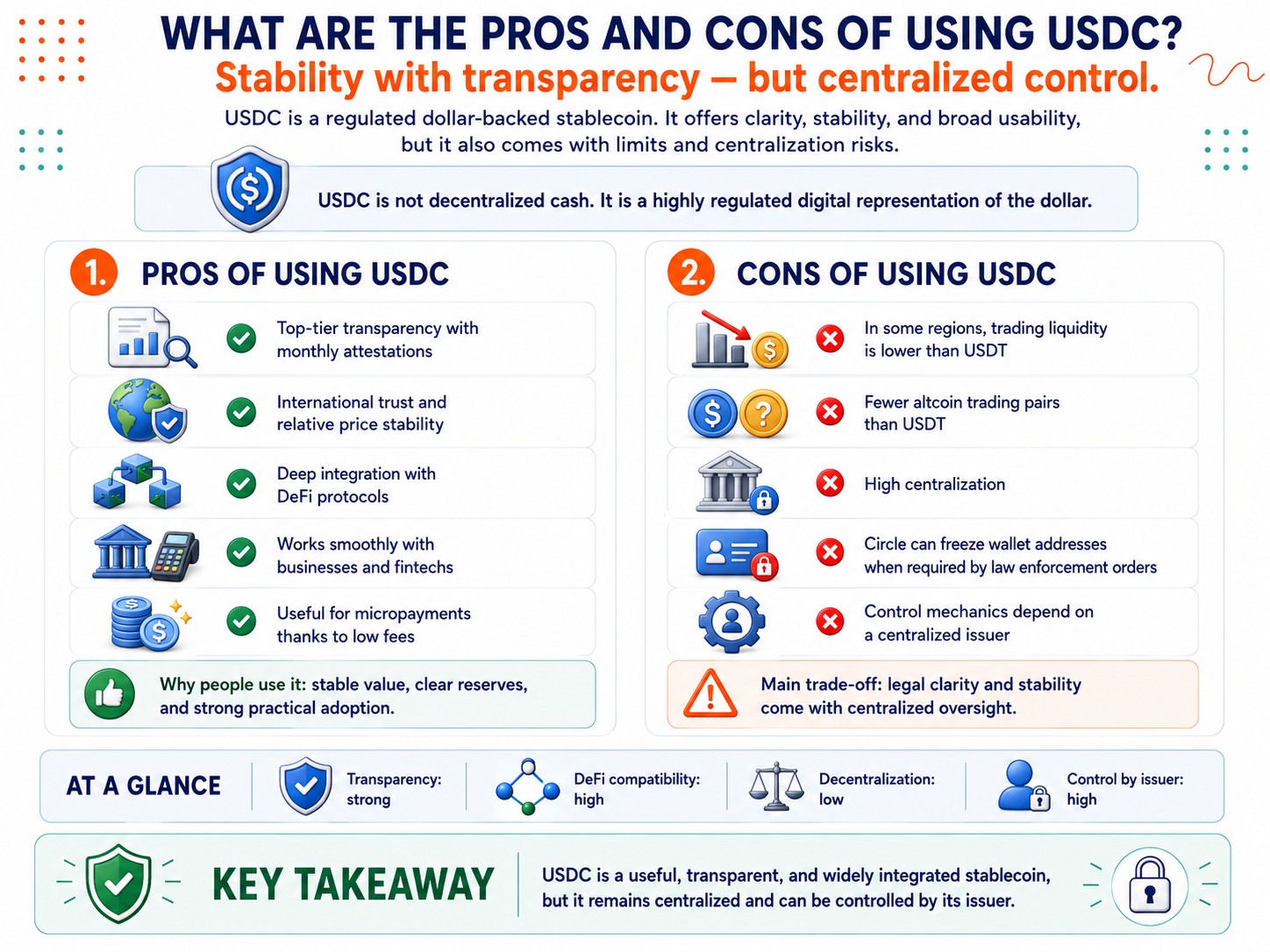
USDC has drawbacks too.
- In some regions, trading liquidity for USDC is lower than USDT.
- Fewer altcoin pairs for USDC than USDT.
- High centralization and Circle can freeze wallet addresses on law enforcement orders.
So, USDC is not decentralized cash. It is a highly regulated digital representation of the dollar. It offers stability and legal clarity, but comes with centralized control mechanics.
What About Other Stablecoins?
While USDT and USDC control most of the market, they are not your only options. Dozens of other stablecoins exist in the market today. They serve specific niches, regions, or technical ecosystems. Not all stablecoins copy the centralized dollar reserve model.
Some are pegged to different fiat currencies, like the Euro (Euro Coin $EURC) or Yen (GYEN). Others rely on algorithmic math or crypto collateral instead of cash deposits. These differences affect how risk and liquidity play out in real life.
Fiat-backed alternatives
Fiat-backed alternatives operate like USDT and USDC on a smaller scale. Examples include PYUSD by PayPal or regional tokens pegged to local currencies. These tokens maintain reserves in bank accounts or short-term securities. Some regional options focus on saving fees for local remittances.
For instance, $EURC helps European users trade without paying currency conversion fees. However, smaller options often suffer from low liquidity. Slippage can occur if you try to trade large amounts. Always check exchange liquidity before holding alternative fiat tokens.
Crypto-backed or decentralized stablecoins
Crypto-backed stablecoins operate without a central corporate bank account. Instead, users deposit cryptocurrency collateral into smart contracts to mint tokens. DAI, managed by MakerDAO, is the premier example of this model. To mint DAI, users must provide overcollateralization. That means depositing $150 worth of Ethereum to borrow $100 in DAI.
If crypto prices crash, the system automatically liquidates collateral to protect the dollar peg. These tokens eliminate central issuer blacklist risk. Nobody can freeze your wallet address on a pure smart contract level. However, they carry smart contract risks and protocol bugs. Liquidation mechanics can also create sudden stress during severe market crashes.
Key Differences Between USDT and USDC
USDT and USDC hold a one-dollar peg as stablecoins but are quite different in how they operate. The main differences between USDT vs. USDC lie in their approach to governance, audits and ecosystem focus. Tether focuses heavily on global market liquidity and accessibility.
Circle focuses on regulatory compliance, legal clarity and institutional integration. When analyzing USDC vs. USDT, you are balancing market reach against corporate transparency. Here is a simple comparison table to show how they stack up.
When Might USDT Be More Practical?
For active crypto traders, USDT is typically the most convenient option. For traders who execute numerous spot trades or leverage trades on global platforms, USDT is a must-have. Most of the other derivative platforms settle trades in Tether. It is also suitable for transfers across international borders in emerging markets.
Usdt is more popular than TRON in many countries where the local P2P sellers strongly prefer them. TRON network transactions are extremely swift and cheap. This allows Tether to be transferred quickly and easily across borders. USDT is a very good choice if you are looking for liquid trading pairs.
When Might USDC Be More Practical?
Conservative investors and businesses may prefer USDC. For businesses that accept digital payment, USDC offers a more straightforward accounting. Financial compliance becomes easier for accountants by getting monthly audit reports. USDC is a fantastic DeFi option for users in Western jurisdictions as well.
There are a variety of decentralized lending protocols that provide competitive yields on USDC. Moreover, it is possible to save a lot of transaction fees by moving USDC over low-cost Layer-2 networks. When it comes to peace of mind about reserve backing, then USDC is the obvious route to take. It’s giving up a little bit of international trade for increased audit visibility.
What Risks Are Associated With USDT, USDC, and Other Stablecoins?
There are no completely risk-free digital dollar tokens. Before you begin using USDT, USDC and other stablecoins it is important to be aware of the layers of risk.
- Issuer risk. Centralized issuers may go bankrupt, be legally frozen out or be subjected to regulatory action. Both Tether Holdings Limited and Circle Internet Financial have code mechanics that allow the freezing of funds on specific wallet addresses.
- Reserve risk. The token can de-peg if the underlying reserves lose value and/or become illiquid. In market crashes, we have witnessed that some stablecoins have plummeted below $1 as the assets in their reserve lose value.
- Technology risks. Smart contract exploits are possible due to vulnerabilities. Possible smart contract exploits due to vulnerabilities. Moreover, if your transfer is done to the wrong blockchain network you will end up losing your assets. Unexpected high network fees can also eat into your balance. Double check the recipient address and network selection.
How Should a User Choose Between Stablecoins?
Choosing the right token depends on your specific goals. Ask yourself a few basic questions before making a transfer.
- What is your main goal? For day trading, pick USDT for deep volume. For long-term holding or business invoicing, pick USDC for transparency. If you want permissionless decentralization, look into DAI.
- What network are you using? Compare transfer fees across supported chains. Sending tokens over Ethereum costs more than using Solana or Polygon. Always select a network that balances low fees with security.
- Where are you located? Local exchange support varies by region. Ensure your preferred exchange offers easy cash-out options for your chosen stablecoin.
Conclusion: Which Stablecoin Should You Use?
Ultimately, there is no one-size-fits-all solution that suits all stablecoins. While USDT and USDC offer similar services, they suit different kinds of users. The liquidity and trading pairs of USDT are second to none worldwide. If this is your major requirement, then you should use USDT.
Use USDC for regulatory peace of mind, transparent reporting and DeFi integration. This makes it a better option for businesses that report their financials. Alternatives to the centralized option provide a way to have censorship-resistant options. If privacy is your main focus then you should use a decentralized stablecoin like MakerDAO’s DAI.
Choose a stablecoin based on the one that best fits what you want to achieve. And as always, be aware of network fees when you use stablecoins, only use secure wallets and store the stablecoin token in the wallet that best suits your needs.
Disclaimer: The content provided in this article is for educational and informational purposes only and should not be considered financial or investment advice. Interacting with blockchain, crypto assets, and Web3 applications involves risks, including the potential loss of funds. Venga encourages readers to conduct thorough research and understand the risks before engaging with any crypto assets or blockchain technologies. For more details, please refer to our terms of service.