
Table of Contents
USDT is USDT. USDC is USDC. You’d be forgiven for thinking the cost of sending them is roughly the same wherever you send them from.
It isn’t. The same token can cost a fraction of a penny on one network and several dollars on another. The stablecoin isn’t what changes. The network underneath it is.
When you send USDT or USDC, you’re choosing a token and a network. Stablecoin fees, transfer speed, and whether the funds arrive at all depend on that combination.
What Are Stablecoin Transaction Fees?
“Stablecoin fees” isn’t one single thing. It’s a stack of potential costs that can appear at different points in a transfer.
The most familiar is the network fee, sometimes called a gas fee: the charge the blockchain takes to process your transaction. But depending on how you’re moving money, you might also encounter exchange withdrawal fees, bridge fees, swap fees, or a spread built into a fiat conversion. Some only show up when you’re withdrawing from an exchange. Others only appear if you’re bridging between chains.
The ‘sending stablecoins is cheap’ idea really only holds in the best case: wallet-to-wallet, low-fee network, nothing in between. Introduce an exchange withdrawal or a bridge and the cost picture changes fast.
Why Does the Network Matter as Much as the Token?
USDT exists on Ethereum, Tron, Solana, Base, Arbitrum, Polygon, and several others. USDC is natively issued on more than 20 chains. Same name on all of them. Very different experience depending on which one you pick.
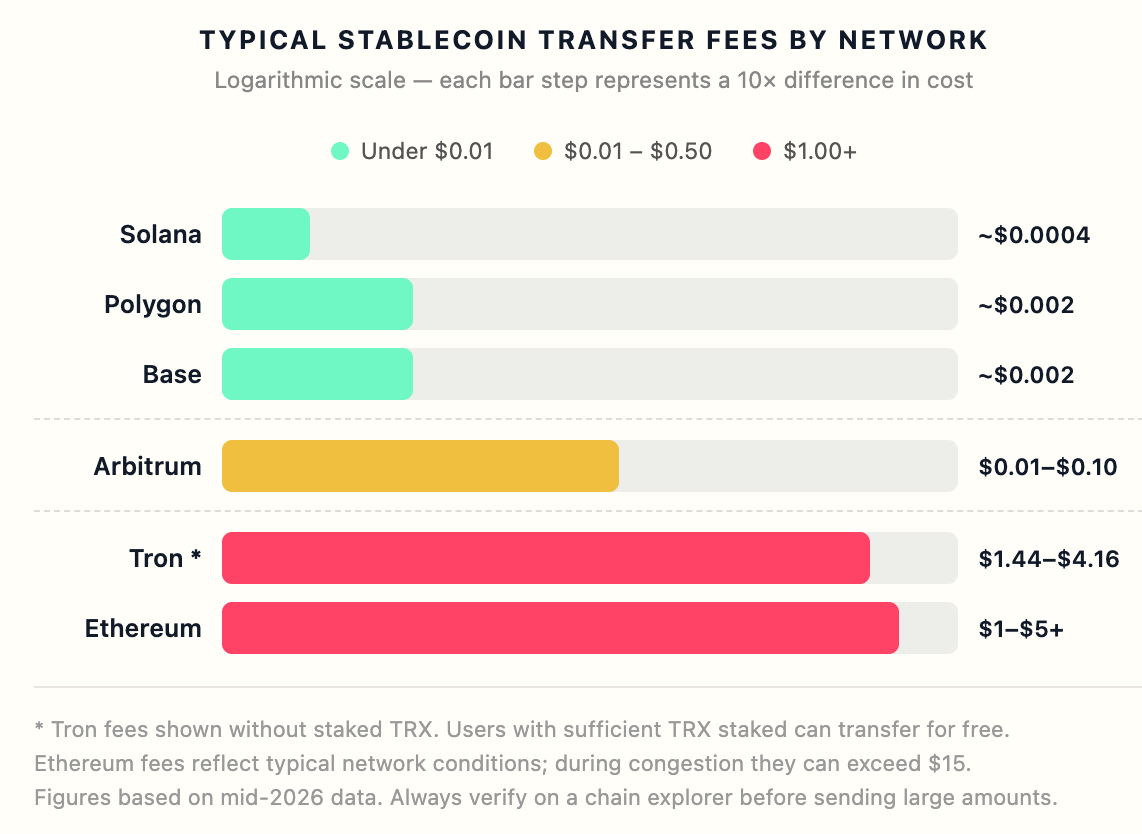
Solana brings a USDC transfer in at around $0.0004, less than half a cent. Ethereum mainnet charges between $1 and $5 for the same thing on a quiet week. During congested periods it can climb above $15. A busy NFT launch or a sudden market move is usually enough to tip the network into that territory. On a small transfer, that’s not a fee. It’s a significant slice of what you’re actually sending.
The network sets the cost. The token just determines which smart contracts are involved.
What Costs Can Appear in a Stablecoin Transfer?
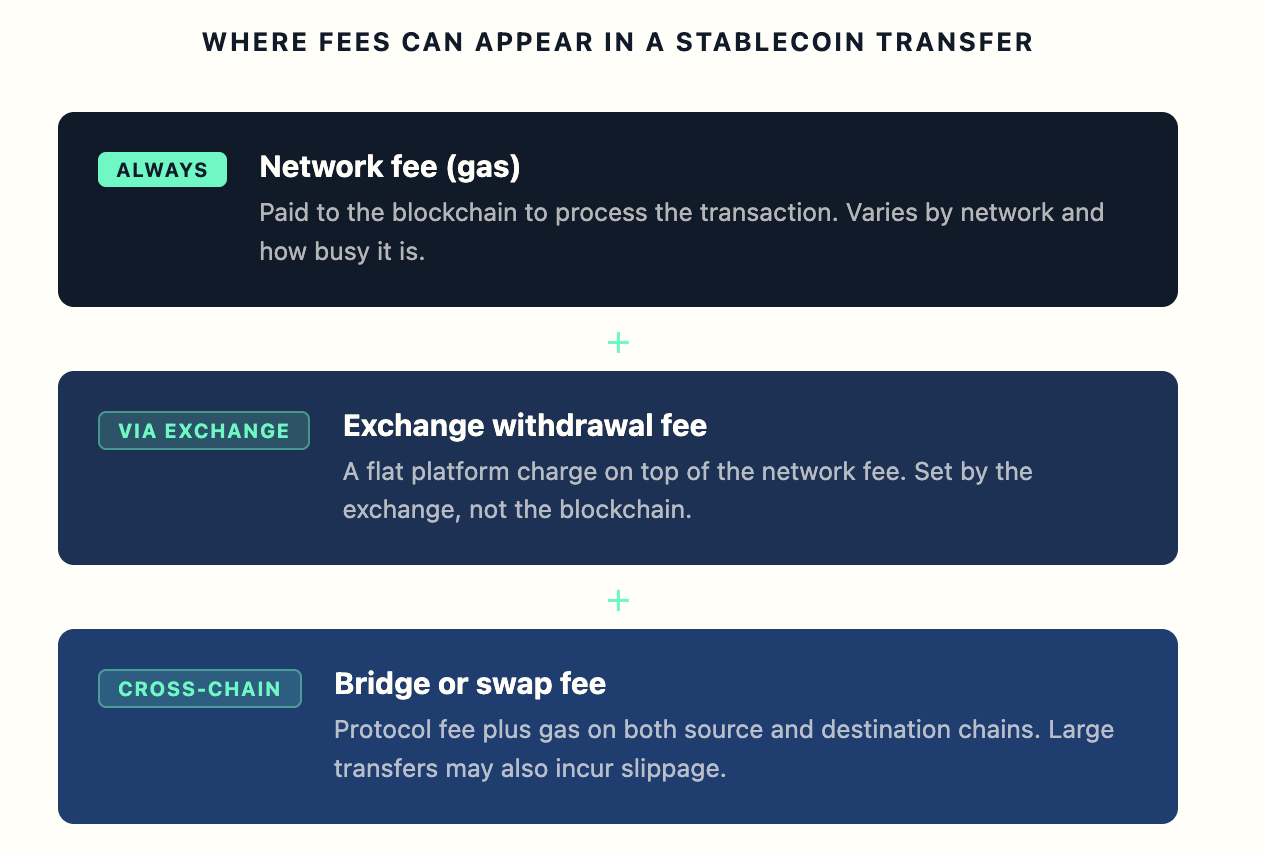
A stablecoin transfer can pass through several cost layers. Not all of them appear in every transaction. That’s part of why people keep getting caught out by the final cost.
Network fees
Network fees are what the blockchain charges to process the transaction. On Ethereum, this changes constantly based on demand for block space. A standard USDT transfer uses around 65,000 gas units. When the network is quiet, that’s manageable. When it’s busy, costs can move quickly.
Layer-2 networks like Base and Arbitrum get around this by batching many transactions (including stablecoin transactions) together before settling on Ethereum’s main chain. That’s why Base can charge $0.002 for a transfer on the same day Ethereum mainnet charges $4. Same underlying security, different way of packaging stablecoin transactions.
Tron uses a different model entirely. Instead of gas, it runs on energy and bandwidth. Each Tron account gets a small daily allowance of free bandwidth, but a USDT transfer also consumes energy. Without staked TRX to cover it, that energy is paid for by burning TRX from your wallet balance. A transfer that looks cheap on paper can cost between $1 to $3.50. Users who stake TRX upfront can transfer for free, but that requires locking up capital in advance.
Exchange withdrawal fees
If you’re withdrawing a stablecoin from a centralised exchange, you’ll usually pay two things: a network fee and a separate flat platform charge on top.
Binance charges $1.00 to withdraw USDT via Tron, $5.00 via Ethereum, and $0.10 via Solana or Arbitrum. Coinbase charges more, around $2.40 for a TRC-20 USDT withdrawal. Same coin, different networks, and the fees range from $0.10 to $5 before gas is factored in.
Most exchanges offer several network options for the same stablecoin at the point of withdrawal.
Note: Exchange fees move with market conditions – always check the current rate on the withdrawal screen before confirming.
Bridge, swap, and routing costs
Moving a stablecoin from one network to another adds another layer. Bridge protocols typically charge between 0.05% and 0.3% of the transfer value, plus gas on both the source and destination chains. That second gas charge, the one for arriving on the new network, catches a lot of users off guard.
Bridges that use liquidity pools also introduce slippage: if the destination pool is thin relative to what you’re sending, you’ll receive slightly less than expected. On a $10,000 transfer, 0.1% slippage costs $10. On larger amounts, it can become the dominant cost in the whole transaction.
The cheapest on-chain fee isn’t always the cheapest overall route. Getting onto that cheap network in the first place is part of the calculation.
Why Can the Same Stablecoin Cost More on One Network Than Another?
Ethereum mainnet is expensive because demand regularly outpaces capacity. The network processes roughly 15 to 30 transactions per second. When more people want block space than that, they bid up the gas price. Transaction fees can spike sharply and without much warning. On top of that, gas is paid in ETH, not in the stablecoin being sent. That means users need a separate ETH balance just to send USDT, which is a quirk that catches a surprising number of people unprepared.
Tron is a genuine curiosity. It handles more USDT volume than any other network, around $714 billion a month, more than Ethereum. The reason isn’t that it’s the cheapest option. It’s that it has deep roots in emerging market remittances and near-universal exchange support. But its energy-based fee model genuinely confuses new users. The real cost depends on whether you’ve staked TRX, how much, and when. That’s not something most people want to calculate before a simple transfer.
Solana keeps fees consistently low through high throughput. Processing tens of thousands of transactions per second means there’s rarely competition for block space. Polygon and Ethereum L2s get to a similar place by bundling transactions together and splitting the Ethereum settlement cost across many users at once.
The stablecoin hasn’t changed. The blockchain it runs on has.
How Do Fees Change the Best Network for Each Use Case?
There’s no single best network. The right answer depends on what you’re actually trying to do.
For large transfers, the gas cost becomes almost irrelevant. Ethereum mainnet has around $180 billion in circulating stablecoin supply, more than any other chain, and it’s the one network that every major exchange and DeFi protocol supports. Paying $4 in gas on a $50,000 transfer works out to 0.008%. The fee barely registers.
For small or frequent stablecoin payments, fees dominate the maths. A $50 transfer on Ethereum mainnet during a busy period could lose 10 to 20% to gas alone. Solana and Base bring those costs to fractions of a penny. For anything under a few hundred pounds, network choice is the most important decision you’re making.
For DeFi, the protocol usually makes the decision for you. Most major DeFi applications run on Ethereum and its L2s. Moving funds to a cheaper chain doesn’t help if the protocol you want isn’t there.
For exchange withdrawals, the limiting factor is recipient support. Choosing Tron for a cheaper withdrawal only works if the destination wallet or exchange credits TRC-20 deposits. Not all of them do, and some have changed their policies without much notice.
What Should You Check Before Sending Stablecoins?

Most costly stablecoin mistakes trace back to skipping a few basic checks. None of them are complicated. They just need to happen before you hit confirm.
The most important is network compatibility. USDT on Tron and USDT on Ethereum are different token contracts on different ledgers. They are not interchangeable. Sending TRC-20 USDT to a platform that only recognises ERC-20 can require contacting support to recover, if it’s recoverable at all.
Worth checking the other direction too: make sure the destination wallet or exchange actually takes the token and network you’re sending on. Then check the fee and any minimum withdrawal amount. Some exchange minimums sit above the fee itself, which makes small transfers impossible on certain networks.
What Are the Main Risks of Choosing the Wrong Network?
The wrong network choice can cost money. It can also prevent a transfer from arriving at all.
The most common outcome is funds landing on a network the recipient doesn’t support. Some platforms will credit these eventually after a support request; others won’t. Either way, it usually means waiting, a support ticket, and a potential recovery fee on top of what was already paid.
Address compatibility is a separate issue. Ethereum and Tron wallet addresses operate on entirely different ledgers. Sending to a mismatched address on the wrong chain can put funds somewhere unreachable, with no obvious path back.
There’s also the straightforward cost of habitual overpaying. Using Ethereum mainnet out of routine when Arbitrum, Base, or Solana would have worked costs real money on every transaction. At small transfer sizes, the wrong network can make the entire transfer economically pointless.
Bridge risk deserves its own mention. Bridges have historically been one of the main attack surfaces in crypto. Chainalysis estimated over $2 billion stolen in bridge exploits by mid-2022 alone. Reputable bridges have improved significantly since then, but using an unfamiliar one to save a few dollars on a large transfer is a trade-off worth thinking through.
Conclusion: What Should Users Remember About Stablecoin Fees?

The token is only half the decision.
USDT on Tron and USDT on Ethereum share a name and a price peg. That’s about where the similarity ends. Different ledgers, different fee rules, not universally accepted in all the same places. The total cost of a transfer can stack up from anywhere: the network, the exchange, the bridge.
Before any transfer, it comes down to whether the recipient supports this token on this network. Check both before sending. A cheap transfer that doesn’t arrive isn’t cheap.
Disclaimer: The content provided in this article is for educational and informational purposes only and should not be considered financial or investment advice. Interacting with blockchain, crypto assets, and Web3 applications involves risks, including the potential loss of funds. Venga encourages readers to conduct thorough research and understand the risks before engaging with any crypto assets or blockchain technologies. For more details, please refer to our terms of service.