
Table of Contents
Initially, stablecoin yield and high-yield savings accounts seem similar: users hold cash-like value and earn returns. However, you shouldn't only compare them by APY. Users must look at the source of the yield, capital protection, access to funds, regulation, technical complexity, liquidity, and risks.
Stablecoin yield can be interesting, but it is not simply a bank deposit in different packaging. After all, you wouldn't say that pretzels and potato chips are the same thing even though the packaging might look similar. It's similar with Stablecoin yield and high-yield savings accounts. The differences are why we called the article stablecoin vs. high yield and not stablecoin AND high yield.
What Are High-Yield Savings Accounts?
A high-yield savings account is a bank savings account with a higher interest rate than a regular savings account. The return usually depends on the banking model, interest-rate policy and competition between banks. HYSAs are usually chosen for simplicity, clear deposit protection, a familiar interface and a low technical barrier.
Often banks will protect your money in a high-yield savings account up to a certain amount, making them a popular option due to less stress involved and protection up to a certain amount if your money is lost or stolen. The low-technical barrier is also a reason some people choose high-yield savings accounts. It takes barely any technical knowledge to open and fund a high-yield savings account, whereas with stablecoins you need to know a bit more.
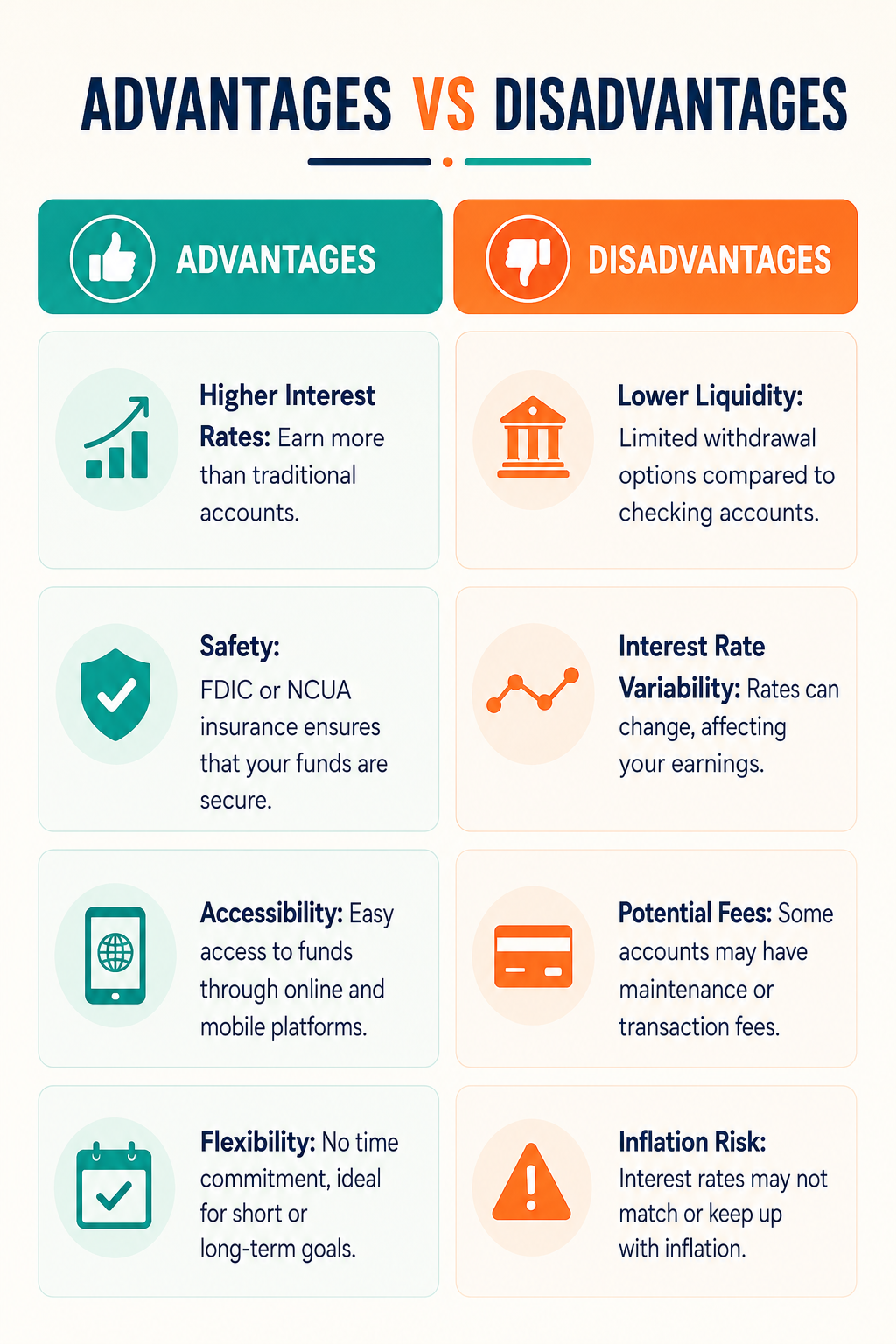
Here are some advantages and disadvantages of high-yield savings accounts when compared to checking accounts and other savings accounts.
What Is Stablecoin Yield?
Stablecoin yield is the return a user receives by placing stablecoins in a platform, DeFi protocol or yield product. Income may come from lending, borrowing demand, protocol incentives, centralized platform rewards or treasury-like strategies. The stablecoin does not pay interest by itself. The income is generated by the funds being used somewhere else and then transferred back to the user. In this case you aren't earning "free money". The money is generated via one of the listed strategies (lending, borrowing demand etc.) The money has to come from somewhere. However, the way it is generated is important to know with stablecoins.
Where Does the Yield Come From?
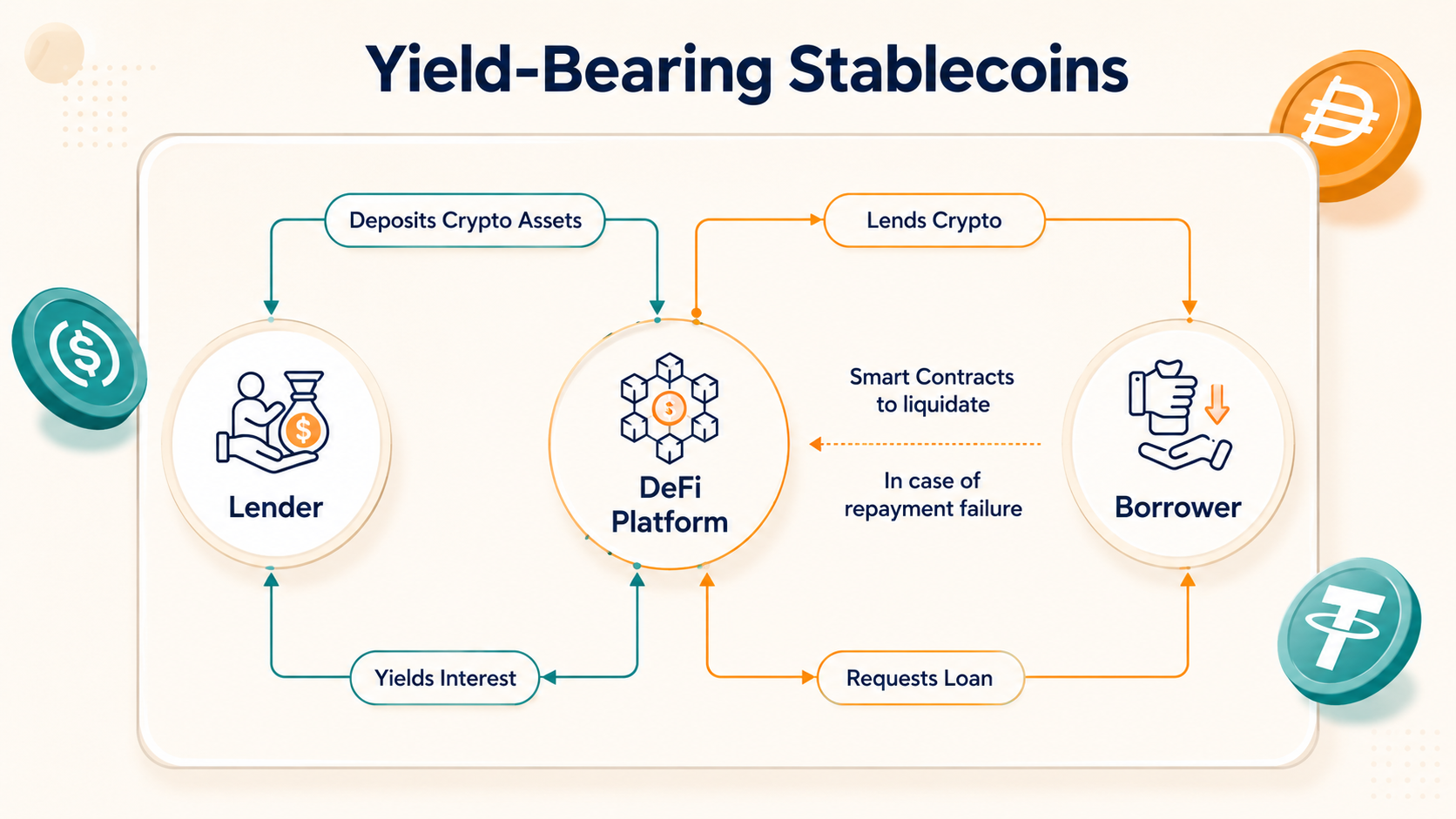
Yield opportunities come from economic activity from borrower demand, trading fees, and protocol incentives. Each of these has a difference in risk. You can read more about stablecoin yield here: (link to Stablecoin Yield Explained article). The image below is an example of how yield appears when stablecoins are lent to other market participants like tranders, institutional borrowers, etc.
How savings accounts generate interest
Banks pay interest on high-yield savings accounts and other savings accounts as compensation for using your deposits to fund loans. The bank uses deposits within its banking model: lending (like I just mentioned), reserve management (strategies used to make sure banks have enough liquidity), and interest rate spread (the difference between two interest rates).
This all happens behind the scenes, kind of like how the lighting technician works behind the scenes to do lighting for a play or theater production. Or how you don't see what's actually happening when a magician pulls a rabbit out of a hat. So, for the user, the process is much simpler: they keep money in their high-yield savings account and receive APY. However, users should keep in mind that the rate can change, especially when interest-rate policy changes.
How stablecoin yield is generated
There are several sources of stablecoin yield. Borrowing demand is when stablecoins are lent to other market participants like traders, institutional borrowers, DeFi users, or protocols. This means that the income comes from interest paid by borrowers.
Stablecoins can also generate income through DeFi lending pools where users provide liquidity for swaps. This means the income comes from trading fees and incentives. Sometimes yield comes from platform rewards that are often temporary. Tokenized money market products allow investors to earn yield from assets like U.S. Treasuries. Treasury yield pass throughs allow interest earned on U.S. Treasury Bills backing a stablecoin to go directly to token holders.
These are all ways in which stablecoin yield can be generated. However, different sources of return have different risk types. Lending means borrower and collateral risk. DeFi means smart contract and liquidity risk. Platform rewards mean counterparty and custody risk. Treasury-like products mean legal, custody, redemption and transparency risk. Each of these types of risk are different and have different impacts on users and users should be aware of these different types of risk when using stablecoins.
APY Comparison: Why the Higher Number Is Not the Whole Story
Stablecoin yield looks higher on paper, but APY cannot be compared separately from risk. Stablecoin products offer higher returns but they are not guaranteed and change depending on the protocol, platform, market and borrowing demand. HYSA rates also change, but they are less risky. They offer more protection for the principal and more clarity. Stablecoin yield is much more confusing and does not offer protection for the principal amount if it is lost or stolen.
Stablecoin Yield vs Savings Accounts: Key Differences
Stablecoin yield and savings accounts are very different from each other. From the returns you get to the user experience, both have pros and cons. For example, as mentioned, stablecoin yield has higher APY so you earn more, but it comes with more risk that users need to be aware of when using stablecoins. Here are a few more comparison points to take into account.
Safety and protection
Savings accounts at insured banks usually have an advantage in principal protection within the insurance limit. This means that within a specified insurance amount, they will cover losses if your money is stolen, so your principal amount, or part of it, is protected. Stablecoin yield does not have the same banking guarantee: users accept platform risk, issuer risk, depeg risk, custody risk and smart contract risk when they choose stablecoin yield instead of savings accounts.
For example, stablecoins can depeg from the fiat currency that they are pegged to, causing the price to change. Stablecoins are supposed to have 1-1 parity, but if they depeg this parity is lost. It's sort of like going through a breakup. Well, not exactly, but you get the point. The stablecoin breaks up with the fiat currency and then they maybe get back together (re-peg) or stay broken up (depegged) for a while.
Access, speed, and global availability
When considering 24/7 access, fast transfers, cross-border movement, and on-chain settlement, stablecoins tend to be more convenient. Savings accounts are usually simpler for local money storage. However, bank transfers often depend on business days, delays, limits, and geography.
It's not as easy to send money across the globe with bank transfers as it is with stablecoins. Also, when the bank is closed on the weekends, this often means no transfers, whereas with stablecoins you can send money at 3 am on a Saturday. Consider that you live in Los Angeles and your cousin lives in London, or Madrid, or Jakarta. A stablecoin transfer will likely get to your cousin faster in any of those places, especially if you need to send the money during hours that your bank is not operating.
Ease of use and technical complexity
A savings account is much simpler for most users. All you have to do is open an account, deposit money, and then you will receive interest. Stablecoin yield usually requires a wallet, network selection, gas fees, custody decisions, platform choice, and an understanding of DeFi. Some services simplify this path, but they do not remove the underlying risk.
If you haven't heard of DeFi, or you don't understand how it works, it might be best to stick with a savings account. If you don't know how to decide which blockchain platform to use, you also might rather stick to something that doesn't require that decision like a savings account.
Transparency and control
On-chain products often provide more visibility. For example, users can usually verify positions, protocols, and fund movements. However, this does not mean that they are safe. Bank accounts have less technical transparency but they offer more legal structure and support. If you are looking for technical transparency, consider going with stablecoins and on-chain products. If you are looking for more support, consider going with traditional banking services.
Pros of High-Yield Savings Accounts
There are many pros of high-yield savings accounts: simplicity, familiar banking experience, deposit insurance, clear reporting, lower technical burden, no seed phrase, and less risk of making a mistake with a network or smart contract. HYSAs are especially logical for emergency funds, essential savings, short-term goals and users who cannot afford principal loss. You never want to invest money that you can't afford to lose, and HYSAs offer principal protection so you don't need to worry about losing your principal money like you would with stablecoin yield.
Cons of High-Yield Savings Accounts
There are some cons to HYSAs that should be considered: rates can fall, real return can be reduced by inflation, international transfers can be slower and more expensive, and access may depend on banking hours, geography and bank rules. Also, for larger amounts the bank insurance limit may not cover the entire amount of funds so it does not always mean zero risk for larger funds. You can still lose part of your principal if it is over the insurance amount.
Pros of Stablecoin Yield
Stablecoin yield definitely has some pros: potentially higher or competitive APY, 24/7 movement, faster settlement, global accessibility, on-chain visibility, the ability to use DeFi or centralized earn products, and flexibility for fintechs, payments, treasury and users comfortable with crypto. They also have lower costs for cross-border payments.
For businesses, stablecoin infrastructure can be useful for payment float (significantly smaller than in traditional banking because stablecoins settle on-chain quickly), instant liquidity management and programmable treasury operations.
Cons and Risks of Stablecoin Yield
Stablecoin yield carries multiple layers of risk at the same time. Even if yield is being paid normally, the stablecoin itself can lose its peg. The reasons may involve reserves, liquidity, market panic, issuer problems or trust in the token.
With centralized platforms, the user depends on the platform’s custody, solvency, withdrawal rules, security, legal structure, and risk management. If the platform restricts withdrawals or faces problems, access to funds may be disrupted. Some platforms can be secretly insolvent or have strange withdrawal rules hidden so that making withdrawals is difficult or impossible. They also may not be adequately prepared to deal with risks, adding even more risk for the user.
DeFi risks include bugs, hacks, oracle failures, liquidation logic, governance decisions, bridges and protocol dependencies. You want to see if any crypto platform or product you use has been audited by a reputable auditing service, but keep in mind that just because a platform or product has been audited does not mean that it is risk-free.
When Does a High-Yield Savings Account Make More Sense?
An HYSA is a better fit if a user is keeping an emergency fund, saving for a short-term goal, does not want technical complexity, is not ready for crypto risk, wants deposit insurance, prefers predictable access through a bank or cannot afford to lose the principal amount deposited. If a user cannot afford to lose the money they are depositing, insured savings makes the most sense.
When Can Stablecoin Yield Make Sense?
Stablecoin yield can be logical if a user already understands crypto, is ready to accept risk, wants 24/7 access, works with cross-border payments, uses on-chain tools, has discretionary capital or wants to diversify part of their free funds. Consider stablecoin yield as a side strategy. It should not be the place where a user puts all of their essential savings.
Why a Hybrid Strategy Is Often More Honest Than Choosing One Side
Users do not have to choose between "only banks" or "only stablecoins". Many users see it as a good strategy to keep emergency funds and savings in an insured savings account and a small part of discretionary funds in stablecoin yield if they fully understand the risks involved in doing so.For businesses, traditional banking may remain the base for compliance and core liquidity, while stablecoin infrastructure can be used for specific treasury, settlement or programmable finance tasks.
What Should You Check Before Choosing Stablecoin Yield?
Here's a list for you of what to check: source of yield, stablecoin issuer, reserves, custody model, platform reputation, supported networks, withdrawal rules, lock-up, APY variability, protocol audits, liquidity, tax/reporting obligations and worst-case scenario. You should ask yourself the following question before choosing a platform: “What happens if the stablecoin depegs, the platform pauses withdrawals, or the APY drops?”
Make sure the platform has fair withdrawal rules and has been audited. Check out the stablecoin issuer and make sure they are legit. Make sure the platform has enough reserves. These are all simple things to check that could mean the difference between you walking away with nothing or having a great experience with stablecoin yield. The choice is up to you!
Conclusion: Which Option Is Better?
The answer is they are both good depending on your situation. High-yield savings accounts are usually better for safety, simplicity and essential savings. Stablecoin yield can be a good option for users who want flexibility, on-chain access, and potentially higher returns, but it carries more moving parts and more risk and is a bit more complicated.
The right question to ask yourself is not "which pays more?" but "Which risk profile fits this money?" They can both be good in different situations and depending on what your financial situation is and what you need the money for exactly. So ask yourself, how much risk are you willing to take on and what are your goals for the money?
Disclaimer: The content provided in this article is for educational and informational purposes only and should not be considered financial or investment advice. Interacting with blockchain, crypto assets, and Web3 applications involves risks, including the potential loss of funds. Venga encourages readers to conduct thorough research and understand the risks before engaging with any crypto assets or blockchain technologies. For more details, please refer to our terms of service.