

Table of Contents
We would agree that every bankrupt investor started with 'high conviction,' and every lucky gambler thinks they are a genius.
We all love looking at a green portfolio and pretending we're financial prophets, being honest, sometimes the market just handed you a winning lottery ticket without you even knowing.
In crypto, having a "conviction" sounds cool because it makes you look strong for holding a position when everyone else doubts you. But there is a huge difference between having a smart plan and just going blindly "all-in".
Knowing the risk only is not courage. Courage is knowing the risk, sizing it properly, and still making a disciplined decision.
What Does “Conviction” Really Mean in Investing?
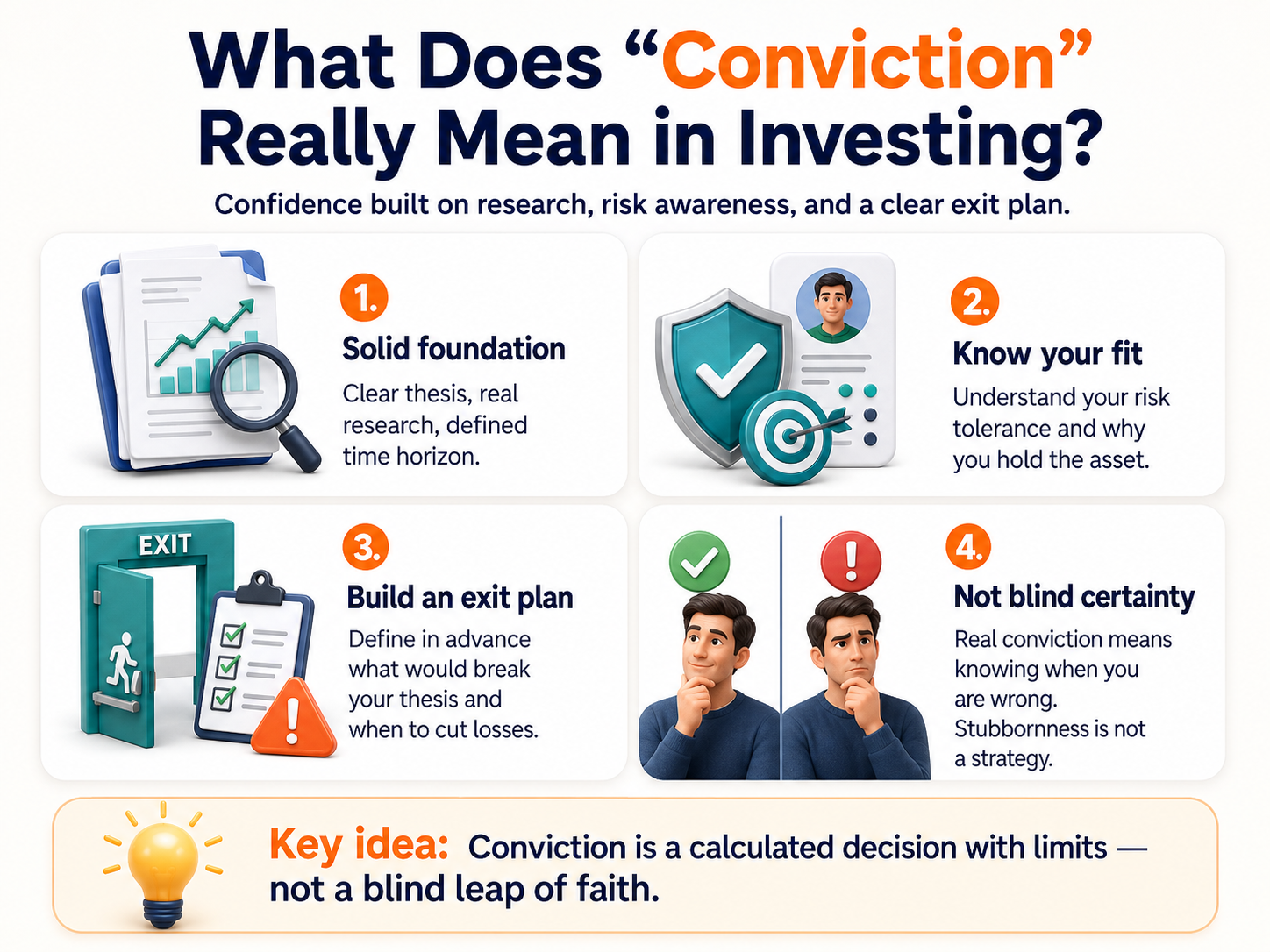
Simply put, conviction is just confidence built on a solid foundation. It means you have a clear thesis, you've done the research, you know your time horizon, you understand your risk tolerance, and you have rock-solid reasons for holding that asset. It’s a calculated business decision, not a blind leap of faith.
Conviction does not mean “I know this, I cannot be wrong”. In fact, it's the exact opposite. It means you are smart enough to know exactly when you are wrong. When you build a real thesis, you also build an emergency exit.
You decide ahead of time: "If X, Y, or Z happens, my idea no longer works, and I am cutting my losses." If your investment plan doesn't include a realistic condition that forces you to pack your bags and leave, you don't have conviction, you just have a stubborn blind spot.
Why “All-In” Feels So Powerful
All in an emotional state that is incredibly intoxicating. It wraps you up in a blanket of clarity, courage and a big bet on the future. That very second you decide to put all your chips on one space, the exhausting mental math stops, the second-guessing vanishes, and you get to feel a massive rush of pure courage.
You are the guy making a bold, cinematic bet on the future.
This emotional high is magnified by a thousand. We are constantly flooded with legendary stories of early believers who ignored the haters, went all-in on a pocketful of change, and walked away with life-changing, generational wealth. Those stories just fuel the emotions more
Having a strong belief is not bad. The danger is that "all-in" thinking completely blurs the line between a calculated risk and pure emotional gambling. It tricks you into believing that because your feelings are intense, your investment strategy must be flawless. In reality, you’ve stopped playing a game of skill but you are now just playing a game of luck, hoping the market bails you out.
When Is Conviction Actually Courage?
True conviction is courage when it is rational not reckless. It’s based on cold, hard facts that you can actually verify.
An investor with real courage does not close his eyes and hope for the best. They can clearly explain exactly why an asset or idea has room to grow, and they have the data to back it up. They’ve done the math to figure out what the market has already priced in, and they know exactly which red flags could break their entire thesis.
Most importantly, courageous investors understand themselves. They don't bet on the house. They pick a position size that they can easily survive both financially if the trade goes to zero, and psychologically so they aren't staring at charts sweating all night. They have total peace of mind because they controlled the risk before the market could control them.
How do you build real conviction ?
You do not wake up on a Tuesday morning because a chart looks pretty and just take a decision that you are convinced about the outcome. It is not an emotional wave you catch from a viral tweet. Real conviction is built brick by brick through a disciplined process. Let's see that process.
You understand the downside
Conviction begins with the question "What happens if I am wrong?" not "How much money can I make?" Before you put a single dollar into an asset, you have to look at the absolute worst-case scenario. If you understand the potential loss, how it will impact your overall portfolio, and how it affects your personal life, your decision instantly shifts. You are no longer acting on a reckless impulse, you are executing a strategy.
You have a clear thesis
Conviction should always be explainable in simple, everyday words. Why does this investment matter? What is the rest of the market completely underestimating? What specific events, numbers, or metrics will prove that you were right over time? If your only answer to these questions is, "I just feel like it’s going to go up," then you don't have conviction, you just have a wish.
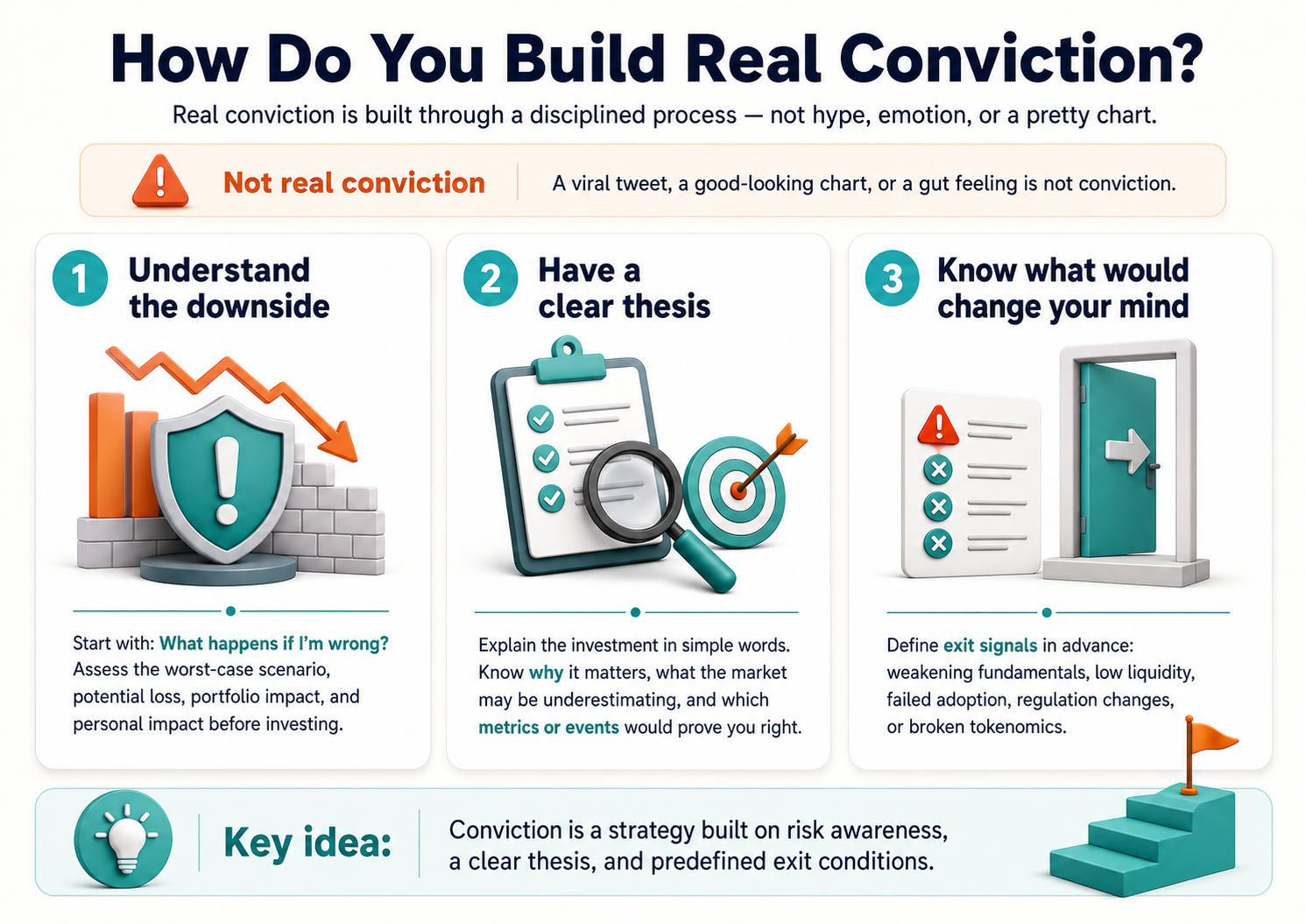
You know what would change your mind
The ultimate sign of mature confidence is knowing exactly when to walk away before you even get in. You must map out your invalidation signals in advance. This means writing down specific red flags, worsening company fundamentals, a sudden loss of market liquidity, failed product adoption, a major regulatory shift, or broken tokenomics. If you don't have pre-determined exit conditions, your conviction isn't brave at all.
When Is “Conviction” Just Luck or Overconfidence?
Time to burst a major bubble.just because you made money doesn't mean you're a genius. The market is notorious for rewarding bad behavior with temporary riches.
Never confuse a good outcome with a good process. Like a Russian roulette, winning it doesn't mean you played a smart game, it just means you got lucky. In crypto it's another story. Here is how to tell if your "conviction" is actually just overconfidence waiting to bite you:
The Thesis is only a story
Weak conviction is built on beautiful fairy tales, not hard data. If your entire investment thesis consists of repeating whatever your favorite influencer said, copying a hyped-up Discord community, or reading a project's shiny marketing roadmap, that's not investing.
If you can't explain the actual fundamentals, the real valuation, the catastrophic risks, and your exact exit plan without using buzzwords, step away from the buy button.
The position is too big for the risk
Even the most brilliant investment idea becomes a terrible decision if your position size is stupidly large.For example, If a sudden 50% to 70% drop would cause you to panic-sell, borrow money to pay rent, or completely change your life plans, your position size does not match the risk. You shouldn't be in this situation.
True conviction means you can sleep at night. If you’re staring at charts at 3 AM sweating, that is financial self-sabotage.
The investor confuses identity with analysis
This is a toxic relationship. You married the asset. People love to turn their investments into their entire personality. If you link your identity so deeply to a stock, a crypto community, or a specific narrative that you treat every piece of bad news or doubt as a personal attack, you're in trouble.
The market doesn't care about your feelings. The moment you start defending an asset like a loyal soldier instead of analyzing it like a cold-hearted accountant, you lose the ability to spot mistakes and save your own cash.
The Difference Between an Asymmetric Bet and a Blind Bet
Taking a big, aggressive move in the market is not completely stupidity. There is a big difference between taking a smart, calculated risk and just closing your eyes and jumping off a financial cliff.
At the end of the day, are you risking a little bit of pocket change to win a mountain of cash, or are you just gambling completely blind? Lets see the difference between both worlds.
- The Asymmetric Bet: This is a calculated move. You take a shot where the downside is strictly capped, but the potential upside is massive.
This is like buying a cheap lottery ticket where you know exactly what you could lose, but the payout could change your life. You have a smart plan, and your bet is small enough that if it goes to zero, you won’t care. You might have to skip eating out this weekend, but your rent is still paid and your portfolio is totally fine.
- The Blind Bet: This is pure financial hopium, you get completely blinded by the dollar signs, entirely ignoring the very real probability of being dead wrong.
It’s like betting your entire life savings on a single spin of the roulette wheel just because you "feel lucky." You only see the dollar signs and completely ignore the fact that you could lose everything. If the market drops, you have no backup plan and no escape hatch.
Aggressive investing can be profitable, but only if you own the risk. An asymmetric bet means you know exactly how much you can lose and you’re totally fine with it. A blind bet means you’re just praying the market doesn't punch you in the face.

Why Survivorship Bias Makes “All-In” Look Smarter Than It Is
The market absolutely loves a winner, that's why your feed most times is a toxic lie.
The guy who went completely all-in on a random asset and hit the jackpot gets to write 50-part threads, give podcast interviews, and get praised as a "visionary."
But you know who you never hear from? The thousands of other people who did the exact same reckless thing, lost their life savings, and quietly deleted their accounts, and may be still suffering.
This creates a big illusion. Because the winners are the only ones left talking, we assume their crazy strategy actually worked. It makes going "all-in" look like a genius masterclass which at that moment was just a terrifyingly dangerous gamble.
How to Test Your Conviction Before Increasing Risk
Before investing, you would want to test your conviction. You need to put your thesis into a stress test. How to do that ? Ask yourself the following questions:
Can I explain the thesis without buzzwords?
Take away the complex financial terminology and the trending buzzwords. If you can't explain why this asset will grow using simple, everyday language, you don’t have conviction. You only have a copy-pasted opinion.
What exactly needs to happen for this to work?
You need a concrete roadmap. What specific numbers, metrics, product launches, or real-world events need to fall into place to prove your idea right? If your only answer is "the price just needs to go up," step away from the buy button.
What could break the entire idea?
Name your ghosts. What major regulatory change, loss of liquidity, stronger competitor, or shift in fundamentals would completely ruin your thesis? If you honestly believe absolutely nothing can stop it, you are blinded by overconfidence. Restrategise again.
What loss can I realistically handle without panicking?
If this position drops by 50% tomorrow, will you sleep fine, or will you be sweating through your sheets and checking charts at 3 AM? If a crash alters your daily life, your position size is way too big for the actual risk.
Do I have an emergency exit plan?
Write down your boundary lines before the market forces you to. Knowing exactly at what price or under what conditions you will cut your losses and walk away is the sign of a mature investor.
Am I buying because of analysis, or because I'm terrified of missing the move?
Be brutally honest with yourself. Are you adding to this position because the data says it’s a smart entry point, or are you just panicking because the green candle is shooting up and you don't want to get left behind?
True conviction will answer these questions because it is not built in the heat of a green market, but has been calmly built in advance, by strategy, setting your rules before the emotional chaos begins.
Why Diversification Is Not the Enemy of Conviction
If you are so certain, why are you diversifying, just go "all-in". Heard this before?.
Diversification doesn't mean you have weak hands or a lack of belief. The "all-in or nothing" crowd loves to make you feel like if you own more than one asset, you’re just a coward who doesn't believe in their own thesis.
That is absolute nonsense. Diversification is a healthy respect for reality. Even if you have the most brilliant, bulletproof thesis on the planet, the market doesn't owe you a win. Unexpected things happen. Diversifying means you are admitting, "I am highly confident in my math, but I am also smart enough to know I don't control the universe"
You can hold high-conviction positions in the assets you love without exposing your entire life savings to a single point of failure. Take your big, aggressive swing, but keep enough cash scattered elsewhere so a single bad bounce won't take you out of the game completely.
What Does Healthy Conviction Look
True conviction doesn’t need to throw a tantrum in a Discord channel or suck up to influencers for validation. Because the data already did the talking, it just sits quietly in your portfolio, minding the business that pays it.
Here is exactly what healthy conviction looks like in practice:
- A Crystal-Clear Thesis: You can explain exactly why you own the asset using simple, everyday words.
- Defined Risk & Exit Plans: You know your invalidation signals and exactly where your emergency escape hatch is before things get ugly.
- Reasonable Position Sizing: Your bet is calculated. If the market takes a sudden 50% dive, your lifestyle, rent money, and sleep schedule remain completely untouched.
- A Regular Review Schedule: You treat your investment like a cold-hearted accountant, stepping back regularly to look at the data rather than checking the price every five minutes.
- Willingness to Pivot: You aren't married to the asset. If the core fundamentals break, you have the emotional discipline to admit you were wrong and walk away.
- The Ability to Survive: Your ultimate goal is longevity. You’ve structured your portfolio so that even if this specific thesis goes to absolute zero, you live to fight another day.
Conclusion
It would be very wise to stop mistaking recklessness for bravery. Going all-in might look like courage on a social media feed especially if the person happens to hit the jackpot, but a lucky outcome never justifies a terrible decision.
As we have already seen, True conviction is a disciplined belief supported by hard evidence, sized perfectly to match the risk, and constantly tested against reality. If you want to survive in this market long-term, remember the difference:
- Courage is taking a risk you actually understand.
- Luck is surviving a risk you never bothered to measure.
Disclaimer: The content provided in this article is for educational and informational purposes only and should not be considered financial or investment advice. Interacting with blockchain, crypto assets, and Web3 applications involves risks, including the potential loss of funds. Venga encourages readers to conduct thorough research and understand the risks before engaging with any crypto assets or blockchain technologies. For more details, please refer to our terms of service.