
Table of Contents
You might get excited when you hear about stablecoin yield. After all, earning from your money is never a bad thing. In fact, you might even get more excited than that time you went to Disney World as a kid. However, there are some things you should know about stablecoin yield and stablecoins before you get started.
Stablecoin Yield Explained: Where Returns Come From and What Risks You Take
Stablecoin yield often looks like "interest on digital dollars", but it is not risk free. If someone pays yield on stablecoins, users need to understand where that return comes from, who generates it, what risk the user takes, and why a high rate does not always mean a good opportunity. With stablecoins, yields come from real economic activity via borrower demand, trading fees, and protocol incentives, but more on that later. If you are trying to earn yield, it's important to know that there are some risks involved.
What Is Stablecoin Yield?
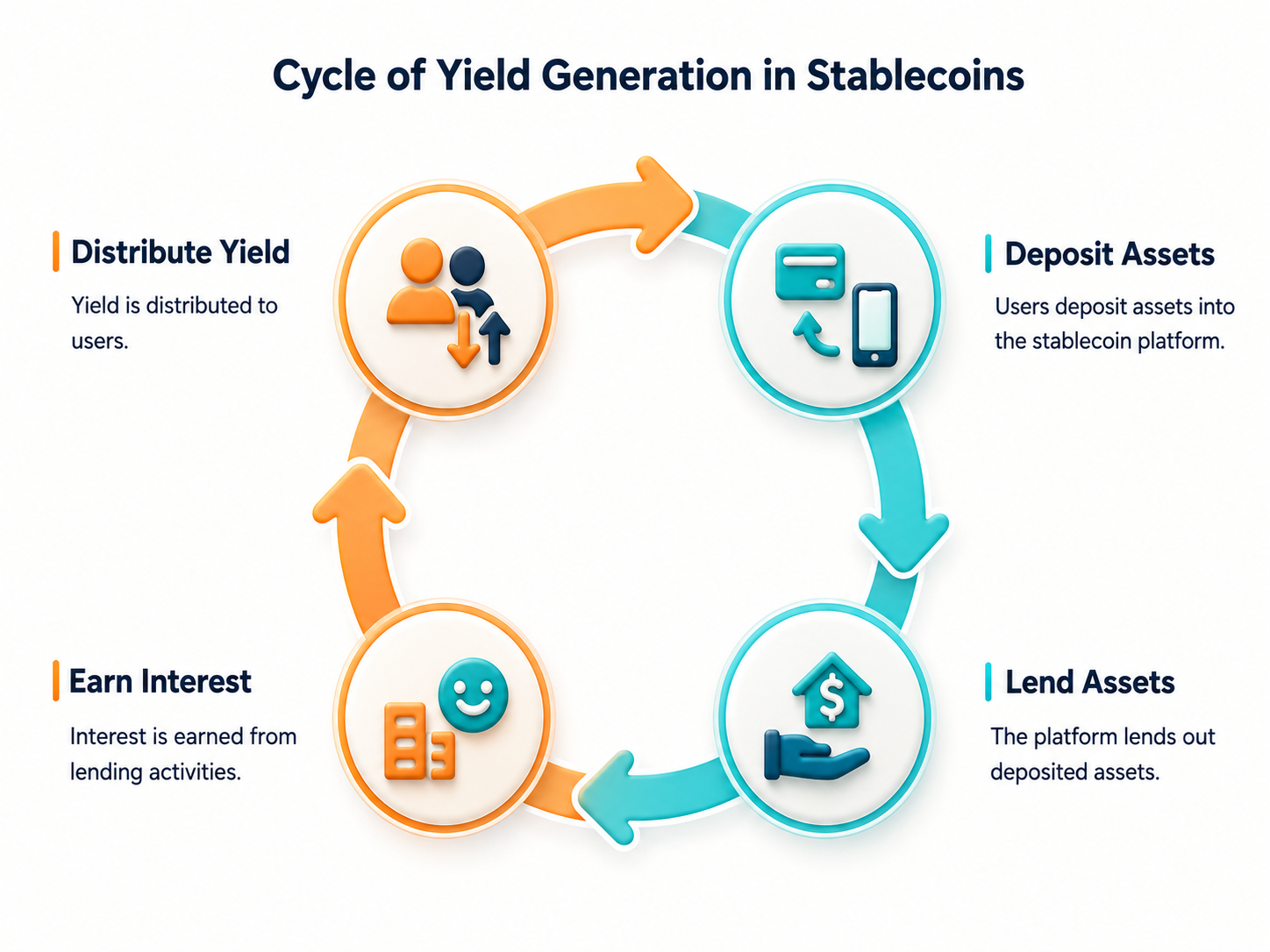
Stablecoin yield is the income a user earns by placing stablecoins in a platform, protocol or strategy. Yield may be shown as APR or APY, but the number itself does not show the risk. Stablecoins may be pegged to the dollar or the euro, but the yield comes from using those funds elsewhere. Stablecoin interest represents the yield generated when users deposit fiat-pegged digital assets into financial protocols. Traditional banking has high overhead costs that limit the yield amounts passed on to people who deposit. Decentralized finance works on blockchain networks using smart contracts to automate the process and pass on more of the generated amount to participants (those who deposit). It's like getting more candy at the candy shop. Who wouldn't want that!?
Where Does Stablecoin Yield Come From?
Yield can have different sources, and each source often comes with a different type of risk involved. As mentioned earlier, yield opportunities come from economic activity via borrower demand, trading fees, and protocol incentives. Each of these operates differently, sort of like how a Lamborghini is different from a Tesla or a Ford car.
Lending and borrowing demand
Part of the yield appears when stablecoins are lent to other market participants like traders, institutional borrowers, DeFi users, or protocols. In this case, the income comes from the interest paid by borrowers. Simply said, you deposit stablecoins into a protocol or platform that lends them to other users. However, keep in mind that if there is lending, there is borrower risk, collateral risk, liquidation risk, or platform risk. Four different possible types of risk that you can encounter with this process. So I will keep mentioning it; stablecoin yield is not without risks.
Liquidity pools and trading fees
Stablecoins can also generate income through liquidity pools, where users provide liquidity for swaps. In this case the income comes from trading fees or incentives. Basically it works like this. You supply liquidity that traders use to swap assets, and in return you earn a portion of trading fees, plus occasional incentive tokens. Unfortunately, this also comes with a bit of risk, sort of like riding your motorcycle at 115 miles per hour. There is smart contract risk, liquidity risk, potential depeg risk, and sometimes impermanent loss, even in cases where the assets seem "stable" (no pun intended lol). Just in case you don't know, impermanent loss is when the value of your allocated assets changes from the time you allocated them to a DeFi liquidity pool.
Protocol incentives and token rewards
Sometimes high yield comes from something other than real economic activity. Sometimes it comes from temporary rewards, subsidies, or token emissions. However, you must remember that although getting token rewards sounds great, this kind of stablecoin yield can fall quickly when incentives end or the reward-token price drops.
Treasury-backed or real-world asset strategies
Some stablecoins may generate income through instruments linked to short-term government debt, money market exposure, or other off-chain assets. However, once again, this is not risk- free. Custody, legal, liquidity, transparency, and redemption risks are still there. I'm starting to sound like a broken record with these risks, right? But it's always important to keep risks in mind when making financial decisions, whether it's related to stablecoin yield or something else.
Why Can Stablecoin Yield Rates Be So Different?
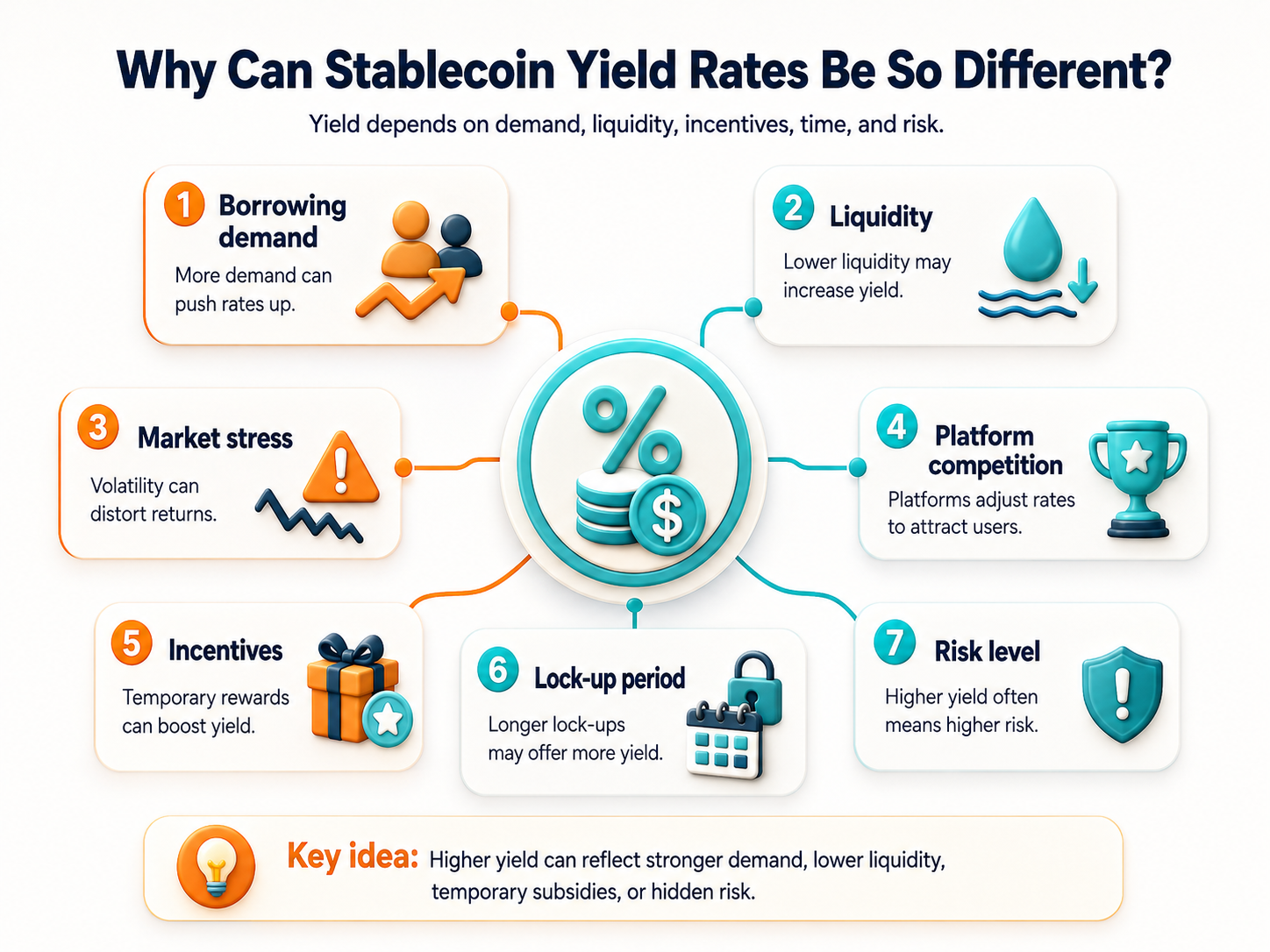
There are a lot of different aspects that can cause stablecoin yield rates to be different. Rates differ because of borrowing demand, liquidity, market stress, platform competition, incentives, lock-up period and risk level. Higher yield often means either higher demand, lower liquidity, temporary subsidies or more risk hidden inside the structure.
What Risks Do You Take When Earning Yield on Stablecoins?
In case you didn't get it the first time, or the second, or the third, users take on a whole combination of risks when they earn yield on stablecoins. For example, stablecoin risk, platform risk, strategy risk, and access-to-funds risk.
Stablecoin risk
One thing that can happen with stablecoins is that they can depeg from the fiat currency they are pegged to. This can cause the price of the stablecoin to change slightly. Issuer risk can be an issue as well. Stablecoins rely on the issuer of the coin to have financial stability and use responsible reserve management practices. Also, reserve composition matters for stability and safety, and not all issuers offer regular audits to see what their reserves are made of. Liquidity risk is another potential issue that means that the issuer or user cannot easily cash out if needed.
Platform or counterparty risk
Counterparty risk describes interacting with an issuer or an exchange that may fail to meet its obligations. This can happen a lot in crypto. You have to do your research to try to learn if the party you are interacting with is legitimate and sound in judgement. You don't want to get stuck in a situation like what happened with Terra/Luna a few years ago. A "simple rate in an app" can hide credit or operational risk.
Smart contract and DeFi risk
In DeFi, users depend on code, oracle data, liquidation mechanics, governance decisions, bridges, and integrations with other protocols. Each of these can cause something to go wrong and create a problem for users. For example, governance decisions are out of the users control and can make changes that alter user investments. There can be errors or bugs in the code behind the cryptocurrency or blockchain that it runs on. An audit can reduce part of the risk, but it still does not mean the strategy is completely safe.
Liquidity and lock-up risk
Some strategies restrict withdrawals, have a lock-up, withdrawal delays, or depend on a secondary market. If there is a lock-up period, users won't be able to sell their funds for a specified period of time, adding risk in the event that something else out of there control happens during that time and they are unable to do anything to prevent potential losses.
In a stressful situation like this, access to funds can mean more to a user than the advertised yield.
How to Tell If a Stablecoin Yield Offer Is Too Risky
Here are some red flags to avoid when looking at stablecoins and stablecoin yield. A very high rate without an obvious source of income, a clouded or obscure strategy, lack of information about reserves or couterparties, complex reward mechanics, a lock-up without clear terms, no liquidity data, a weak platform reputation, or promises of being safe without explaining the risk are all red flags that should make you think twice.
Check the platform's reputation by reading reviews and other research tactics before making an investment. Be wary of very high rates without explanation of how they are able to offer such high rates. Don't trust any platform that says it's safe. There are always risks involved in making investments.
How Should Users Compare Stablecoin Yield Opportunities?
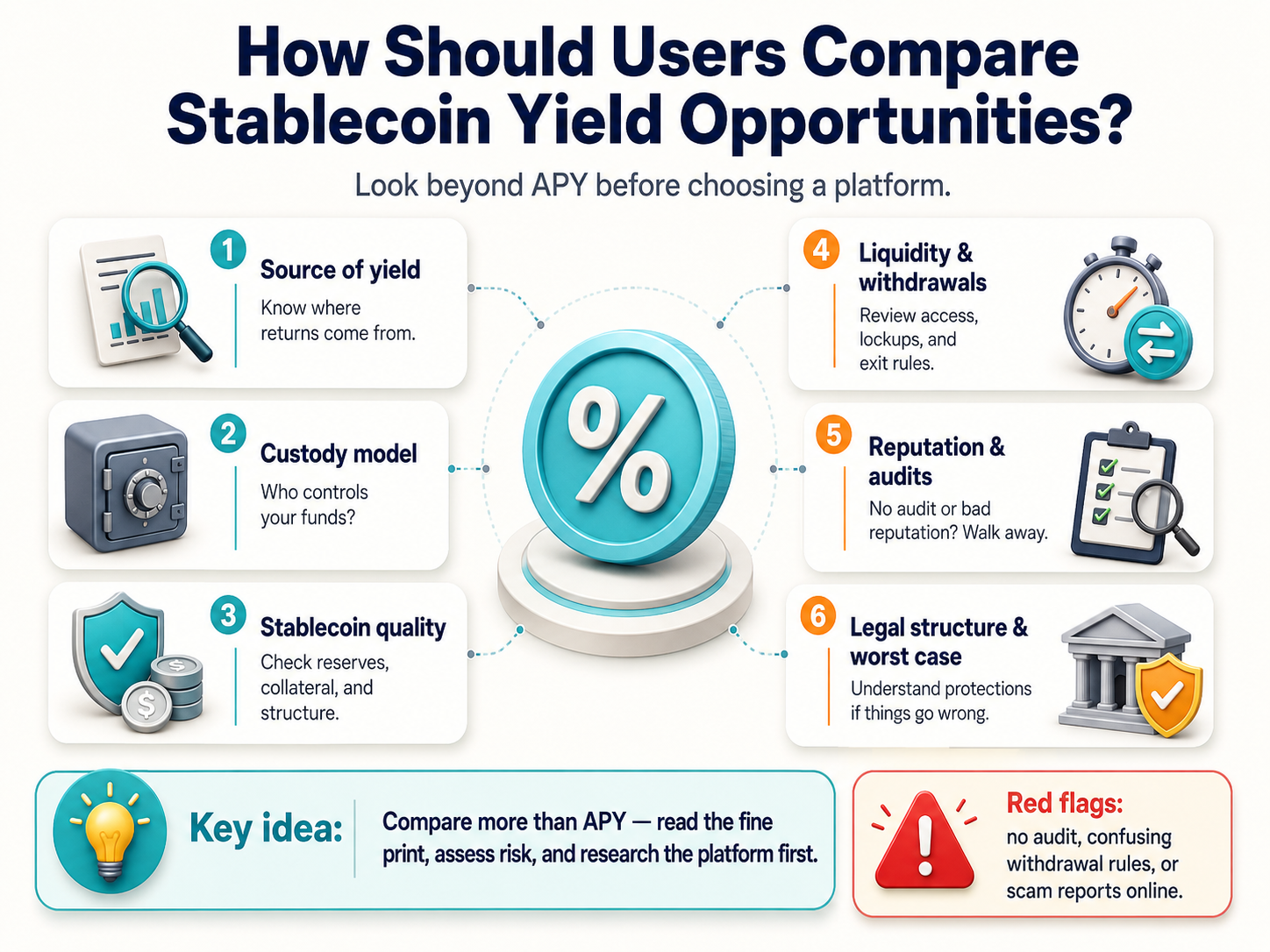
If looking at stablecoins or stablecoin yield opportunities, users should do more than compare APYs. They should look at the source of yield, custody model, stablecoin quality, liquidity, withdrawal rules, platform reputation, audits, collateral, legal structure and worst-case scenario. Has the platform not been audited in a while, or ever? Run away.
Does it have a bad reputation online of being untrustworthy or scamming people? Don't invest no matter how appealing the APY is. Does it have strange withdrawal rules that seem confusing and like withdrawals may be stopped at any point? Find another platform. Make sure you put on your glasses to read the fine print and do your research first.
Remember: Stablecoin Yield Is Not Free Money
Stablecoin yield can be a useful tool, but the return you get always comes from somewhere and pays for something. If yield comes from lending, liquidity, incentives or off-chain strategies, the user must understand the corresponding risks. Don't simply ask yourself "How much will I earn?" but also ask yourself "What are the risks and where is the yield coming from?" Because the interest you earn has to come from somewhere.
Don't get caught in the trap of chasing the highest yield or APY. Make sure you understand the the platform and all of its possible risks before investing. Don't be the guy or gal who gets caught in the next Terra/Luna situation and loses everything. If it seems too good to be true, it often is.
Disclaimer: The content provided in this article is for educational and informational purposes only and should not be considered financial or investment advice. Interacting with blockchain, crypto assets, and Web3 applications involves risks, including the potential loss of funds. Venga encourages readers to conduct thorough research and understand the risks before engaging with any crypto assets or blockchain technologies. For more details, please refer to our terms of service.