
Table of Contents
You've probably sent a payment before and watched the fee swallow half of it. Or waited ten minutes for something that should take two seconds? That's usually a blockchain layer problem, not a you problem.
People use L1, sidechain and L2 like they mean the same thing. They don't. Your transaction settles somewhere specific. Somebody specific secures it. And the fee you end up paying, a few pence one day, several pounds the next, isn't random. It comes down to which layer of the blockchain handled it.
Quick version first, detail after. A Layer 1 blockchain sits right at the bottom, the base network everything else is built on. A sidechain sits next to it instead, running as its own separate chain. Layer 2 blockchains take a different position entirely, building on top of the L1 and borrowing its security rather than replacing it. Three layers, three different setups entirely, even though people often lump them together.
What Are Blockchain Layers?
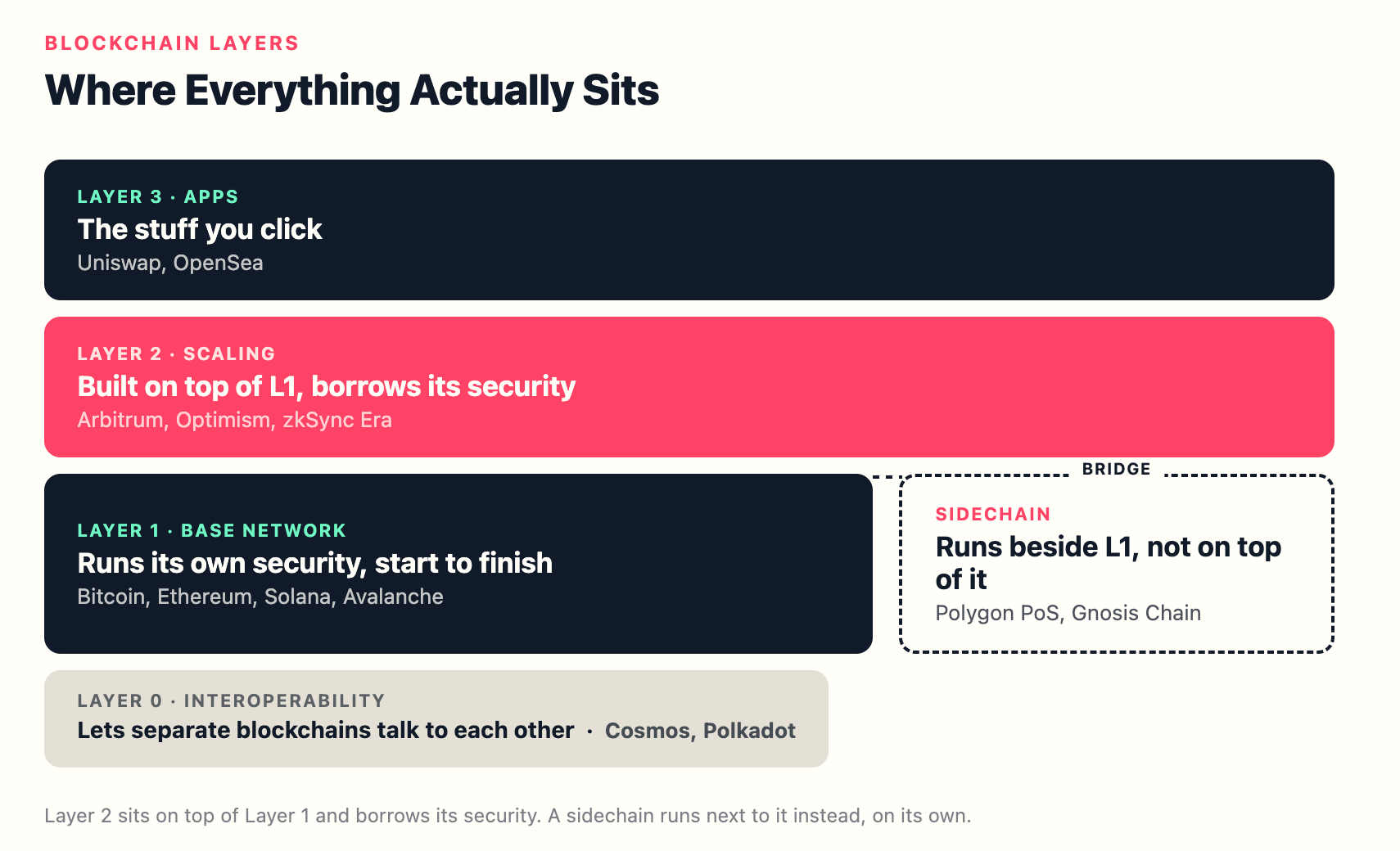
Blockchain layers are basically infrastructure stacked in levels, and each level has its own job to do. Some layers deal with security and consensus. Others handle scaling. And some are built purely so different blockchains can talk to each other, or so users get an actual app to click through instead of raw code.
There are two more layers worth a mention, even though this guide doesn't dwell on them. Layer 0 sits underneath everything else, quietly letting separate blockchains like Cosmos or Polkadot talk to one another. Layer 3, meanwhile, is what you'd actually recognise: apps like Uniswap or OpenSea, built on an L1 or L2 without you ever seeing the plumbing underneath. This guide sticks to the three in between, Layer 1, sidechain, and Layer 2, because those are the ones your everyday decisions actually touch.
Why just these three? Because they're the ones that decide your fees, your speed, and how safe your funds are. Layer 0 and Layer 3 aren't unimportant, they just sit one step removed from the wallet decisions you make day to day.
Why Do Blockchain Layers Exist?
Base blockchains hit limits fast. Bitcoin tops out around 7 transactions per second, and Ethereum's mainnet isn't dramatically better, somewhere in the 15 to 30 range. Visa processes thousands in that same second without even trying.
Picture buying a coffee with Bitcoin. The coffee costs £4. Most days the network fee is a fraction of a penny, but when the chain gets busy, it can spike past what you're actually buying. Then you're stuck waiting ten minutes for confirmation, while whoever's queuing behind you taps their card and is out the door already. None of that's a glitch. It's just what happens when a blockchain is built the way Bitcoin's is.
That's the blockchain trilemma showing up in real life. Push hard on decentralisation and security, and scalability tends to suffer, which is roughly the trade Bitcoin and Ethereum both made early on. Fine when things are quiet. Expensive and congested the moment demand spikes.
Layering is basically the workaround. Rather than making one blockchain juggle everything at once, the job gets split up. The base layer focuses on security and settlement. Other layers pick up the scaling work, so the whole system doesn't have to compromise everywhere simultaneously.
What Is a Layer 1 Blockchain?
A Layer 1 blockchain doesn't borrow anything from anyone. It has its own validators or miners. Its own native coin. Its own way of agreeing on what's true. Bitcoin, Ethereum, Solana and Avalanche are the Layer 1 blockchains most people actually recognise, and every single one of them processes its own transactions start to finish, alone.
Everything from here on builds on top of Layer 1 somehow. Say "the blockchain" without any qualifier, and this is usually what people actually mean. Not every L1 tackles scaling the same way, either. Solana leans into raw throughput as its answer. Avalanche instead built what it now calls Avalanche L1s (subnets, before a late-2024 rename), letting different applications run on their own customised slice of the network. Neither one escapes the trilemma entirely, but both prove there's more than one way to design a base layer.
What Does Layer 1 Do?
An L1 does the unglamorous stuff that keeps a blockchain running, but none of it's optional. Recording transactions. Keeping the network's state accurate. Agreeing on what actually counts as valid. Locking blocks down so nobody can quietly rewrite them later.
Security lives here too. Bitcoin's proof-of-work and Ethereum's proof-of-stake both operate at this layer, and that's exactly why "not your keys, not your coins" holds up as more than just a slogan. Whatever gets built above the base chain, sidechain or L2, still ultimately depends on what that base layer can guarantee. Compromise the L1, and nothing built on top of it stays safe either. Which is precisely why L1 security gets so much attention in the first place.
What Is a Sidechain?
A sidechain sits beside a main blockchain network, not inside it, and a bridge is what connects the two. Assets can move across, sure, but don't confuse this for the same chain wearing a different name. Its validators are its own. Its consensus rules are its own. Security, top to bottom, is entirely its own job too.
Polygon's original PoS chain is probably the best-known case. Back when it launched, it was just a sidechain to Ethereum, quietly running its own transactions long before turning into the much bigger ecosystem it is today. Gnosis Chain works on a similar principle, though smaller in scale. It used to go by xDai, and it exists mainly so everyday stablecoin payments stay fast and cheap.
That independence is the whole appeal of a sidechain. It's also the catch. That's the trade-off, really. A sidechain's security is homegrown, not borrowed, so it doesn't get to lean on the main blockchain's protection the way an L2 can. Newer or smaller validator sets carry real risk here. Worth actually checking before assuming otherwise.
What Is a Layer 2?
A Layer 2 blockchain is a solution built directly on top of a Layer 1 blockchain to ease the load on the base network. Rather than running its own independent security, an L2 leans on the L1 underneath it. It processes activity off the main chain, then sends the results back to L1 for final settlement.
That "borrowing" of security is the main difference from a sidechain. A sidechain stands on its own two feet. An L2 stays tethered to its base layer, and that tether is precisely what makes it trustworthy.
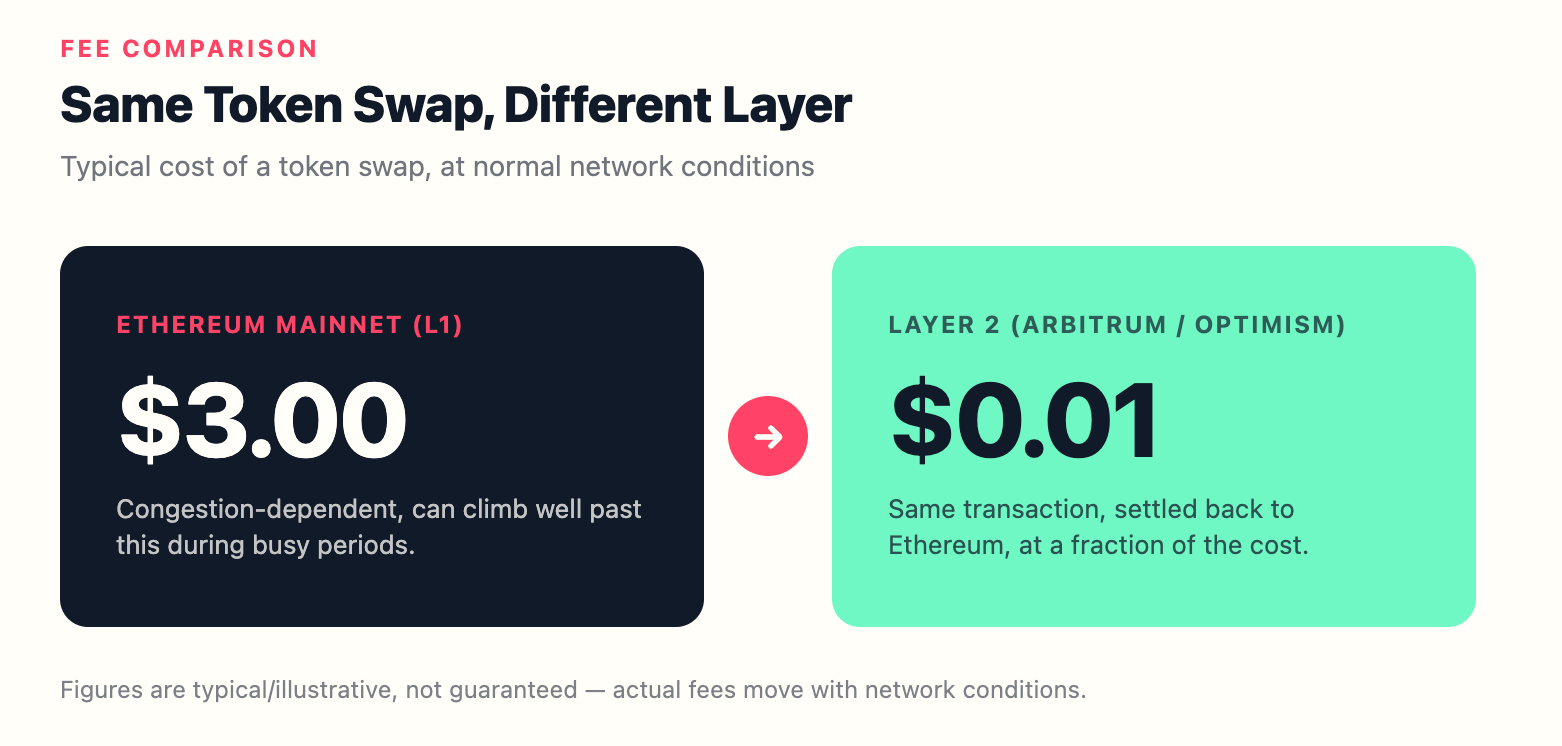
The numbers make the case better than any explanation could. A token swap that costs around $3 on Ethereum mainnet often costs as little as $0.01 to $0.15 on Arbitrum or Optimism. Since the Dencun upgrade introduced dedicated data space for rollups back in 2024, typical fees on Layer 2 blockchains have dropped to somewhere between $0.001 and $0.01 for simple transfers, while a basic mainnet transfer (as opposed to a swap) still ranges up to around $0.33 depending on how congested the network is. That's not a marginal saving. It's the difference between a transaction being viable for everyday use and not.
Common Types of Layer 2 Solutions
There's no single technology called "Layer 2." A handful of different approaches all chase the same goal of taking pressure off the base blockchain, just via different routes.
Rollups
Rollups take a big batch of transactions, bundle them together, and post the result, or a cryptographic proof standing in for it, back to the L1 underneath. There are two main flavours. Optimistic rollups assume transactions are valid unless someone challenges them within a set window, usually around seven days. ZK rollups use cryptographic proofs to confirm validity upfront, which means faster finality but more complex technology underneath.
Arbitrum and Optimism are among the biggest optimistic rollups by usage, hosting most of the major DeFi protocols people actually trade on day to day. Base, Coinbase's OP Stack chain, has grown fast enough to rival both on activity and revenue, despite being newer to the space. zkSync Era is one of the better-known ZK rollups, often posting some of the lowest fees on any Ethereum layer, frequently under $0.10 per transaction.
State Channels
State channels let participants transact many times off-chain, then only record the final state on the base blockchain once they're done. Bitcoin's Lightning Network is the go-to example here. Two people can fire payments back and forth instantly and for next to nothing, and the main chain only ever sees two moments in that whole exchange: the channel opening, and the channel closing.
It works nicely for anything fast and repetitive, think frequent small payments, though it starts to struggle once you need more complex smart contract logic layered in.
L1 vs Sidechain vs L2: What's the Difference?
This is the comparison that actually matters when you're deciding where to transact.
An L1 is the base network. It handles everything itself: consensus, security, settlement, the lot, with nothing else to fall back on.
A sidechain, on the other hand, runs as its own separate blockchain next to the base chain, bridged across, playing by its own rules and answering to its own security entirely.
An L2 doesn't stand apart the same way. It's built directly on top of an L1, borrows that chain's security, and settles everything back down to the base layer rather than going it alone.
The practical distinction comes down to trust. When you use an L1, you're trusting that blockchain's own validators. When you use a sidechain, you're trusting a different, separate set of validators entirely. When you use an L2, you're mostly still trusting the L1's security, with the L2 adding speed and lower costs on top of that foundation.
How Assets Move Between L1s, Sidechains and L2s
None of this works without bridges. A bridge locks, or sometimes burns, an asset on one blockchain and mints a matching version on another, which is how value ends up moving between environments that would otherwise have no way of talking to each other.
Deposits into an L2 are generally quick. Withdrawals back to the base blockchain can take longer, particularly on optimistic rollups, where that seven-day challenge window exists specifically to catch anyone trying to submit fraudulent data before it settles.
This is where a lot of newer users get caught out. Sending assets to the correct network is only half the job. Sending them through a bridge you actually trust, and understanding the withdrawal timeline involved, matters just as much. Bridge exploits have been responsible for some of the largest losses in crypto's history, running into hundreds of millions of dollars in a single incident more than once, so this isn't a minor detail worth glossing over.
Benefits and Risks of Each Layer
Layer 1 is usually strongest on security and finality. What it isn't strong on: speed and cost, especially once the base blockchain gets busy.
Layer 2 cuts fees dramatically and speeds everything up. The trade-off is added technical complexity, plus a dependency on the L1 it settles to. Run into trouble on the base chain, and whatever's built on top of it as an L2 feels that trouble too.
A sidechain earns points for flexibility and lower costs, and its block times are often quicker than the base blockchain it runs beside. But its security is entirely its own responsibility, borrowed from nobody, so it's worth actually checking who's validating that chain before putting anything meaningful on it.
How to Choose Between L1, Sidechain and L2
The right layer depends on what you're actually doing, not which name sounds most impressive at a party.
Storing significant value for the long term? An L1 usually wins on security. Making frequent small payments or trading actively in DeFi? An L2 probably makes more financial sense. Testing a new product, or need specific features an L1 doesn't offer out of the box? A sidechain might be the better fit.
The mistake to avoid is picking a layer of the blockchain by reputation alone. What actually matters is the trade-off between cost, speed, security, and how well-supported the ecosystem is around whatever you're trying to do with it.
Common Beginner Mistakes
A few mix-ups come up again and again with newcomers to blockchain technology.
- Treating a sidechain as identical to an L2. They're not the same thing, and the underlying security assumptions are different between the two.
- Sending assets to the wrong network. An address can look perfectly correct while pointing at an entirely different blockchain, and that mistake is often unrecoverable once it's confirmed.
- Ignoring bridge risk. Bridges have historically been one of the more exploited parts of the whole ecosystem, and that risk doesn't disappear just because a bridge looks official.
- Chasing the lowest fee without asking why it's low. Sometimes it's efficient technology, built and battle-tested properly. Sometimes it's a newer, less tested blockchain with fewer safeguards built in yet.
- Not knowing where settlement actually happens. Not knowing this, whether your funds ultimately rely on L1 security or a sidechain's own validators, means you don't really understand what you're holding. Confidence doesn't fix that.
Closing Thoughts
L1, sidechain, L2. Three names, three completely different jobs inside the blockchain ecosystem, not variations on the same thing. A Layer 1 provides the foundation and the security guarantees everything else depends on. A sidechain runs its own show alongside that base blockchain. A Layer 2 borrows the base layer's security while handling the speed and cost problem the L1 can't solve alone.
None of that is complicated once the roles are clear. What changes is how you read the wider crypto world from here. Next time a fee looks suspiciously low, or a transaction settles in a couple of seconds instead of minutes, you'll have a decent idea of which layer is doing the work, and exactly what you're trusting to make it happen.
Disclaimer: The content provided in this article is for educational and informational purposes only and should not be considered financial or investment advice. Interacting with blockchain, crypto assets, and Web3 applications involves risks, including the potential loss of funds. Venga encourages readers to conduct thorough research and understand the risks before engaging with any crypto assets or blockchain technologies. For more details, please refer to our terms of service.