
Table of Contents
Compared to the rest of crypto, stablecoins feel almost boring, with no overnight swings and no reason to check the price at 3am. But calm isn't the same as safe.
The biggest risk to your stablecoins usually isn't a depeg or an issuer going wobbly. It's who actually controls access to your funds, and honestly that boils down to three boring but important things: whose hands the private keys are in, what network you sent on, and whether you caught it in time if something went sideways.
So you've basically got two options. Stick your funds on Coinbase, Kraken, Binance, whatever, and they hold the keys. Or you hold them yourself. MetaMask works fine if you want quick access from your phone. If you'd rather your private keys never go near the internet, get a Ledger or Trezor instead. Honestly, the whole "which is better" debate you see online is overblown. Balance size and what you're actually doing with the money decide it for you most of the time.
It matters more for stablecoins than people assume. A lot of holders treat them as a parking spot between trades, or use them for actual payments and transfers, rather than a long-term speculative bet. That day-to-day usage pattern changes what "safe" even means, because you're not just protecting against a price crash. You're protecting against every single transfer you make.
What Does It Mean to Store Stablecoins Safely?
Safe storage isn't just picking a well-known crypto wallet and calling it done. There's more going on underneath.
Who controls the custody model. How you recover your account if something goes wrong. Whether the wallet supports the right networks. The risk of sending funds to the wrong chain entirely. dApp permissions you've granted and forgotten about. Basic device security.
Here's the bit people miss: a stablecoin can hold its price perfectly and you can still lose every penny. Phishing, a network slip-up, a compromised account, or a seed phrase stored somewhere it shouldn't be. Price stability and fund safety are two completely different things.
This trips people up more than you'd expect. USDC lives on Ethereum, Solana, Base, and a handful of other networks, so send the Ethereum version to an address set up only for Solana and that money's simply gone. No depeg involved anywhere. Just a network mismatch, and a transaction nobody can reverse.
What Is Custodial Stablecoin Storage?
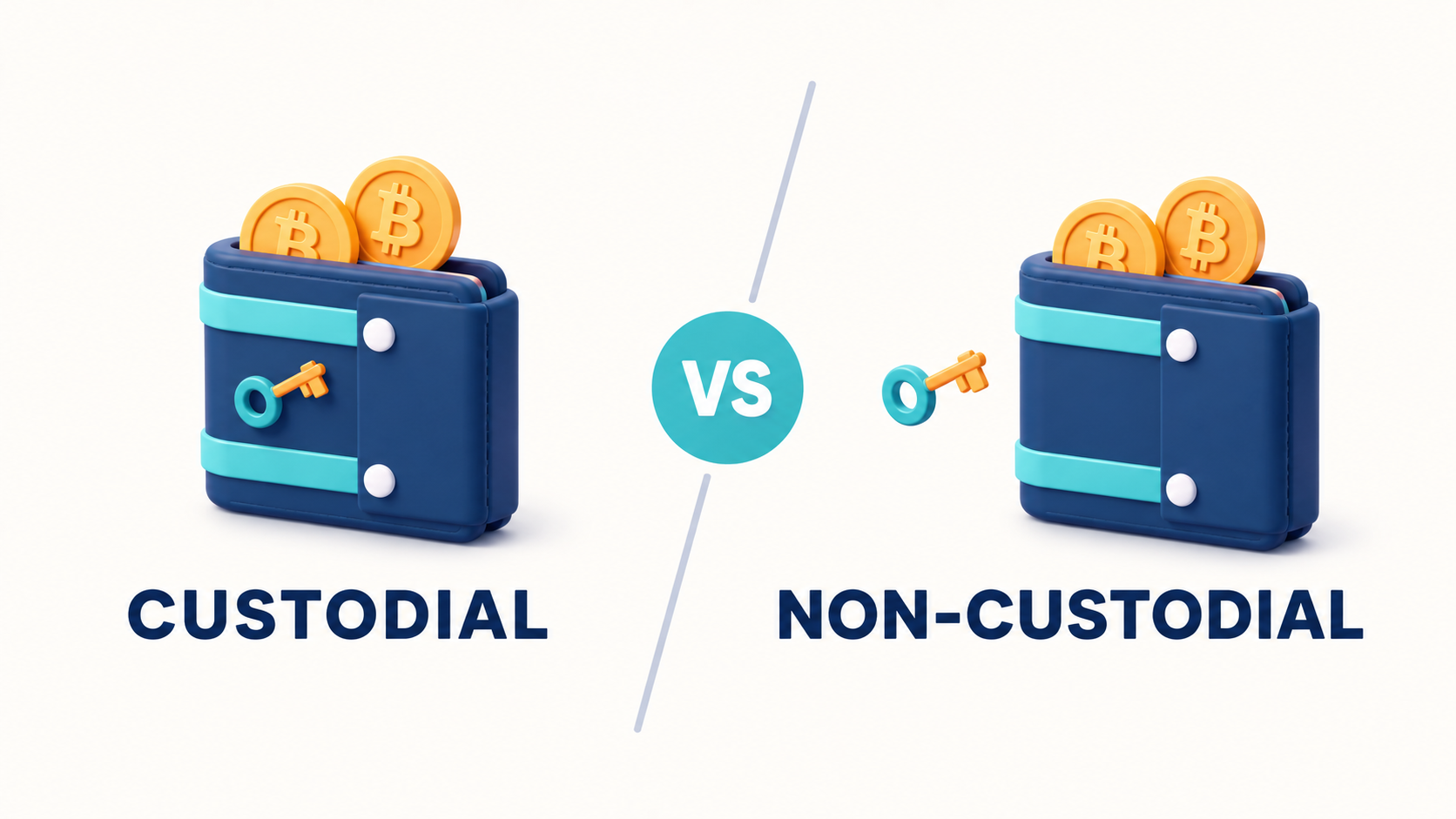
With custodial storage, it's a platform, exchange, or custodian that manages access to your stablecoins, not you directly. You see a balance in your account. You don't hold the private keys yourself.
The trade-off is straightforward. It's more convenient for buying, selling, recovering a lost password, and cashing out to fiat. But you're now dependent on that platform's rules, its security, and honestly, whether it's even still operating. Larger institutional custodians, such as Coinbase Custody or BitGo, add layers like insurance and compliance audits on top, which is part of why institutions favour them over managing private keys internally.
When custodial storage can make sense
Trading is the obvious one. If you're moving in and out of positions regularly, having funds sitting on an exchange saves a lot of back-and-forth.
Small working balances too. Money you're using day-to-day doesn't need the same treatment as long-term savings. Quick access to a fiat on-ramp matters here as well, along with straightforward beginner scenarios where account recovery and customer support genuinely count for something. If you've never managed a seed phrase before, starting custodial and moving funds across gradually as you learn is a reasonable way in.
What risks come with custodial storage
Account freezes happen. So do withdrawal limits, KYC restrictions, and the occasional platform hack. Some of these are inconvenient. Others are catastrophic for your digital assets.
You don't have to go far to find examples of custodial storage going wrong, unfortunately. FTX is probably the one you already know about: it collapsed in November 2022, and around $8 billion in customer money just wasn't there when people went looking for it. It wasn't the only blow-up that year, either. Celsius froze close to $4.7 billion in user funds around the same time, and a few years earlier, in 2014, Mt. Gox managed to lose 850,000 Bitcoin to hackers (worth an absurd amount of money today, given how far Bitcoin's come since). None of it was bad luck. It was custodial failure, plain and simple, and the people affected couldn't do a thing about it no matter how careful they'd been.
A custodial wallet takes a chunk of personal burden off your shoulders. In exchange, it hands you counterparty risk. You're trusting the platform to still be solvent, honest, and operational whenever you next need your funds. That trust isn't a small thing to hand over.
One extra wrinkle worth knowing: some custodial platforms offer "earn" or yield accounts on stablecoin deposits. These can look like a savings account, but they're not covered the same way a bank deposit would be. Celsius offered exactly this kind of product before it froze withdrawals, and depositors found out the difference the hard way.
What Is Self-Custody for Stablecoins?
With self-custody (also known as non-custodial), that arrangement is reversed. You control the wallet and the private keys, full stop. Your funds sit directly on the blockchain, with no platform standing between you and them.
There's real independence here, and full access to DeFi: lending, liquidity pools, on-chain payments, all of it. The catch? Nobody's coming to fix it if you mess up. Wrong seed phrase, dodgy link, wrong network, take your pick. Once it's done, it's done. There's no identity verification check to fall back on here, the kind that gets a custodial account back online. Self-custody just doesn't work that way.
When non-custodial wallets can make sense
Long-term storage is the classic case. Larger amounts too, where counterparty risk starts to matter more than convenience.
If you're active in DeFi, making on-chain payments, or simply don't like the idea of keeping everything on one platform, non-custodial wallets start to look a lot more sensible. A hardware wallet, or a dedicated wallet kept separate from your everyday spending, works well here. For genuinely large holdings, some people go further and use a multi-signature setup, where more than one private key is needed to approve a transaction, spreading the risk across more than one point of failure. Just know it works best when you're actually willing to follow some basic security discipline.
What risks come with self-custody
Losing your seed phrase is the big one, and there's genuinely nothing to fall back on if it happens. No password reset waiting for you, no line you can call. Write it down. Keep it offline. Lose that piece of paper and you've lost the wallet, full stop.
Most scam attempts aren't even clever, which almost makes it worse. Fake login pages, malicious approval requests, drainer scripts hiding in a dodgy dApp, a browser extension that's been quietly compromised. You'll see some version of these again and again. A fake token-approval pop-up can quietly hand someone permission to drain your wallet days later, long after you've forgotten clicking "approve." Send to the wrong network and that money's gone the same way. Basically, self-custody doesn't get rid of risk. It just hands it to you instead. You become the single point of failure, not the platform.
Custodial vs Non-Custodial Wallets: Which Is Safer for Stablecoins?
Depends who you ask, really. Risk tolerance and technical comfort matter more here than reputation does.
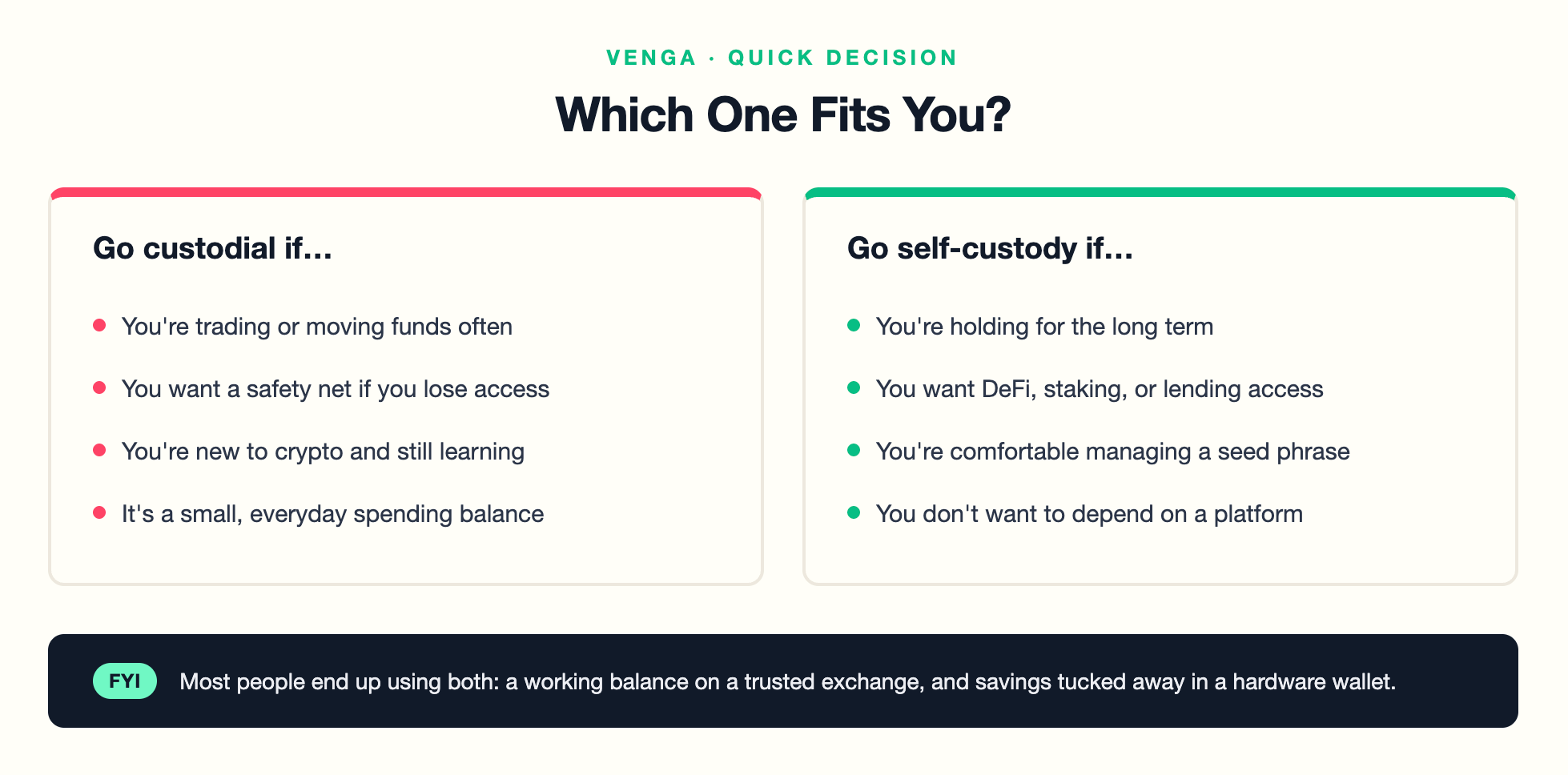
Someone who isn't ready to manage a seed phrase and genuinely values account recovery may well be safer on a custodial platform. Someone confident in protecting their own private keys, who doesn't want to rely on a third party staying solvent, may be safer in self-custody. Someone with two hundred pounds sitting ready for a quick swap has a very different risk profile to someone holding a year's worth of savings.
Neither model removes risk. Each one just relocates it somewhere else. The question worth asking isn't which is safer in the abstract. It's which risk you're more comfortable carrying.
Plenty of people don't actually pick a side and stay there forever. It's pretty common to run both, keeping a working balance on a trusted exchange for everyday convenience while tucking the rest away in a hardware wallet for anything you'd genuinely be upset to lose. Nobody's making you choose just one.
How Custodial and Non-Custodial Storage Compare on Cost and Risk
How Should You Store Stablecoins for Different Use Cases?
You don't need to store every stablecoin the same way. That's actually the whole point.
A small active balance benefits from convenience and quick access. A larger, long-term balance benefits from control, offline backup, and separation from anything experimental. Using one wallet for savings, DeFi testing, and random dApp connections all at once is asking for trouble. It's the crypto equivalent of keeping your rent money in the same pocket as your festival spending cash.
Small active balance
Transfers, fee payments, quick swaps, the odd trade. Convenience and network support matter most here. A few hundred pounds sitting on an exchange for active use is a fairly low-stakes trade-off.
Still worth the basics: avoid suspicious apps, don't click random links, and don't store your recovery phrase as a note on your phone. Small balance doesn't mean zero risk.
Larger or long-term balance
This is where control matters more than speed. Offline backups, a hardware wallet, minimal active connections, and genuine separation of funds all count. It's fairly common for people with larger holdings to spread them across two or three separate crypto wallets, so no single mistake or compromise can wipe out everything at once.
The crypto wallet holding your long-term stablecoins shouldn't double as the one you use to try out a new dApp on a whim. That separation alone prevents a lot of avoidable losses.
What Security Habits Matter Most?
Seed phrase offline, no exceptions. If you've got anything worth protecting, get a metal backup plate instead of paper. Paper burns, floods, disintegrates in a drawer for ten years; metal doesn't care. On the custodial side, turn on 2FA and use an actual authenticator app instead of SMS if the option's there. SIM swaps happen more than people think. And before you send anything, just glance at the network first. Takes two seconds, saves you a genuinely terrible day.
Only ever use official apps, full stop. And here's the thing about your recovery phrase: nobody who actually works for a wallet or exchange will ever ask you for it. Not by email, not in a support chat, not in a DM from someone claiming to help. If anyone asks, that's the scam, every time. Go check your approved dApps every so often too, set a reminder if you need to. Most wallets list them right there, and there's a decent chance you'll find something from months ago you don't even remember approving. Don't ignore app and device updates either. Sending somewhere new for the first time, and it's a decent amount? Send a small test transfer first, confirm it lands, then send the rest. None of this is thrilling stuff. It's just the difference between people who still have their stablecoins a year from now and the people who don't.
What Should You Check Before Choosing a Stablecoin Wallet?
Before committing to a wallet, run through this list first. Custody model, supported stablecoins, supported networks, fees, withdrawal limits, recovery options, reputation, security features, DeFi compatibility, and how easily you can actually move funds out.
The network point deserves a bit more attention than it usually gets. A wallet needs to support the right token and the right network. Sending USDT or USDC to the wrong one can turn into a very expensive lesson. Worth checking fees too, since these vary a lot: a custodial withdrawal fee is fixed and predictable, while a non-custodial wallet’s network fee shifts with congestion and can spike sharply during busy periods.
Reputation is worth a genuine look, not just a glance. How long has the platform or wallet been operating? Has it published security audits? If it's ever been hacked, how did the team handle the aftermath? A few minutes checking these tells you considerably more than a polished interface ever could.
Conclusion: What Is the Safest Way to Store Stablecoins?
Safety here isn't a fixed answer. It depends entirely on how you actually use your stablecoins.
Custodial wallets buy you convenience and a safety net if you lose access. The cost is dependence on a platform staying solvent and honest. Self-custody hands you full control, at the price of managing your own private keys and permissions carefully.
The version of this that actually holds up starts with choosing the right custody model for what you're doing, keeping different use cases in separate wallets rather than blending them, and checking both token and network before anything meaningful gets sent. Everything else tends to follow once that part is right.
Disclaimer: The content provided in this article is for educational and informational purposes only and should not be considered financial or investment advice. Interacting with blockchain, crypto assets, and Web3 applications involves risks, including the potential loss of funds. Venga encourages readers to conduct thorough research and understand the risks before engaging with any crypto assets or blockchain technologies. For more details, please refer to our terms of service.