
Table of Contents
For most people, crypto starts on an exchange. Sign up, add payment details, buy. Job done. Coinbase, Kraken, Binance all make it easy, and for a lot of people that setup stays in place for years.
Then someone brings up hardware wallets. The recommendation tends to come with urgency: if you’re serious about crypto, you need one. It’s the gold standard. But what a hardware wallet actually protects you from, and what it doesn’t, rarely comes packaged with the advice.
This guide covers both. The real benefits, the genuine limits, and how to figure out whether one makes sense for where you are right now.
What is a hardware wallet?
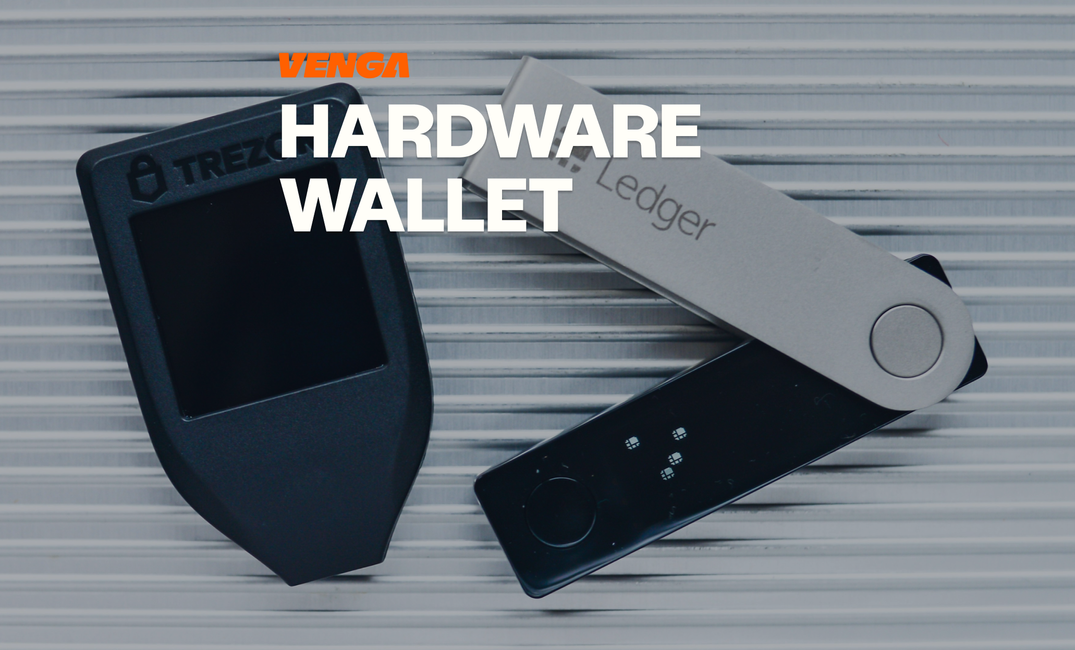
Most hardware wallets look like a chunky USB stick with a small screen bolted on. That’s about it, physically. What makes them worth knowing about is what they do: store your private keys offline, away from any internet connection. Ledger and Trezor are the two main names, with prices running from around £50, with premium models reaching well over £200.
Here’s the thing that trips people up first: your crypto doesn’t live on the device. Cryptocurrency sits on the blockchain. The hardware wallet holds your private key, the alphanumeric string that proves you own the wallet and authorises transactions from it. Lose it and you lose access.
On most exchanges, the platform holds those keys for you. That’s known as custodial storage. It’s convenient, but it means a third party controls access to your funds. A hardware wallet hands that control back to you entirely.
How does a hardware wallet work?
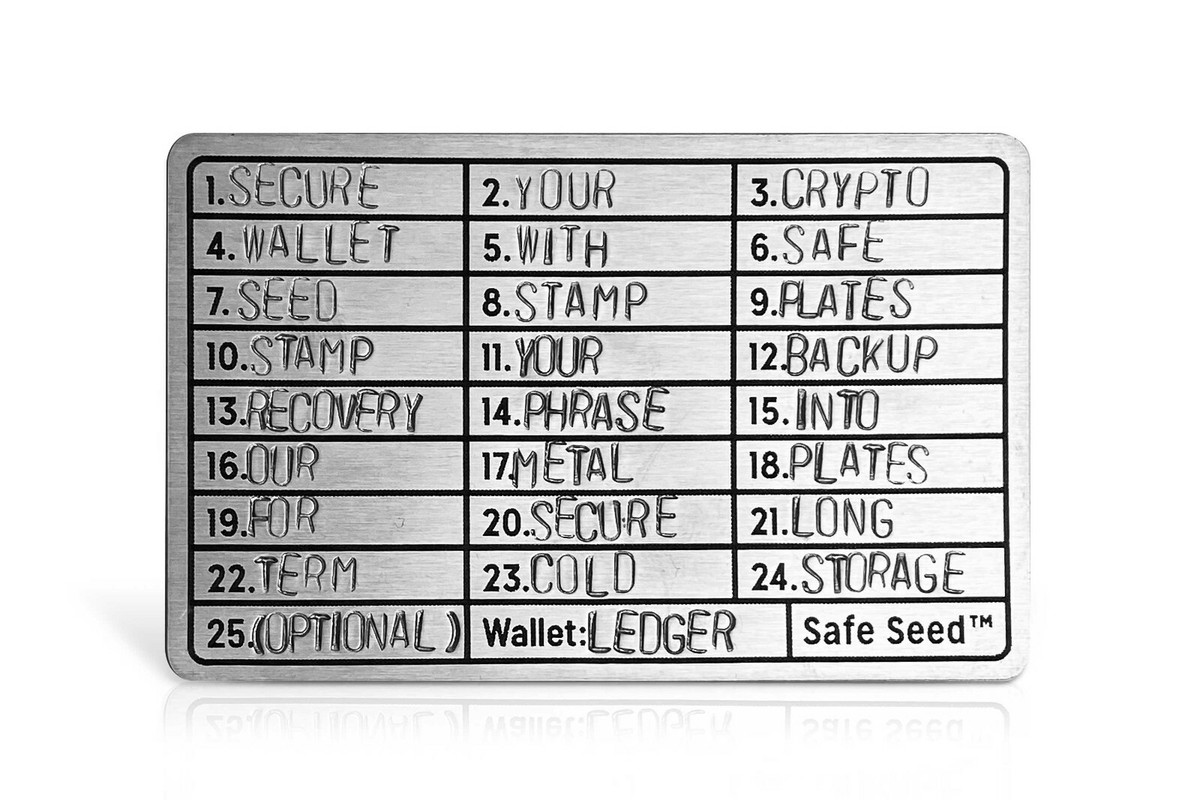
Setting it up takes around 10 minutes, most of which goes on writing down the seed phrase the device generates: a list of 12 to 24 words. This is your master recovery key. Keep it offline and separate from the wallet. The device itself is replaceable if it breaks or gets lost. That list of words isn’t.
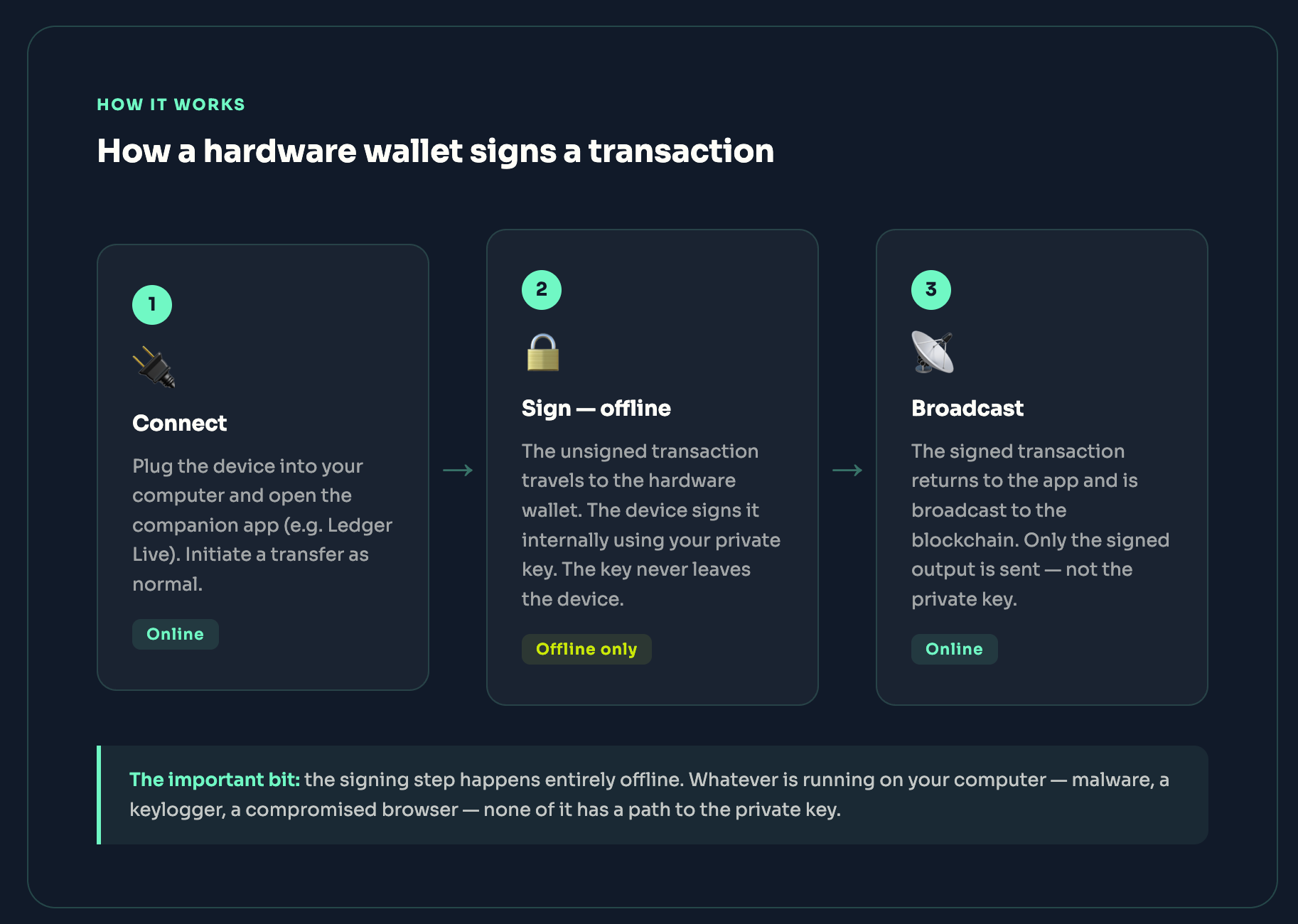
Transactions involve plugging the device into a computer and using an app like Ledger Wallet to initiate them. The signing itself happens on the device, offline, using your private key. What gets broadcast to the blockchain is the signed output, not the key. Your private key never leaves the hardware wallet at any point in that process.
That’s the bit that matters. The signing happens offline, in an isolated environment. Whatever is happening on your computer, whether a keylogger, a compromised browser, or malware of any kind, none of it has a path to what’s stored on the device.
What does a hardware wallet actually give you?
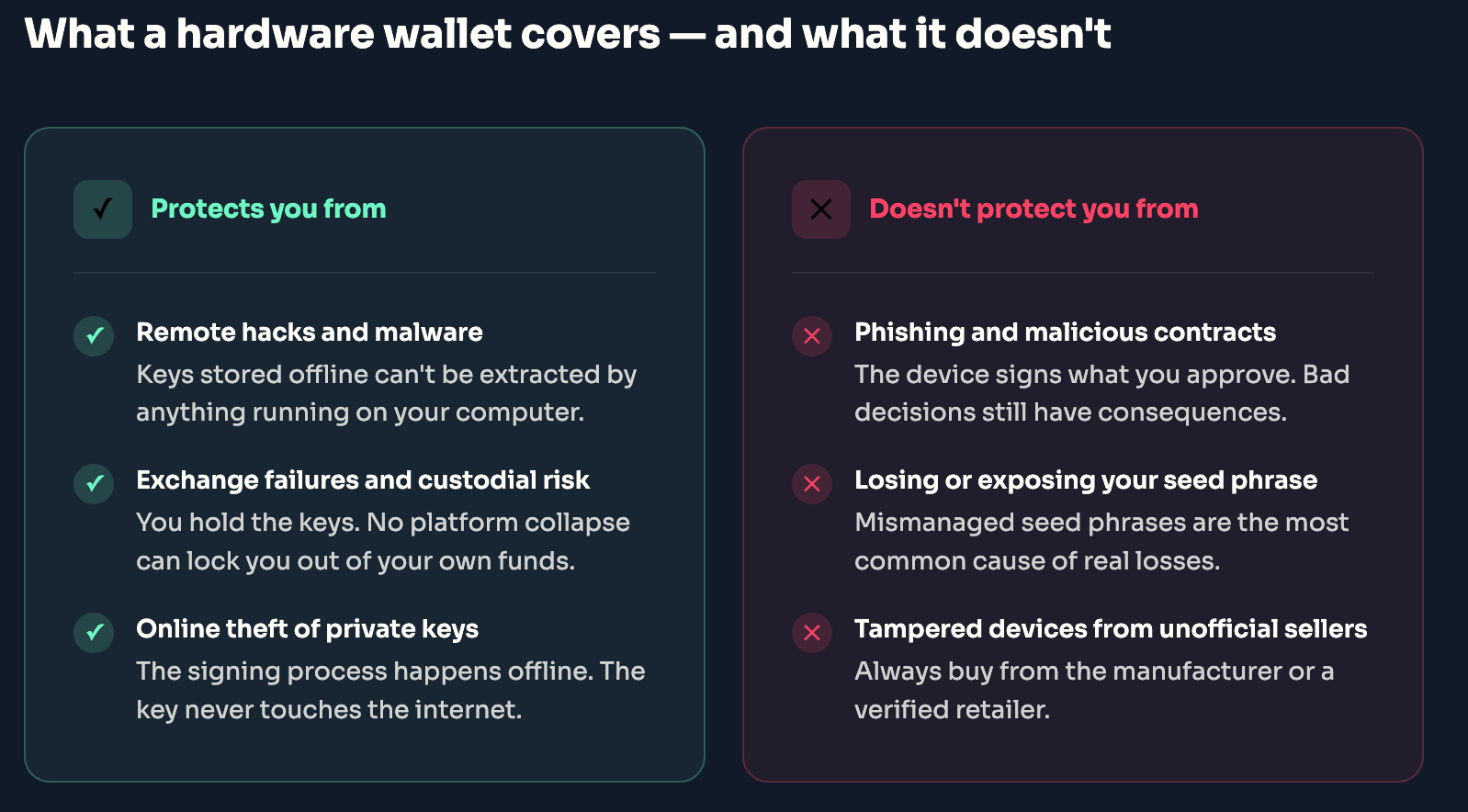
There are three things a hardware wallet consistently delivers. Worth understanding each clearly before weighing the trade-offs.
Strong protection against remote attacks
Your private keys are stored offline. That single fact closes off most of the routes that lead to stolen crypto.
Malware on your machine can’t extract keys that never pass through it. A phishing site can replicate any legitimate interface, but it can’t reach keys it has no path to. The device stays isolated regardless of what else is happening on the host computer.
This is where hardware wallets pull well ahead of hot wallets and exchange accounts. By removing the keys from any internet-connected environment, the attack surface shrinks considerably. Getting to those keys would require physical access to the device itself.
Full control over your funds
When crypto sits on an exchange, the exchange holds the private keys. Your access depends on that platform staying operational, solvent, and willing to let you withdraw.
The collapse of FTX in late 2022 is the clearest illustration of what happens when that assumption breaks down. Around $8-9 billion in customer deposits became inaccessible almost overnight. Withdrawals froze, accounts locked, and people who held crypto in FTX wallets faced months of uncertainty with no immediate recourse.
With a hardware wallet, you’re the custodian. Only you can authorise transactions. No company failure, regulatory freeze, or policy change can touch a self-custodied wallet. The phrase repeated constantly in crypto, “not your keys, not your coins,” describes this situation exactly.
A reliable option for long-term storage
A home safe is a useful comparison. Not something you reach for every day, but exactly the right place for something valuable that doesn’t need to move often.
For long-term holders, people buying Bitcoin or Ethereum with no plans to trade it for years, a hardware wallet fits the strategy naturally. Buy, transfer to cold storage, leave it alone. The friction that makes hardware wallets impractical for daily use is, in this context, the whole point.
What a hardware wallet does NOT give you
Knowing what it protects against is only half the picture. The rest is understanding where that protection ends.
It is not 100% hack-proof
Hardware wallets remove your private keys from remote reach. What they can’t do is protect you from your own decisions.
If you connect to a malicious site and approve a transaction, the device signs it – because you told it to. Phishing campaigns targeting hardware wallet users are common and convincing: fake Ledger support emails, counterfeit wallet interfaces, imitation pop-ups designed to get you to authorise something harmful. The hardware wallet can’t distinguish a legitimate transaction from a bad one. That judgement sits with you.
Tampered hardware wallets are a real, documented risk. Devices bought through unofficial channels have arrived pre-modified in some cases, with no sign anything was wrong on the outside. Buy from the manufacturer’s own site or a known retailer, and skip the second-hand market entirely.
It does not remove human error
The device itself can be replaced. The seed phrase cannot.
Most real losses involving hardware wallets trace back to seed phrase mismanagement rather than any failure of the device. Storing it in a notes app, a cloud document, or a photo on your phone puts your keys back online in everything but name. Losing it with no backup leaves no recovery option: the funds are gone, with no support desk to contact.
Secure, offline seed phrase storage is non-negotiable. Write it down immediately after setup, keep it somewhere separate from the device, and treat it with the same care as a meaningful sum of cash. Metal backup plates exist specifically for this purpose, offering better resilience than paper against fire or water damage.
It is not the most convenient option
This isn’t a criticism. It’s just an accurate description of the experience.
Using a hardware wallet means having the physical device to hand, connecting it, entering a PIN, and confirming steps on a small screen. For someone who trades frequently, uses decentralised finance (DeFi) protocols regularly, or moves funds often, that friction adds up. Hot wallets are faster and better suited to active use.
A hardware wallet is a secure storage solution. It isn’t designed to function as a daily tool, and treating it as one tends to cause frustration quickly.
When is a hardware wallet worth it?
The clearer the answer to “what am I protecting?”, the easier this decision gets.
It makes the most sense when holding a meaningful amount of crypto without plans to access it regularly. Long-term investors in Bitcoin or Ethereum are the natural fit. The strategy and the tool match well. Anyone who’s been stung by an exchange failure, or who simply wants their holdings away from third parties altogether, will likely find the decision straightforward.
A useful thought experiment: picture your current crypto setup failing tomorrow. If the amount at risk doesn’t particularly worry you, a hot wallet is probably fine for now. If it does, that’s your answer.
When is it NOT necessary?
If you’re new to crypto and experimenting with small amounts, a hardware wallet adds complexity without proportionate benefit at this stage. Getting seed phrase storage wrong is a real risk for beginners, and it can cause more problems than it solves.
Active traders and regular DeFi users tend to find hardware wallets too slow for their workflow. Responding quickly to market conditions, moving funds across protocols, interacting with multiple platforms, all of that is more practical with a hot wallet.
Hot wallets aren’t inherently unsafe. A reputable option with sensible security habits, strong passwords, two-factor authentication (2FA), and verified URLs, is a reasonable choice for smaller amounts or frequent use. The two approaches also aren’t mutually exclusive. A hardware wallet for long-term holdings alongside a hot wallet for day-to-day activity is a setup many experienced crypto users arrive at over time.
Hardware wallet vs hot wallet: what’s the difference?
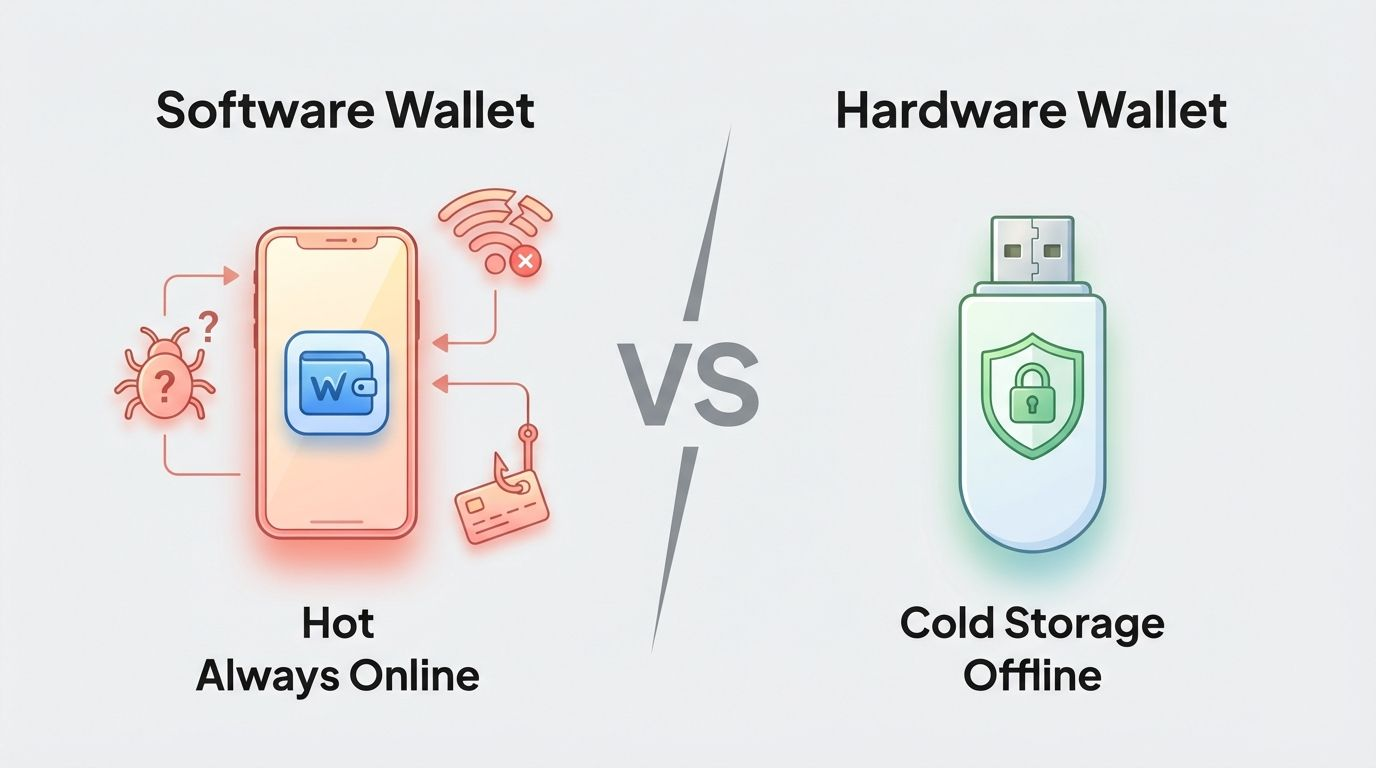
The core trade-off is fairly simple. Hardware wallets maximise security at the cost of convenience. Hot wallets run the opposite way.
Both let you hold and transact crypto. The difference is where private keys live and whether the wallet ever touches the internet. Hardware wallets keep keys entirely offline. Hot wallets, whether that’s MetaMask, Rabby, a mobile app, or an exchange account, are permanently connected. That’s what makes them faster to use and more exposed to attack.
One more distinction worth knowing: hot wallets include both non-custodial options, where you hold your own keys, like MetaMask, and custodial ones, where an exchange holds them on your behalf. Hardware wallets are always non-custodial.
Conclusion
A hardware wallet does one thing very well: it keeps your private keys offline and out of reach of anyone attempting remote access. For long-term holders or anyone managing a meaningful amount of crypto, that’s a solid case for owning one.
What it doesn’t cover is the human side of security. Seed phrase management, phishing awareness, and buying from reputable sources are all still your responsibility, regardless of the device.
The question worth sitting with is whether the trade-offs fit how you actually use crypto. Hold long-term, value genuine self-custody, and rarely need to move funds? A hardware wallet makes clear sense. Still exploring with smaller amounts? Good habits and a reputable hot wallet will serve you well for now.
Disclaimer: The content provided in this article is for educational and informational purposes only and should not be considered financial or investment advice. Interacting with blockchain, crypto assets, and Web3 applications involves risks, including the potential loss of funds. Venga encourages readers to conduct thorough research and understand the risks before engaging with any crypto assets or blockchain technologies. For more details, please refer to our terms of service.