Table of Contents
We can all agree that the 2021-2022 period was wild when it came to NFTs. People were buying pixelated monkey profile pictures for a million dollars which made them super viral. There was also so much yelling about "flipping images." However, this was all based on hype.
By 2026, all of the hype questions have turned into utility questions. People want to know what you can do with non-fungible tokens after you buy or mint them. Now that the hype is dying down, people are interested in the real thing. The emphasis now is on actual ownership, how something can be used and what you get access to.
What Is an NFT?
Here's the short answer that anyone can understand. A non-fungible token is a blockchain asset that can represent access, identity or someone owning a unique digital or real-world-linked item.
NFTs are different from Bitcoin or Ethereum because those are all the same and fungible. NFTs are totally non-fungible. This means that no two NFTs are identical.
If you are new and learning all the stuff, our What is NFT? Beginner's Guide is here to help you.
How Did NFTs Move From Hype to Utility?
It was not a simple step by step process to get here. We can simplify the development into three main waves that brought NFTs from hype to utility.
Phase 1: The Collectible Boom
The first big NFT rush was really all about digital art and collectibles and the betting aspect of NFTs.
CryptoPunks and the Bored Ape Yacht Club became cultural icons during this peak. Everyone wanted to be the first to find the next big investment, so celebrities started to buy NFTs. The general public thought the same and thought buying them would make them rich too.
A lot of new users bought into the idea of NFTs as just easy money and just photos to make your social media profiles cooler.
At first, it was exciting. But everyone started to see all the money grab schemes taking over with projects that were worth little to nothing.
Phase 2: The Reset
Then there was a reset.
NFT prices plummeted. Many anticipated NFT collections lost trading volume and disappeared. This was a crucial period. It proved that minting a unique image does not create long-term value.
This new philosophy began to change the NFT industry from pure speculation to functionality.
Phase 3: Utility
We are having a more complex conversation about NFTs in 2026. Instead of retail mania, the use of NFTs is now as access, ownership and verification tool.
In a lot of ecosystems, NFTs are not even the final outcome of the product. They are more like the underlying structures.
This is a significant shift compared to the initial phases. Now, well designed NFTs are more concerned about utility rather than scarcity.
Where NFTs Actually Matter in 2026
So where are NFTs being used today? The answer is everywhere. The difference is that today it is almost silent compared to the noise of yesterday.
Let’s see where exactly.
Access, Ticketing, and Memberships
NFTs function as an access layer, be it tickets or passes. They are given as individual and unique codes. With tickets being so hard to get, this could be a game-changer.
Not only that, NFTs help stop counterfeiting. Remember that they can be verified directly on-chain and are also programmable. This means event organizers can program a limit as to how much a ticket may resell for while also giving you more membership benefits post-event.
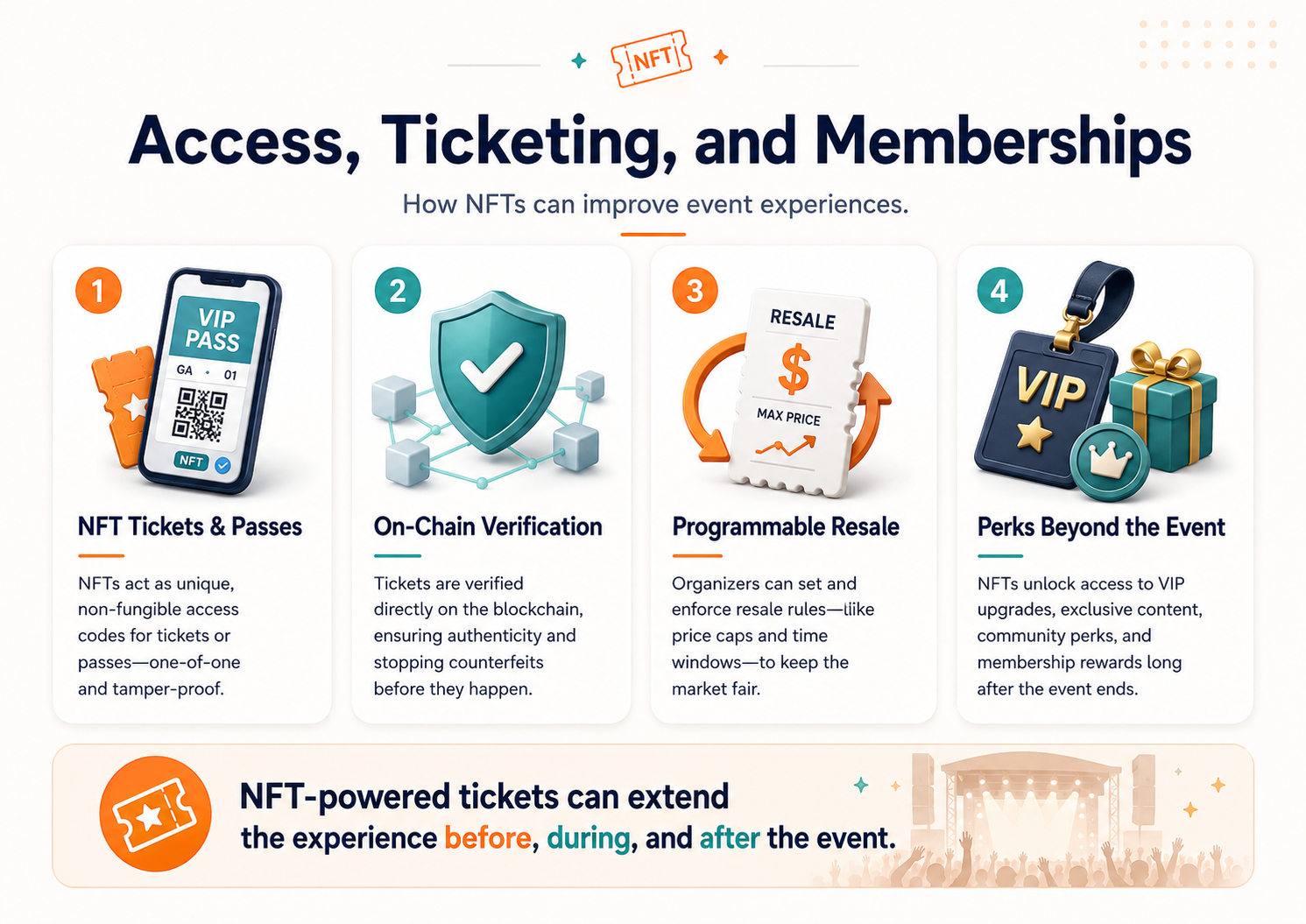
They could give you rewards that are VIP upgrades or some exclusive content. Basically, these rewards extend the experience past the event.
Now, concert tickets could help you get more perks thanks to NFTs.
Gaming and Digital Ownership
Gaming is the perfect place for NFTs. This is because all gamers know about digital items. They have been buying in-game skins, weapons and characters for years. In fact, the Business Research Company report shows that the in-app purchase market size was worth $255B in 2025.
However, the trade off here is that gamers do not own these digital items. So if a game shuts down, consider all money which was spent lost.
With NFTs, game assets become part of your blockchain address which means your assets are not tied to the game. Therefore, you can choose what to do with your digital assets. You can sell them, display them or even use them across systems. As a result, more NFTs are now becoming ownable in-game items that users can buy.
Identity, Credentials, and Proof
Another big change is how NFTs are being used as proof systems.
Out of all the NFT types, this might be the most underrated, since it’s all about building trust infrastructure rather than speculation.
For example, many conferences now issue POAPs (Proof of Attendance Protocol) which are NFTs that serve as proof of your attendance at an event. These NFTs are one of a kind and help track who has been to what event while also handing out rewards at the same time.
This is just a sample but they can also be used as identity markers, certificates or any other non-fungible record. It is also worth mentioning that these tokens are tamper-proof which means no foul play can be done.
Tokenized Assets and Asset-Linked Ownership
NFTs are increasingly found along with tokenized assets as well. High-end brands like Gucci have also linked physical products to NFTs. Get a luxury watch and you get an NFT that proves the item is yours and not fake.
NFTs are also used by projects to represent claims tied to real-world assets like real estate rights. They allow people to buy a smaller piece of a property than they would normally be able to. Because of this, NFTs allow everyone to have an opportunity to chip in.

Keep in mind that NFTs don't exactly solve any ownership problems. NFTs provide a new method for showing ownership and transferring digital items.
This is why NFTs are here to stay for many people. They are a component of the tokenization of a broader system.
What Changed in How People Evaluate NFTs?
One of the biggest changes in 2026 is how people think about NFTs. Things like floor price and social status do not matter so much anymore. Now it's more about what the NFTs can do and not how it looks.
People want to know what having the token actually gives them. Usually, the community will pass on NFTs if it doesn't provide access rights, proof or some ownership. So, value no longer comes from just an NFT collection having scarcity. It now must have utility.
This approach is honestly better for the industry since NFTs were looked at as standalone images just a few years ago.
What Still Gets Overhyped?
Of course, there are some signs that things have not changed fully. We still have hype and do not get me started on buzzwords.
Some projects still claim their NFTs bring gaming utility but they lack the community support behind it. No matter how big the brand or the developer is, without a real community behind the project, these digital collectibles will not succeed.
Another thing to talk about is a lot of projects saying they have utility, but they don't really say what it is. If they say something like an NFT has “future ecosystem benefits” and don’t say what they are, this means that you should worry.
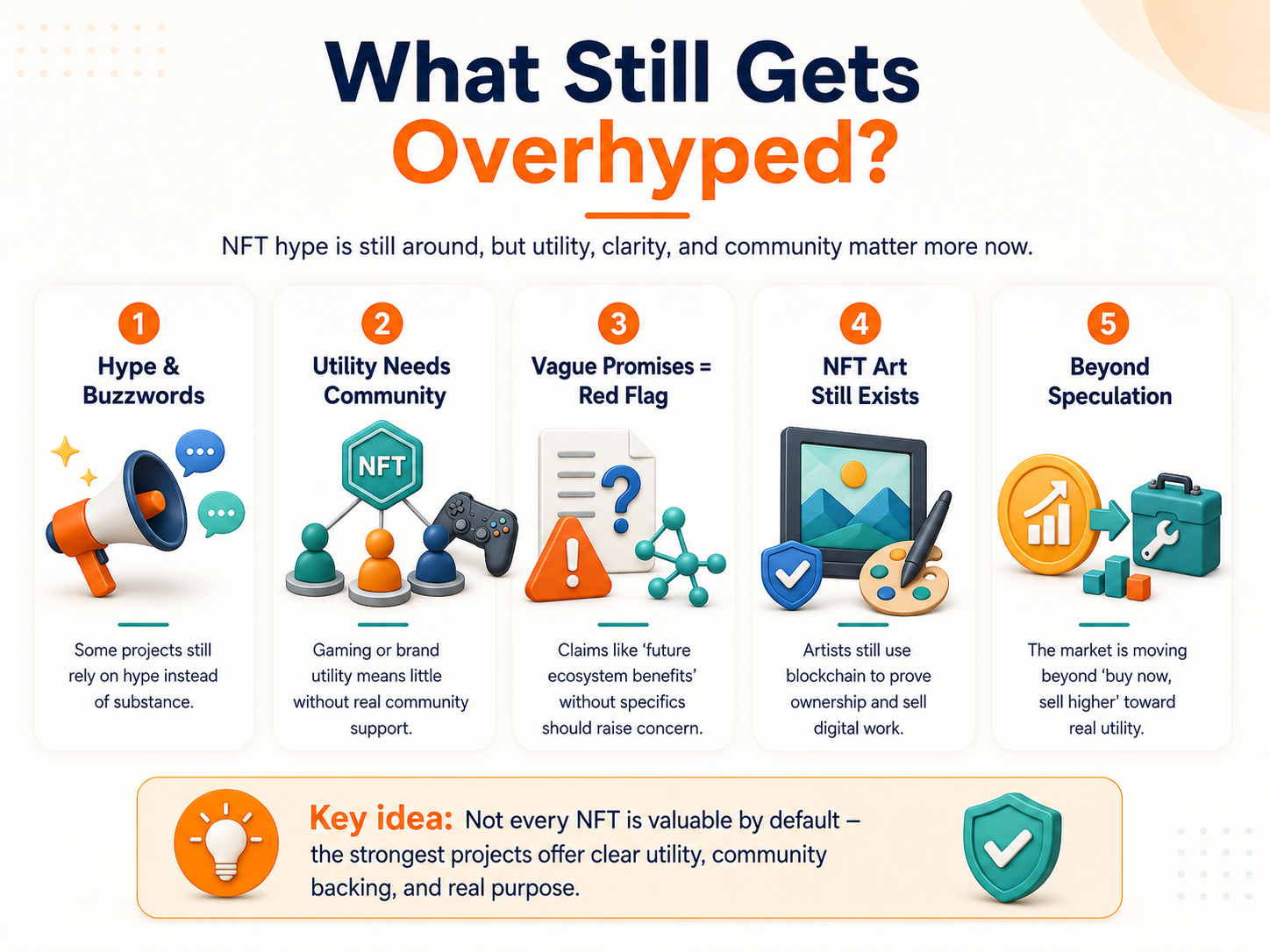
Keep in mind NFT art is still around. Digital artists are still using blockchain systems to track ownership and sell their pieces. However, art does not represent the whole NFT system anymore. The category got much bigger than digital collectibles.
Some folks will always buy NFTs with the hope that they will sell for a ton of money. The key thing to remember is that not every collection is now seen as valuable since it must provide utility. Market activity is now growing without this “financial only” mindset.
What Should You Check Before Taking an NFT Seriously?
If you are interested in an NFT in 2026, here are some things that you should keep an eye out for.
Representation
Firstly, check out what the NFT represents. Is it a linked physical item, a game asset etc. If it has a clear role, you get a better understanding of it. Plus, you can try seeing if there is demand for it.
Long-term Utility
Next check what you are left with after minting this NFT. Some NFTs stop having value after mint week. Others bring you value in the long run. Utility that keeps going after the honeymoon stage is key.
Access
Another good tip is to check if the NFT access is dependent on a centralized platform. It is not bad per se if it does. But, remember that the companies have control over the users in a situation like that. If it shuts down, you may lose access to the NFT too.
User Activity
NFTs with no community chatter and user activity are a bad omen. Forget social media chatter. Real user engagement is what matters. A smaller project with active users can be more than a big-time NFT collection that has no engagement.
Conclusion: What Are NFTs in 2026, Really?
To sum it up, the profile picture phase was just that: a phase. The NFT space has matured from being solely a speculation story to an infrastructure that brings digital ownership, access and proof.
We believe the technology is not going anywhere and that it will keep changing. What is important is that people now care more about what an NFT can actually do instead of caring about what digital picture can make them the most money.
That will likely remain the most important part of the NFT story.
Disclaimer: The content provided in this article is for educational and informational purposes only and should not be considered financial or investment advice. Interacting with blockchain, crypto assets, and Web3 applications involves risks, including the potential loss of funds. Venga encourages readers to conduct thorough research and understand the risks before engaging with any crypto assets or blockchain technologies. For more details, please refer to our terms of service.