

Table of Contents
“Guaranteed Returns are one of the most common hooks used in crypto investment scams. Be suspect of anyone making a guarantee that they can earn you returns or get you a specific amount if you invest with them. There are no guarantees in investing. The only guarantee in life is that at some point you will be expected to pay taxes.
Nobody can magically guarantee that you will make X amount of money from an investment. This would mean there is no risk. However, in real crypto markets, high volatility makes risk unavoidable. That means that any promise of fixed profit is suspicious. It should immediately set off your warning bells. A promise of fixed profit is always a red flag. Unfortunately, the popularity of crypto has made it a major target for scammers. Thankfully, by learning more about investment scams, you can protect your cryptocurrency and your cat’s cryptocurrency (and cash) from being stolen.
What Is an Investment Scam?
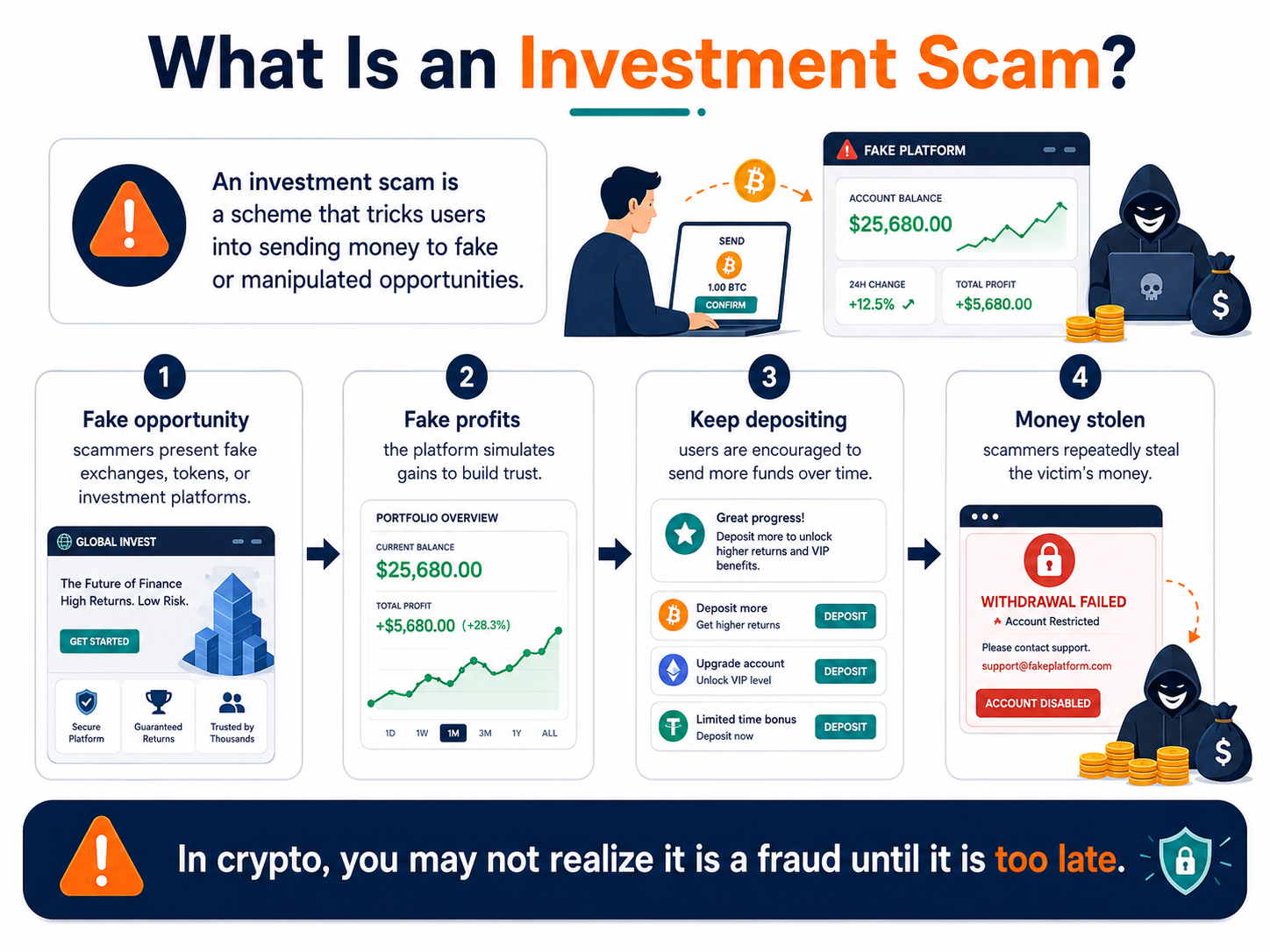
An investment scam is a scheme that tricks users into sending money to fake or manipulated opportunities. In crypto, the crypto fraud often involves fake exchanges, tokens, or platforms that simulate profits. If you get taken advantage by one of these investment fraud schemes, you may not know you are being taken advantage of until it is too late. In these schemes, scammers try to keep users depositing funds over time so they can continue to steal your money repeatedly.
Why “Guaranteed Returns” Are Always a Red Flag?
A fundamental principle of crypto investing is that volatility drives both risk and reward. Guaranteed returns contradict this principle, which is why they are always a red flag and this type of “investment opportunity” should always be avoided. In these situations, scammers often promise a fixed return on investment (ROI), staking rewards, or trading bots to create false investment certainty. However, “guaranteed profit” is almost always a sign of fraud. There is no certainty when it comes to investing.
Most Common Types of Investment Scams
There are different formats of crypto scams, but they follow similar patters of deception. Here are a few common types of crypto scams to look out for.
1. Crypto Investment Scams
One type of crypto scam involves fake exchanges. The exchanges operate with a model that lures users with the promise of better-than-average returns on investment. The steps are quite simple. First, you’re presented with the scam site via direct messages on social media or traditional communication methods like email or text. Then you are promised significant rewards like instant sign-up bonuses or very high returns on deposits. Then when you decide to invest, the money you deposit to invest is stolen, and your portfolio and trades are manipulated.One of the most infamous crypto scams is the “rug-pull”. In this scam, investors release a cryptocurrency and raise assets by selling the cryptocurrency. Then they immediately abandon the crypto project, take the money raised, and leave participants of the fund raise with worthless tokens. True to its name, it is like having a rug pulled out from under you.
In a fraudulent token launch, criminals create fraudulent tokens that mimic legitimate cryptocurrencies and then use them to steal users’ money or sensitive data.
2. Romance and “Pig Butchering” Scams
Romance and “Pig Butchering” scams involve scammers gaining the trust of victims, often through a fictitious romantic relationship, and duping them into making investments in fake crypto projects. They often begin with the victim meeting someone (a scammer) on an online dating website. The scammer eventually highlights seemingly impressive monetary gains and encourages the victim to invest larger and larger amounts by gaining their trust. This oftentimes eventually leads to financial ruin for the victim. If a romantic relationship seems too good to be true, maybe it is. So it’s important to be aware of fraud when swiping on dating sites like Tinder and Bumble.
3. Ponzi and Pyramid Schemes
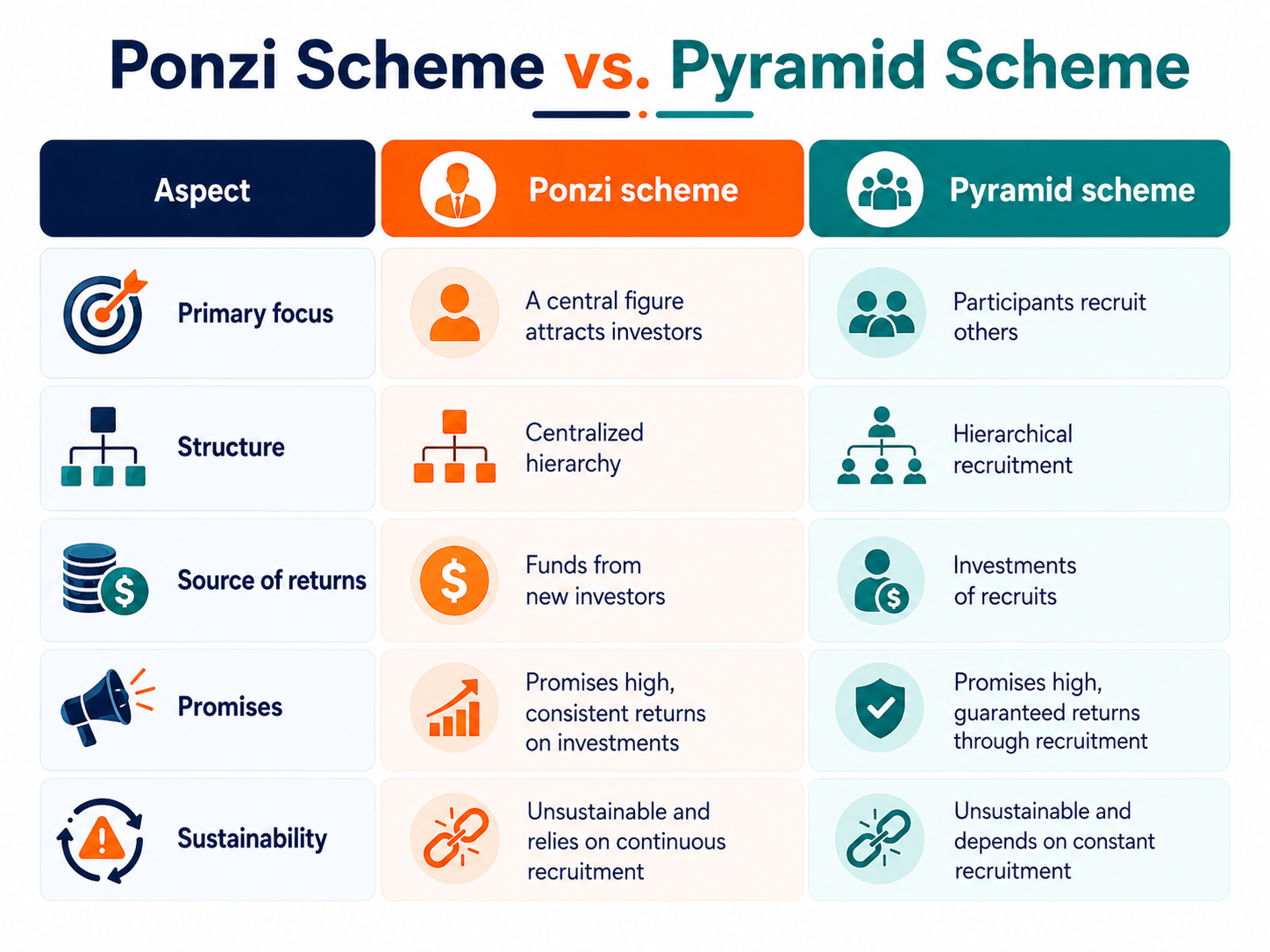
In modern investment fraud, some of the most common and well-known investment scams are ponzi and pyramid schemes. Ponzi schemes and pyramid schemes are both types of fraud where existing investors are paid by the contributions of new investors and there are usually no underlying real returns from investments. However, there are a few differences between them.
Ponzi scheme investors usually believe they invested in an actual security and are not aware that they invested in a ponzi scheme. Participants in pyramid schemes are often at least aware that they are responsible for recruiting new members. Ponzi scheme participants believe they are earning returns from their investment when it’s actually just money paid by new investors. Pyramid scheme participants are aware they are earning money by recruiting new participants into the scheme.
4. Advance Fee Scams
In this type of investment scam, victims are asked to pay crypto fees to withdraw funds, but no withdrawal is ever initiated. In other words, the scammer disappears with the “advance fee” paid by the victim and the withdrawal the victim sent the advance fee for is never sent to them.
5. Exclusive Investment Opportunities
In exclusive Investment scams, scammers lure victims by promising high returns from private, “invite-only” trading platforms or tokens and then disappear with the victim’s funds when victims invest in what they think is a special access investment.
6. Trading Signal and “Expert” Scams
In these scams, fake crypto traders offer signals or portfolio management and promise guaranteed profits. The performance data they use to lure victims is almost always fabricated, and after they convince victims to let them manage their portfolio, they disappear with the funds. These scams rely on the scammer making a victim believe that they are an expert and an amazing trader through often fabricated performance data from past investments and trades.
Key Warning Signs (Red Flags You Should Never Ignore)
The good news about all this is that most crypto scams (and in some cases other online scams) share common warning signs and recognizing them early can prevent losses.
1. Guaranteed Returns and Fixed Profits
Promises from seemingly intelligent crypto gurus regarding guaranteed returns and fixed daily/weekly profits completely contradict the volatile nature of crypto markets. The truth is, nobody knows what’s going to happen in the crypto markets and unforeseen circumstances can always impact market fluctuations. So any project offering risk-free income is highly suspicious and should be avoided.
2. Urgency and Pressure Tactics
Often scammers will create a sense of urgency by promoting “limited-time” crypto offers. This tactic is used to try to get victims to pay into the scam sooner. By presenting an offer as “limited-time”, some potential victims may be more likely to pay sooner and be less inclined to look deeper into the offer and think twice about whether to do it.
3. Unsolicited Contact and Private Messaging
It’s best to be wary of any potential investment opportunity that you hear about through a direct message. Scammers often reach out via social media, Telegram, or Whatsapp with investment offers. Moving conversations to private channels is also a common tactic that scammers use to avoid detection and keep from being discovered. The private messaging via social media and Telegram has become such a recognized scammer tactic that many members of legitimate crypto project will advertise that they “never direct message you first.” This helps signify that they are not coming to you with a fake offer.
4. Lack of Transparency and Verifiable Information
Crypto projects that are legitimate always provide information about their team, technology, and tokenomics. Scammers don’t do this because they don’t want to be known. So any missing or unverifiable details are a strong red flag that the project is not legitimate.
5. Withdrawal Issues and Additional Fees
Scam platforms often allow deposits easily but block users from making withdrawals. They also sometimes will request additional crypto payments to “unlock” funds. This is a clear sign of fraud. So before you invest, be sure to look for a clear way to withdraw funds and try to find user reviews of the exchange or crypto project that don’t seem like they were written by a bot.
6. Crypto-Specific Red Flags
There are also some red flags that are specific to crypto. Lack of on-chain activity should raise concerns. Unaudited smart contracts that do not have a clear third-party security review should also be avoided.
Fake liquidity, such as orders in an order book that don’t reflect a true intention to trade should raise concerns as well. An example of this could be a huge buy or sell order on the screen that then vanishes (often called “bait walls”). These fake big orders make traders think there is significant demand or supply when in reality they are being scammed.Finally, copied whitepapers are an example of a red flag as well. You should always check that a whitepaper is original and specific to the particular crypto project. If the whitepaper seems plagiarized, run away fast like you are racing against Usain Bolt.
How to Protect Yourself from Investment Scams
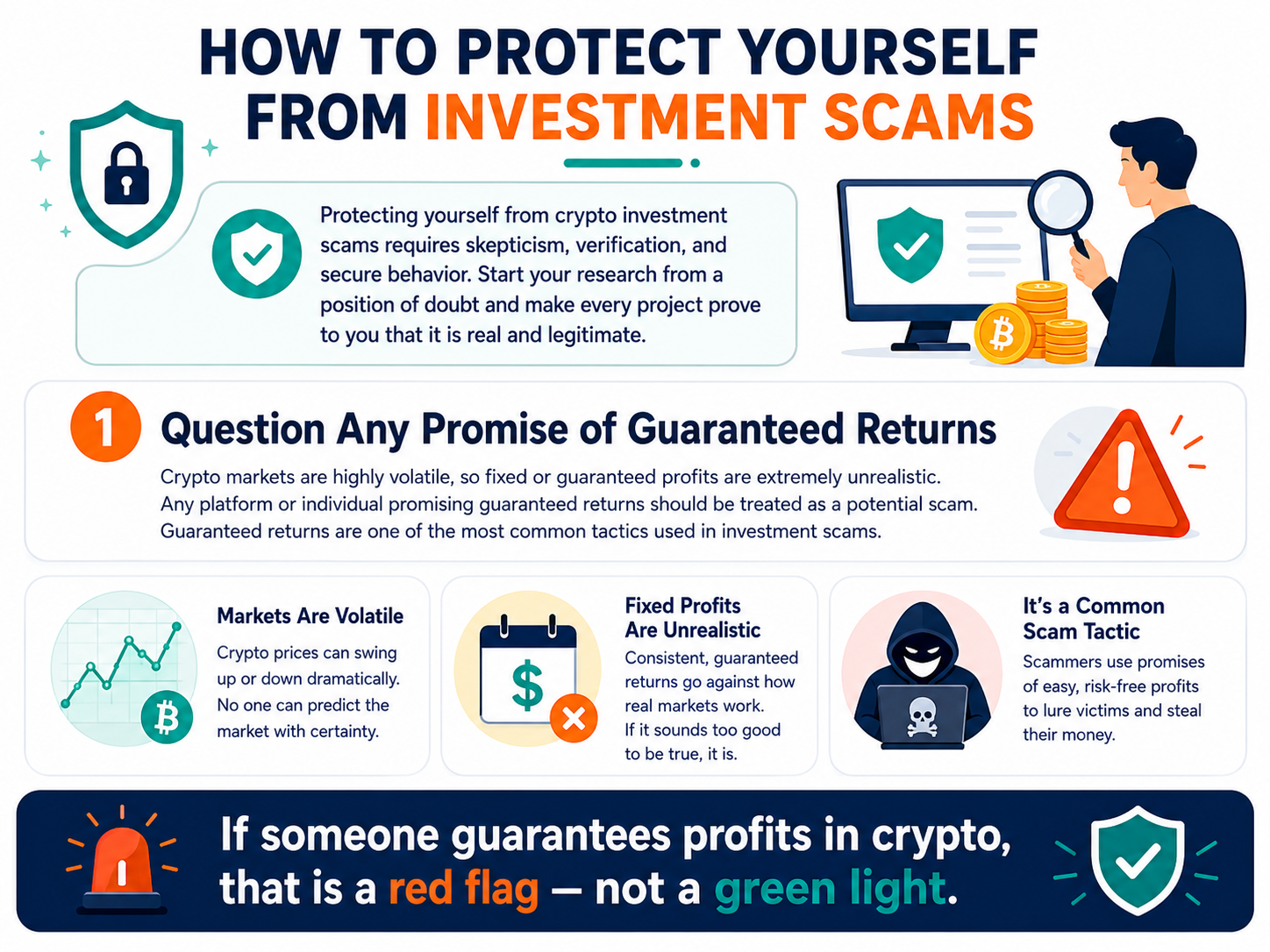
Preventing crypto scams, or rather protecting yourself from them, requires a combination of skepticism, verification, and secure behavior. You should start any research into a crypto project from a position of skepticism. Make them “prove” to you through your research that the project is real and legitimate.
1. Question Any Promise of Guaranteed Returns
In the crypto market there is a lot of volatility. This volatility makes fixed profits extremely unrealistic. Any crypto platform or individual guaranteeing returns should be treated as a potential scam. Guaranteed returns are a common tactic in investment scams.
2. Avoid Unsolicited Investment Offers
Real crypto projects do not randomly contact users with investment opportunities. Messages from strangers on social media or Telegram are risky. Look for projects that say they won’t DM you first as mentioned earlier.
3. Take Time Before Investing
Be sure to slow down and do your research before investing. Remember, many scammers will try to get you to invest quickly via “limited-time offers”. They do this because they are aware that if you take the time to research their project you may notice some red flags and avoid them entirely. Do the proper due diligence on any project or cryptocurrency you are thinking of investing in. Take your time.
4. Use Trusted Platforms and Tools
Users should only invest through reputable crypto exchanges and verified platforms. Check reviews of each platform you are going to put money into and look for official sources verifying the legitimacy of the platform. There are plenty of reputable crypto exchanges out there that are used by millions of happy users. No need to go with the random sketchy crypto exchange that has no user reviews or reviews that seem fake.
5. Protect Private Keys and Personal Data
Your private keys and wallet access should never be shared. This is one of the most important rules in crypto. Never share your private keys with anyone. If they have them they can empty your wallet and leave you with nothing. Scammers often try to obtain your private keys or access your wallet so they can gain free access to your account and your funds. So don’t share your keys with anyone, even if they seem nice or seem like they are trying to help you. Requesting private keys is one of the most common investment scams in crypto but it’s easy to avoid by simply not giving this information out to anyone.
Conclusion: Protect Yourself and Avoid Scams
Remember: guaranteed returns are one of the most obvious signs of a crypto investment scam. Crypto markets are volatile which means it’s unlikely that anyone can provide the guaranteed returns that they are promising. Do your research and think critically about any project that you are thinking of putting money into. Take your time and make sure the project or token is legitimate before investing. Always keep in mind that in crypto investing, risk cannot be eliminated. It can only be managed, so anyone promising a steady return with little to know risk is trying to scam you.
Disclaimer: The content provided in this article is for educational and informational purposes only and should not be considered financial or investment advice. Interacting with blockchain, crypto assets, and Web3 applications involves risks, including the potential loss of funds. Venga encourages readers to conduct thorough research and understand the risks before engaging with any crypto assets or blockchain technologies. For more details, please refer to our terms of service.