
Table of Contents
Crypto wallet users need a private key to sign transactions. Whoever owns this key can manage funds. However, it’s possible to make money management much more secure. There is a trust-minimized technology—multi-sig wallets.
These crypto wallets require several private keys to authorize a transfer or a swap. They help to move away from a single point of control and distribute oversight between parties.
The technological solution is useful for teams and companies that manage budgets, investment accounts, and operational token storage. They can transfer the principles of corporate financial control and internal transaction approval policies to the blockchain.
Below, we explain how multi-sig wallets reduce the risk of mistakes, disorder, or confusion in handling access, as well as the risk of asset loss due to a single key being compromised.
What Is a Multisignature Wallet?
It is a wallet where you need to use a fixed number of private keys together to move funds out of your wallet. So, you might require two out of three, three out of five, seven out of ten, or even ten out of fifteen signatures at once.
You are free to set up the multisig wallet the way you want. The more signatures you mark as mandatory, the lower the chance that you lose money, as the probability follows a binomial distribution. The 2-of-3 option is the norm since it strikes a balance between security and practicality. If you have to type in five or seven keys, the signing flow gets slower, and it can be pretty inconvenient.
If you use an intermediary service for transactions and it implements multisignature wallets, it technically cannot withdraw or steal your money without the consent of other parties. That is why this model is used for reliable crypto escrow.
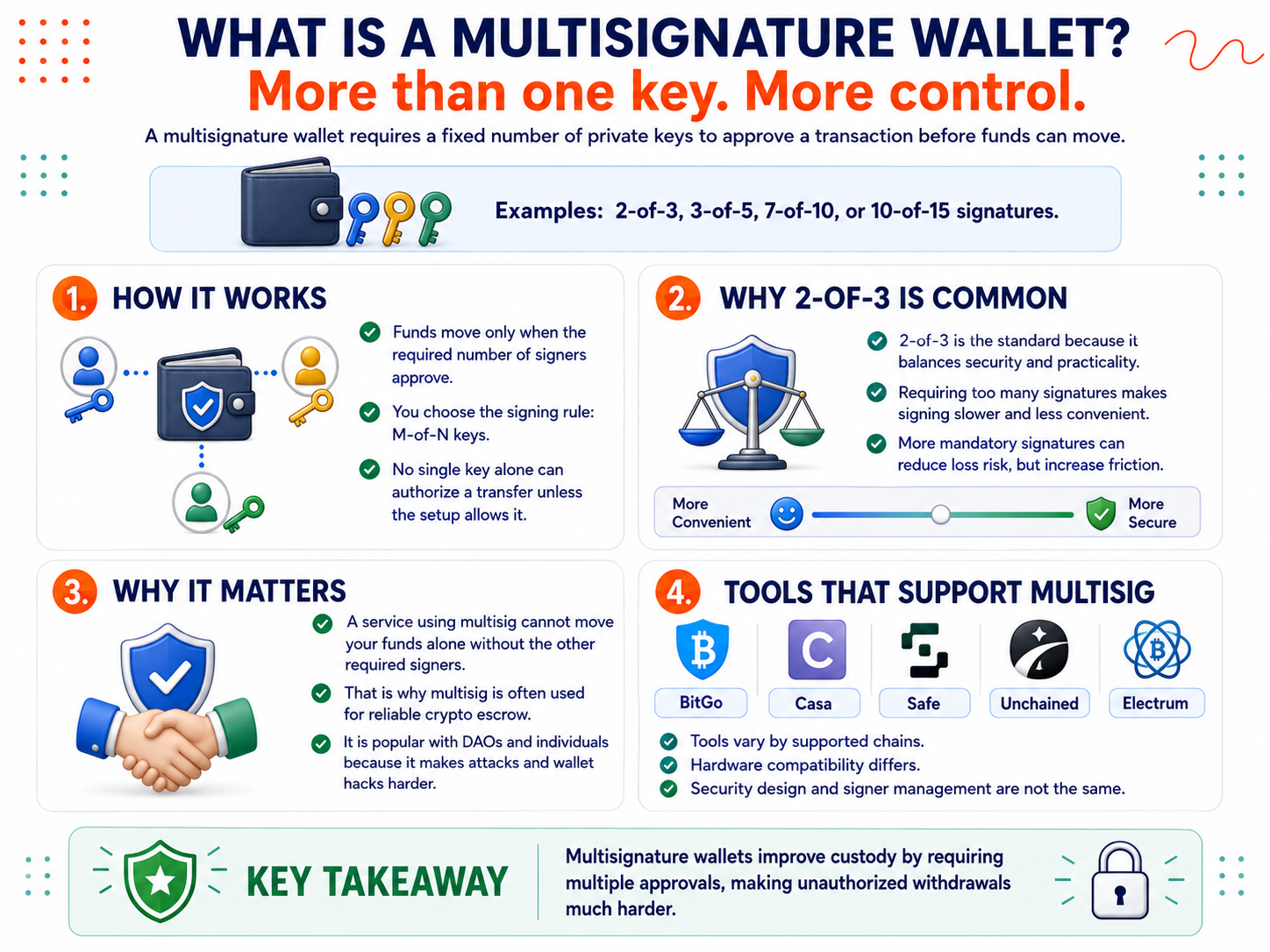
BitGo, Casa, Safe, Unchained, and Electrum are top wallet providers and platforms that support multi-sig. They are popular with DAOs and individuals because they make attacks and wallet hacks difficult and help to custody your crypto. Tools vary in terms of supported chains, hardware compatibility, security design, and signer management.
How Does a Multi Sig Wallet Actually Work?
One person or one key does not control everything. A way to describe the tech solution is with an M-of-N scheme. M is the number of signatures required and N is the total number of keys.
Importantly, not all participants have to sign every operation:
- 2-of-3 means any 2 of 3 authorized signers must approve.
- 3-of-5 means any 3 of 5 authorized signers must approve, etc.
This means one person initiates a transaction, others confirm it, and only after the threshold is reached, the software allows the funds to be sent.
The exact usage policy should be attached to a wallet address or smart contract or implemented at the script level. If you use modern services, this works in semi-automatic mode and can be quickly done through a clear user interface. You won’t have to manually program the contract.
The step-by-step flow is like this:
- The signer describes how the transaction should behave and names the destination, amount, network (Bitcoin, Ethereum, Solana, etc.), fees, and a few other details.
- Then, the transaction becomes pending until the set number of signatures is obtained.
- Next, the participants related to this transaction sign it using their private keys.
- After that, the digital tool or the contract verifies that the collected signatures satisfy the requirements.
- If everything is fine, the transaction runs and gets broadcast to the blockchain network. If not, it just stays incomplete or not enforceable.
All signatures are unique. A multi signature scheme of shared control does not refer to multiple copies of the same password.
The multisig wallet technology was initially designed to enable two or more users to jointly control funds in one wallet and sign crypto transactions, as well as for corporate asset management, on-chain asset security, and custody services. But it also can be used by one person in case they own several keys and simply want to protect their money better.
Why Is Multi-Sig a Fortress Against Human Risk?
A multi-signature wallet assumes that crypto can be managed by several users at once. There’s no single point of failure. This is why such tools are a powerful defense against many threats like human errors or intentional crimes.
Unlike single-signature wallets that are vulnerable to hacks and compromises, multi-sig options have stronger measures to prevent unauthorized activities. If a transaction takes place, neither party can withdraw money without the consent of the other participants.
Any user, whether it’s a dishonest team member or a hacker, cannot independently move funds. Your protections will work even if one key is compromised or one device is infected with a virus.
When it comes to money, precautions are always relevant. Perhaps everyone in your team is trustworthy and no one plans to steal the budget (although you can’t know for sure). But someone can just accidentally make a mistake that will drain your corporate wallet. It’s worth protecting against this using shared authorization.
What Is the Difference Between Multi-Sig and Single-Sig Wallets?
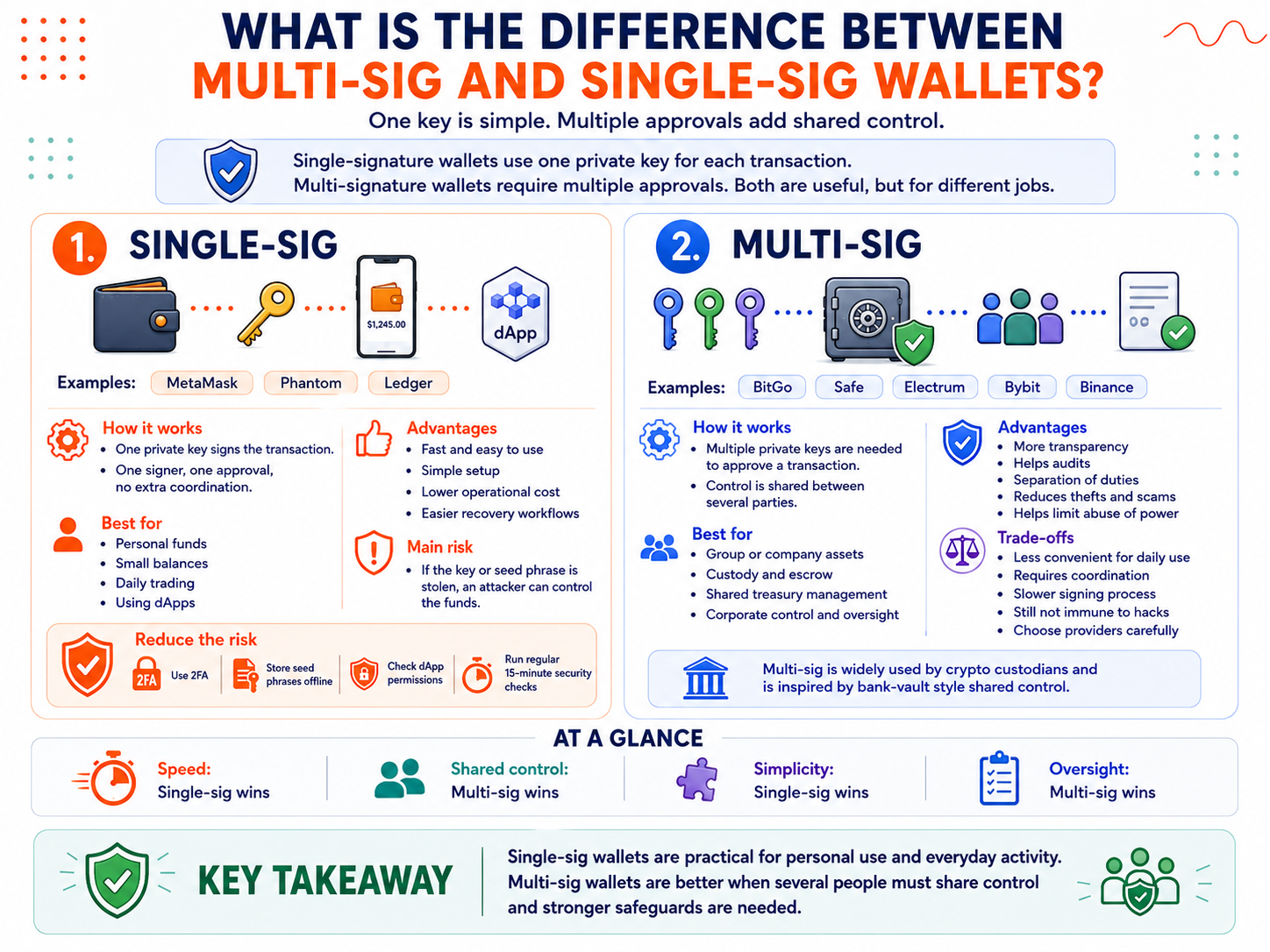
MetaMask, Phantom, and hardware Ledger devices are single-signature wallets. They require only one private key to make a transaction. They are great for personal use, working with dApps, and managing daily trading operations.
BitGo, Safe, Electrum, and more than 60% of crypto custodians, including well-known exchanges Bybit and Binance, use multi-sig technology inspired by bank vaults. People use them for managing assets belonging to a group of companies, where sharing control between multiple parties helps reduce the number of thefts and scams.
Single-Sig
Single-sig wallets are not inherently dangerous or bad. They just employ a security model with fewer controls. If one private key authorizes spending, the wallet is fast and easy to use. Single-sig solutions are popular because they are straightforward. There’s one signer, one approval, and no extra coordination. For many, this is the advantage, not a weakness.
Single-signature wallets are a nice choice for managing your personal funds, operating with small balances, or if you want the simplest possible setup. Plus, they reduce operational costs and make recovery workflows easier.
However, if the key or seed phrase is stolen, the attacker can control the funds. In other words, there is a risk of access loss. But you can always limit risk exposure by using 2FA, storing secret phrases offline, checking dApp permissions, and regularly running 15-minute security checks.
Multi-Sig
This type of wallet can help with transparency, audits, and separation of duties. It can provide protection against abuse of power in a corporate setting. A multi signature cryptocurrency wallet provides more control but is less handy for day-to-day use.
And multisig wallets are still susceptible to hacks. The probability of them is lower, but they happen. There are malicious programs on the market, so be careful when choosing a wallet for your team.
The described wallets are used for different tasks. Below we’ll look at when multi-signature wallets bring real benefits.
Why Are Multi-Sig Wallets Useful for Business?
Usually, multi sig wallets are used by:
- Decentralized autonomous organizations with shared governance;
- Treasury teams that need approval before large withdrawals;
- Payroll operations that require review and authorization;
- Finance teams that want separation of duties.
Basically, they are appropriate anywhere you need multiple parties to approve transfers, for example, if your operational reserve accounts should not depend on one employee. They enable collaborative control for businesses where shared decision-making is important. In the table, you can see the most popular use cases.
Enhancing Internal Control and Policies
Multi-sig helps embed the approval process directly into wallet logic instead of keeping control only at the level of internal agreements. No one, even the CEO, can move company assets alone. It becomes possible not only to develop and write down the rules but also to technically enforce regulations that cannot be violated from a technical standpoint.
Additionally, every transaction shows which specific keys provided the signatures. You can see a permanent record of which board members approved an expenditure. So, internal audits and regulatory reporting become easier.
Helpful if One Key Is Lost or Unavailable
A scheme like 2-of-3 also provides resilience. If one participant is temporarily unavailable, for example, if they are on vacation, transactions can still go through. They won’t be fully blocked. Setting a minimum number of signers that is less than the total number of people involved, the company ensures an unstoppable workflow.
The setup provides more robust options for wallet recovery in case of key theft. If one executive loses their key or their hardware device, the crypto firm can still access its funds using the remaining keys. This can be viewed as a business safety net.
Plus, the infrastructure should evolve as the company grows and personnel changes. With multi-sig, you can add new signers or revoke access for former employees. You need to update the list of authorized signers. This allows the company to maintain its existing public address for many years, and it won’t need to move the funds to a new wallet.
Please note that on some blockchains, the rules of a multi sig wallet are built into a smart contract. Updating them or rotating keys can require gas fees or, in some cases, the creation of a new wallet and the migration of assets. Changing the signer list is also not always a wallet UI setting and can require using the wallet SDK and coding.
What Risks and Limitations Come With Multi-Sig Technology?
As mentioned, multiple signatures that come with special wallets are not very convenient for one person to use on a daily basis. You spend more time to approve an action and make several confirmations. This complicates interaction with crypto.
Multisig sometimes has issues with compatibility and gas optimization or a lack of dApp integrations and transaction simulations. For personal use, there are more suitable options and additional simpler protection methods.
Bad Setups That Create Problems
A mistake that users often make is that they forget they sacrifice speed when using a multisig wallet. In a standard wallet, a transaction is instant. People get used to it and may overlook that a series of confirmations is much slower than one approval. They have to adapt to make fast, coordinated efforts; otherwise, all important financial matters like payroll, rebalancing, or liquidation protection will be greatly delayed.
Another common mistake is a poor initial setup. If all participants in a multi-sig scheme depend on the weak infrastructure, for example, if they store keys on the cloud service, the risk of a single point of failure remains. Similarly, if roles are distributed poorly and one signer has much more control than the others, the decentralization and safety can vanish.
When Multi-Sig Makes Sense and When It Doesn’t
It’s justified for shared funds, business treasuries, and high-value storage where the cost of a mistake or a hack is high. One more layer of coordination is a small price to pay for the peace of mind that comes from knowing a single compromised device or a rogue employee cannot drain the accounts.
But for managing small amounts or for high-speed trading, multi-sig might be excessive. If the increased technical complexity and the time spent on multiple approvals are not offset by a genuine need for shared oversight, the operational friction can be a hindrance. In such cases, a well-secured single-sig wallet is often more than enough.
What Should You Understand First About the Multisig Wallet?
A multi signature wallet represents a model of shared control and changes the individual digital currency ownership standards. The primary benefit of multi-sig is the reduction of human error and reducing the risks of fraud, both inside your company and from external hackers. It protects against losing funds fully due to one compromised key.
Also, it allows businesses to translate their internal approval processes from paper manuals into blockchain code, making them technically impossible to avoid. The core goals are to distribute responsibilities and enhance protection.
While multi-sig provides a defense against unauthorized access, it requires proper confuguration to be effective. Poor infrastructure, weak key management, or the use of malicious software can still lead to security breaches.
If you don’t run tests and plan for failures, issues, and recovery scenarios, many other measures intended to protect the money will be useless. It’s even possible that the funds freeze permanently if too many keys are lost or the setup instructions are forgotten.
Plus, it’s not a universally good solution and may not be convenient for personal regular transactions and trading. Therefore, first determine why you need it and whether you are ready to work with it, and only then set up your multi-signature wallet.
Disclaimer: The content provided in this article is for educational and informational purposes only and should not be considered financial or investment advice. Interacting with blockchain, crypto assets, and Web3 applications involves risks, including the potential loss of funds. Venga encourages readers to conduct thorough research and understand the risks before engaging with any crypto assets or blockchain technologies. For more details, please refer to our terms of service.