
Table of Contents
When you first dip your toes into the crypto waters, the first thing you are told is choose a wallet. New in this space you would think a wallet holds your coins just like your leather wallet in your pocket. Well, that is not the case.
When you choose a wallet, you don't choose a storage container, you are choosing who gets to hold the master key to your crypto. There are no digital tokens sitting inside your phone waiting to be kept safe. Your assets always live on the blockchain.
And when you choose a wallet, you are simply choosing who manages the private keys to your wallet and authorises transactions. Lose it, and access disappears. Share it, and control disappears even faster.
Now, we get torn between who should have and manage the keys of our assets. That is choosing between Custodial and Non-Custodial wallets.
In simple words custodial wallets means you are trusting a provider to keep and manage your key while non-custodial means trusting yourself to keep and manage the keys.
What is the difference between custodial and non-custodial wallets?
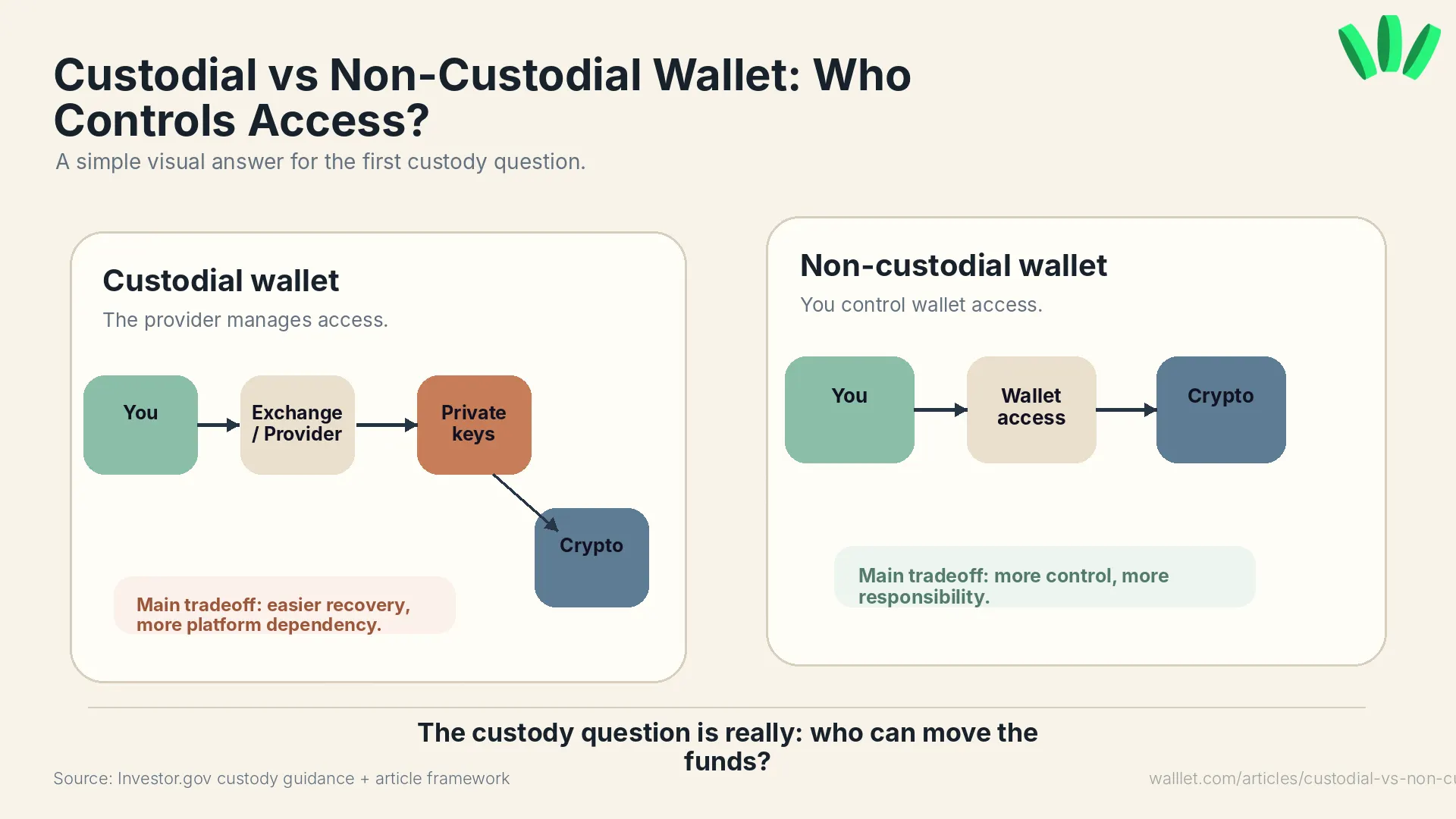
Custodial wallets is when a third party holds and manages your crypto private keys. These third parties may be crypto exchange companies that step in to safely keep your crypto assets for you. Examples of these custodians are big exchange companies like Venga, Binance and Coinbase.
With Non-Custodial wallets, you are the absolute ruler of your crypto, you hold the private keys yourself.
There is no middleman, no corporate office, and no one standing between you and your funds. Examples of these independent sidekicks include wallets like MetaMask, Trust Wallet, or hardware devices like Ledger.
How Does a Custodial Wallet Work?
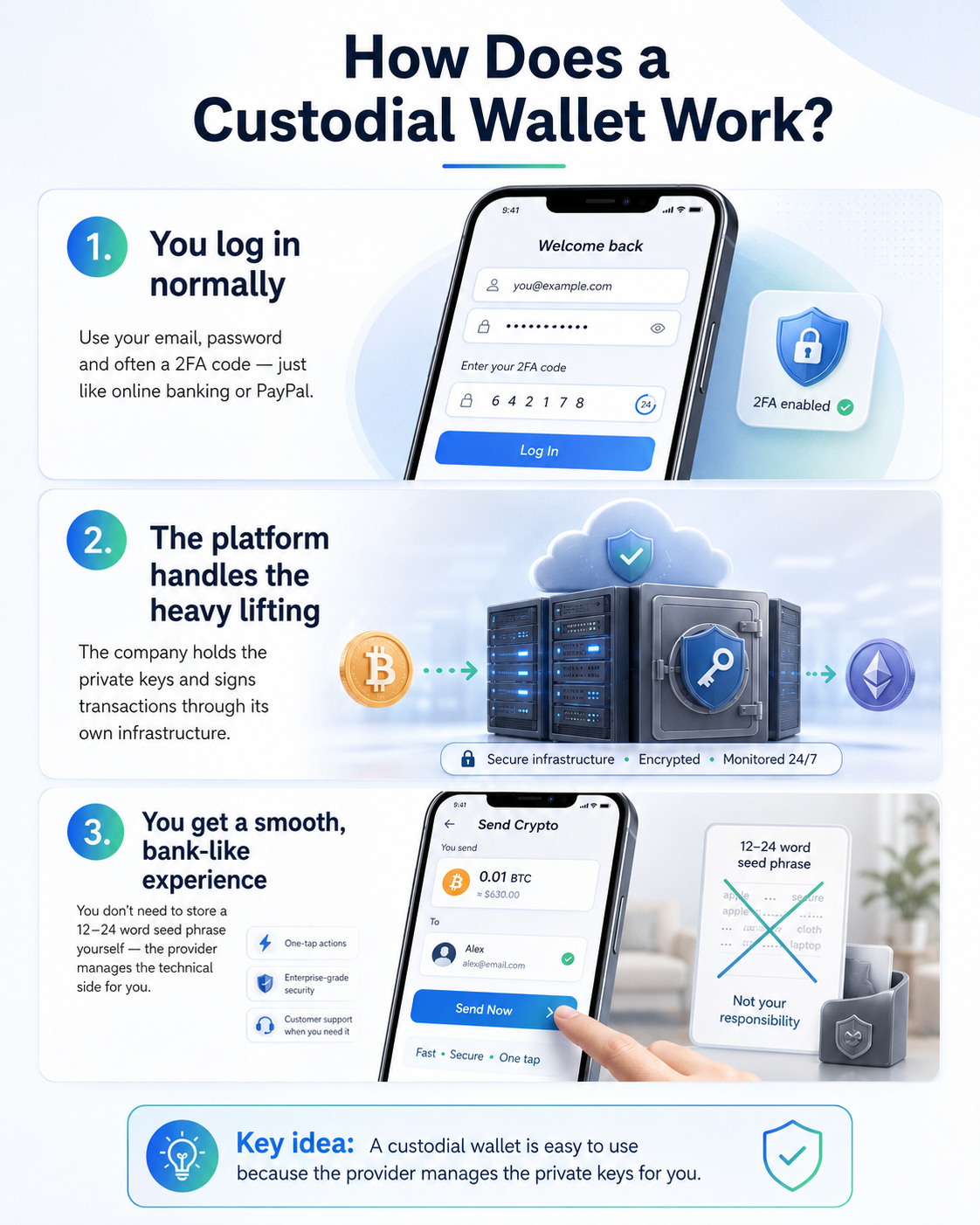
Using a custodial wallet feels beautifully, comfortingly familiar. If you’ve ever used online banking, PayPal, or basically any modern financial app, you already know the drill.
Instead of dealing with raw cryptographic code, you log in using standard credentials, could be your email address, a password, and usually a handy little 2FA (Two-Factor Authentication) code pinging your phone. You tap the screen to send some coins, but behind the curtain, the platform’s infrastructure does the heavy lifting. They handle the private keys, and their servers digitally sign the transactions for you.
The beauty of this setup is that you don't have to stress about hiding a complicated 12-to-24-word seed phrase (your master password) anywhere. Instead, you get a smooth, bank-like experience where a company does the tech work for you.
Just remember,you are fully trusting that company to stay secure, keep enough cash on hand, and keep their app running smoothly.
Main Advantages of Custodial Wallets
For anyone just stepping into crypto, custodial wallets offer a smooth, stress-free entry point. It's built to feel like a premium financial service, offering several practical advantages:
- Effortless Onboarding: You can sign up, verify your identity, and start exploring in minutes with no technical expertise required.
- Simple Account Recovery: If you forget your password, your funds aren't lost forever. A standard "Forgot Password" link and identity check get you right back in.
- Real Customer Support: If a transaction gets stuck or you get confused, there is actually a human support team you can message for help.
- Convenient Trading & Fiat Ramps: Buying crypto with your credit card or linking your European bank account to swap Euros for Bitcoin is usually seamless and happens instantly inside the platform.
- Less Technical Responsibility: You don't have to stay awake at night worrying if your private keys are safe from malware. The platform takes care of the IT heavy lifting.
Keep in mind: Just because someone else is doing the heavy lifting doesn't mean the risks vanish into thin air. You're handing the security responsibilities to a company, which means you're now relying on their systems, policies, and ability to keep your assets safe.
Main Risks of Custodial Wallets
While the service model is cozy, it comes with a major trade-off. In the financial world, we call this counterparty risk, which is the simple fact that someone else controls the keys, the infrastructure, and ultimately, your assets.
When you use a custodial wallet, you are fully exposed to the operational reality of that third party.
So what are the risks? If the platform gets hit by a clever hacker, suddenly freezes withdrawals due to new government regulations, changes its daily rules, or goes completely bankrupt, you could instantly lose access to your money.
In short, you are trading away your ultimate control for maximum convenience, meaning your crypto is only as safe as the company looking after it.
How Does a Non-Custodial Wallet Work?
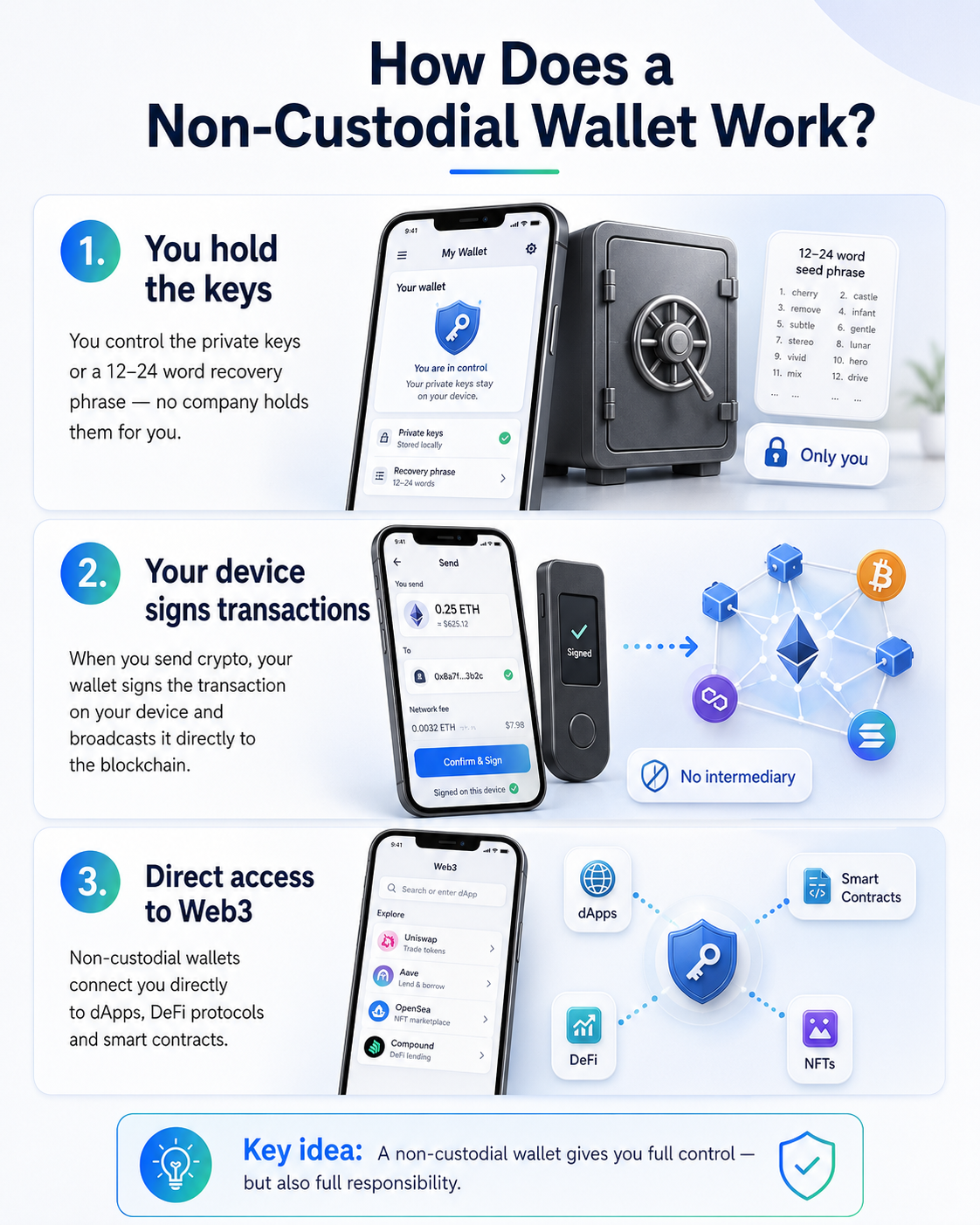
If a custodial wallet is like letting a bank babysit your money, a non-custodial wallet is like having a heavy-duty steel safe welded to your living room floor. You, and absolutely only you, hold the combination.
Instead of logging into someone else's platform with a username and password, a non-custodial wallet gives you direct custody of your private keys or a 12-to-24-word recovery phrase (your seed phrase). When you want to move some crypto, your wallet software or hardware signs the transaction right on your device and sends it straight to the blockchain. You don't need to ask a centralized company for permission, wait for their approval, or worry about their office hours.
Non-Custodial wallets give you an open passport to the entire Web3 universe, letting you interact directly with decentralized apps (dApps), DeFi protocols, and smart contracts.
Main Advantages of Non-Custodial Wallets
For anyone who can't stand being told what to do, non-custodial wallets are a fit. It's built for total financial independence, offering some very juicy advantages:
- True Ownership: Your coins, your rules. No third-party company can freeze your account because they didn't like your transaction history.
- VIP Access to Web3: You can connect to decentralized exchanges, buy weird NFTs, or play blockchain games instantly without waiting for a corporate green light.
- Bankruptcy-Proof: If the developers who made your wallet app go completely bust tomorrow? Who cares? Your crypto is safely floating on the blockchain, waiting for you to plug your keys into a different app.
- Total Transparency: No shady internal company ledgers here. Everything you do is written in stone on the public blockchain for the world to see.
- Zero Corporate Drama: You don't have to stay awake worrying if your exchange is doing shady things with your money behind closed doors.
Just because you fired the middleman doesn't mean you're suddenly invincible. Non-custodial isn’t a magic shield. it just means if everything goes wrong, the blame entirely falls on you.
Main Risks of Non-Custodial Wallets
While being your own bank sounds incredibly badass, it means you are now your own IT and cybersecurity department, your own Customer support.
In this realm, the biggest threat is not even the company going bankrupt, it’s you making a silly mistake. If you lose your recovery phrase, get tricked by a fake website, or accidentally click a shady link, a scammer can drain your wallet in seconds. And because there is no bank to call, your chances of getting that money back are exactly zero.
To manage this risk, you have to choose your weapon. You can go with software wallets, which are super convenient apps on your phone or laptop, but since they are always connected to the internet, they are naturally exposed to hackers. Alternatively, you can level up to a hardware wallet, a physical, offline device that keeps your keys completely disconnected from the internet, giving hackers a zero percent chance of touching them.
What wallet type fits different user profile
The question of what wallet fits what profile is a deeply personal choice that depends entirely on your lifestyle, your technical confidence, and how you handle responsibility.Before you move to downloading a wallet, you should ask yourself these questions:
How much crypto experience do I actually have?
Am I holding pocket change or my entire life savings?
Am I trading three times a day, or buying and forgetting for the next five years?
Do I want to dive into the wild world of DeFi, or am I just holding a little Bitcoin?
Most importantly: Am I adult enough to manage a master password with zero outside help, or do I need a corporate safety net?
If those questions are answered, let's look at the first typical profile to see if it’s a match.
Beginner with a small amount of crypto.
If you are brand new to the crypto jungle and only playing around with a small amount of cash, you don't need to overcomplicate things.
For this profile, a reputable custodial wallet is usually the perfect entry point. It gives you that familiar, cozy online banking experience. You get a normal login screen, a team of human beings in customer support to help you if you panic, and that beautiful "Forgot Password" link when you inevitably lose your credentials. It takes the terrifying technical responsibility off your shoulders while you learn the ropes.
However, you are still advised to choose a reputable, regulated, rock-solid provider (like Venga or Coinbase) and immediately turn on 2FA (Two-Factor Authentication). Never forget, they are holding your keys. You are a guest in their house, so make sure it's a house you actually trust.
Active Trader
If your daily routine involves staring at charts, tracking price tickers, trades, your needs are all about speed and convenience.
For this fast-paced lifestyle, keeping your trading funds in a custodial exchange account makes total sense. Why? Because it’s fast and easy. When the market suddenly moves, you need to buy or sell right that second. If you have to wait to transfer funds from a private wallet over to an exchange first, you’ll lose precious minutes and in crypto, those minutes can cost you serious cash.
Long-Term HODLer
If your grand plan is to buy crypto, put it away, and not touch it until your hair turns grey, you are a HODLer (Holding On for Dear Life). You are here to build generational wealth.
For this patient mindset, a non-custodial wallet should absolutely be your soulmate specifically, a physical hardware wallet (like a Ledger Flex or a Trezor Safe). Since you are storing a serious stack for the long haul, your number one priority is bulletproof security, not convenience. You want to completely remove the middleman so that no platform bankruptcy, corporate hack, or sudden withdrawal freeze can ever touch your treasure.
Also, this level of absolute freedom demands serious adult responsibility. Because a hardware wallet keeps your secret keys completely offline,far away from the digital jungle and sneaky internet hackers, the only real weak spot in the chain is you.
You have to be fully prepared to write down your 12-to-24-word recovery phrase on paper, keep it safe from water or fire, and hide it in a spot so secret that even the best detective couldn't track it down. If you are ready to take your own cybersecurity seriously, a hardware wallet rewards you with total peace of mind. No exchange collapse, corporate drama, or platform bankruptcy will ever be able to touch your future wealth.
DeFi Explorer
Do you look at standard crypto trading as boring and you like to venture into the DeFi (Decentralised Finance) wilde west, looking at things like hunting for high yields in liquidity pools, lending out your stash for interest, or swapping weird tokens on decentralized exchanges.
For this kind of crypto lifestyle, a centralized app is utterly useless. A non-custodial wallet is your mandatory VIP pass. You need an active tool that connects you to the blockchain and doesn't ask a corporate guy for permission to make a move.
With this setup, you can connect directly to the network and play the market like a pro. On the other side, when you play in the deep end of the pool, you also have to watch out for the sharks.
Cutting out the middleman feels amazing until you realize that middleman was also the guy keeping the scammers out of the lobby. When you go full DeFi, you are signing digital contracts directly on the blockchain. This means you have to be sharp enough to dodge broken code in an app (smart-contract risk), spot flawless fake websites (phishing), and avoid blindly clicking "approve" on a pop-up that accidentally gives a shady platform a blank check to empty your stash.
A non-custodial wallet gives you absolute power to conquer this frontier, but it demands total focus, reading the fine print on every single prompt and never signing a transaction with your eyes closed.
Enterprise & Treasury User
For those managing digital assets for a business, companies may need more than just choosing a wallet. You are handling other people's money, and a single employee holding a lone recovery phrase is a multi-million-dollar disaster waiting to happen.
Your situation requires high-level security where no single person, not even the CEO has the power to move any money alone. Managing crypto for a business entails strict internal rules and absolute safety.
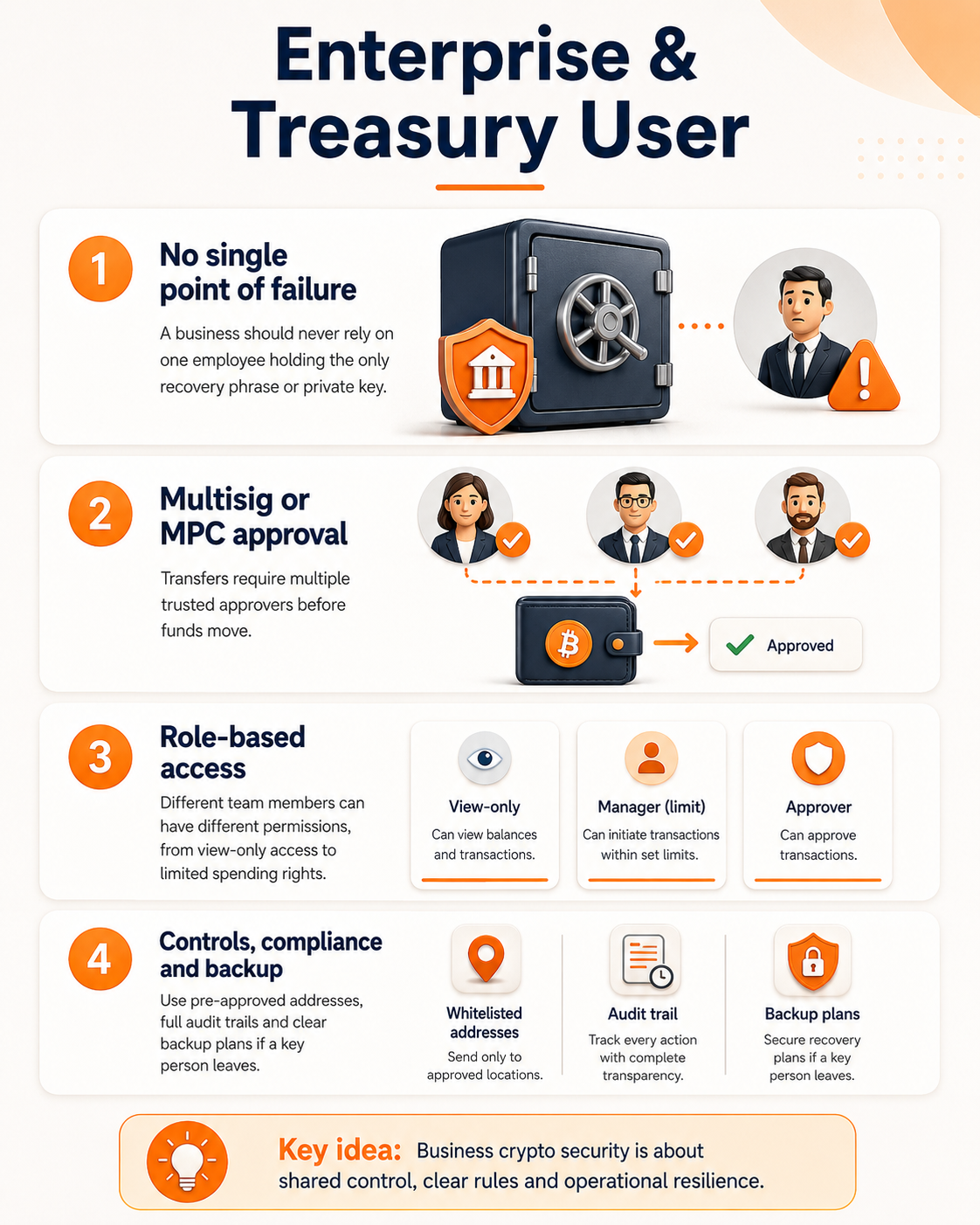
Instead of standard apps, companies use multi-signature (Multisig) or Multi-Party Computation (MPC) setups, which require multiple trusted executives or key shareholders to approve a transfer before it hits the network.
This system stops your intern from playing day-trader with company funds by giving your accountant "look but don't touch" tax access and capping manager spending. It locks down transfers to pre-approved addresses, tracks every move for regulators, and includes clean backup plans if your CFO rage-quits.
How to choose between custodial and non-custodial wallets?
Choosing a wallet depends on matching your tool to your actual needs, technical skills, and the amount of money you are handling.
It can not be simpler than this: if you want a safety net with account recovery, customer support, and easy access, go custodial. If you want absolute ownership of your funds, full independence, and access to the wider world of decentralized finance (DeFi), go non-custodial. Base your choice on your use case, not just ideology.
Consider the table below to guide you on what wallet to choose for your activities.
What mistakes should users avoid?
You need to exercise some degree of personal responsibility irrespective of the wallet you choose. Some mistakes worth avoiding are;
- Too much safety assumption: Assuming an exchange is safe just because it feels like a traditional bank account. If a centralized platform collapses, freezes accounts, or gets hit by insider fraud, you are treated as an unsecured creditor. Your balance can vanish overnight.
- Do not think you have immunity: Thinking a hardware or non-custodial wallet protects you from bad math. A secure device will not stop you from willingly signing a malicious smart contract that drains your balance, nor will it save you if you type your keys into a fake phishing site. Therefore you need to be cautious with your actions.
- Storing Your Seed Phrase Anywhere on an Internet-Connected Device Invites Hackers to Steal It: Taking a screenshot, saving a text file, or printing a cloud note of your seed phrase is not safe. If this device is connected to the internet, its storage can be scraped. Hackers routinely scan cloud backups specifically looking for 12 and 24-word patterns.
- Keeping All Your Assets Under One Key: Keeping your entire crypto net worth under a single private key or on a single platform. If you don't segregate your active trading capital (hot wallets) from your deep savings (cold storage), a single compromise can wipe you out completely.
- Blind Ecosystem Surfing: Approving wallet permissions on unverified platforms just to chase high yields or free airdrops gives malicious code direct access to your funds. You can lose everything without ever revealing your password.
- Choosing an App Based Solely on a Sleek: Modern interface often masks dangerously weak security:. Slick aesthetics are frequently used to hide closed-source code, weak encryption protocols, or poor key management.
Can you use both wallet types?
The simple answer is Yes! In fact, dumping your entire net worth into a single app is not a very smart decision.
Most people who actually know what they’re doing run a hybrid setup, separating their cash by purpose so a single mistake doesn't completely wipe them out. Think of it like real-world money, you don't carry your life savings around in your leather wallet, nor do you lock your coffee money inside a Swiss bank vault.
A simple example of how you can use both wallets could be in a situation where you use a custodial exchange as your quick checking account just to buy, sell, or swap tokens on the fly.
But the second you accumulate a stack you'd actually cry over losing, ship it straight to an offline hardware wallet in your desk drawer, completely disconnected from the internet. This gives you the fast trading speeds of an exchange for your play money, while your real wealth stays entirely out of reach from hackers, bankrupt platforms, and your own bad clicks.
Conclusion: the best wallet is the one that matches your responsibility level.
At the end of the day, choosing between custodial and non-custodial wallets is a choice of who you trust more, a company or yourself. With custodial, you bet on a platform’s security and solvency. With non-custodial, you take total ownership of your private keys and accept all the personal responsibility that comes with it.
Ultimately, the right wallet is the one whose real-world risks you thoroughly understand and can actually manage without breaking a sweat.
Disclaimer: The content provided in this article is for educational and informational purposes only and should not be considered financial or investment advice. Interacting with blockchain, crypto assets, and Web3 applications involves risks, including the potential loss of funds. Venga encourages readers to conduct thorough research and understand the risks before engaging with any crypto assets or blockchain technologies. For more details, please refer to our terms of service.