

Table of Contents
An investment plan is a personal document that records why a person invests, for what period, how much they are ready to invest, what risk they accept, and by which rules they will review the portfolio. It is not a market forecast or a list of best assets, but is instead a framework for disciplined decisions.
You aren't trying to predict the crypto market with your investment plan but are setting up a detailed document to help you make important decisions about your investments and help form an investment strategy. Crypto investing can be difficult so you need a plan if you are going to do it correctly. Sort of like how life is different and not exactly correct before you have a dog but it's better after you have a dog. 🙂
What Is an Investment Plan?
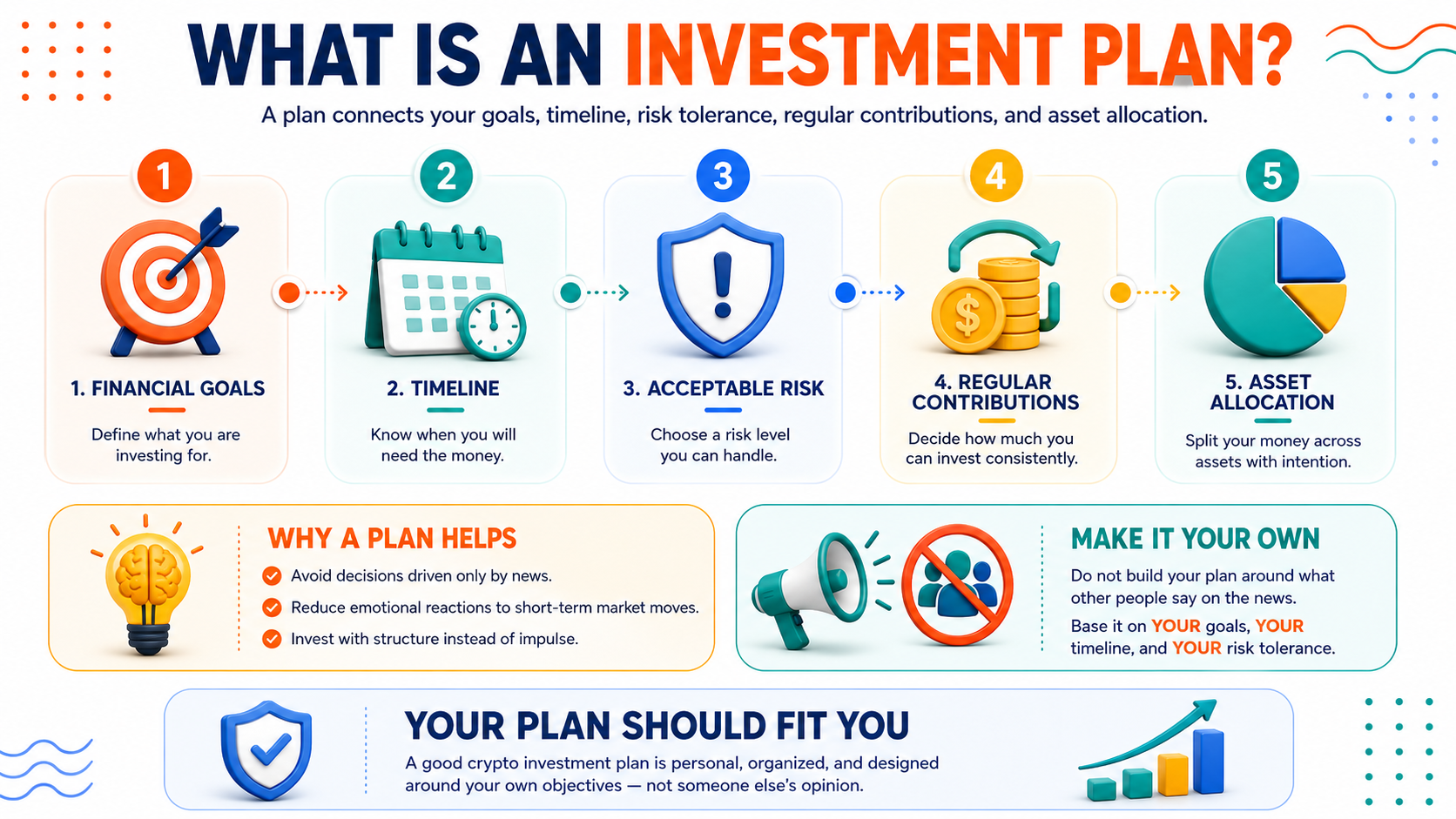
An investment plan connects financial goals, timelines, acceptable risk, regular contributions and basic asset allocation. A good plan helps users avoid making decisions only because of news, emotions or short-term market movement. You don't want to simply listen to Bob or Jim or Sophie on the news say that they have an investment that is good and listen to that. You need your own organized plan so that you don't just follow what other people say. You need to base your cryptocurrency investment plan on your OWN investment goals, timelines, and risk tolerance, not somebody else's.
Why Do You Need an Investment Plan?
A plan will help you understand why you invest, which decisions fit your specific goal, when you should avoid changing strategy and how to track progress. Goals and time horizon affect the choice of strategy and level of risk. If your time horizon is 30 years, you won't need to take as much risk as someone who wants to reach their financial goal in a few years. Your strategy will be different if your goal is to become a millionaire in a few years starting from nothing vs. if your goal is simply to grow your portfolio a little bit each year just so that it beats inflation. If you are investing in digital currencies, you need a plan to help you navigate the complex cryptocurrency market.
What Should a One-Page Investment Plan Include?
One page is enough if the plan answers the key questions: goal, timeline, amount, regular contributions, risk, asset types, review rules and limitations. You don't need your investment plan to be super long. It just needs the information that you need to stay on track with your plan and invest successfully according to your own investment goals and strategy for investing in digital assets.
Investment Goal
Your particular investment goal should be very specific. Is it retirement, education, a home purchase, emergency buffer, or long-term wealth building? What are you working towards? You should specify an amount and a timeline rather than just writing something abstract like "grow money". You need to be detailed about your goal and what you are working for. A specific goal is easier to achieve than "grow money". It's similar to if your goal was to buy a donut. You need to have a specific amount of money to purchase the donut and a timeline for when exactly you plan on eating the donut so when you need to purchase it by. It's not exactly the same, but you get the picture, right?
Time Horizon
Time horizon is the period after which the investor may need the money. A short and long horizon require different approaches to risk and liquidity. If you have a long horizon, you may not need to take on as much risk in order to achieve your goals because you have more time to achieve them. If you are trying to achieve your goals in a short time horizon, you may need to take on more risk to get your money to grow at a faster rate.
Risk Tolerance
Risk tolerance is how comfortable you are with losing money in the short term so you can earn a higher return with your investments over the long run. Risk tolerance is not only the desire to earn more but it is also the ability to withstand drawdowns. You have to be able to withstand risk and potential drawdowns if you want your money to grow faster.
Cryptocurrency investing and making a trade or multiple trades involves risk, but ask yourself just how much risk you are willing to take? Can you easily handle it if your money goes through a drawdown or two or maybe more, or do you feel like you are going to explode or sad inside if you see your investment is worth less for a while? You have to decide what you are able to stomach to determine what your risk tolerance is and how much you are willing to take on.
Contributions
This is how much and how often you plan to invest. Is it monthly, quarterly, once, or when free funds become available? What you decide here can make your plan either realistic or not realistic depending on your goals and how often you make contributions. For example, if your goal is to grow your money a lot and quickly, you may need to make more than one contribution in order to have a greater chance of achieving your goal in the timeline you set for yourself.
Asset Allocation
Asset allocation is the distribution across different asset classes, such as cash, bonds, stocks, funds or crypto. Investor.gov describes asset allocation, diversification and rebalancing as basic ways to manage portfolio risk. For example, if you put all of your money into crypto, you are taking on more risk because you could lose all of your money. However, if you keep some in cash, you will still have money to use if your crypto investment doesn't go as planned.
It's a good idea to allocate some to cash, bonds, stocks etc so that if one asset class doesn't do as well, you can be picked up by the others. A well diversified portfolio helps you manage your risk and protect yourself somewhat from the possibility of losing everything.
Review Rules
You want to set up how often you will review your investment plan. For example, will it be once a quarter, once every six months, or after serious changes in income, goals, or timelines? You don't want to review your plan and strategy every time there is market noise. You should set a particular timeline for how often you review it or what triggers an investment plan review.
Example of a One-Page Investment Plan
Here's an example of an investment plan. Yours may be quite different according to your own goals, timeline etc. The numbers are just examples, not investment advice.
Tom's Investment Plan
Investment Goal: Tom wants to save up to buy a house. The house type he wants costs about $500,000. He wants to buy the house in 5 years. He thinks it will take that long to invest and save to that amount.
Time Horizon: The time horizon is 5 years because that's the deadline that Tom set for himself to purchase a $500,000 house.
Risk Tolerance: Tom has a high risk tolerance for his strategy. He is willing to accept the risk to make more risky investments because he knows he needs to do that in order to get to $500,000 in only 5 years.
Contributions: Tom plans to make contributions monthly from his monthly salary of $9,000. He plans to contribute at least $3,500 every month towards his investments.
Asset Allocation: Tom knows that he needs to have a well diversified investment portfolio. He plans to invest 40% in cryptocurrencies, 40% in stocks, and 20% in bonds. That means if one of his asset classes doesn't do as well, hopefully the others will pick up the pieces and he can still reach his goal.
Review Rules: Tom plans to review his investment plan every quarter. That way if he gets the raise he is expecting at work or something else happens that changes his investment thinking, he can address it with enough time for it to impact his investments but not too often where the plan is constantly changing.
Common Mistakes When Writing an Investment Plan
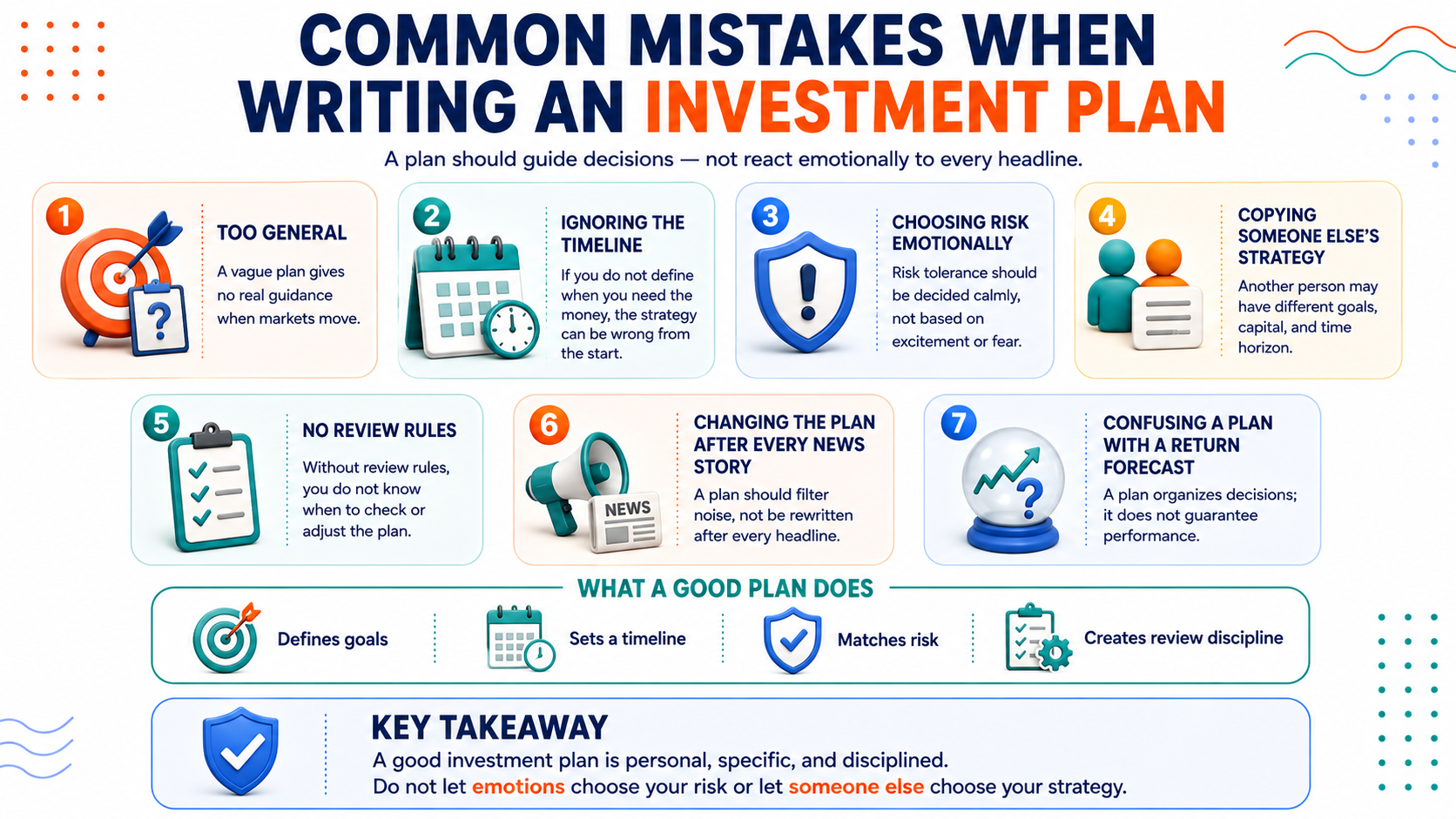
There are a few mistakes that you can run into when writing an investment plan and figuring out your investment strategy. Some are: writing a plan that is too general, ignoring the timeline, choosing risk “emotionally”, copying someone else’s strategy, not recording review rules, changing the plan after every news story, and confusing an investment plan with a return forecast. Don't let emotions get in the way when you are choosing your risk tolerance. Also, you don't want to base your strategy on someone else's. They may have different goals than you do or a different timeline.
When Should You Update Your Investment Plan?
The plan should be updated when the goal, income, timeline, family situation, risk tolerance or available investment amount changes. These will all have an impact on the overall plan so you should re-visit and update your plan if one of these changes. However, ordinary market volatility alone is not a reason to rewrite your entire plan.
Conclusion
An investment plan helps investors make decisions according to rules they set in advance. A one page plan does not need to be complicated. It should clearly state why you invest, for what period, with what level of risk, how much you contribute and when you review the strategy. It doesn't need to be any more complex than that, so don't make it into a big deal. Just sit down with your iced coffee and start writing.
Disclaimer: The content provided in this article is for educational and informational purposes only and should not be considered financial or investment advice. Interacting with blockchain, crypto assets, and Web3 applications involves risks, including the potential loss of funds. Venga encourages readers to conduct thorough research and understand the risks before engaging with any crypto assets or blockchain technologies. For more details, please refer to our terms of service.