
Table of Contents
You've got a lump sum sitting in your account, and two ways to handle it: put it all in today, or spread it out over the coming months.
Plenty of people get stuck on the sidelines over that exact choice, longer than they’d like to admit. DCA is one of the most common answers to it, and also one of the most misunderstood.
This isn’t really about picking the "right" stock or timing the market perfectly. It’s about deciding how your money gets into the market in the first place.
Get this decision right for your situation, and it barely matters. Get it wrong, and you can end up either sitting on cash for months longer than you needed to, or investing a lump sum right before a rough patch. Here’s when DCA earns its reputation, and when it quietly costs you.
Dollar-Cost Averaging, Defined
You’ll see what is dca in investing pop up as a common search question, and the answer is simpler than it sounds. DCA, or dollar-cost averaging, means putting a fixed amount into the market at regular intervals rather than investing everything in one go. £200 a month into a stock index fund, say, regardless of what happened to prices last week.
The idea isn’t new. Benjamin Graham wrote about it back in 1949, in The Intelligent Investor. The core logic hasn’t moved much since then: buy the same amount every time, and the maths does the rest. Prices dip, you pick up more shares. Prices climb, you pick up fewer.
You’ve probably used a version of DCA without labelling it that way; a workplace pension or a standing ISA order on payday works on exactly the same principle. The strategy isn’t exotic. It’s just regular, automated investing under a fancier name.
How Does DCA Work?
Here’s how DCA works in practice. Say you have £1,200 to invest in a particular stock, and you decide to spread it across six months at £200 each.
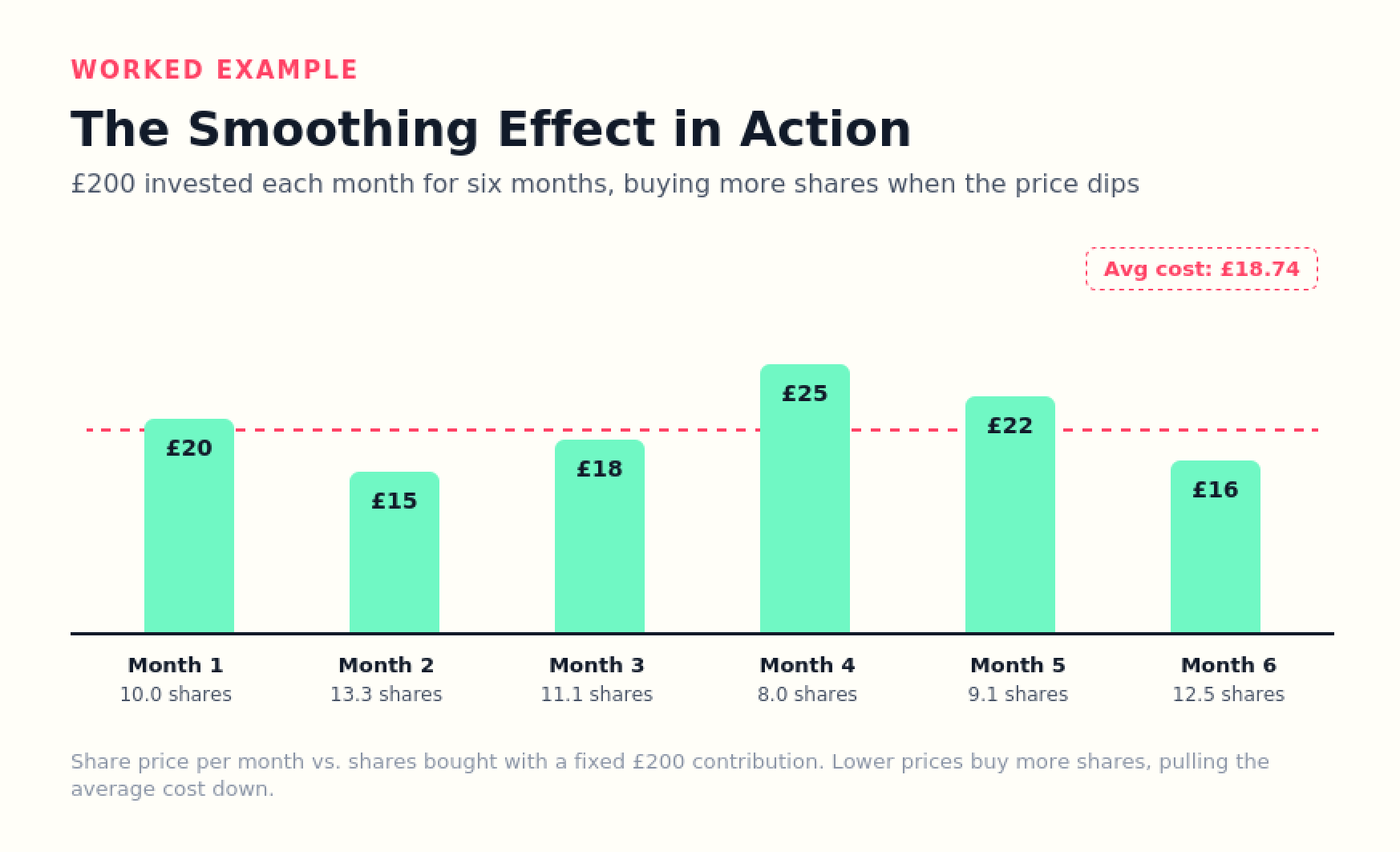
By the end of the six months, you’ve bought at a range of prices instead of just one, and ended up with roughly 64 shares. Your average cost per share settles somewhere between the market’s high and low points, pulled down by the fact that you bought more when the stock was cheap and less when it wasn’t.
That smoothing effect is the whole pitch. It won’t guarantee a lower cost than putting the £1,200 in on day one, but it takes the pressure off guessing the perfect entry point. Nobody has to call the bottom of the market for DCA to work reasonably well.
There’s a practical side too. Most modern brokerages and investment apps let you automate this entirely, so once it’s set up, the strategy runs itself without you needing to log in and buy each month.
Why Investors Reach for DCA
It usually comes down to two things: psychology, and plain old access.
On the psychology side, investing a large sum right before a downturn is a rough experience, and that fear alone keeps plenty of people from investing at all. Spread the purchases out, though, and the decision stops feeling so final.
On the access side, DCA doesn’t require a windfall. Setting aside £50 or £100 a month from a salary is DCA in its most common form. It’s also how most workplace pensions and regular savings plans already operate, whether people realise it or not.
There’s a habit-forming effect too. Automating a fixed contribution each month turns investing into a routine rather than a decision you have to keep making. That matters more than it sounds for anyone prone to putting things off.
It also sidesteps a particular kind of decision fatigue. Trying to work out the "right" week to invest a lump sum involves refreshing news headlines and price charts, then hoping your gut says something useful. Most of that effort doesn’t actually improve the outcome. DCA takes that decision off the table entirely. The schedule decides, not your mood on a given Tuesday.
When DCA Helps
Sustained Downturns and High Volatility
DCA does its best work when markets are choppy or falling. Take 2008: anyone DCA-ing into the market as the financial crisis unfolded kept buying through the crash, each purchase a little cheaper than the last, and came out ahead of anyone who’d gone all-in at the start. The dot-com crash in 2000-2002 tells the same story. So does the 2020 pandemic drop.
Here’s why. In a falling market, each fixed contribution buys more shares than the last one did, and when prices recover, that larger pile of shares does more of the heavy lifting.
When a Lump Sum Feels Too Big to Deploy at Once
Say you’ve just come into a large amount: an inheritance, or money from selling a property. Putting it all into the market on a single day can feel reckless, even when the maths says otherwise. DCA offers a middle ground. You’re still investing, just not all in one uncomfortable moment.
This matters more than pure statistics might suggest. An investor who freezes up entirely because a lump sum feels too risky, and ends up leaving the money in cash for years, does worse than one who DCAs in imperfectly but actually gets started. The best strategy on paper is worthless if fear stops you using it.
Building a Long-Term Habit
Regular, automated contributions build a habit that a one-off lump sum doesn’t. For anyone early in their investing journey, that consistency can matter more than squeezing out an extra percentage point of return.
A monthly contribution also grows alongside a career. Income rises, and the contribution can rise with it. No need to redesign the whole approach from scratch each time. It just keeps running quietly in the background.
When DCA Falls Short
Steadily Rising Markets
Markets go up more often than they go down over long stretches. Every month DCA holds cash back instead of investing it straight away, that cash is missing out on potential gains. In a market climbing steadily, a lump sum invested on day one usually ends up ahead of the same amount spread across a year.
This is the flip side of the smoothing effect that makes DCA appealing during a downturn. Smoothing works in both directions. It softens the blow of a falling market, but it also softens the benefit of a rising one, and rising stretches happen more often than falling ones.
What the Research Actually Found
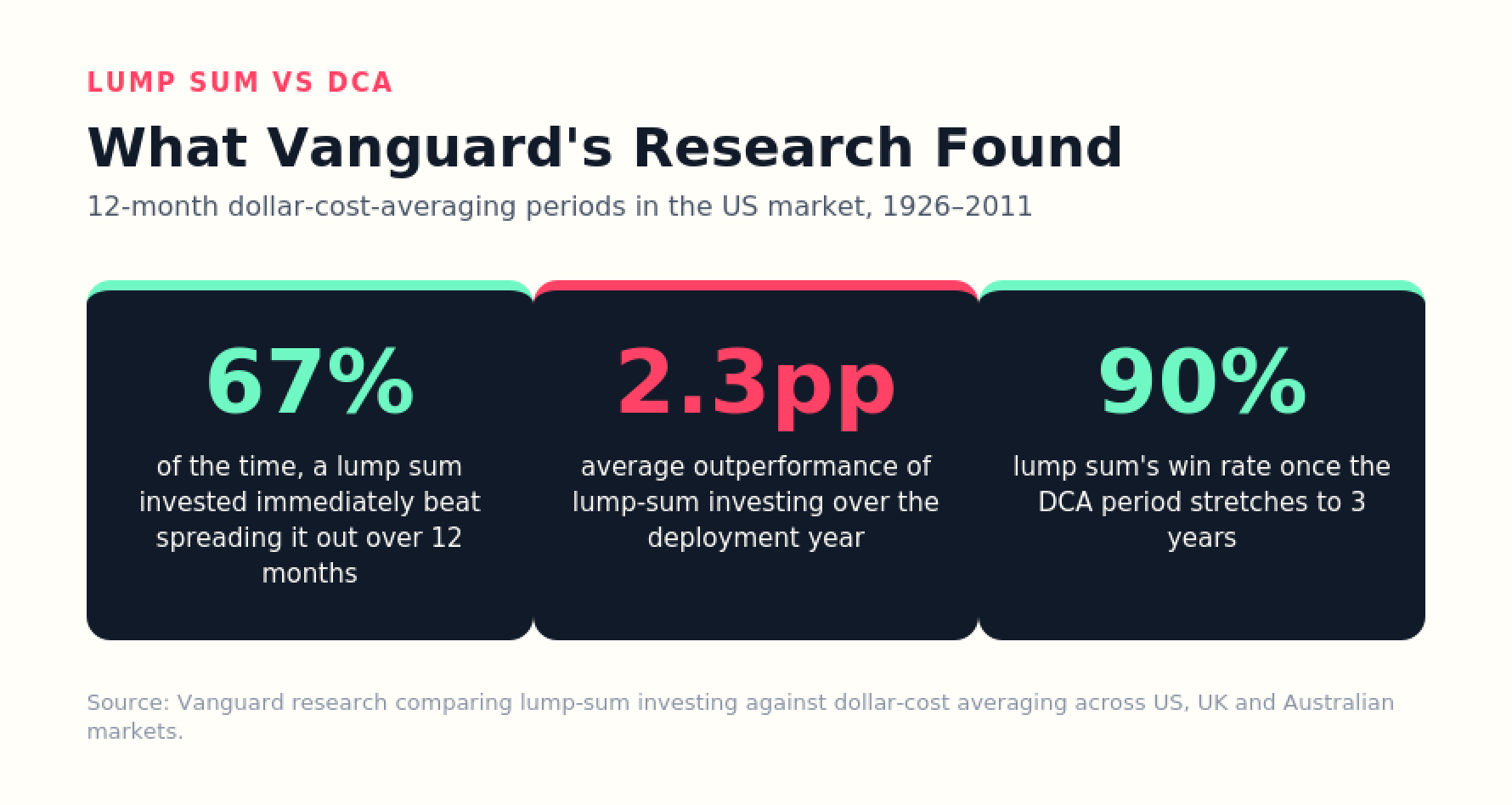
The clearest evidence comes from Vanguard’s research comparing lump-sum investing against DCA across the US, UK and Australian markets. Looking at 12-month DCA periods in the US going back to 1926, lump-sum investing beat DCA around 67% of the time, with an average outperformance of roughly 2.3 percentage points over the deployment year. Stretch the DCA period out to three years, and lump sum’s win rate climbs to around 90%.
That’s not a small gap. It’s worth taking seriously rather than assuming DCA is automatically the safer or smarter choice.
The Cost of Sitting on the Sidelines
Every pound held back from the market while you DCA in is a pound not compounding. That opportunity cost is easy to overlook because it’s invisible. There’s no loss to point to, just growth that never happened.
Picture £12,000 waiting to be invested. Under a twelve-month DCA plan at £1,000 a month, exactly half of that, £6,000, is still sitting in cash rather than in the market at the six-month mark. If the market has climbed in the meantime, that uninvested half missed the ride entirely, a cost you won’t see on any statement.
DCA vs Lump-Sum: Quick Comparison
Side by side, the trade-off comes down to a handful of factors.
Choosing What’s Right for You
Four questions, answered honestly, tend to settle this.
Is the money already sitting in cash, or is it new income arriving a bit at a time? If it’s the latter, DCA isn’t really a choice. It’s just how you invest.
How would you feel if the market dropped 20% the week after you put in a lump sum? If that scenario would put you off investing again for good, DCA’s psychological cushion might be worth more to you than the statistical edge of a lump sum.
What’s your time horizon? Investors with decades ahead of them have more room to ride out a badly timed lump sum than someone investing money they’ll need within a few years.
Does the platform you’re using actually support it? Most brokerages, workplace pensions and even several crypto exchanges now offer a recurring buy feature, which does the DCA scheduling for you automatically. No recurring buy feature? DCA still works. Just set a calendar reminder instead of relying on a toggle in an app.
There’s no single correct answer here, and rushing through them defeats the point. Sit with them honestly. The plan that actually fits your temperament is the one you’ll stick with.
Conclusion
Right and wrong don’t really apply here. On average, lump-sum investing wins on the numbers. DCA wins on getting nervous investors to actually invest in the first place, which counts for more than a spreadsheet gives it credit for.
The best strategy is the one you’ll stick with when the market does something uncomfortable. A good plan you abandon halfway through beats a slightly better plan you never finish.
If the money is already in your account and you can stomach the swings, the statistics lean towards getting it invested sooner rather than later. If it’s arriving gradually, or the idea of a downturn the week after you invest would put you off the whole thing, spreading it out isn’t a mistake. It’s just a different trade-off, and one that plenty of investors make quite happily.
Disclaimer: The content provided in this article is for educational and informational purposes only and should not be considered financial or investment advice. Interacting with blockchain, crypto assets, and Web3 applications involves risks, including the potential loss of funds. Venga encourages readers to conduct thorough research and understand the risks before engaging with any crypto assets or blockchain technologies. For more details, please refer to our terms of service.