

Table of Contents
Bitcoin had kind of a Civil War moment last weekend. A group of Bitcoin supporters tried to create a different version of the network. But it only lasted two blocks… 🫠
For a few years now, part of the Bitcoin community has been unhappy about inscriptions of images, text and other types of data, stored directly on the Bitcoin blockchain. This became a particularly big debate with the arrival of Ordinals and other inscription projects, which made it possible to use Bitcoin’s limited block space for much more than financial transactions.
For some, this is simply another use of a permissionless network. If a transaction follows Bitcoin’s existing rules and the sender pays the required fees, why should anyone decide what that transaction is allowed to contain? For others, Bitcoin was created solely to move money, not to become the world’s most expensive storage tool.
And this disagreement is not new. The Bitcoin community has been debating what the network should be used for, and how much data should be allowed on it, for years.
It’s in this context that BIP-110 came in.
What is BIP-110?
BIP stands for Bitcoin Improvement Proposal. It is a way for developers and members of the Bitcoin community to propose changes to the network’s rules.
This particular BIP-110 proposed to temporarily change Bitcoin’s rules and make it harder to use the blockchain for storing large amounts of arbitrary data. The idea was to put limits on several types of data that can be included in Bitcoin transactions, while keeping normal transactions working as usual.
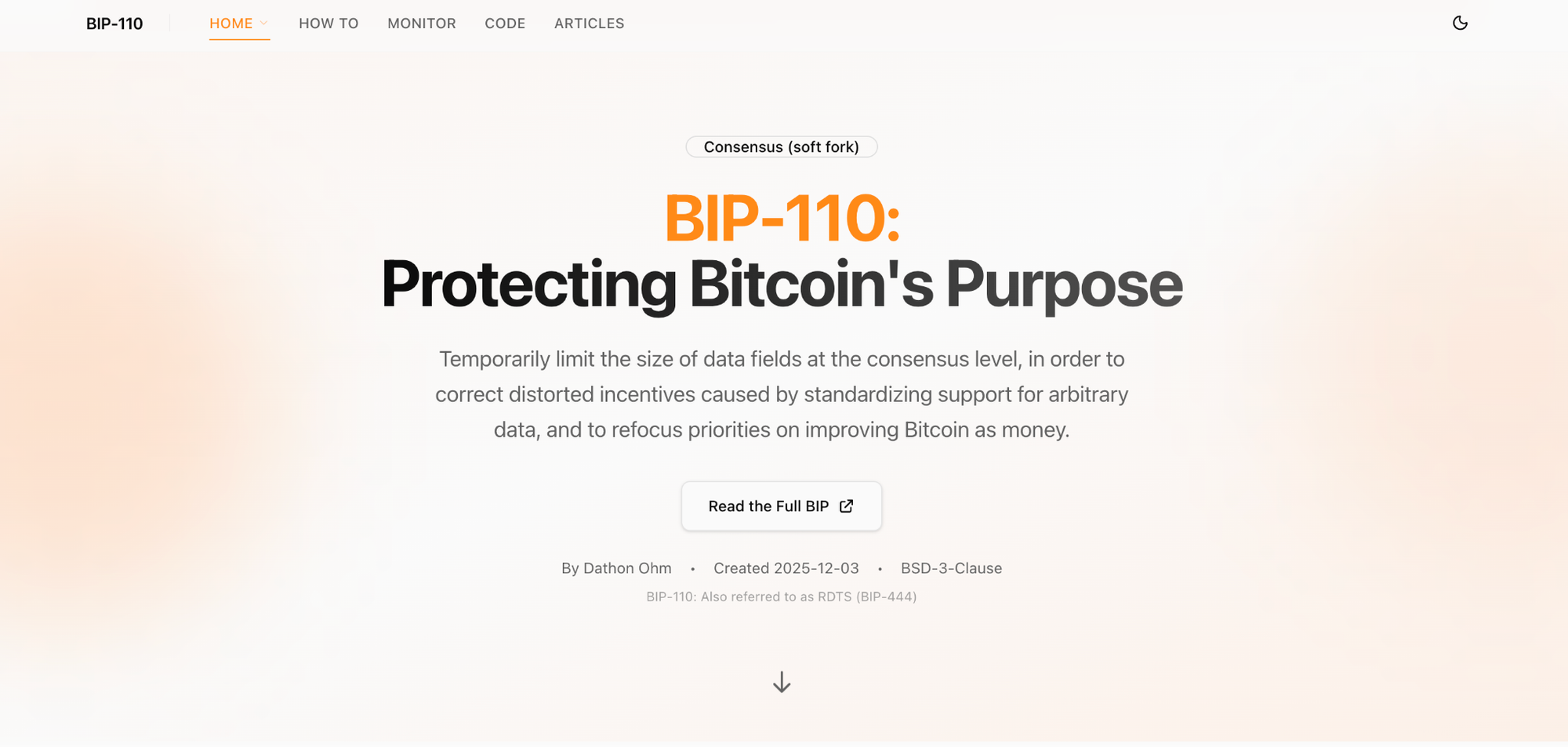
The proposal was designed to apply for a year. After that, the restrictions would expire unless the community decided otherwise.
But there was a small problem with the way BIP-110 planned to activate these new rules.
How do Bitcoin rule changes normally work?
Bitcoin doesn’t have a CEO, a board of directors or a central authority that can simply announce a new rule and make everyone follow it. It is decentralized, and that’s kind of the whole point.
Changes to Bitcoin require coordination between the different stakeholders of the ecosystem, from developers to miners, node operators, businesses and users.
Miners are particularly important because they use computing power to secure the network, produce new blocks and generate new BTCs in the process. When a major change is proposed, miners can signal whether they support it, giving the rest of the ecosystem an idea of how widely the change would be accepted.
Usually, major Bitcoin rule changes are designed to require very broad support before they activate.
But here, BIP-110 took a different approach. It set the initial threshold at 55% of miners signalling support. And even if that threshold wasn’t reached, the proposal was designed to eventually force its rules onto the chain enforcing BIP-110.
Spoiler alert: they didn’t. But the thing is, when major disagreements happen in blockchain, it can result in what we call a fork.
What is a blockchain fork?
Well first of all, no. We’re not talking about the famous food app or the tool you use to eat.
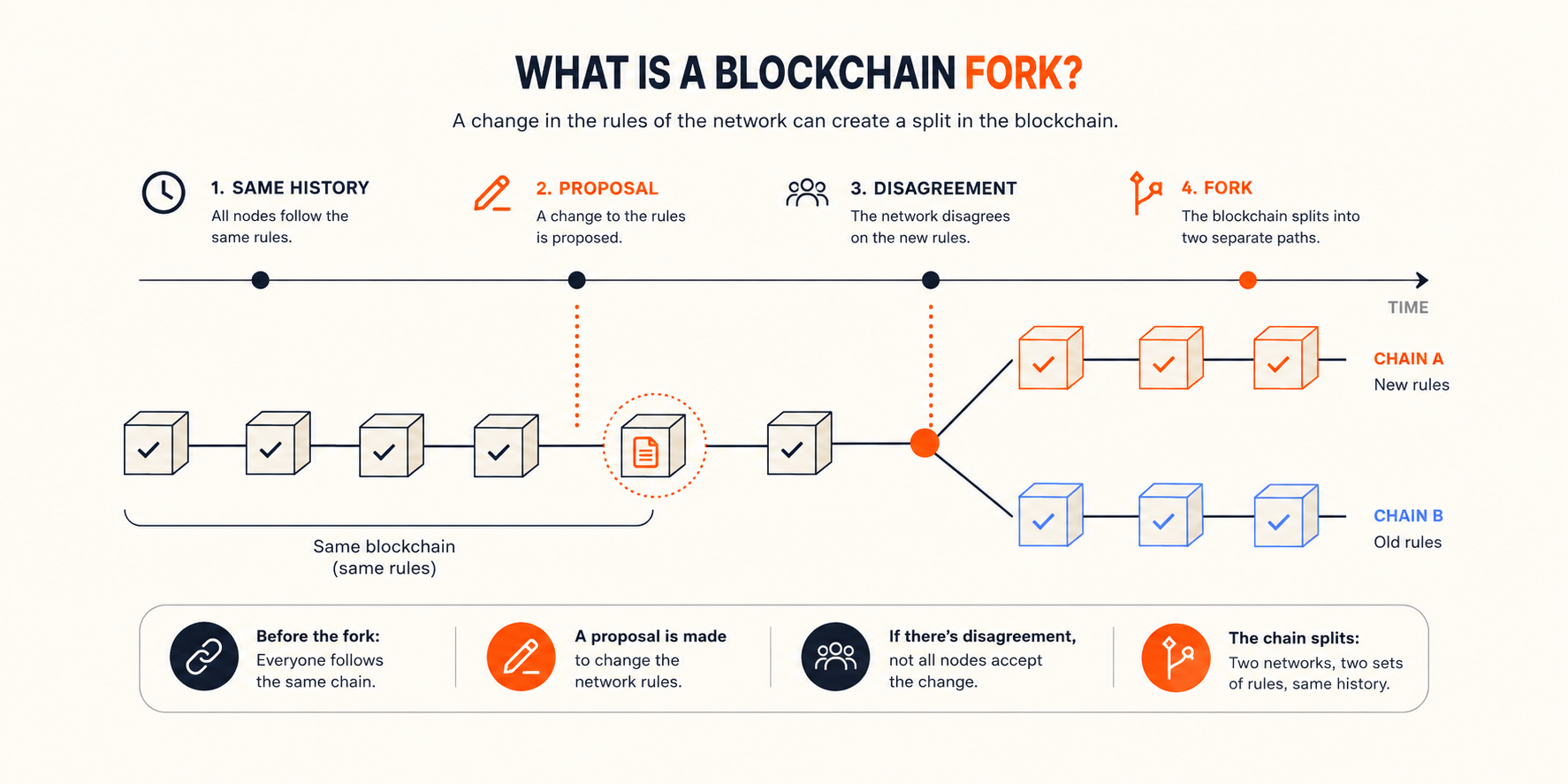
In the blockchain world, a fork happens when someone proposes to change the rules of a network. If everyone agrees with the new rules, the network simply moves forward with the update.
But if there is a disagreement and part of the network starts following different rules, the blockchain can split into two separate paths. Both chains share the same history up to the moment of the split, but from then on, they follow different rules.
Think of it like a road splitting in two. Everyone starts from the same place, but some people decide to take a different route. From that point on, the two groups can end up going in completely different directions.
And this is exactly what happened with Bitcoin last weekend through BIP-110.
Two blocks vs. 48
Once the fork happened, the difference between the two chains became very obvious.
The main Bitcoin network continued producing blocks normally, roughly one every eight hours. So, at the same time it produced 48 blocks, the BIP-110 chain managed to produce just 2.
The reason was simple, almost no miners were supporting it. The BIP-110 chain had only around 0.15% of Bitcoin’s total computing power behind it.
Keep in mind that Bitcoin uses a system called Proof-of-Work, where miners compete using computing power to produce new blocks. The more computing power a chain has, the more likely it is to find blocks and keep moving at the expected pace. So when this power is lacking, it’s pretty problematic.
That is what happened to BIP-110. With almost no mining power behind it, producing blocks became extremely difficult. After two blocks, the chain effectively stalled while the main Bitcoin network continued producing blocks normally.
Why didn’t everyone just switch to BIP-110?
Changing Bitcoin’s rules isn’t like updating your phone’s software.
If Apple releases a new version of iOS, you can update your phone and continue using the same ecosystem. Apple releases the new version, you agree to update your software, done. With Bitcoin, changing the rules means getting enough of the network to agree to those new rules.
So for a new chain to become meaningful, you need way more than just a few developers writing and running a new code. Miners need to produce blocks under the new rules, nodes need to accept them, users need to transact on the chain, and businesses, wallets and exchanges may need to support it.
Without that wider ecosystem, you can technically create a new blockchain, but it will turn into a no man’s land.
That is why the BIP-110 episode is interesting. It shows that creating a fork in itself is relatively easy, but convincing everyone to follow isn’t.
Why is BIP-110 so controversial?
The debate around BIP-110 goes much deeper than the previously mentioned inscriptions.
On one side, BIP-110 supporters believe Bitcoin should stay focused on its original purpose: being a decentralised form of money. For them, large amounts of non-financial data take up valuable block space, compete with financial transactions and can potentially make the network more expensive and demanding to operate.
From their point of view, limiting this kind of activity helps keep Bitcoin focused and protects its long-term decentralisation.
On the other side, others believe that Bitcoin is supposed to stay permissionless. If a transaction follows the existing rules and pays the required fees, the network shouldn’t decide whether the transaction is useful, useless, a payment, an image or a meme. It should just be made.
Besides, if some Bitcoin supporters can use a minority of the network to force a change in the rules, what does that mean for how future changes are made?
And underneath the whole debate is one very fundamental question: what should Bitcoin actually be? Should it primarily be digital money? Should it also be a place to store data? Should it support applications and other use cases? Or should it try to do all of these things?
But there is no answer that everyone in the Bitcoin community agrees on.
What happens next?
BIP-110 isn’t necessarily throwing in the towel yet.
Some of its supporters are considering changing the mining system later this year to give the chain a fresh start and make it easier to attract miners. If that happens, the BIP-110 chain could get another chance to build a community around it.
Though for now, the numbers tell a pretty clear story. The vast majority of Bitcoin’s mining power stayed on the original network, while the BIP-110 chain produced only two blocks before stalling.
This isn’t the first time Bitcoin has experienced a major disagreement by the way.
The most famous example is probably Bitcoin Cash, which split from Bitcoin in 2017 following years of disagreement over how the network should scale. Bitcoin SV later split from Bitcoin Cash in 2018 after another major dispute within that community.
But the difference is that those forks attracted enough support to become functioning networks of their own, while BIP-110 didn’t (at least for now).
The bigger lesson
The most interesting part of the BIP-110 story isn’t really the fact that its chain produced only two blocks. It’s what the whole episode reminds us about how Bitcoin works.
It isn’t controlled by a single entity. There is no central authority that decides what everyone else has to do. Anyone can propose a change, developers can write the code and users can choose which software to run.
But for a change to become part of Bitcoin, you need enough of the ecosystem to actually follow it.
Disclaimer: The content provided in this article is for educational and informational purposes only and should not be considered financial or investment advice. Interacting with blockchain, crypto assets, and Web3 applications involves risks, including the potential loss of funds. Venga encourages readers to conduct thorough research and understand the risks before engaging with any crypto assets or blockchain technologies. For more details, please refer to our terms of service.