Table of Contents
The phrase “blockchain fork” sounds alarming. Occasionally it is: a community dividing, two separate chains running where there used to be one. But usually, it’s just how a blockchain keeps itself running. Bugs get patched, rules get tweaked, the network adapts to growth.
Some forks are invisible to almost everyone using the network. Others end up creating an entirely new cryptocurrency and dividing communities for years. Blockchain forks vary enormously, and that gap is worth understanding.
What Is a Blockchain Fork?
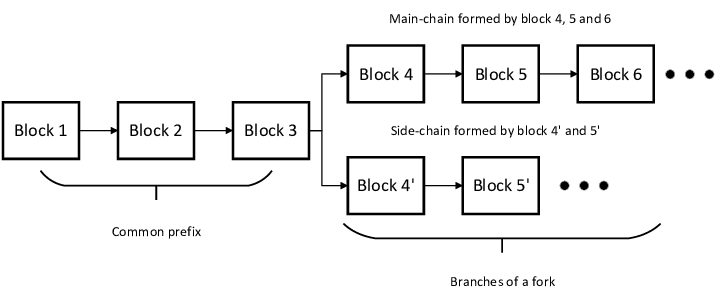
The term gets used for a few different things. At its core though, a fork is what happens when a blockchain’s rules change and not everyone on the network has adopted those changes at the same time.
The blockchain’s history is shared up to a certain point. Everything before the fork stays the same for all participants. What changes is what comes after: if enough of the network starts following different rules, two chains can end up running from that same origin.
Unintentional forks are actually quite common. They happen when two miners produce valid new blocks at almost exactly the same time, briefly splitting the chain. The network defaults to the longest chain of blocks and drops the shorter branch, usually within minutes. Most users never notice.
The deliberate forks are what actually matter. Someone has a problem with how the protocol works. They then put forward a change to the protocol. Subsequently, the community discusses it. Finally, something gets pushed through. Those are the ones to keep aware of.
Why Do Forks Happen in the First Place?
Every fork has a cause. Usually it’s one of the familiar ones: slow performance, security updates the network needs, a new feature someone wants to add, or a community disagreement about direction.
Both Bitcoin and Ethereum have been through forks for all of these reasons at various points in their histories.
Because blockchain software is open-source, anyone can put forward a proposed change to the blockchain protocol. Getting it adopted is a different matter. In a decentralised blockchain network, there’s no central authority that can simply push through a patch. It only happens when enough nodes and miners agree to run the updated software. When that agreement falls apart, a fork is often what follows.
What’s the Difference Between a Soft Fork and a Hard Fork?
There are two fork types and each has very different outcomes. They’re worth telling apart.
Soft Fork
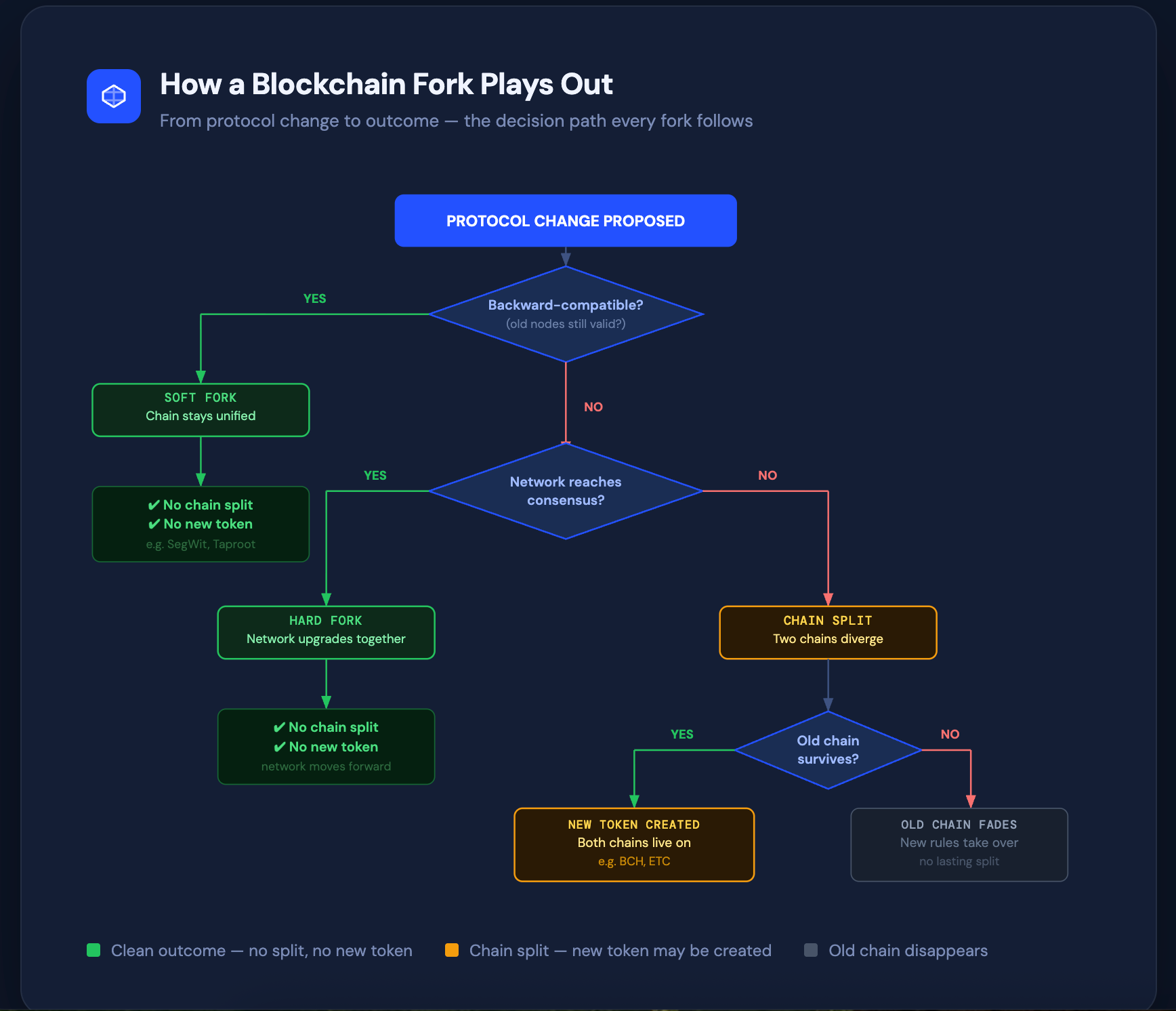
A soft fork is the tidier upgrade option. Older nodes running the original software can still read and validate the new blocks. They just can’t produce them.
This keeps the blockchain on one chain throughout. Updates filter through gradually as more nodes switch over.
SegWit (which is short for Segregated Witness) is Bitcoin Improvement Proposal 141. It’s the soft fork upgrade most people have heard of. It changed how transaction data was stored inside blocks, cleared congestion, and made the Lightning Network possible, all without splitting the chain.
Bitcoin’s Taproot upgrade (BIPs 340–342) went through the same process in November 2021. This led to improved privacy, as well as leaner transaction scripts and more capable smart contracts. The chain stayed intact.
Hard Fork
Hard forks work differently. The protocol change isn’t backward-compatible. What happens to nodes that don’t upgrade? They reject the new blocks outright, which means if the network ends up splitting over whether to adopt the new rules, you can end up with separate blockchains – albeit running from the same shared history.
The case that comes up often is the Bitcoin Cash split of August 2017. The block size debate had been grinding on for years. Eventually one faction pushed through an increase from 1 MB to 8 MB. Most of the network refused. Bitcoin, meanwhile, carried on under the old rules; whilst the other side built Bitcoin Cash (BCH) as a completely separate cryptocurrency. That meant that those holding BTC at the moment of the split received the equivalent amount in BCH on the new chain.
When Does a Fork Actually Change the Game?
Most blockchain forks pass without much fuss. The ones that actually matter tend to affect one of a few things: the fundamental rules of how the network runs, the unity of the community behind it, or the economic reality for people holding the relevant asset.
When the rules of the network change
Some forks touch a network’s core parameters: block size, validation logic, how signatures are processed. These aren’t cosmetic. They change how the network actually functions, and the downstream effects can take months or years to fully show up.
SegWit is the clearest illustration of this. By restructuring how transaction data was packed inside blocks, it freed up block space, reduced fees during busy periods, and made the Lightning Network viable. The actual change was purely technical, but what followed from it stretched well beyond the protocol.
When the community no longer agrees
A fork is as much a political event as a technical one.
The Ethereum split is a good one to know. In 2016, an attacker found a loophole in the DAO (a decentralised autonomous organisation) smart contract and pulled roughly $60 million in ETH out of it. Ethereum’s answer was a hard fork to roll back the transactions. Most of the network went along with it.
A minority refused. They argued that blockchains are supposed to be immutable. Reversing transactions, even stolen ones, undermined the whole point. That group stayed on the original chain. It’s now known as Ethereum Classic (ETC). Both still run today under different teams and different principles.
When a new chain or asset appears
When a hard fork produces a new blockchain, it produces a new token. Holders of the original asset at the point of the split typically find themselves with an equivalent balance on the new chain.
After that, it gets complicated. Exchanges have to decide which chain to list, developers have to pick a side, and markets price both tokens based on which one looks like it has a future. Most new chains from hard forks don’t last; they need a reason to exist that the original chain can’t provide.
Bitcoin Cash’s whole pitch was that bigger blocks would make things faster and cheaper for everyday users. Nearly nine years on, that question still isn’t settled.
What Do Forks Mean for Users, Holders, and Developers?
For users, the most immediate problem during a fork is usually confusion about what’s happening. Which chain is a wallet connected to? Will the exchange support the new token? When a significant fork is live, platforms often halt deposits and withdrawals while they sort out which chain to back. That can take hours. If there’s something coming up on a network where you hold cryptocurrency, your provider’s guidance is worth reading beforehand.
For holders, a major hard fork can be an unexpected windfall. You sometimes end up with balances on both chains. That said, fork periods tend to be volatile in both directions, and the new token’s value is an unknown quantity until the market has had time to settle.
For developers, a fork usually means unplanned work. Protocol changes break existing tools and force code rewrites. When a community fractures, the engineering time that kept one network moving gets divided between two, and both projects can end up slower as a result.
What Risks and Misunderstandings Come With Forks?
Not every fork creates a new coin
People often assume any fork comes with a free token airdrop. Soft forks don’t create new tokens at all. Hard forks only produce a new coin if both chains survive the split, and that’s not a given. If the whole network migrates to the new rules and the old chain quietly disappears, there’s nothing on the other side to receive.
Forks can create confusion and security risks
One risk specific to hard forks: replay attacks. If a new chain doesn’t include replay protection, a transaction you make on one chain can end up duplicated on the other. You send funds on Chain A, and the same transaction goes through on Chain B, creating an unintended transfer you didn’t authorise.
Fork periods also tend to attract bad actors: fake airdrop announcements, phishing sites dressed as official wallets, exchanges running slower than usual. If you’re unsure what’s happening, waiting for official confirmation from your wallet or exchange beats acting on secondhand information.
“Upgrade” and “split” are not the same thing
Most forks are software updates with an intimidating name. The word “fork” tends to get treated as a warning sign, but soft forks and hard forks with broad community support typically go through without any disruption at all. You might not know it happened.
The ones to watch are those where the network is divided going in. When a significant portion of miners, developers, or holders opposes the proposed change, the conditions are there for a genuine chain split. That’s the scenario where the word “fork” actually earns its reputation.
The Bottom Line on Forks
Blockchain forks are part of how any long-running network stays functional and relevant. They’re how vulnerabilities get patched, how chains scale, and sometimes how communities work through disagreements about where a project is headed. Most pass without incident, and most users don’t notice them at all.
The ones that leave a lasting mark tend to involve genuine disagreement within the network, because that’s what turns a protocol update into a real chain split. Whether a fork ends up mattering usually comes down to whether the network stays aligned or fractures.
So when a fork gets announced, the good/bad framing isn’t that useful. Better to ask: which part of the network is actually behind the new rules, and what’s the situation for everyone who isn’t?
Disclaimer: The content provided in this article is for educational and informational purposes only and should not be considered financial or investment advice. Interacting with blockchain, crypto assets, and Web3 applications involves risks, including the potential loss of funds. Venga encourages readers to conduct thorough research and understand the risks before engaging with any crypto assets or blockchain technologies. For more details, please refer to our terms of service.