
Table of Contents
Conviction can be valuable when it comes from research, patience, and a clear risk plan. But “all-in” thinking can also be a warning sign: the investor may be confusing confidence with certainty, or courage with gambling. This article will help you understand the line between a strong thesis and an oversized, emotional bet. It will remind you to think before making big bets in investing so you can overcome your all-in mentality that is risky and think in a smart way.
What does conviction mean in investing?
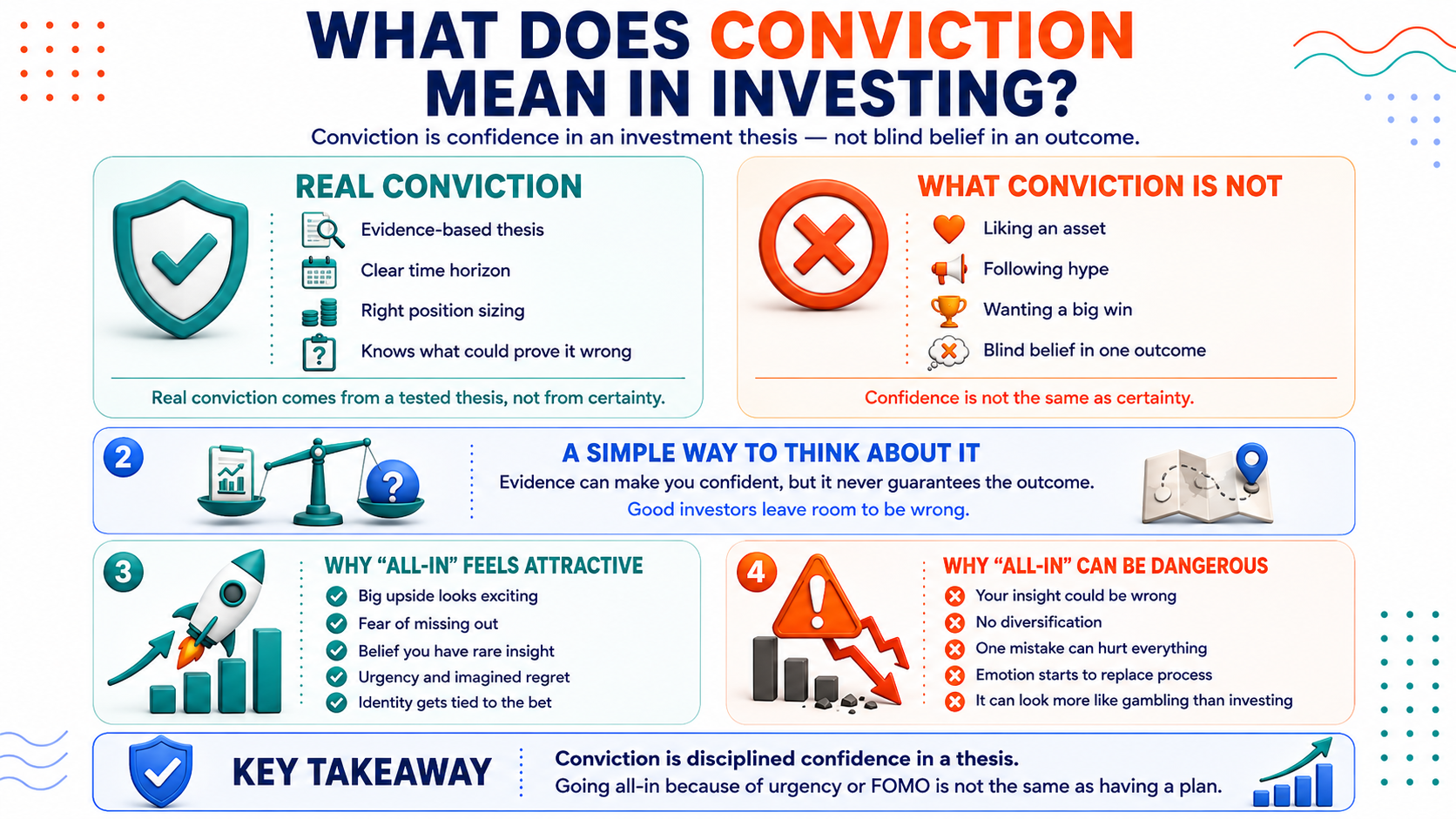
Conviction is confidence in an investment thesis, not blind belief in an outcome. Here's an example. If your brother is always late to dinner, you may have confidence that he will be late again this time, but he also could surprise you and arrive early, so it's best not to blindly believe that he will always be late. It's not exactly like that, but pretty close, am I right? Real conviction should be based on evidence, time horizon, position sizing, and a clear idea of what could prove the thesis wrong. It is not the same as liking an asset, following hype, or wanting a big win. Real conviction should be based on a tested investment thesis.
Why “all-in” feels attractive
Concentrated bets can feel rational or exciting: you see a big opportunity, want to maximize upside, fear missing out, or believe you have rare insight. The emotional appeal of “all-in” often comes from urgency, identity, and imagined regret. You have major FOMO and feel the investment will go up forever, so why not go "all-in". But your rare insight about the big opportunity could be wrong, and without diversification into other assets, you could lose it all. Sometimes if you feel like you urgently need to make a lot of money, it's easy to go all-in, but this can become more similar to gambling than investing, and gambling doesn't have good odds.
The difference between courage and randomness
Courage means taking risk knowingly, with limits. Randomness means taking a large risk without enough evidence, without a downside plan, or without accepting that the outcome may be luck-driven. If you need to choose between the two, it's much better to be courageous than random. Remember back in grade school when you didnt do your homework so you got an F on the assignment. Randomness is the same. It means you didnt do your homework (research) and made a random bet on a luck-driven situation. Work on taking risk knowingly, with limits, rather than taking risk without evidence. You will thank me later when you don't go broke and lose everything.
Real conviction has a thesis, not just a feeling
A real thesis includes: why the asset should perform, what assumptions must be true, what timeframe is needed, what risks matter most, and what would change the decision. You need to prove that your assumptions have to be true with logic so that you are more than confident in your conviction. You are certain of it.
You need to understand why the asset should perform, not just invest in it because everyone is doing it. You should be fully aware of the risks and what could happen that would definitely change your decision to invest or cause you to pull out your investment money. If you do all these, you have a structured view, and it's much better to have a structured view than simply going on your emotional certainty.
Position size is where conviction becomes risk
The same idea can be reasonable at one size and reckless at another. A 5% position and a 70% position can reflect the same thesis but completely different risk profiles. There is added risk in concentration. If you are too concentrated in one asset, you are taking on more risk than if you spread out your investments and diversify.
Concentration in a specific asset can impact your portfolio, and can make you feel the volatility of that one asset that you invested in more than if you had a more diversified portfolio. In a diversified portfolio, one assets price swings are buffered by the other assets to a certain degree. So if one asset goes down, another one could go up and shield you from a substantial price swing. Therefore, position size can greatly determine risk.
When concentration can be intentional
It's important to note that concentration is not always wrong. Some investors choose concentrated positions because they understand the asset deeply and accept the risk. But intentional concentration should come with stronger analysis, stricter limits, and clearer review rules than a diversified approach. You need to know what you are getting yourself into with a more concentrated position and make sure you have done your research and have a strong analysis. You also need to set up when you will review you approach. What happens that will trigger a review.
When “all-in” becomes a red flag
Here are the warning signs: You cannot explain the downside, refuse to compare alternatives, dismiss all negative information, keep increasing exposure after gains, or believe the outcome is “obvious.” All-in behavior is greatly connected to overconfidence bias in investing. Overconfidence bias is the tendency people have to overestimate their knowledge and abilities in a certain area. If you overestimate your knowledge and abilities in investing, you often lose. Getting over confident can lead to your downfall.
Red flag: you cannot define the maximum acceptable loss
If you cannot say how much you can lose without damaging your plan, the position is most likely not controlled. You need to know at what point your plan has been irreparably damaged and needs to be aborted or greatly altered.
Red flag: you treat disagreement as stupidity
Real true conviction can handle opposing evidence. If a counterargument from a friend who believes differently than you about your position feels like an attack, the decision you are making is likely emotional. This is a major red flag and should cause you to reconsider your position. Difference in opinion is good and every theory should be tested, especially investment theories that you have a lot of money tied up in.
Red flag: your plan depends on being right quickly
Your position is fragile and not good if you need the market to validate your thesis immediately. Making gains can take time and can't be rushed. You shouldn't rush to be right. If your plan depends on being right quickly, you have to go back to the drawing board and work on a new plan.
Crypto makes “all-in” thinking even more dangerous
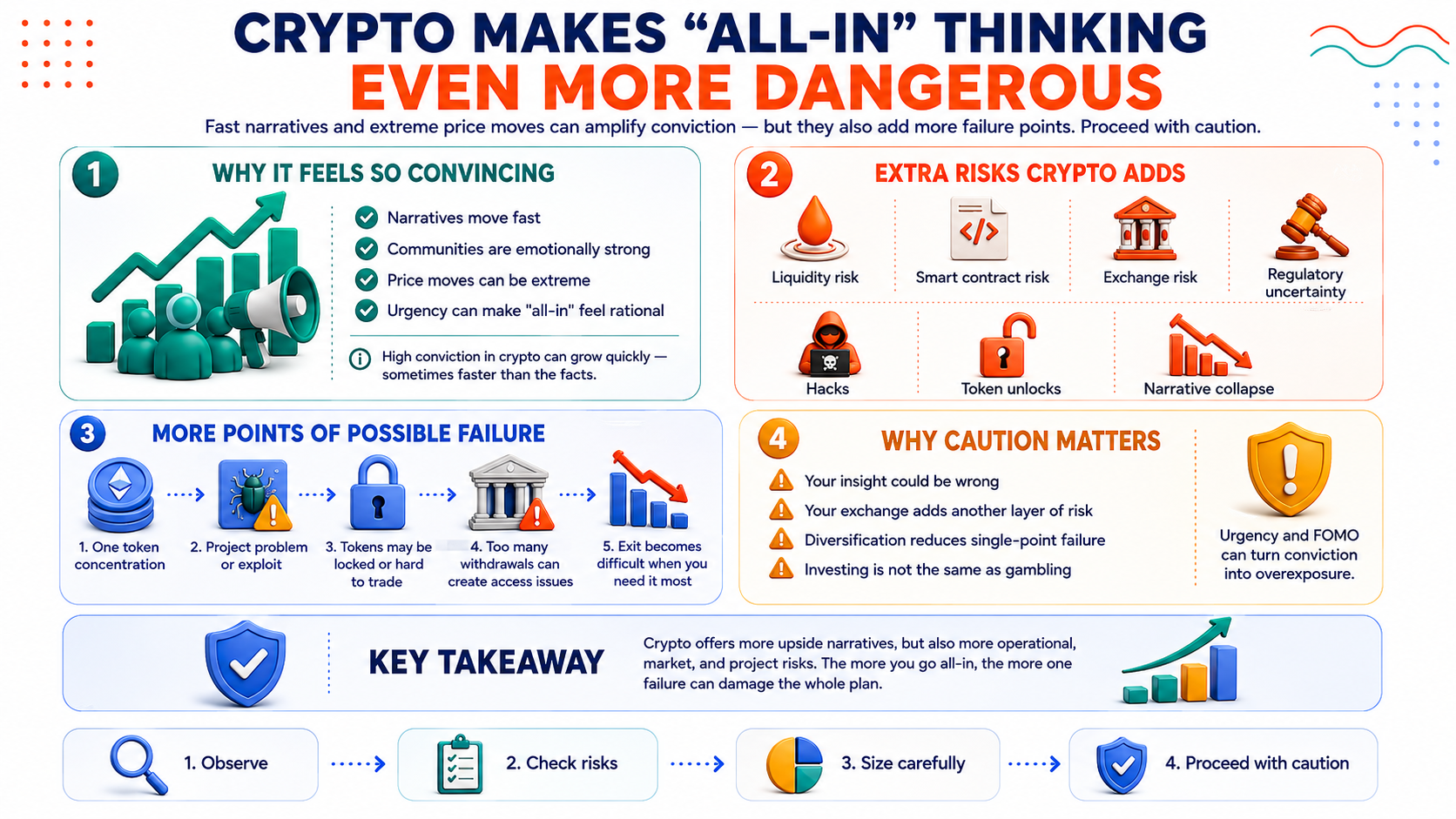
Crypto can intensify conviction because narratives move fast, communities are emotionally strong, and price moves can be extreme. But crypto also adds extra risks: liquidity, smart contract risk, exchange risk, regulatory uncertainty, hacks, token unlocks, and narrative collapse. You could very easily go "all-in" on a token and then have the project lock your tokens and not let you access or trade them. This happens sometimes when something goes wrong with the project or too many people try to withdraw their tokens at the same time. You also have risks with the exchange that you choose to complete your transactions on.
Basically, there are a lot more things to think about when making decisions with crypto investments and their are a lot more risks, so going "all-in" has more points of possible failure. Proceed with caution.
How to separate conviction from overconfidence
Overconfidence often appears as certainty, rushed decisions, oversized positions, and ignored downside. If you feel certain that your belief about an asset is correct, you may be overconfident about your position. If you are making quick decisions without thinking about them first, you may be overconfident. If the price drops significantly and you ignore it and don't reconsider your oversized position in the particular asset, you are overconfident. Conviction is calmer. With conviction, you accept uncertainty and still manage risk. Here you can see overconfidence and conviction compared in a table.
Why luck can look like skill after one big win
One successful “all-in” trade does not prove the process was good. A risky decision can work once and still be dangerous if repeated. When investing, you should focus on process over outcome. Trust the process you are using. The outcome can drastically change from one investment to another. Good investing is not judged by whether one bet paid off. Good investing is judged by the process that was used to make the decisions that ended in the result.
How to size conviction without going all-in
Conviction can be expressed gradually: starter position, staged entries, rebalancing, caps per asset, caps per sector, and rules for adding only after new evidence. By starting with a smaller position or putting caps on how much to invest in a certain asset or sector, you can protect yourself from the uncertainty in the markets. Position sizing is not a lack of belief — it is how conviction survives uncertainty. Making rules for only adding to the position after new evidence appears can prevent you from immediately going all-in without thinking.
Conclusion: conviction should make your process stronger, not your risk unlimited
Conviction is not measured by how much of the portfolio you risk. It is measured by the quality of the thesis, the honesty of the downside review, and the discipline of position sizing. If you don't have a strong thesis and you aren't honest with yourself about your investment and review the investment when the price drops, you aren't investing with conviction. Furthermore, if you aren't disciplined about the size of your position in any one asset, you are likely going to go all-in and not invest with conviction.
Going all-in looks brave, but without a risk framework it is often just randomness with confidence. So remember to think twice before going all-in on any investment. It might look cool, but it often ends in financial hardship. Make sure your confidence in your investments is due to rigorous research instead.
Disclaimer: The content provided in this article is for educational and informational purposes only and should not be considered financial or investment advice. Interacting with blockchain, crypto assets, and Web3 applications involves risks, including the potential loss of funds. Venga encourages readers to conduct thorough research and understand the risks before engaging with any crypto assets or blockchain technologies. For more details, please refer to our terms of service.