
Table of Contents
Crypto assets are renowned for their potentially high returns and explosive growth opportunities. In highly speculative cases, cryptocurrency can generate thousands of percent of income and provide exceptional ROI for early and lucky investors, but it is also extremely volatile and can just as quickly result in substantial financial losses.
So, it is often unclear whether it is better to hold, sell, or purchase assets anticipating a price rally. Questions like “Should I buy the new memecoins?” and “Is it profitable to hold Bitcoin?” also come up.
In this article, we’ve gathered the most profitable crypto assets based on their performance — to help investors navigate the 2026 market. However, note that their profitability depends on your strategy, engagement, analysis, and risk tolerance.
What’s more, different categories of crypto assets pay out in distinct ways and bring ROI in various forms, such as passive income from staking or high-risk speculation.
What Are Crypto Assets?
Crypto assets are digital financial instruments built on blockchains. These are digital currencies, utility tokens, NFTs, altcoins and memecoins, stablecoins, and on-chain tokenized real-world assets.
Crypto serves multiple purposes. It can be:
- used as a payment method;
- a means for DeFi governance;
- used in decentralized apps;
- best for yield generation;
- a collateral, a collectible, and more.
Despite those multiple ways of using crypto, the media often discuss APY (annual percentage yield) and other financial metrics rather than the underlying blockchain technology.
There are nearly 20,000 cryptocurrencies, but only 10,025 of them are currently active — traded by users and maintained by developers. The most popular in 2025 were:
- Tether (USDT);
- Bitcoin (BTC);
- Ethereum (ETH);
- Solana (SOL);
- Binance Coin (BNB);
- Ripple (XRP).
However, their profitability does not solely depend on their sharp and sudden pumps. And it’s not based on their rating, stability, market cap, and trading volume. Let’s see what is really relevant for those who want to capitalize on crypto.
What Makes a Crypto Asset “Profitable”?
Experts believe that profitability is based on cryptocurrency yield potential, utility, and current market trends. Other factors like price appreciation, volatility, and associated risks also matter.
If you have ever invested in traditional financial instruments like stocks, you know that there are growth stocks and dividend stocks. The first category rises in value over time, while the second remains relatively stable but regularly gives you rewards.
With cryptocurrency, it works similarly:
- Price appreciation. You buy an asset because you believe demand will increase and the price will go up.
- Yield generation. You hold an asset and get staking rewards, lending interest, or liquidity fees.
Besides, there are other reasons why crypto becomes a profit source. We’ve gathered them in a brief table.
What You Should Know to Get Profits
Higher returns come with higher risk. A cryptocurrency that can rise in price by 50% in a day can also lose all its market value in an hour. The assets that yield the highest profits are frequently the most volatile and demand caution. If you are a more conservative investor, it is better not to trade them.
Watch out for low liquidity. This refers to how easily you can buy or sell cryptocurrency without lowering the price. If you hold an illiquid token, the system can show you a high profit before the sale. However, the moment you try to sell, the price drops because there are no buyers. Highly liquid assets are safer, as they make it easier to exit a position without significantly affecting the market price.
There can be a risk premium. In addition to strong volatility and the risk of quick losses, you may also encounter a scam, smart contract risk, code vulnerabilities, regulatory risk, and project risk. That’s why sometimes investors are paid a premium in the form of high yields or low cryptocurrency prices.
The Most Profitable Types of Crypto Assets
Now let’s look at the main categories of crypto assets known for strong return potential. This is where investors are finding value now. We’ve classified them based on the mechanism of how they produce returns.
Staking Coins
Many major blockchain networks, like Ethereum and Solana, use a consensus mechanism called proof-of-stake. To keep the network working, they need users to lock up their coins. In return, the users may earn staking rewards and a share of transaction fees, although the incentives vary and aren’t guaranteed.
Users can stake ETH, SOL, ATOM, APT, SUI, and other digital currencies. Profits in PoS networks depend on the specific protocol’s issuance schedule, validator uptime and performance, and lock-up periods. Additionally, DeFi projects often airdrop tokens to stakers.
Liquid Staking Tokens (LSTs) and Restaking Assets
Liquid staking and restaking are recent innovations in DeFi. LSTs are representations of staked tokens on PoS blockchains that allow users to earn rewards while keeping their assets liquid. They provide free tradeability.
For example, if you stake Ethereum through a liquid staking provider like Lido, you get a receipt token—stETH. You can trade it or use it in DApps while it still earns staking rewards. Other examples include divETH, sETH2, rETH2, sfrxETH, frxETH, cbETH, etc.
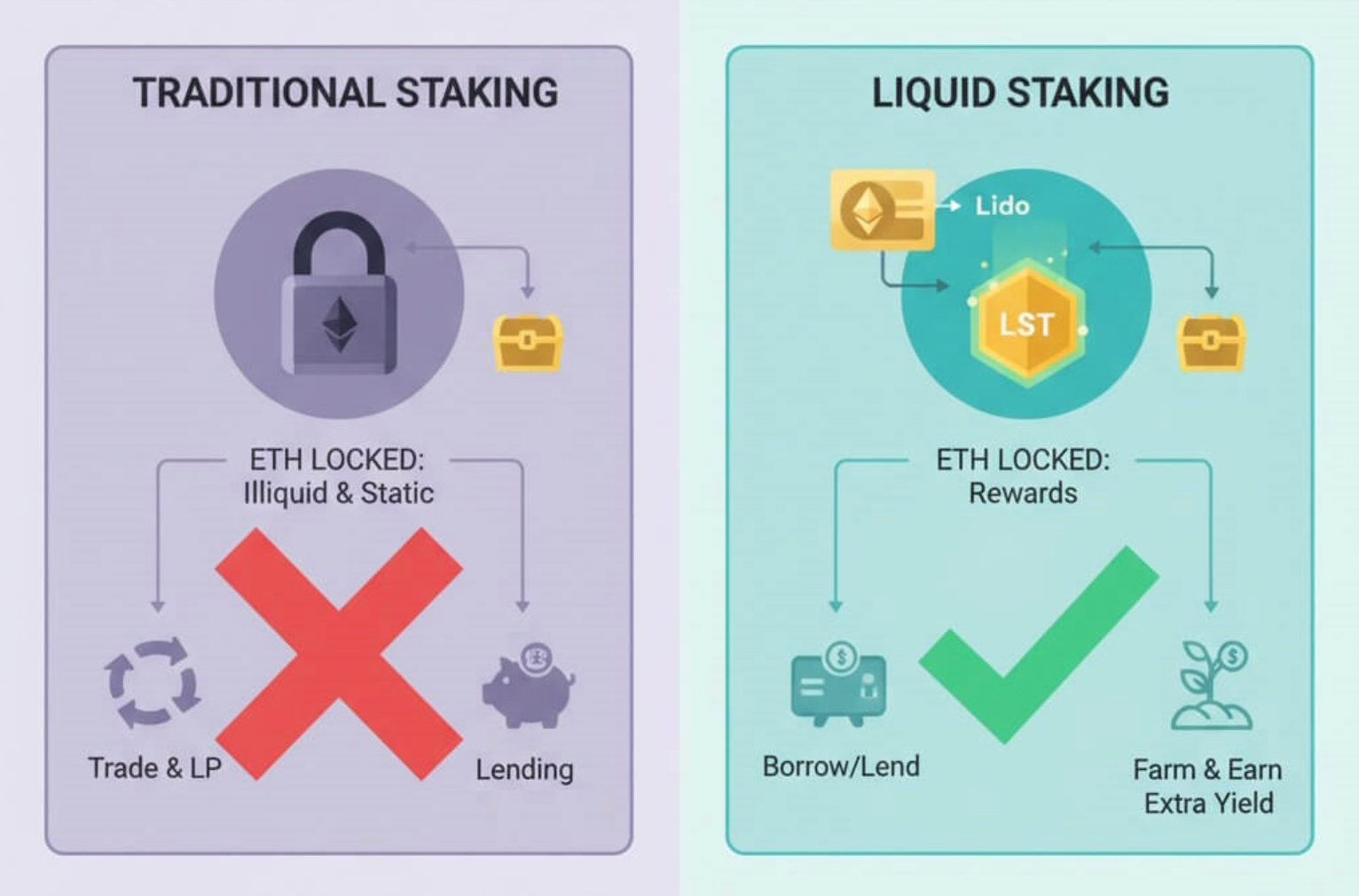
Restaking platforms like EigenLayer and Babylon enable LSTs to secure additional networks, which layers yields. You get the base staking reward, potential DeFi yields, and restaking rewards at the same time. But this increases smart contract risks and systemic vulnerabilities from overextended collateral.
DeFi Yield Assets
Experienced users can put their crypto assets into liquidity pools (LPs), use lending protocols, and buy structured yield products that generate returns. Here’s how this works:
- Lending protocols like Aave, Compound, JustLend, and Spark offer returns to lenders. You deposit cryptocurrency into a protocol, borrowers pay interest to use it, and their money goes to you. Profits are influenced by utilization rates and demand.
- Liquidity pools (LPs) in DEXes such as Uniswap, SushiSwap, Balancer, and Curve Finance let users earn trading fees. You provide a pair of tokens (BTC and USDT) to a pool. Then, you’ll get a portion of the trading fee based on your pool share each time someone trades between those two. With liquidity mining mechanisms, you can earn governance tokens on top of fees.
- Structured products by Harvest Finance or Idle Finance like yield vaults (Yearn Finance, Beefy Finance) optimize returns via automated strategies. You invest in ready-made strategies that combine several tools (derivatives, credit protocols, tokens) to obtain a specific return/risk profile.
In comparison to traditional finance, DeFi can bring higher yields, but they go hand in hand with greater risks, including volatility, smart contract vulnerabilities, and limited regulatory protection. Besides, your actual earnings will depend on demand, market conditions, pool dynamics, the effectiveness of specific strategies, the risks you are ready to undertake, and other factors.
Stablecoin Yield Products
Platforms like MakerDAO or CeFi services like Binance Earn offer yields on stablecoins (USDT, USDC, or DAI) via lending, LP provision, or treasury strategies.
Lending or providing liquidity with stablecoins is perfect for those who want to have cash but still earn a return. Platforms like Binance and OKX offer “Earn” products where you deposit coins and earn a predictable APY.
Stablecoins pegged to the dollar offer relative stability, while the demand for borrowing them is often high. Still, there are risks of counterparty defaults, depegging, and platform failures, which necessitate audits and diversification.
Real-World Assets (RWA)
One of the major trends in the industry now is real-world asset tokenization. Crypto companies and enthusiasts bring conventional assets like treasury bills, real estate, collectibles, invoice financing channels, and corporate debt onto the blockchain.
You can buy a tokenized version of commodities like PAX Gold (PAXG) or Tether Gold (XAUT), treasuries, or real estate fractions and earn the safe, government-backed yield.
Returns come from real-world economies, and you access new investment classes. The income amount hinges on issuer creditworthiness, legal wrappers, regulations.
High-Risk, High-Return Assets
Memecoins (like DOGE, PEPE, or SHIB) have no utility and are made for fun and hype. But because they are small and volatile, they can explode in value and bring about 10x, 50x, or even 100x returns quickly. The cryptocurrency value can last longer if a robust community is formed. However, these are the riskiest assets. Most memecoins go to zero, so they are used for speculation only.
Volatility plays, like options and perpetual futures (perps), surge via hype, FOMO, or market swings. They deliver outsized short-term gains but are prone to rug pulls, pump-and-dumps, and total wipeouts. A common risk-management approach in volatile markets involves limiting individual positions to a small percentage of the overall portfolio (for example, 1–2%), using stop-loss mechanisms, and avoiding leverage.
Please note that it’s important to obey the rules of taxation. Cryptocurrency is considered a capital asset, so you will have to pay capital gains tax if you sell crypto with a profit.
How to Build a Profitable and Balanced Portfolio
There are many ways to earn thanks to cryptocurrency, and you can choose any method or a combo for yourself based on your risk profile, level of experience, and goals.
It’s better to combine different asset types to balance yields with stability. If you go 100% into memecoins, you might lose everything. If you go 100% into stablecoins, you miss the growth.
One of the ways to create a top-performing portfolio is to invest:
- 50–60% into big names like Ethereum. You can hold or stake them.
- 20–30% into DeFi strategies, liquid staking, or RWAs.
- 10–20% into high-risk cryptocurrency plays, small-cap altcoins, or memecoins.
We suggest diversification, ongoing monitoring, risk management, and periodic rebalancing.
Conclusion
Everyone has their most profitable cryptocurrency. For a trader who executes orders full-time with high frequency and bots, it is worth looking at volatile altcoins. And for a calm investor who does not want to engage in exchange transactions for 8 hours a day, stable staking, lending, liquidity provision, and combined strategies are more suitable.
You should think about your risk tolerance and investment horizon first. The main thing is not to speculate too much so as not to worry and lose money. The most successful investors build a strategy, mixing the stability of blue chips with the income of DeFi.
Disclaimer: The content provided in this article is for educational and informational purposes only and should not be considered financial or investment advice. Interacting with blockchain, crypto assets, and Web3 applications involves risks, including the potential loss of funds. Venga encourages readers to conduct thorough research and understand the risks before engaging with any crypto assets or blockchain technologies. For more details, please refer to our terms of service.