
Table of Contents
Many novice investors are intimidated by by the need to constantly monitor market movements. This seems tedious and complicated. Even experienced traders may get tired of staring at charts all day. Plus, this approach can lead to erroneous decisions.
It’s not necessary to spend all your time checking charts. Instead, you can develop a strategy that allows you to make decisions less frequently, but with more accuracy. If you have a plan, a review schedule, and clear action rules, you do not need to react to news or short-term price ups and downs.
Below we’ll look at why inspecting prices too often is unnecessary or even unprofitable, how to start investing calmly, and when it is better to evaluate quotes of securities.
Why Constantly Checking the Chart Hurts Your Decisions
Not all investment strategies involve constant chart monitoring. For example, such portfolio construction models as a strategy based on publicly traded company valuations, a method focused on finding startups with high potential growth, and a decision-making strategy based on fundamental analysis do not require checking charts every hour. For these approaches, such frequent actions are simply redundant.
There are several categories of investors who tend to constantly monitor the charts. These are managers of hedge funds who use active management techniques, as well as day traders and scalpers who profit from short-term fluctuations. But for long-term, index fund, and passive investors, continuous price monitoring is not typical. It even leads to poor or emotionally driven transactions.
For beginners who have been on the market for up to three months, studying and analyzing a bunch of charts daily is a normal step. However, it’s very important not to confuse monitoring with overchecking and analysis with panic-driven behavior.
Checking the charts 10+ times a day is rather harmful because:
- It creates information overload and FOMO, so it’s harder to see trends.
- It increases your exposure to market noise and triggers fear or greed.
- It reinforces confirmation bias, reducing decision quality.
- It causes decision fatigue, drains cognitive resources, and increases mistakes.
- It disrupts a long-term investment plan and tempts you to change risk rules and position sizing.
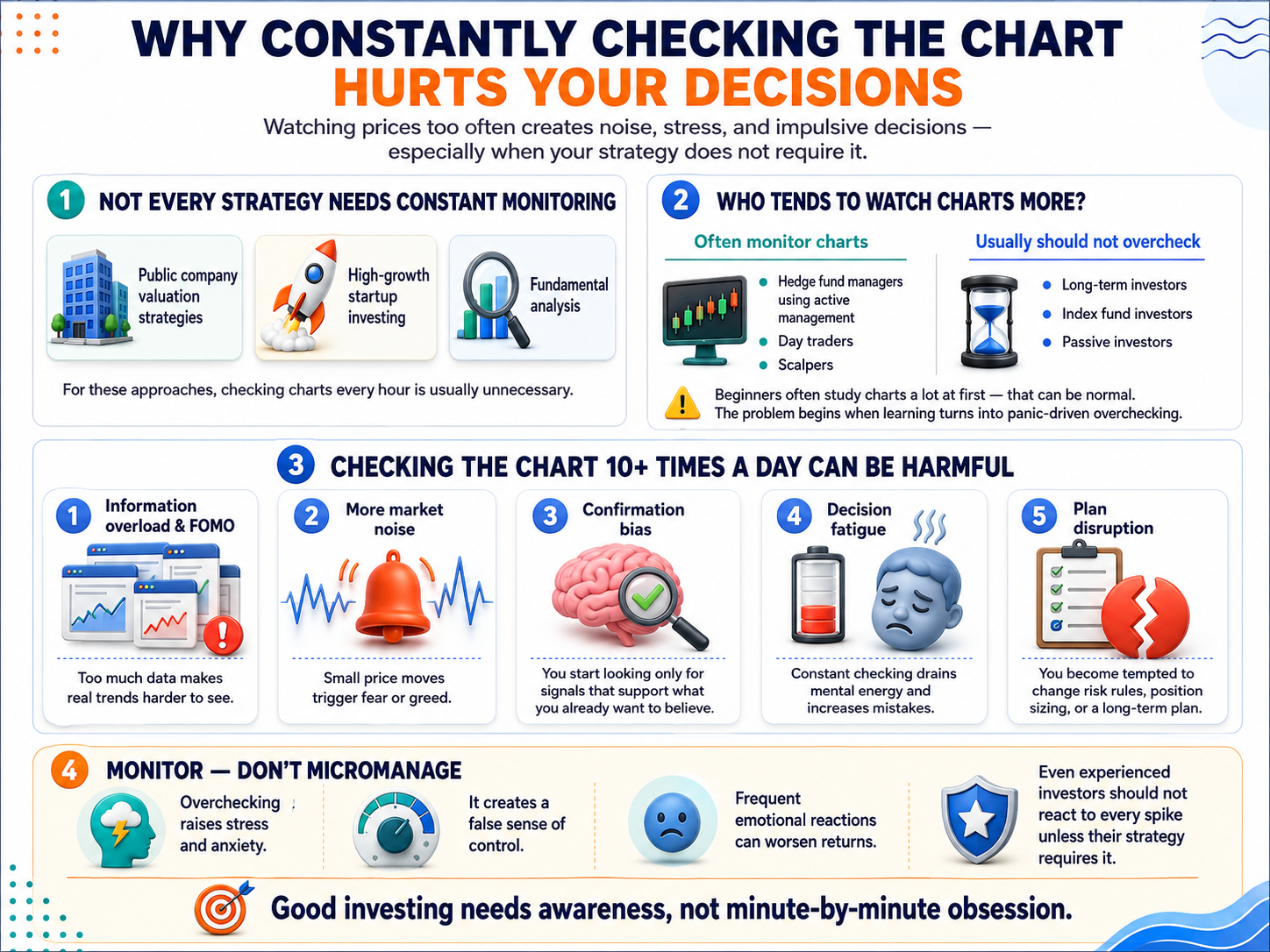
You need to keep track of your portfolio, but not every minute. Otherwise, you risk facing higher costs that erode returns, increasing emotional reactions to short-term volatility, and worsening portfolio performance. It’s very stressful and exhausting. Alertness increases anxiety and impairs judgment.
The illusion of having up-to-the-second control often leads to false confidence and trade micromanagement. Experience helps reduce panic, so seasoned traders are less likely to make impulsive decisions. But even they should not control every price spike if their strategy does not force the opposite.
Start With an Investment Strategy
Inexperienced investors should first learn about the market and establish a plan. Importantly, repeated analysis of random graphs makes this harder, as it reduces the quality of study and slows a sustainable strategy formation. By reacting to every minor movement, you may miss broader patterns, fail to evaluate trading results objectively, and delay reliable rules adoption.
Therefore, it’s recommended to start with other steps, namely:
- Define financial goals and set specific timelines and target amounts for each goal. The goals should be measurable and achievable, as well as rely on your risk tolerance.
- Decide on the contribution frequency and amount to build discipline. You can use a popular strategy like dollar-cost averaging, where regular investments reduce timing risk.
- Outline target shares of stocks, mutual funds, high-yield assets like crypto, and cash for each horizon. To get fixed income, specify the weight of bonds or other income instruments that stabilize returns.
When this is done, your next step is to create an investment journal that will help you keep track of your trades, see if you reach your KPIs, and stick to a regular review schedule.
Set a Fixed Review Schedule
Behavioral finance research has shown that frequent portfolio checks can change investor behavior in a harmful way. When people evaluate outcomes too often, they tend to become more risk-averse and more sensitive to losses.
The human brain is twice as afraid of losing as it is happy about gaining the same amount. So, investors who see losses are more likely to make urgent, unreasoned changes. And the more often they check the balance, the higher their chance of seeing a downward movement, panicking, and selling assets that would bring them benefits in the long run.
Instead of opening an investment app every time the market moves, it’s better to define when to review the portfolio.
Daily: A Few Minutes Once a Day
A daily routine should not include deep analysis. It should be operational and mainly help you make sure the portfolio is functioning as planned. At most, scan the market at a high level. You can also check that scheduled contributions went through successfully and there are no account errors or failed orders. Review urgent security notices that actually require action and ignore random news flow.
Weekly: Find Data-Backed Arguments for Future Changes
A weekly review is a bit more detailed and goes beyond a brief health check, but it’s still more operational and light than a monthly review. You have to examine processes and early warning signs. Confirm that transfers went through and check for margin issues, missing deposits, or security alerts. Look for major events that could affect holdings, for example, corporate actions, regulatory news, or changes in the fundamentals of an asset. Scan if any position has changed noticeably, but don’t make any major asset allocation changes yet.
Monthly or Quarterly: Review the Portfolio
A more serious analysis is usually better done monthly or quarterly. You should focus on whether the allocation is consistent with the plan, whether any assets have deviated too far from the target weight, and whether fees or other expenses reduce profitability. Financial advisors usually recommend checking portfolios once a month and rebalancing them once or twice a year.
These recommendations are approximate and depend on the strategy and objectives of a particular investor. For example, if you have a horizon of two months, then rebalancing every six months is obviously not suitable for you.
Automate What You Can
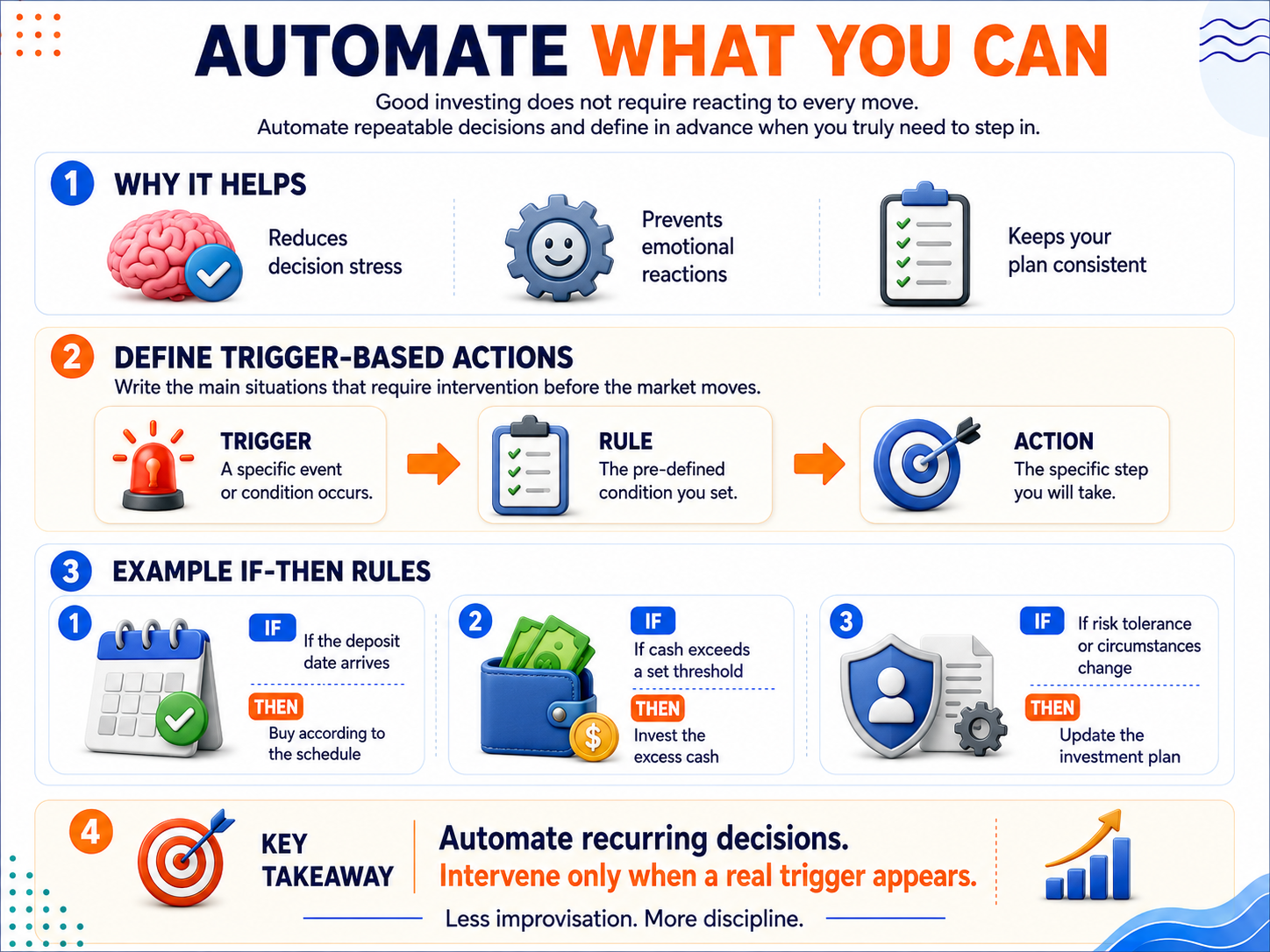
One of the most difficult tasks investors face is making decisions. They need to undertake something every time the market changes, deciding whether to buy and hold or sell assets. Therefore, it would be great to automate this process. In particular, it’s worth defining the main trigger-based actions in advance. Create a list of rules for when you truly need to intervene. For example:
- If the deposit date comes, then buy according to the schedule.
- If cash exceeds a set threshold, then invest it.
- If risk tolerance or circumstances change, then update the plan.
Create Rules for Buying, Selling, and Rebalancing
Automation reduces the number of decisions you have to make and helps you avoid emotions when investing. But some decisions will still have to be made. So, you need to establish additional, more complex rules on rebalancing, entering and exiting positions, and risk management. They will help you stay disciplined.
When to Buy
It’s important not to fall prey to the temptation of quickly finding a good entry point, buying the asset low, and waiting for the moment to sell it at a higher price. Timing the market is challenging and risky, as it can move in unpredictable ways, causing fear of lost profits. It is advised to tie purchases to a predetermined plan, a regular schedule, or available cash flow. For example, you might buy on a fixed date each month or when new savings arrive.
When to Sell
Selling, as a rule, should be caused by a significant change in the investment situation and not just a temporary decrease in the price. A sale may be justified if:
- Your long-term goals change;
- Your time horizon shortens;
- Your risk tolerance decreases;
- The quality of your assets declines.
A drop in price does not mean that an asset has become bad. Sometimes the right action is to hold, not immediately exit the market. If selling, consider the expenses, as the bid-ask spread, slippage, and taxes can diminish the actual profit from a trade, especially with small-scale trading.
When to Rebalance
Portfolio rebalancing means bringing a portfolio back to the target proportions of assets after market movements change the initial allocation. If a portfolio drifts, your risk exposure changes. You can use a calendar-based rebalancing quarterly, semiannually, or annually.
Alternatively, stick to threshold-based rebalancing. You can define the percentage deviation from the target value you are willing to accept, such as 5%, 10%, or 15%. You should act as soon as the asset class deviates further than that.
Keep a Simple Investment Log
Having an investor’s diary is a good option to lower stress, track your trades and outcomes, and separate planned decisions from emotional ones. When you write down each action, it becomes easier for you to understand whether you followed your strategy or acted out of fear or excitement. A useful log should be simple and include:
- Date;
- Action;
- Amount;
- Reason, rule, or trigger;
- Result or note.
Reduce Triggers That Make You Check the Chart
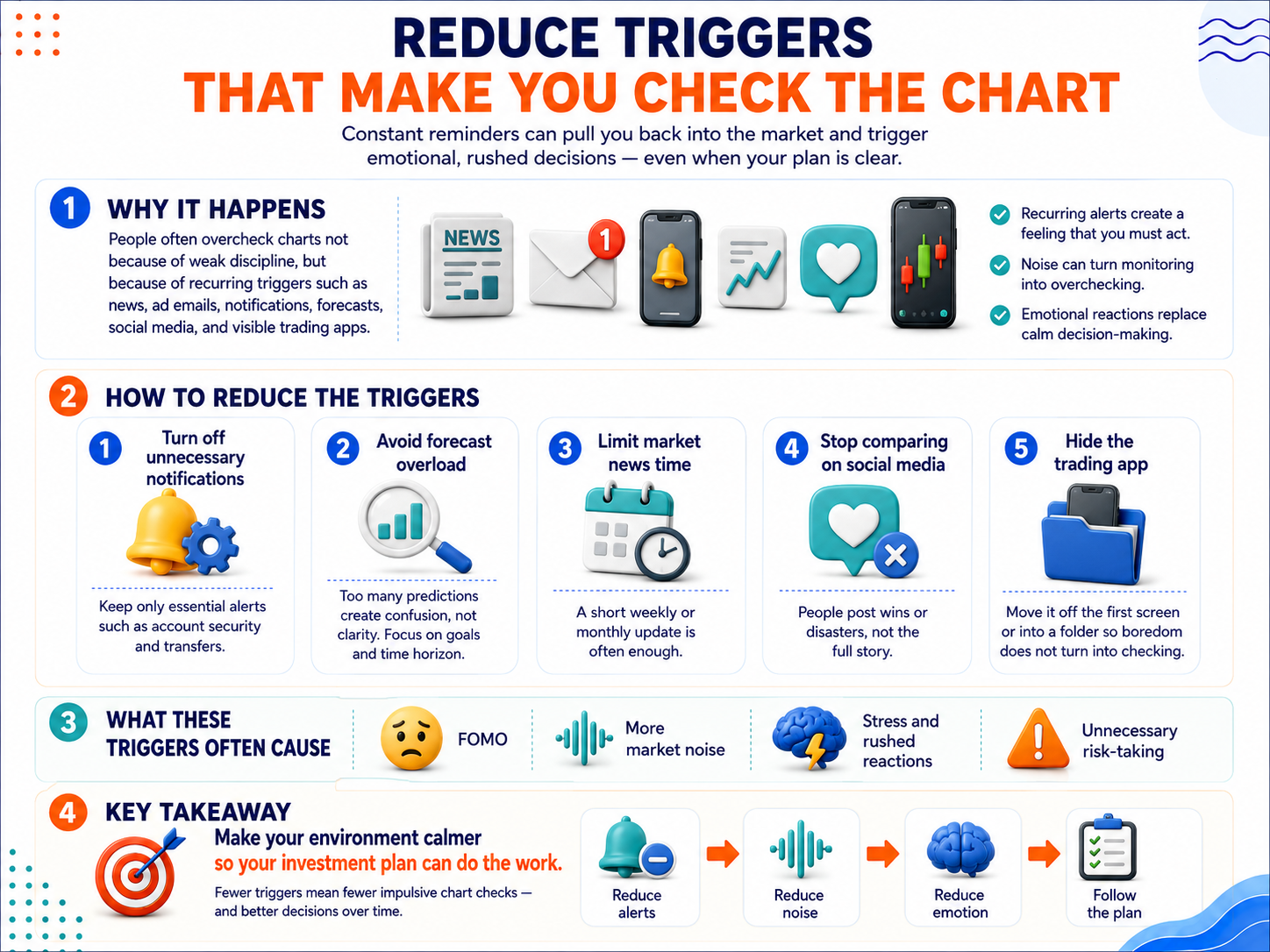
It can be difficult for investors to resist the urge to constantly monitor the charts. Often it’s not due to a lack of discipline or a clear plan, but rather to the recurring reminders. External factors and motivations like news, ad emails, or notifications may not allow you to leave investments alone and may even force you to react emotionally or act in a hurry.
Here’s what you can do to reduce the triggers:
- Turn off unnecessary notifications. News reports and alerts about market events can create the feeling that you constantly need to take action. Remove unnecessary notifications and keep only the most important ones, such as messages about account security and transfers.
- Avoid following different forecasts. Most predictions are short-lived, often contradictory, and rarely useful. Instead of collecting opinions, focus on your financial goals and time horizon. The more forecasts you consume, the more likely you are to confuse uncertainty with insight.
- Limit the time spent on market news. A short window is enough for staying updated without feeling overwhelmed. For many investors, a concise weekly or monthly update is more beneficial than reading headlines throughout the day.
- Don’t compare your results with what people share on social media. Traders and investors usually post victories or tragedies, not full histories. So, the comparison is misleading. Contrasting your strategy with someone else’s successful trades leads to frustration and increases the likelihood of taking unnecessary risks.
It’s also helpful if you remove the trading app from the first screen of your phone. If it is hidden in a folder so that you don’t see its icon, you are less likely to open it out of boredom. The same logic applies to news apps and social platforms.
Main Rules for Creating Good Investment Strategies
If you want to start investing carefully and save money, it’s not advisable to check charts every free minute. In fact, reacting to minor moves rather than concentrating on future growth causes emotional discomfort and provokes investors into impulsive trades. This comes with poorer results, excessive commissions, fatigue, and stress.
It will be most effective if you build a routine for price and portfolio reviews (daily, weekly, or monthly), automate some part of decision-making, and create rules for buying, selling, and rebalancing.
Try to reduce triggers that force you to check charts more often than you want. Unfortunately, posts and news can be more powerful motivators than rational, cold calculation. You should not ignore the market completely, but it’s advisable to make chart-checking a conscious choice.
Also, keep an investment journal, as over time it becomes a record of what you intended to do, what you did, and how your choices fit your plan. The trade history is valuable when you review performance or refine your rules.
Disclaimer: The content provided in this article is for educational and informational purposes only and should not be considered financial or investment advice. Interacting with blockchain, crypto assets, and Web3 applications involves risks, including the potential loss of funds. Venga encourages readers to conduct thorough research and understand the risks before engaging with any crypto assets or blockchain technologies. For more details, please refer to our terms of service.