

Table of Contents
Investors and traders know that a significant increase in portfolio profitability is never guaranteed and not always possible. Therefore, when one of the purchased assets sharply rises in price, it feels very encouraging. It seems like you made the right decision and “predicted” a jump in value.
However, sudden and substantial growth is not a clear reason for joy. It happens that investors mistake profit for proof that they were right. They may abandon a sustainable plan and balancing risks in favor of expecting further potential benefits, as it is dictated by greed.
There are no general and only true rules for when to sell and buy. Otherwise, everyone would be selling high and buying low. The market and the future of assets are unpredictable. But below, we’ve gathered real scenarios and a checklist that will help you make decisions about investment product management without emotions like fear or euphoria.
Why a Big Price Jump Can Be Dangerous
A distinct asset price increase is not necessarily a healthy sign. It can happen due to several reasons. For example, there may occur economic bubbles. When prices rise too quickly and far beyond the norm, investors may start buying because of herd mentality (bandwagon effect). Valuations can reach unsustainable levels, which is later followed by a correction. A classic historical example is Tulipmania.
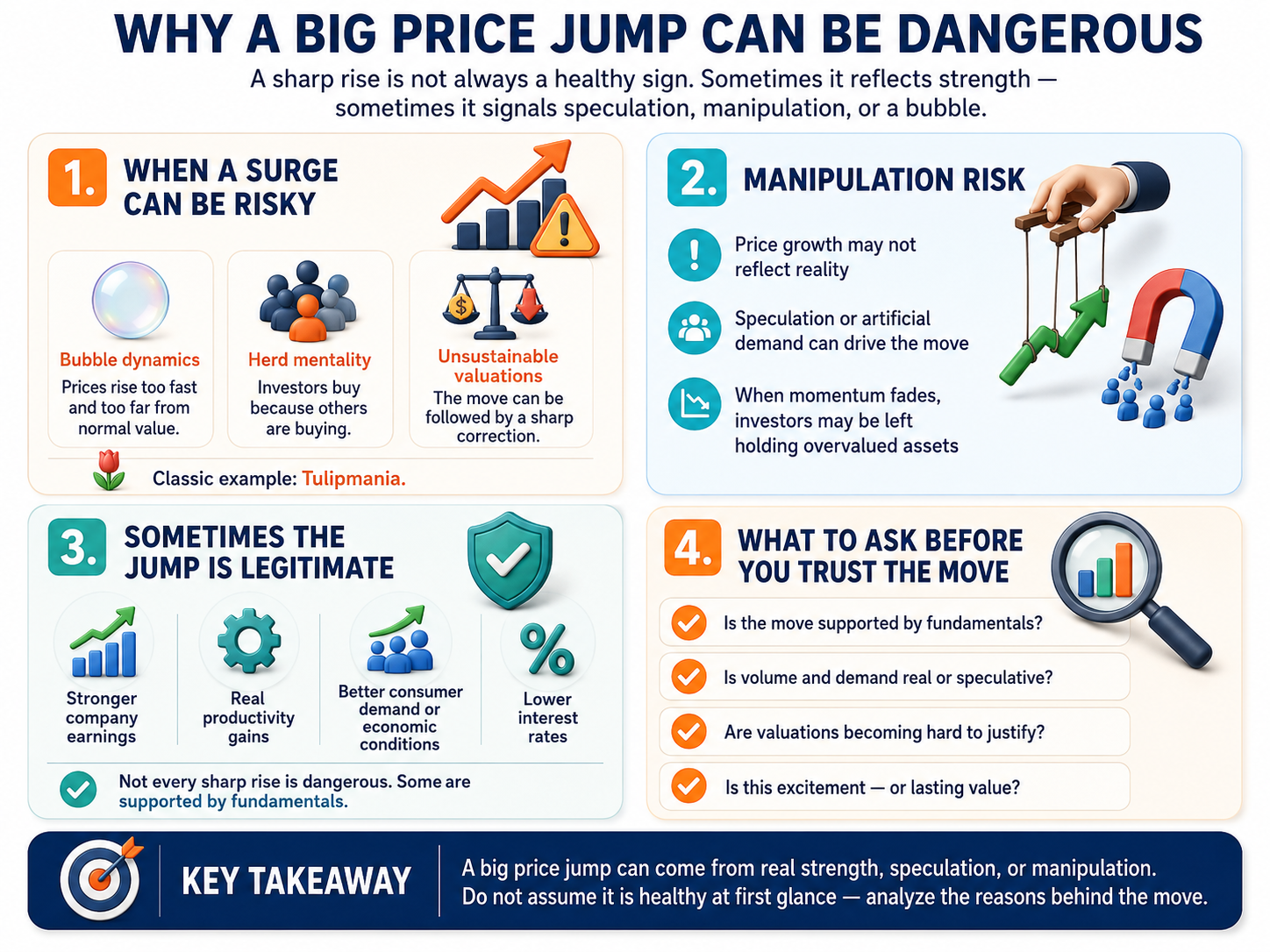
Another unpleasant reason why the price can surge is market manipulation. Then, growth does not correspond to reality and is explained solely by speculation or artificial demand. When valuations depend on sentiment rather than on real indicators, investors may be left holding overvalued assets as soon as momentum fades.
Of course, there are ordinary reasons for an asset price to rise sharply, including stronger company earnings, genuine productivity gains, improving consumer demand or economic conditions, and lower interest rates that make capital more valuable. But it’s difficult to say immediately whether an upgrowth is natural or dangerous. It takes time and deep analysis to assess whether the move is supported by fundamentals or driven by speculation.
Consequences of Price Jumps for Investors
For investors, it’s important to know whether the product growth is sustainable, justified, and aligned with their long-term goals. This defines the following rational actions. If the price increase is unexpected and unreasonable, but the investor does not do anything about it, there may be consequences. Among them:
- A strong change in the portfolio structure. If one asset grows much faster than the rest, it can begin to dominate the overall value of the portfolio. Hence, risk exposure increases. A balanced portfolio becomes unintentionally concentrated or aggressive.
- Unjustifiably high expectations. Due to rapid growth, investors may start assuming that high returns are normal and will continue indefinitely. This comes with a distorted investor judgment and makes future performance seem disappointing.
- Encouraged emotional decision-making. Instead of sticking to a consistent and verified plan, investors may feel pressure to buy an asset as soon as possible and to the best of their ability. It seems that you have to hurry and try to keep up, so you may enter the market too late and act out of FOMO and greed.
- Increased volatility risk. Fast-rising assets are frequently more vulnerable to news or sentiment changes. So, a sudden rally can be followed by an equally abrupt drop. If left unnoticed, this can lead to money loss and reduced investment stability.
What to Do If an Asset Rises Too Much
A “sharp rise” is not defined by a fixed percentage or time period. It’s usually judged relative to the asset’s normal volatility and market context. For some assets, that may mean 10–20% in days; for others, it could mean 20–30% over a few months. So, investors should check whether the move is supported by fundamentals. Still, if what you see in your portfolio can be classified as a sharp rise, here’s what you may do to preserve money and peace of mind.
Check Your Original Investment Thesis
The first step is to play it cool and review the initial investment rationale. Recall why you bought stocks, bonds, or cryptocurrencies in the first place. It’s crucial to verify the decision was grounded in long-term research, business potential, or portfolio strategy rather than HYPE.
If the first underlying reason no longer matters or if the price has gone up much faster than expected, the asset allocation should be reconsidered. And if the original logic is still correct, the decision should be based on your comfortable risk exposure and investment horizon.
Has the Asset Changed or Only the Price?
Since the price growth does not automatically mean the intrinsic value has become higher, check whether anything real has improved:
- Fundamentals like revenue;
- Profit margins or competitive advantage;
- Improved balance sheet or cash flow;
- Adoption, utility or network activity;
- Or another factor that supports the higher valuation.
If nothing meaningful has changed, then the price may be running ahead of reality.
Are You Holding Because of a Plan or Because of Euphoria?
The investment plan and portfolio rebalancing help investors achieve their goals. If the asset value changes dramatically, you may face a spontaneous desire to buy more. Sometimes you want to keep a growing product forever, despite the strategy. However, if this doesn’t match your financial goals, it causes psychological pressure and can lead to poor outcomes.
Remember, by selling stocks, ETFs, or tokens that have grown well according to the plan, you will be able to make a profit. When your expectations have been fulfilled and your target position has been reached, it makes sense to close it. Stick to the rules that you’ve set in advance.
Check How Much of Your Portfolio It Now Represents
An important task is to prevent the portfolio from becoming too aggressive or too conservative. By maintaining the initial ratio of shares of different asset classes, you keep the allocation within the framework of your core strategy.
For example, if you hate drawdowns and therefore chose a balanced strategy with a high share of bonds and cash, uncontrolled growth of stocks makes your portfolio high-risk. So, it will no longer suit you.
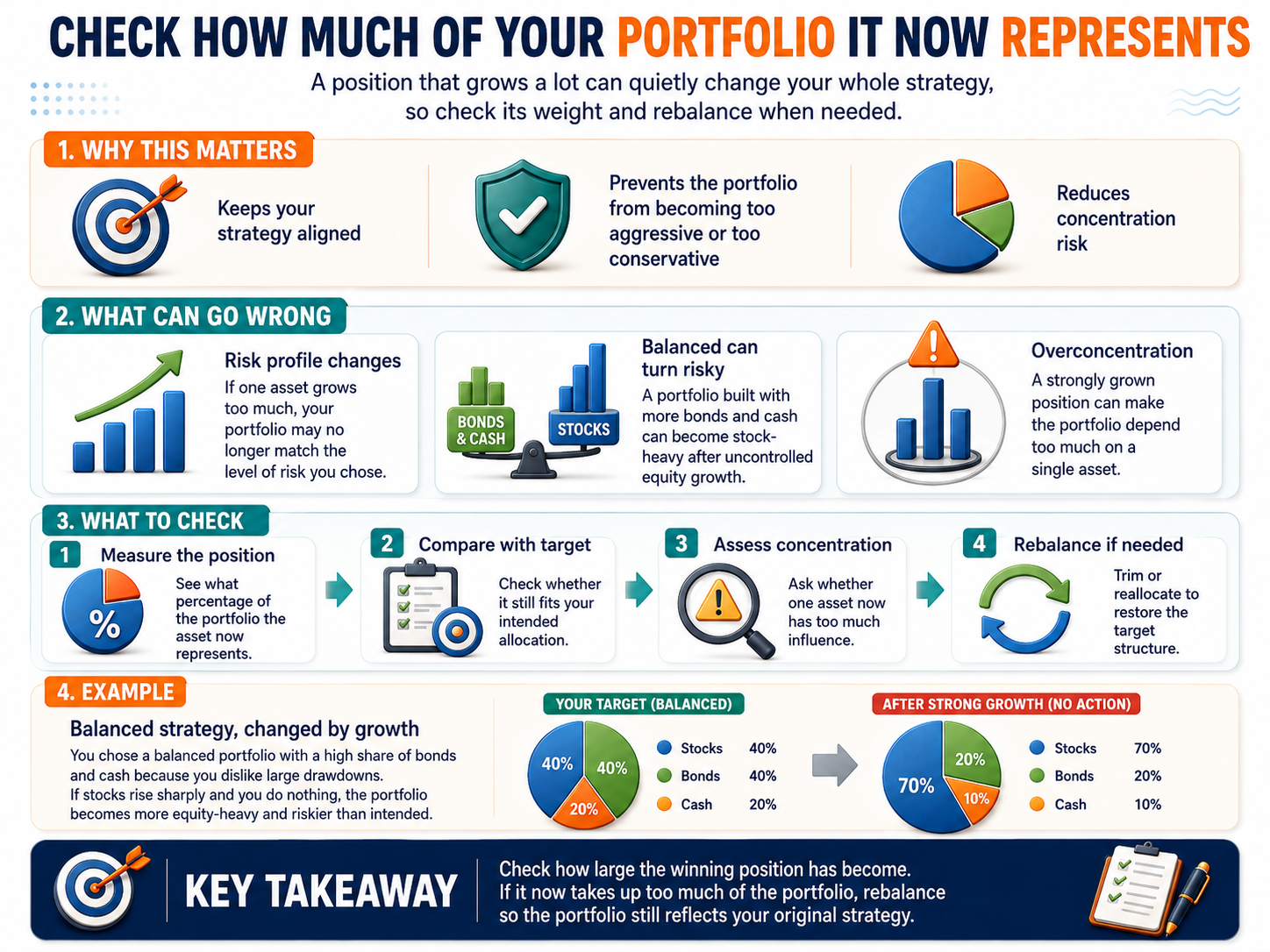
Strongly grown positions lead to overconcentration and make a portfolio vulnerable to the movement of a single product. To prevent this, check how much of your portfolio the increased asset now represents and rebalance to achieve the target structure.
Compare the New Risk With Your Investment Plan
When comparing the new weight of the investment product with your original structure, you’ll see how much it deviated.
Example: Your portfolio had 70% fixed-income assets and 30% stocks and crypto. Let’s say cryptocurrencies have grown and the ratio has become 60% to 40%. This means that the excess weight of risky assets is 10%.
To decide if it's worth changing the portfolio’s current state, consider whether the new risk still fits your goals, time horizon, and overall plan. If it’s not, diversify and rebalance to keep a portfolio aligned with its intended risk level.
Use an Anti-Euphoria Checklist Before You Act
You should avoid trading without analysis, dictated by euphoria or fear. We’ve prepared a practical checklist that will help you slow down the decision and make sure you are acting on logic. Before you buy more, hold, or sell, check the following:
- If the price dropped sharply, would I feel comfortable holding it?
- Does the current position still fit my time horizon and risk tolerance?
- Am I holding it because of a strategy, or because I am afraid of missing out?
- Would I buy this asset today, taking into account the new price?
- Is the asset now overvalued compared with fundamentals?
- Has the risk level of the product changed compared with when I bought it?
- Is the position now too large compared with my original plan?
- Did the product grow because of real progress or market excitement?
Watch for FOMO and Performance Chasing
It’s worth making decisions based on discipline and research, not on emotions and recent swings. This matters especially after a strong rally. Investors may start buying more simply because the asset has already gone up, which is a classic form of performance chasing.
The attempt to buy after impressive results, driven by bias, social proof, and FOMO, often fails because of mean reversion, changed market dynamics, or crowding. Therefore, do not allow sentiment to take the place of discipline to avoid weakening future results.
Decide: Hold, Trim, Rebalance, or Exit
If you have already reviewed the original thesis, assessed the new risks, and verified that you are not reacting emotionally, move on to action. There are four main options for what can be done with obviously highly grown investment products. Plus, there is also an option of “doing nothing” if it suits your goals.
Hold
Holding may be advisable if the investment thesis remains unchanged, the position has not become too large, and growth has not affected the overall risk profile of the portfolio. In this case, saving investments can be consistent with a long-term plan.
Trim
Trimming means selling part of the position. It’s useful when the asset has gained so much that it now carries more risk than you can handle. Still, this option does not necessarily imply exiting completely. You then lock in part of the profit and reduce concentration.
Rebalance
Rebalancing means adjusting the portfolio closer to its optimal structure. Vanguard describes it as a way to restore the portfolio to its intended investment product mix, rather than trying to guess short-term market moves or maximize returns.
Exit
A full exit may be appropriate if the original thesis is broken, the risk has become unacceptable, or the asset rose only on speculation. Check if other financial priorities matter more at the moment and act accordingly.
What to Write Down Before Making a Decision
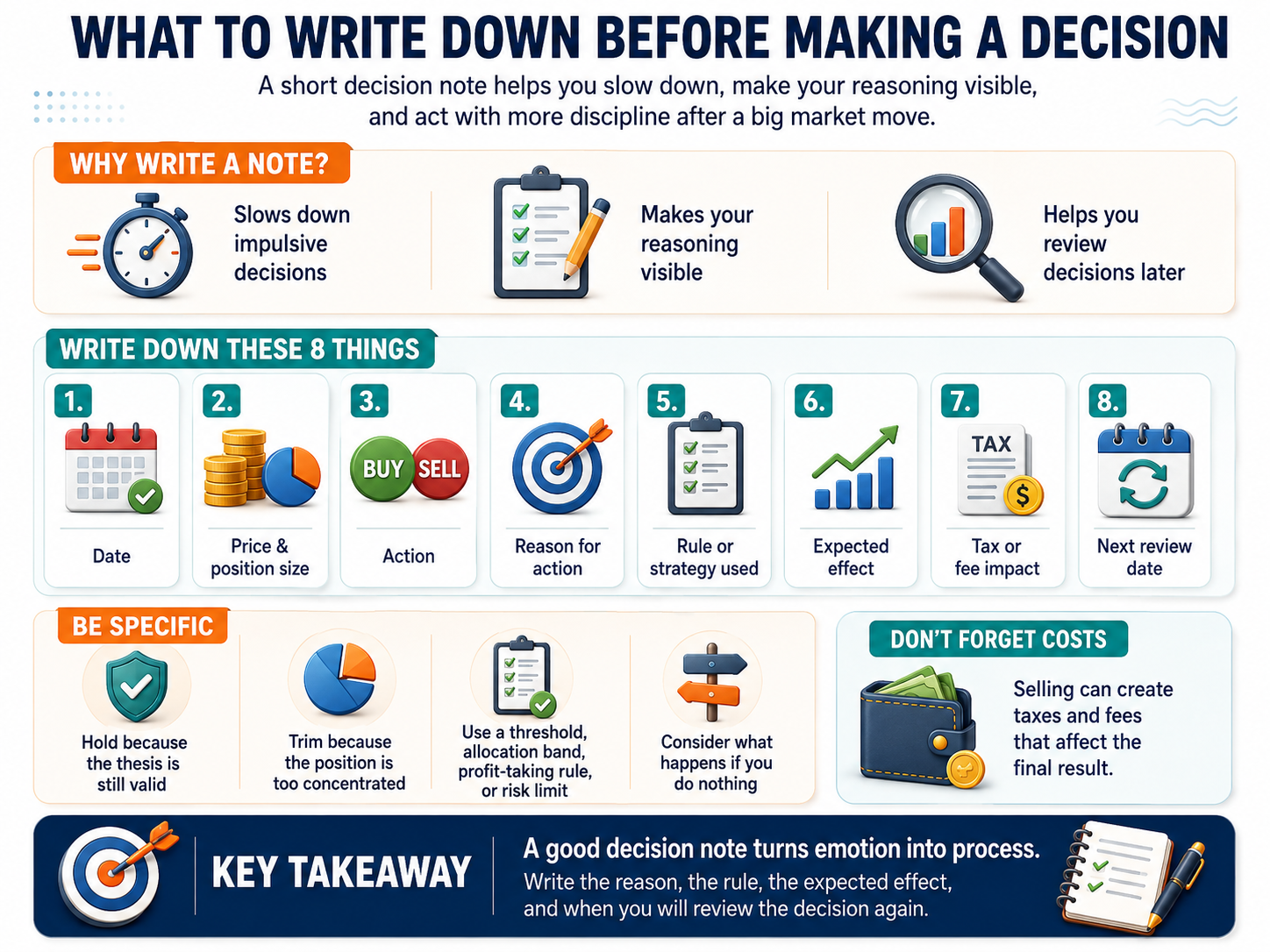
Before changing a position after a pronounced move, it’s helpful to write down a short decision note. Experts recommend this practice, as it is simple but effective. The note helps to make sure the choice is careful and prudent. When markets move quickly, investors tend to rely on intuition or confuse excitement with conviction. Notes make the reasoning visible.
Write down the following:
- Date;
- Price and position size;
- Action;
- Reason for action;
- Rule or strategy used;
- Expected effect;
- Tax or fee impact;
- Next review date.
Take the trouble to write the exact reason for the action. For example, state that you are holding because the thesis is valid or trimming because the position is too concentrated. Add the rule you are using, such as a set threshold, a target allocation range, a profit-taking rule, or a risk limit. Mention the expected downside if you do nothing or the potential effect. And since selling can create costs, which affect the final result, consider taxes and fee implications.
The Final Anti-Euphoria Rules
It’s difficult for investors to remain calm, mainly because markets evoke strong emotions such as fear, greed, and euphoria. Investors often feel the need to act, even when waiting is the best choice. Gains feel good, while losses hurt, so many of them start to worry and react. Plus, headlines, alerts, and social media market noise create pressure and make normal volatility feel like a crisis or an unprecedented spike you shouldn’t miss.
If you face this, there is no need to immediately sell or buy more. A better choice would be to review the original rationale, check the deviation percentage and changes in allocation, and then evaluate the new risks. After that you can decide what to do: hold, trim, rebalance, or exit. But make decisions only if you have verified that you are not reacting emotionally.
Disclaimer: The content provided in this article is for educational and informational purposes only and should not be considered financial or investment advice. Interacting with blockchain, crypto assets, and Web3 applications involves risks, including the potential loss of funds. Venga encourages readers to conduct thorough research and understand the risks before engaging with any crypto assets or blockchain technologies. For more details, please refer to our terms of service.