
Table of Contents
Investment risks can be divided into two large groups: systematic (market) risk and unsystematic (specific) risk. The former affects the entire market or a significant part of it, and investors cannot influence it. The latter is associated with certain assets, industries, or instruments and is often manageable. That’s why investors use diversification to make portfolios more stable.
However, not all diversified portfolios reduce specific risks that stem from internal or localized issues. This means that the portfolio looks balanced but carries one hidden vulnerability that can reveal itself completely unplanned and cause widespread disruption.
For example, you can have ten different tokens, but if they all depend on the same chain, sector, bridge, or protocol, the portfolio may be less sustainable than it seems.
In this article, we explain how to detect concentration risk, how to understand that the risk is too high, and what to do about it. Below you’ll find a convenient exposure map, which clearly shows what to look for when quickly assessing portfolio risks and diversifying.
What Does Overexposure Mean in Crypto?
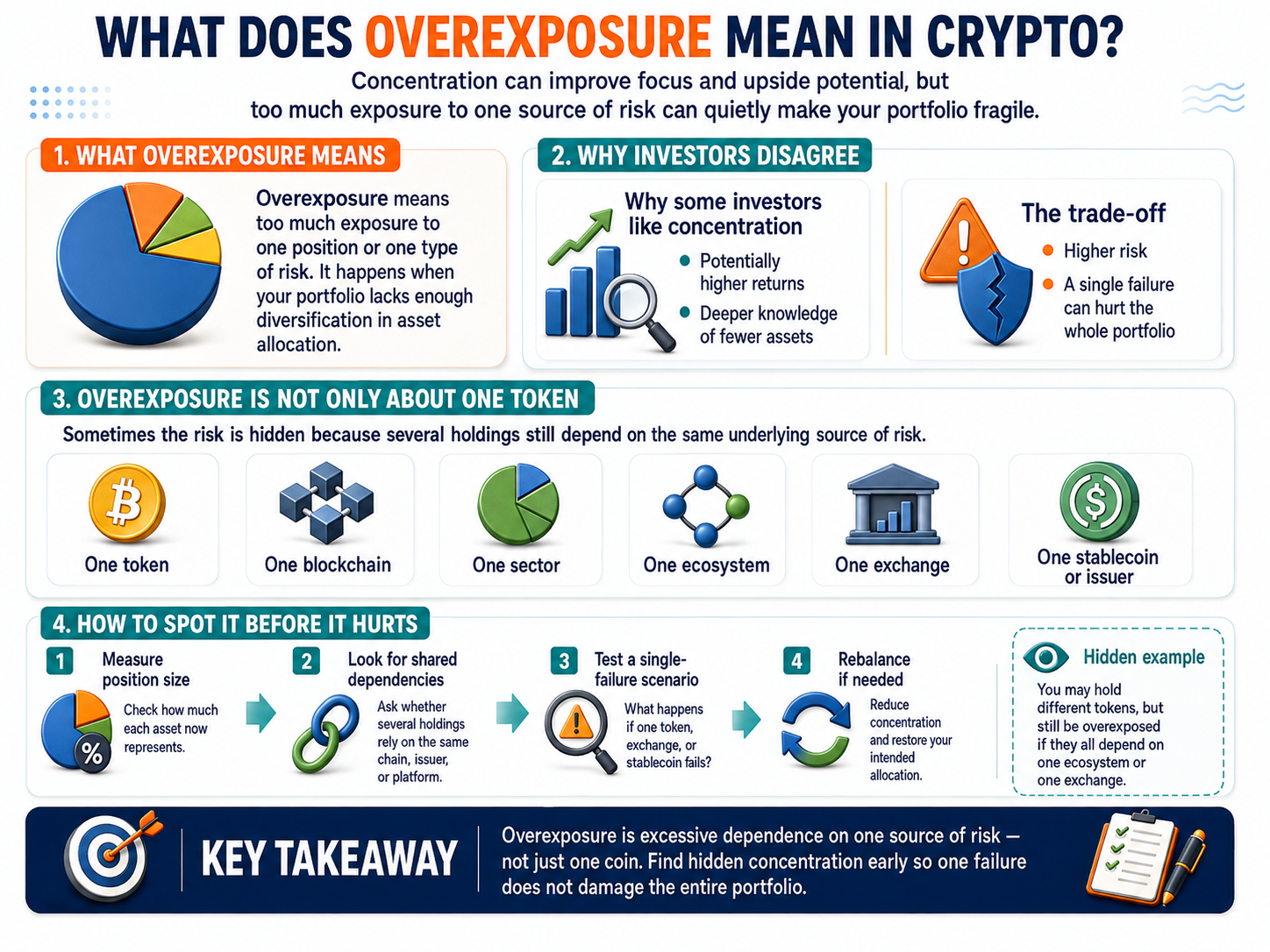
Investors disagree about the benefits of diversification. Some are sure that putting all your eggs in one basket is a mistake and a sign that you can lose money with any sharp drop in stock or crypto prices. Others consider concentration to be a great idea that increases portfolio returns and enables deeper knowledge. However, it surely elevates risk.
Excessive concentration implies too much exposure to one position or risk. It is called overexposure and means you lack diversity in asset allocation. Notably, overexposure is not necessarily about holding too much of one token. It can also mean relying too heavily on one blockchain, sector, ecosystem, issuer, exchange, stablecoin, etc. It’s usually hidden, so below we explain how to identify it before a single failure affects your portfolio.
Why “Many Tokens” Does Not Always Mean Real Diversification?
If you invest in cryptocurrencies through an exchange or an application, it may seem that buying many different coins and tokens will help you greatly increase the stability of your portfolio. This is partially true. However, the sense of safety that you get from holding multiple assets can be illusive if they move together or depend on the same infrastructure.
Correlations: Do Your Assets Fall Together?
Crypto assets can be highly correlated. For example, XRP and XLM are often cited as moving in tandem and reacting to the same market forces. BCH and BSV also share sentiment, narratives, and behavior tied to Bitcoin’s ecosystem. Interestingly, currencies based on different technological frameworks can correlate as well. For example, BTC, ETH, and SOL are quite different, but they all tend to fall together during major market downturns.
Having several independent DeFi tokens in your portfolio won’t help either if they all rely on Ethereum liquidity, one stablecoin pair, or the same lending demand. That’s why if you buy 10 random cryptos, real diversification may not happen. So, you'll have to do dependency research before you start investing.
Token Exposure: Are You Relying on One Asset Too Much?
The most obvious type of concentration is when one token represents too much of the portfolio. For example, you can have 90% Bitcoin and 10% USDT. But true exposure is broader than allocation alone. It happens that the positions are almost equal in size, but the risk is still there. This is due to other factors:
- If liquidity or trading volume is thin, even a moderate sale can move the price sharply.
- High volatility increases the chance that one position dominates the portfolio.
- Future token unlocks create sudden supply pressure and weaken price stability.
- If a few wallets (whales) control a large share, they can influence price and liquidity.
- Large team or insider allocations boost centralization and sell-pressure risk.
Pay attention to independent demand. A crypto token is stronger when it has users, fees, or utility beyond speculation and hype. When it doesn't capture value from meaningful activity, it becomes vulnerable to demand drops or spikes around marketing events.
Warning Signs of Token Overexposure
Analyze whether any one token affects the results of your portfolio to a greater extent, whether you check it more than the others, and whether significant growth of this asset will change your financial plan. It’s also worth taking a break if you increase your position mainly because you feel emotionally attached to it, rather than because the investment still makes sense.
Chain Exposure: What Happens if One Network Has Problems?
Another common issue is chain exposure that appears when too many assets depend on one blockchain ecosystem. For example, the Solana network is a foundation for SOL, JUP, LINK, PUMP, CAKE, RENDER, and many other tokens that rely on its infrastructure, fees, and validator performance. Ethereum is tied with many ERC-20 tokens that depend on its base layer, while the BNB Smart Chain ecosystem has BNB-linked assets, BEP-20 tokens, and protocols. The exposure can be caused by:
- Network outages, congestion, and slowdowns;
- High fees and changes in gas costs;
- Bridge problems that hit several holdings;
- Validator or consensus problems;
- Developer and liquidity migration.
How to Spot Chain Concentration
You can pinpoint chain exposure by grouping assets by the network they are issued on, used and staked on, bridged to, or mainly traded on. Then, calculate how many assets and tools each network in your portfolio supports. If the figure is high, the concentration risk is also high. Issues at the blockchain level can affect settlement and trust, causing price swings.
If you do research manually, look at each token’s chain and its main liquidity source. If you prefer automated analytics, use cross-chain data portals, tools like BubbleMaps and CryptoQuant, block explorers, portfolio trackers, and other platforms to verify which assets belong to the same network.
Sector Exposure: Are Your Assets All Making the Same Bet?
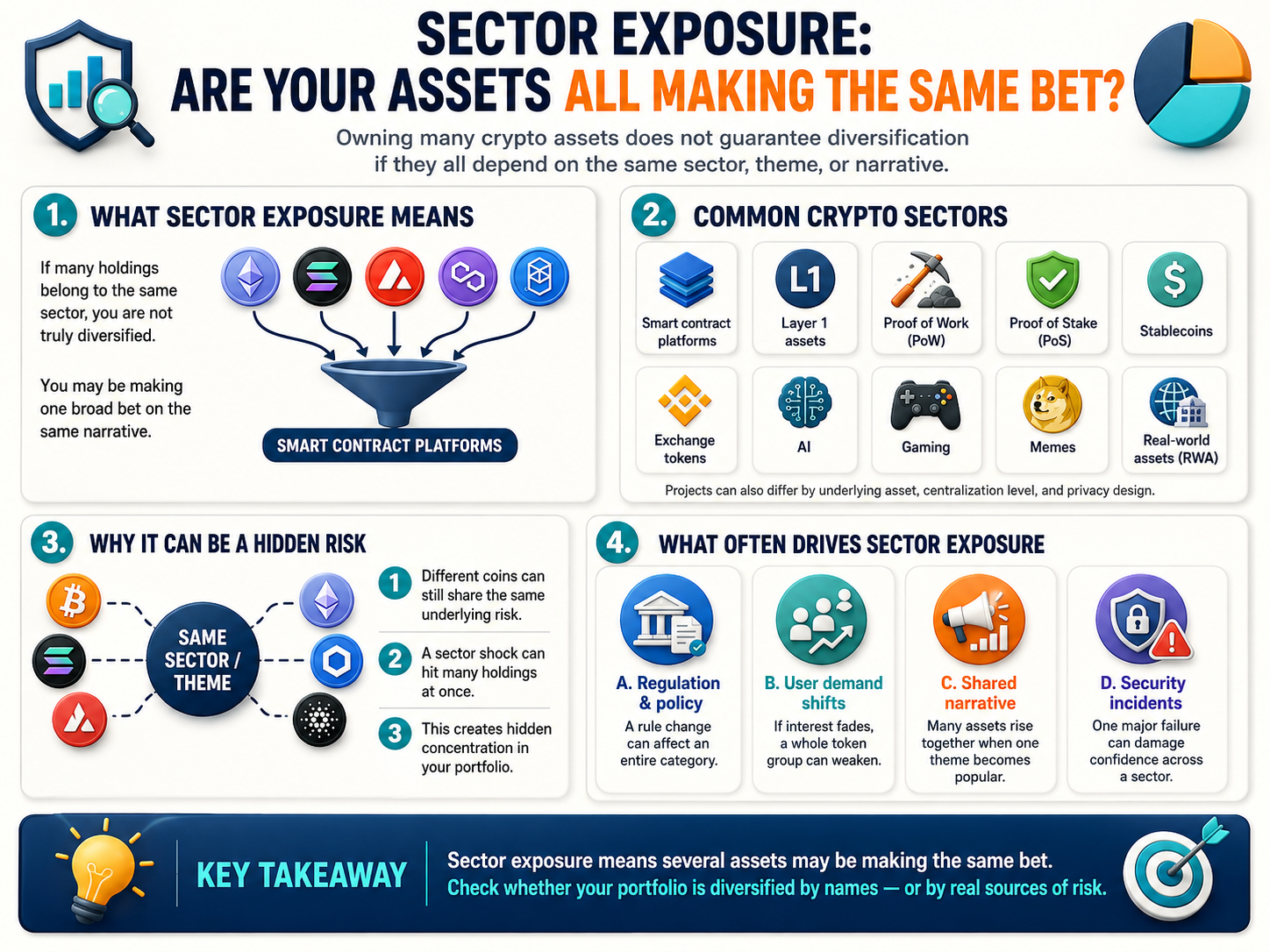
Top sectors in crypto are smart contract platforms, Layer 1 assets, Proof of Work (PoW) and Proof of Stake (PoS) assets, stablecoins, exchange-based tokens, and more. Cryptocurrencies can also be categorized by themes (AI, gaming, memes), underlying assets (fiat-backed, crypto-collateralized, real-world asset), centralization level, and privacy mechanisms.
If many holdings belong to the same sector, you are not really diversified and are making one broad bet on the same narrative. Sector exposure typically comes from:
- Regulation and policy changes that hit an entire category;
- User demand shifts that make a token group weaken;
- Shared narrative, where many tokens rise due to the popularity of one theme.
- Security incidents that damage confidence across a whole category.
How Sector Risk Shows Up
Sector risk usually displays when a whole category gets hit by regulation, weaker user demand, or a shift in market sentiment. Capital can leave an entire sector if market participants' preferences shift. That’s why, for example, a DeFi-heavy portfolio can suffer if lending activity slows.
To spot sector exposure, group your holdings by category and check whether one sphere dominates. Also, look for liquidity concentration, platform reliability, niche popularity, and security matters. Changes in rules or trust affect all related tokens.
Stablecoin and Liquidity Exposure: What Are You Using as Safe Capital?
A large allocation to one token can make the whole portfolio behave like a single bet. Yet, when investors build a strategy around this idea, they often focus on risky assets and forget that the same logic also applies to cash equivalents. Many treat stablecoins or liquid reserves as neutral, although these can also constitute a concentration risk. Serious exposure to redemption, depeg, or custody risk appears when most liquidity in your portfolio depends on one stablecoin, issuer, chain, exchange pair, or custodian provider.
Bridge and Wrapped Asset Exposure: Are You Depending on One Connector?
Bridges move assets or data from one blockchain to another by locking the original asset on one chain and issuing a representation on the other. Wrapped assets are those representations. They are not native to the destination chain and depend on the bridge that backs them. Examples include WBTC, WETH, WLTC, and WXRP.
Their concentration may be harmful because it creates a shared point of failure. If many positions rely on the same bridge or wrapped-asset mechanism, one exploit, outage, or any other problem will affect many assets, disrupting redemption and price stability. To spot it:
- Check which of your holdings are native to a chain;
- Check which tokens are bridged or wrapped versions on another chain;
- See whether they rely on the same bridge or custodian;
- Analyze what will happen if the defined connector fails.
Platform and Custody Exposure: Where Are the Assets Held?
Imagine that you have considered all the factors involved in portfolio diversification, such as position sizes, asset types, toolkits, and networks. Now, think about where you keep this portfolio. Could there be a risk that, if one investment platform, exchange, wallet, or app you use were to break down or be hacked, you would lose access to your money? If yes, then you might deal with platform exposure.
Your custody choices are connected to portfolio risks. Overexposure can come from infrastructure, not the assets. If most funds are on one DEX, wallet setup, staking provider, or DeFi protocol, you may face operational and counterparty concentration. Consider distributing investment products across multiple storage or management systems.
An Exposure Map
You need to understand exactly where an excessive concentration of risks may occur. We've included in the table the things that experts advise being aware of.
When Does Exposure Become Potentially Dangerous
Exposure gets threatening when one factor is so critical that any issue with it affects access to funds or pricing for multiple positions. In other words, if a single asset, platform, storage system, or crypto disrupts a large portion of your liquid assets or affects multiple products simultaneously, you have excessive concentration.
We advise beginners to consider any concentration as a wake-up call and reduce it if it contributes to the portfolio mobility or stability. The exact limit depends on your risk tolerance. For reference, check bank or institutional guidelines on concentration risk management.
Common Mistakes When Trying to Diversify Crypto Risk
Here’s what you should not do when diversifying and some brief explanations why it’s so:
- Buying more tokens from the same ecosystem. Adding cryptocurrencies from the same chain or sector may increase complexity without reducing the core crypto risk.
- Overlooking wrapped and bridged assets. These look like separate holdings but actually depend on the same connector or collateral lock.
- Ignoring infrastructure dependencies. It’s not advisable to diversify by token while relying on one bridge, exchange, or liquidity source. Tech issues can hit many related assets.
- Confusing narratives with independent exposure. Different tickers can represent the same market story and all fall together. Regulation, security, or sentiment changes make this abrupt and painful.
- Assuming stablecoins are risk-free. A stablecoin can still carry redemption, depeg, reserve, or custody risk. If they dominate pricing, the portfolio is exposed to a single failure point.
What to Do if You Find Overexposure: Real Diversification Tips
No matter how attractive concentration may seem, it inevitably leads to high volatility and vulnerability to fluctuations. It may sometimes be suitable for aggressive traders, but research shows that increased concentration does not provide a sustainable advantage in the long run and leads to lower results compared to diversified strategies.
If you find an overexposure, don’t panic and sell everything. There are more practical options. First, you need to stop increasing excessive risk, and then gradually balance it, direct new capital to really different types of assets, create a larger reserve of liquidity, and reduce dependence on one platform. After that, you should set a simple verification rule so that the problem does not happen again unnoticed.
Real diversification starts with knowing what can fail. If you want to create a strong portfolio, simply determine what each asset depends on (chains, sectors, tokens, liquidity, storage) and avoid unknowingly feeding into one risk.
Disclaimer: The content provided in this article is for educational and informational purposes only and should not be considered financial or investment advice. Interacting with blockchain, crypto assets, and Web3 applications involves risks, including the potential loss of funds. Venga encourages readers to conduct thorough research and understand the risks before engaging with any crypto assets or blockchain technologies. For more details, please refer to our terms of service.