
Table of Contents
Dollar-cost averaging (DCA) is a simple but powerful strategy that helps investors reduce risk and avoid emotional mistakes. It has gained popularity with people trading crypto because of the market’s volatility: there’s a real need to reduce the impact of short-term fluctuations.
The flexibility to “set it and forget it” appeals to investors, even though the model itself doesn't always ensure higher profitability when compared to other practices. 59% of crypto investors use dollar-cost averaging as their core investment strategy.
Read on to find out why DCA is a great solution for traders who wish to gradually increase their crypto holdings over time.
What Is Dollar-Cost Averaging (DCA)?
Dollar-cost averaging means investing a certain sum of money at regular intervals, regardless of market ups and downs. The strategy involves dividing the entire amount of investments into fixed parts that are put to use according to a predetermined schedule.
Why do investors need such a strategy? DCA allows buying more of an asset when prices are low and less when prices are high, effectively averaging the cost.
Using this practice, investors don’t look at the price of digital assets, such as crypto, stocks, or ETFs, when making purchases. Therefore, the approach helps them reduce the risk that their fear or greed will lead them to make poor choices (for instance, panic selling).
What’s more, with dollar-cost averaging, individuals are investing small amounts. They don’t invest a huge sum at a time, risking a budget, and still don’t have to actively manage trades.
Source: Kraken
The Origins of DCA in Traditional Investing
DCA was first used in stock markets, and the concept has been around for decades. It developed in response to the markets’ unpredictability, where asset prices can change dramatically over brief periods. It was used to minimize timing risk and build positions steadily in the long run. That’s why employing it is reasonable.
Why DCA Became Popular in Crypto Markets
High volatility and unpredictable swings make the crypto market an ideal space for DCA adoption. The main factor in the DCA popularity was the brutal bear market in 2018: the sharp drop in Bitcoin hit many investors. There was a need to somehow reduce the risks.
Then, during the DeFi Summer of 2020 and the NFT boom in 2021, centralized exchanges like Coinbase and Binance introduced automatic recurring purchase features (with no need to pay network fees). So, many DCA fans started to use such instruments.
Success stories further fuel people's interest in this approach. There is a perfect example discussed on the social network X. A trader, @regothetrader, spent eight years buying Bitcoin for $30 daily. While his out-of-pocket cost was $86,250, the long-term growth pushed his returns up by 1,250%. The result: a $1 million portfolio.
How Does Dollar-Cost Averaging Work?
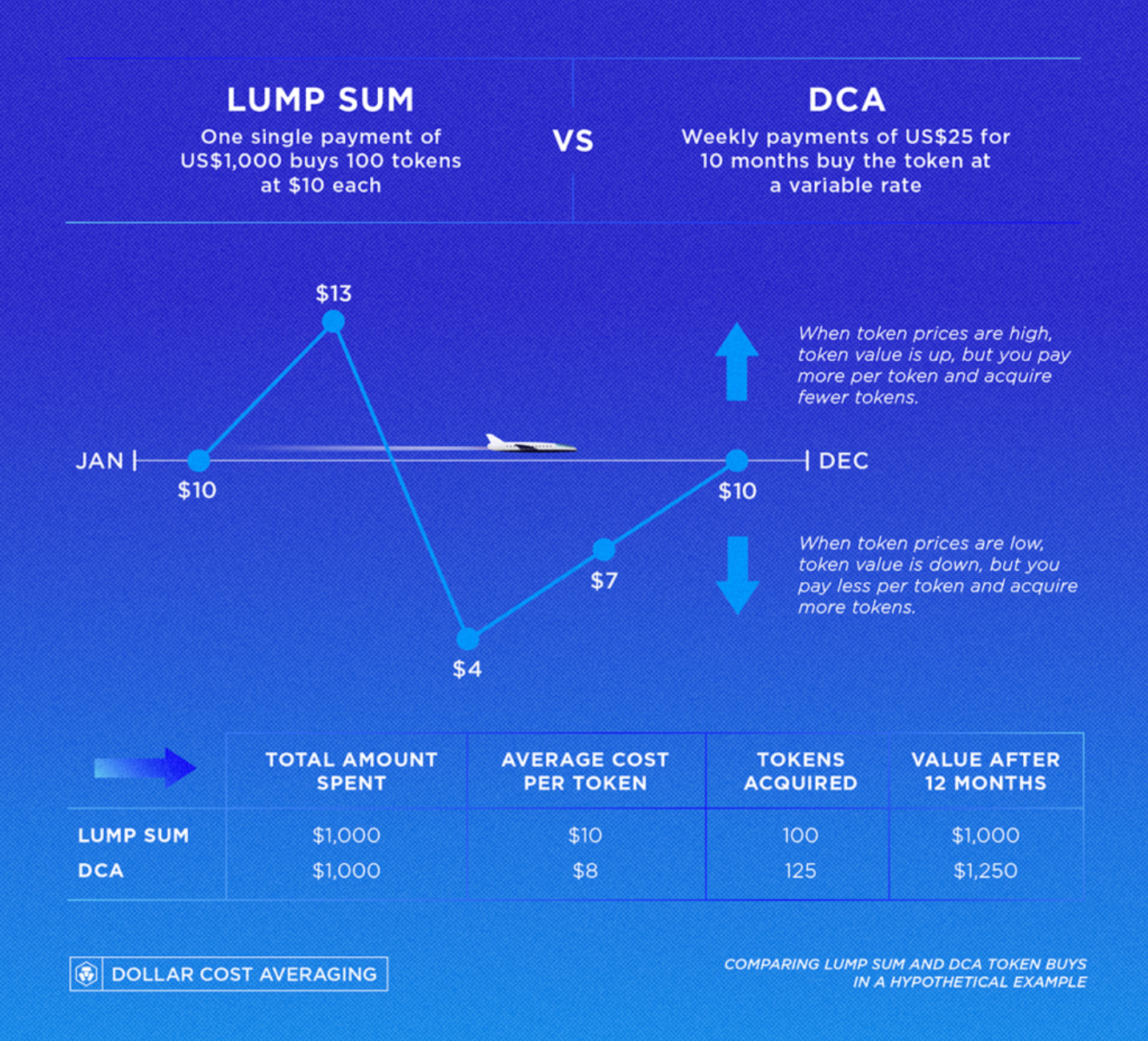
Let’s see the logic of spreading an investment over time. Imagine you invest the same amount of money at the same intervals. The dollar sum is fixed, but the amount of tokens you get changes:
- When prices are high, you get fewer assets.
- When prices are low, you get more assets.
Over time, this can result in a cost per token that’s lower than the average market price.
Instead of trying to predict market tops and bottoms, you just do the same thing day by day. And you can go like this for months and years. You can even automate this, if you want. Perhaps your portfolio will be worth a lot more than it was at the beginning.
The Principle of Investing Fixed Amounts Regularly
The idea of DCA is simple: regardless of the asset’s price, invest a set sum of money on a regular basis. Why? Because small, consistent purchases help average out entry prices and reduce the impact of market volatility. Plus, it builds the discipline of investing without the pressure of having to be right about the entry price.
Applying the DCA Investment Strategy to Crypto
Although initially the approach was used in the stock market, the same principle works in crypto. Investors can buy, say, Bitcoin — weekly, biweekly, or monthly. It’s only important not to try this with stable assets like USDT or USDC. They are linked to the dollar exchange rate, and so the trader will not gain anything.
How Can You Implement a DCA Strategy in Crypto?
You can try to DCA crypto if you believe it will go up in the future. You no longer need to time the market thanks to it. In general, the goal is to vary the prices at which you buy, cutting the costs of your overall purchase. Here are some practical steps to get started.
Choosing the Right Cryptocurrency to Invest In
Study the available cryptocurrencies carefully and choose trustworthy projects with potential for growth. We suggest focusing on established assets before experimenting with altcoins. Historically, major cryptocurrencies such as BTC and ETH have reached new highs in each market cycle, while many smaller ones have failed to do so, often dropping to $0.
Setting the Investment Amount and Frequency
Then, you should decide how often to invest (daily, weekly, or monthly) and how much to invest each time. The crypto market is very volatile. In a month, Bitcoin can grow by 20% and fall back. So, consider weekly purchases, as they smooth out these sharp peaks better. When selecting the amount, think of setting aside a percentage of your income (5–20%).
Platforms and Tools That Automate DCA
You will need to make a purchase of cryptocurrency for a pre-determined amount. To do this, you can use popular cryptocurrency exchanges. Binance, Coinbase, and Kraken have native recurring purchase options, making the process easier.
Record every purchase, no matter what tool you use. The effectiveness of dollar-cost averaging should be regularly monitored and evaluated in order to adjust it if necessary.
What Are the Benefits of Dollar-Cost Averaging in Crypto?
DCA turns market fluctuations into an ally so that you accumulate more at low prices and less at high prices. Let’s outline the main dollar-cost averaging advantages.
Reducing Emotional and Impulsive Decisions
It’s possible that investors who try to time the market come up short. Dollar-cost averaging removes the pressure, FOMO, and uncertainty of market timing because investors are adhering to a fixed investment schedule.
Mitigating the Effects of Market Volatility
You may know that regular purchases smooth out price fluctuations. This is exactly what cost averaging DCA does. With this strategy, investors may lower their average cost per digital asset of any kind (crypto, shares, indices) and reduce the impact of volatility.
Encouraging Long-Term Investing Discipline
DCA also provides psychological relief and encourages investors to invest regularly. It helps build consistent habits, a schedule, and a long-term perspective. For market participants who are dedicated to making ongoing investments but lack the time or desire to monitor the market, it can be a particularly dependable approach.
Making Crypto Investing Accessible for Beginners
The DCA investment strategy is believed to be a fairly simple way to build a portfolio. It is accessible for beginners who don’t want to constantly be in front of a screen or feel a lot of stress from trying to buy an asset “at low” or “on time”. Even small but regular amounts invested grow over time, making crypto more approachable.
What Are the Risks and Drawbacks of DCA in Crypto?
There are certain risks and drawbacks to cost averaging DCA, even though it helps take some guesswork out when investing in the crypto market. For instance, you should think about how much money you have to keep buying assets when prices are low. Here we’ve listed the other potential downsides.
Lower Returns in Strong Bull Markets
DCA might miss out on rapid market upswings. This is because DCA may generate lower returns compared to buying all at once. You could spend more money on smaller amounts of crypto if you purchase it automatically at set intervals. This has the opposite intended effect, and can actually raise your costs.
Risks of Investing in Failing or Declining Projects
Applying dollar-cost averaging to weak, declining, or scam projects can magnify losses, as regular investments continue pouring money into assets with diminishing or no value. DCA can’t protect you against a declining (bear) market. Meanwhile, the fraudulent projects trap funds irreversibly, as exit liquidity vanishes.
Transaction Fees and Platform Costs
Please note that frequent purchases can lead to an increase in the total transaction fees on some platforms, which will affect the net profit. Many exchanges charge a fixed or percentage-based fee per transaction, so when making numerous small purchases, the commission may be higher than with fewer, larger buys.
Overreliance on Automation Without Research
Automation should never replace due diligence and market research. Investors are still responsible for evaluating asset quality, project fundamentals, and market conditions before setting automated buys.
DCA vs. Lump-Sum Investing: How Do They Compare?
During market downturns, some traders prefer to invest in lump sums in the hopes of making larger profits. According to research on the US stock and bond markets, investing all capital at once (LSI) is better than DCA in 74–88% of cases. If the cost of an asset rises sharply, lump-sum investing can outperform.
Another issue is that DCA forces you to keep money in cash for an extended period, which may result in low rates of return. And if we are talking about short-term investments for less than 3–5 years, then DCA is also irrelevant.
Does this mean that LSI is much better? Not really. Actually achieving gains requires successfully timing the market, which is very hard to do. LSI assumes you bet on the general upward trend and have the iron stomach to handle an immediate crash.
So, there are advantages and disadvantages of each approach in different market conditions. Here’s a direct comparison of both strategies.
What Variations and Alternatives Exist to DCA?
Besides cost averaging DCA and LSI, there are several other models. Below, we explore more approaches to systematic investing.
Value Averaging as a Different Approach
For example, you can use value averaging. It adjusts investment volumes based on market dynamics in order to match a specific trajectory of portfolio growth. When prices are falling, you will buy more, and when prices are rising, you will buy less. This helps achieve sustainable growth but requires active management.
Hybrid Approach: Lump-Sum and DCA
Individual investors may mix a lump-sum model with DCA for flexibility. To do so, they deploy a portion of capital immediately into assets like Bitcoin. And they use DCA for the remaining amounts to average into positions over time. It’s adjustable based on risk tolerance or market conditions.
Manual vs. Automated DCA Approaches
Manual DCA suits active traders monitoring assets closely. But if you have a routine of automatic purchases, whether weekly, biweekly, or monthly, you will invest consistently without needing to analyze the market. It’s better for passive investors.
Who Should Consider Using a DCA Strategy?
Dollar-cost averaging can be a good idea. There are three profiles of investors who benefit most: beginners, risk-averse traders, and long-term investors.
For beginners: DCA does not require in-depth knowledge of the market, different assets, patterns, trends, and charts. It can be used by novice investors with little to no experience. They won't even need to do fundamental and technical analysis.
For risk-averse traders: some people are terrified of volatility, and DCA works for them because it mitigates its impact. If the market drops, the risk-averse investors view it as a discount: their next move is to buy more tokens for the same amount of money. This makes market declines an opportunity, not a cause for concern.
For long-term growth-oriented investors: cost averaging DCA is consistent with cash flows for those who are thinking about a 20- or 30-year investment horizon, receive a salary, and want to passively grow their wealth. It allows them to automatically invest a portion of their income each month.
Is Dollar Cost Averaging the Right Strategy for You?
Crypto is highly volatile and may be more susceptible to market manipulation than stocks. So, dollar-cost averaging is your tactic of balance and moderation that mitigates the effects of market volatility. While DCA doesn’t guarantee higher profits compared to other models, it offers a disciplined, low-stress way to invest in crypto.
DCA is not suitable for everyone. This is not necessarily good for those who invest during periods when prices are trending in one direction or another. Also, averaging the value of a crypto in dollars can only make sense if you are confident that the asset will grow.
Our suggestion is to align the method with your goals and risk tolerance. Try a couple of approaches to see what works for you. Good luck!
Disclaimer: The content provided in this article is for educational and informational purposes only and should not be considered financial or investment advice. Interacting with blockchain, crypto assets, and Web3 applications involves risks, including the potential loss of funds. Venga encourages readers to conduct thorough research and understand the risks before engaging with any crypto assets or blockchain technologies. For more details, please refer to our terms of service.