
Table of Contents
You would agree that many years ago, the internet used to just be full of annoying trolls, but today? Every minute you are running into fake profiles and phishing links on platforms like LinkedIn, Telegram, and X which are not only annoying but dangerous.
One wrong move may mean a compromised social account, it can lead to full-blown identity theft, lost money, and completely drained crypto wallets.
The scammers behind these scam accounts have gotten incredibly sophisticated. They have stepped up from only sending obvious spam to building believable personas to lower your guard.

Wondering how to identify a fake profile and spot a phishing scam before you reply to their messages, click a sketchy link, or connect your wallet, let us explore the exact red flags you need to watch out for across these platforms.
Why Are Linkedin, Telegram, and X Easy Ground for This Type of Scam?
It will profit us to note that scammers are not only good in coding but they are also good in psychology. They weaponize the natural environment of each app to make you trust them way too quickly.
When you're on these three platforms, your guard drops because you think you’re among your peers.
Understanding why we may fall for their tricks will be an eye opener to keeping safe in these apps. Let's see them one at a time.
- LinkedIn is the "Suit and Tie" Illusion. You're there to network, look smart, or find a job. When a slick profile claiming to be a VC founder or an executive recruiter messages you, your brain registers "opportunity," not "danger." The professional setting acts like a digital camouflage for identity theft and a lot of people have been falling for this.
- X (Twitter) as the Hype Machine. Everyone there is smart, or so it seems. Everything moves at lightning speed. It takes two minutes for a fake account to buy a blue checkmark, copy an influencer's branding, and reply to a thread looking like an authority figure. It feeds on FOMO (Fear Of Missing Out).
- Telegram is the "Inner Circle" Trap. This is the home of crypto communities, but it feels intimate. It’s incredibly easy for scammers to pull you out of a public group into a private chat or a custom bot. Because it feels exclusive, you assume you're talking to a teammate or a mod, making it easy to drop your guard before they drop a malicious link.
Essentially, these apps are built to connect us instantly. Unfortunately, that means they are also perfectly optimized for psychological manipulation which scammers have on their fingertips.
What Signs Usually Reveal a Fake Profile?
Spotting a scammer goes beyond spotting sketchy broken English phrases, these are probably from cheap scammers. You should be worried about the most dangerous fake profiles, the ones that look a little too pristine.
To identify them before they get anywhere near your assets, you need to look past the surface and check the digital footprints.
The too perfect Profile
A profile that looks too perfect or too empty: A perfect, polished and sleek account. Looks exactly like what a corporate board or a high-end crypto project would want. But if you scratch beneath the shiny surface, you'll realize it’s as lifeless as a staged apartment. You need to double check issues such as:
The Overly Generic Bio: Their bio reads like a robot threw a bunch of industry buzzwords into a blender. If you see strings like "Web3 Enthusiast | Crypto Pioneer | Venture Capitalist | Cross-Border Connector" without a single mention of a specific, verifiable company, project, or track record, be careful. They are using broad terms just to bait as many people as possible.
A Sudden Jump in Followers or Connections: Scammers love to buy social proof. You might see an X profile with 25,000 followers, but when you look at their actual posts, they get exactly two likes and zero organic retweets. On LinkedIn, they might have 500+ connections, but not a single mutual friend in your specific industry network. Beware of such accounts.
Template-Like Posts: If they do post, it’s entirely unoriginal. It’s usually stolen crypto news, generic AI-generated motivational quotes, or dry industry reposts with zero personal commentary. There is no unique human voice behind the keyboard.
The Ghost account
On the opposite end of the spectrum is the incredibly lazy fake. This profile doesn't even bother to hide the fact that it was thrown together in five minutes to launch a quick phishing scam. How do you identify them?
A Strange Creation Date: This is one of the typical tips that give them away. If an account claiming to be an "Official Project Support Lead" or a "Senior Talent Sourcer" was created just a few weeks (or even days) ago, run.
Real professionals don't just magically materialize on social media out of thin air right before sliding into your messages.
An Empty Feed: There is almost no normal, living history here. The timeline is a barren wasteland. No banter, no casual replies, no history of normal interactions with other real users.
Few Real Interactions: If you check who they are talking to, they have almost no real interactions with the outside world. If they are replying to anyone, it’s usually just tagging other obvious scam accounts in a desperate attempt to look active. These fake accounts exist solely to like and retweet each other's malicious links.
Inconsistencies in Identity, Tone, or Context
Scammers are great at copying but terrible at details. Suspicion comes from a bunch of tiny, awkward details that don't add up.
For instance, you might see a profile named "Jane Monroe, Web3 VC," but the actual handle is something chaotic like @Crypto_king19743, funny right? Or their bio says they are a corporate executive in Zurich, yet they message you at 3:00 AM (GMT +1) using broken Google-Translate English.
When someone claiming to be a "Chief Technology Officer" can't answer basic tech questions without hiding behind generic buzzwords, the math isn’t mathing. If three small details feel off, trust your gut and run.
Urgency, Quick Familiarity, or Pressure
Scammers' goal is to move you from stranger to victim instantly, which is why they act like your long-lost bestie within three sentences.
Once your guard is down, they will manufacture intense urgency around an "exclusive" offer. In crypto, they love to dangle a secret whitelist spot, a token allocation, or a fake support emergency where your funds are "at risk" unless you click a famous link right now - like immediately.
Anytime someone creates an artificial countdown or rushes you into a decision involving your keys, take a breath and slow down. Real opportunities don't vanish because you took ten minutes to think.
How Can You Recognize a Trap Link Before Clicking?
Trap links nowadays are way too organised to think you would just spot them at first glance. Dangerous links rarely look like obvious spam anymore. A sophisticated phishing scam won't send you a broken string of random numbers.
Instead, the malicious link will look like a completely normal part of your day. It could be a Notion document, a Google form, a calendar invite, an official support portal, or an exclusive airdrop page.
To identify these links, you can check things like:
Typo-Squatting Trick: Scammers register fake domains that look almost identical to the real deal. They use extra characters or visual illusions, like replacing an "m" with an "rn" (rnetamask) or adding sneaky words (like brand-support-portal.com). If the spelling is even a millimeter off, walk away.
Shorteners and Hidden Destinations: If an unsolicited message uses a shortened link like Bitly or TinyURL, they are actively hiding the actual URL from you. Treat it like an unmarked package.
The Redirect Loop: If you click a link and your browser address bar aggressively flashes through three different URLs before landing, close that tab immediately. They are trying to scramble the track before pushing you to a malicious "connect wallet" page.
The Telegram DM tests: Scammers love sliding into DMs with "special offers" for free Telegram Premium, but real official communication from Telegram only happens through a verified system service account with a blue badge in your main chat list. If a link bypasses official, clear trust signals and begs for a login or wallet connection, slam the door.
What Traps Appear Most Often in a Crypto Context?
As people concerned and deep in crypto, it will benefit us to know and understand how the scammers in this arena function. Unlike other industries, scammers here do not waste time pretending to be a lonely prince looking for love or a distant relative leaving you a random inheritance. They know exactly what drives this industry, so they weaponize three specific emotions: FOMO (fear of missing out), authority, and extreme urgency.
They don't try to win your heart, they try to hijack your rational brain by making you think you're about to make big wins or lose a fortune. On LinkedIn, X, or Telegram, these are the exact traps you're bound to run into:
Impersonated Founder or Admin: Scammers copy the profile picture, bio, and pinned posts of prominent Web3 founders or group admins. They will message you directly with an "exclusive" token sale, an unlisted seed round, or an insider advisory role, trading completely on the founder's stolen authority. Always double check the people reaching out to you.
Shinny Airdrop Illusion: You’ll be tagged in a post or added to a closed Telegram group boasting a massive, time-sensitive airdrop or a surprise mint page. These sites are meticulously cloned to look exactly like real projects, but clicking "Connect Wallet" gives them permission to wipe your assets within milliseconds.
The LinkedIn "Partnership" Trap: On the professional side, attackers use LinkedIn to target builders and investors under the guise of listing opportunities, advisory work, or VC investment access. They’ll send over a "pitch deck" or a "proposal link" that is actually a phishing trap or malware disguised as a PDF. Once you open it? Attacks from every side.
The Fake Support Swarm: In cases where you post a complaint on X or Telegram about a wallet glitch or a stuck transaction, "Official Support" accounts will swarm your DMs. They look legitimate, but their only goal is to panic you into clicking a "verify wallet" link that drains your funds. You should look out for this if you post complaints.
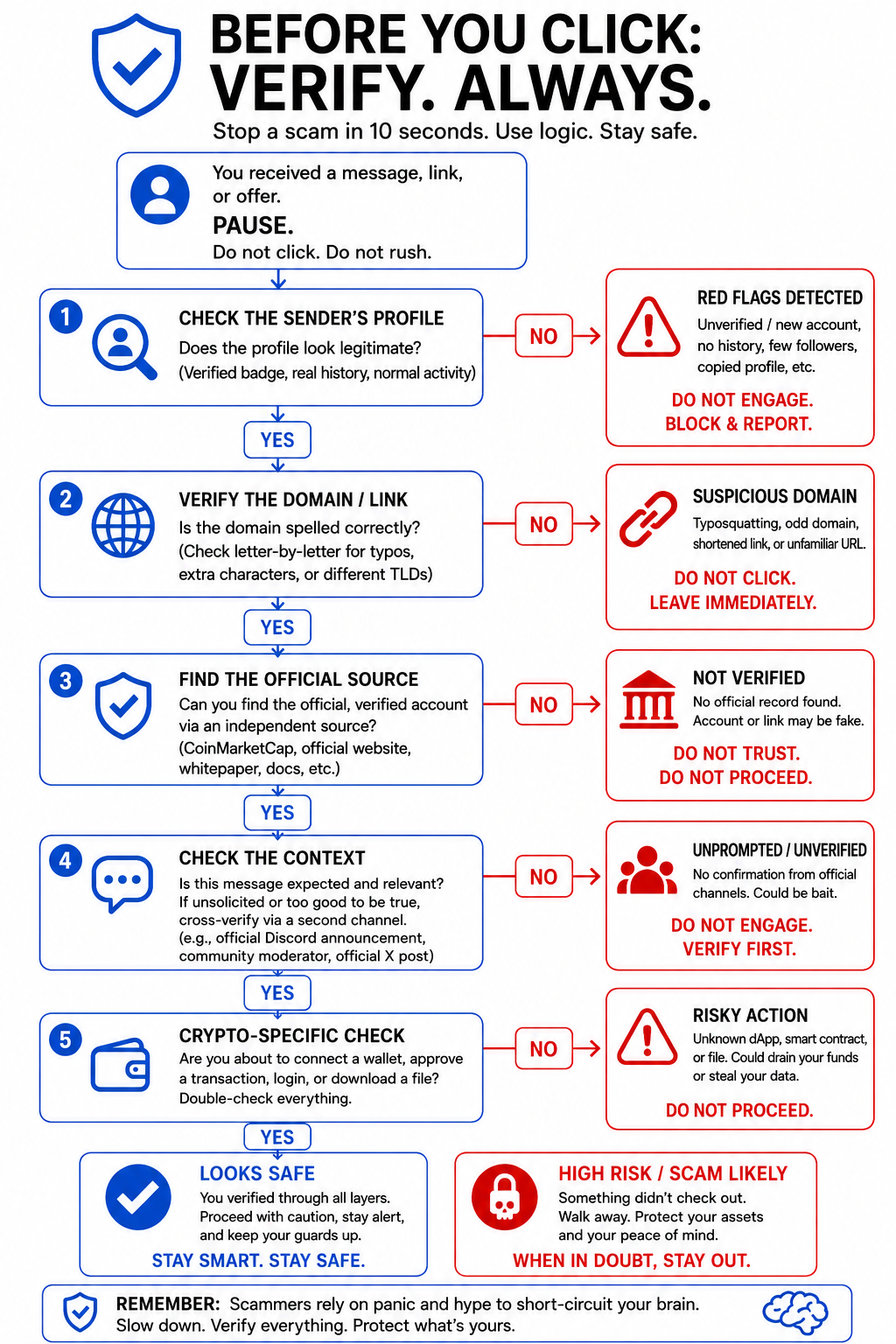
What Should You Check Before Replying, Clicking, or Connecting a Wallet?
Before you touch that mouse or tap your screen, you need to implement a strict verification routine. Never act in a hurry,scammers require panic, for their trick to work. Taking a few minutes to run a logical check is all you need to identify if you should continue or abort.
Checking logic
What Should You Do If You Already Replied, Clicked, or Entered the Page?
If you realise that you have already clicked on the link or entered a suspicious site, do not panic, that is where the scammer wants you. In panic mode. . We’ve all been caught off guard by a sleek trick at least once. What do you need to do?
- Stop the conversation: Drop the conversation immediately without saying a single word, stop typing, and close that sketchy browser tab right now.
- Lock Down Your Accounts: If you entered a password on a fake page, immediately go to the real official site, change your credentials, and force a log-out of all other active sessions.
- Revoke Wallet Permissions: If you interacted with a Web3 smart contract, instantly head to a trusted tool like Revoke.cash to cancel any allowance or approval you just granted.
- Report the fake profile on the platform: block them into oblivion, and submit the malicious link to Google Safe Browsing so the rest of the internet stays safe too.
Conclusion : The Most Useful Rule for Not Falling for It.
Ultimately, on their own, fake profiles and trap links rarely succeed because of complex technology. They succeed because we panic, we act hastily without stoping to think.
I am believing we will like to walk away from this completely scam-proof, let us keep this in mind.
If an account pushes you to trust them quickly, or a page demands that you act before you can verify, that pressure is the only signal you need to slow down.
True professional opportunities, legitimate support teams, and real Web3 projects will never run away from you because you took a few minutes to check their credentials.
Do not fuel their success with panic, Keep your guide up.
Disclaimer: The content provided in this article is for educational and informational purposes only and should not be considered financial or investment advice. Interacting with blockchain, crypto assets, and Web3 applications involves risks, including the potential loss of funds. Venga encourages readers to conduct thorough research and understand the risks before engaging with any crypto assets or blockchain technologies. For more details, please refer to our terms of service.