
Table of Contents
You may have heard that crypto carries risks. However, sometimes the risks are increased not because of bad investments or hacks but due to non-compliance with data security principles. Some details users share online may seem harmless but are in fact highly sensitive. Therefore, it’s necessary to review your digital footprint and understand what screenshots, messages, and account or wallet details should never be published.
Below we’ll look at why protecting your personal information matters, how to handle data securely, and what to avoid to ensure the safety of your crypto assets.
Why Is Sharing Your Information Publicly Dangerous?
Although cases of instant loss of funds due to a single mistake happen, more often a compromise happens when an attacker collects data piece by piece. You might post an email address, username, city, account screenshot, wallet activity, or transaction details.
Together these data points help make phishing or impersonation more convincing and convenient. Attackers combine and stage them to beat verification systems or to trick you into revealing the facts they need. For example, one stolen credential may open email, one email thread may reveal a password, and that password will unlock an option to drain the user’s crypto wallet.
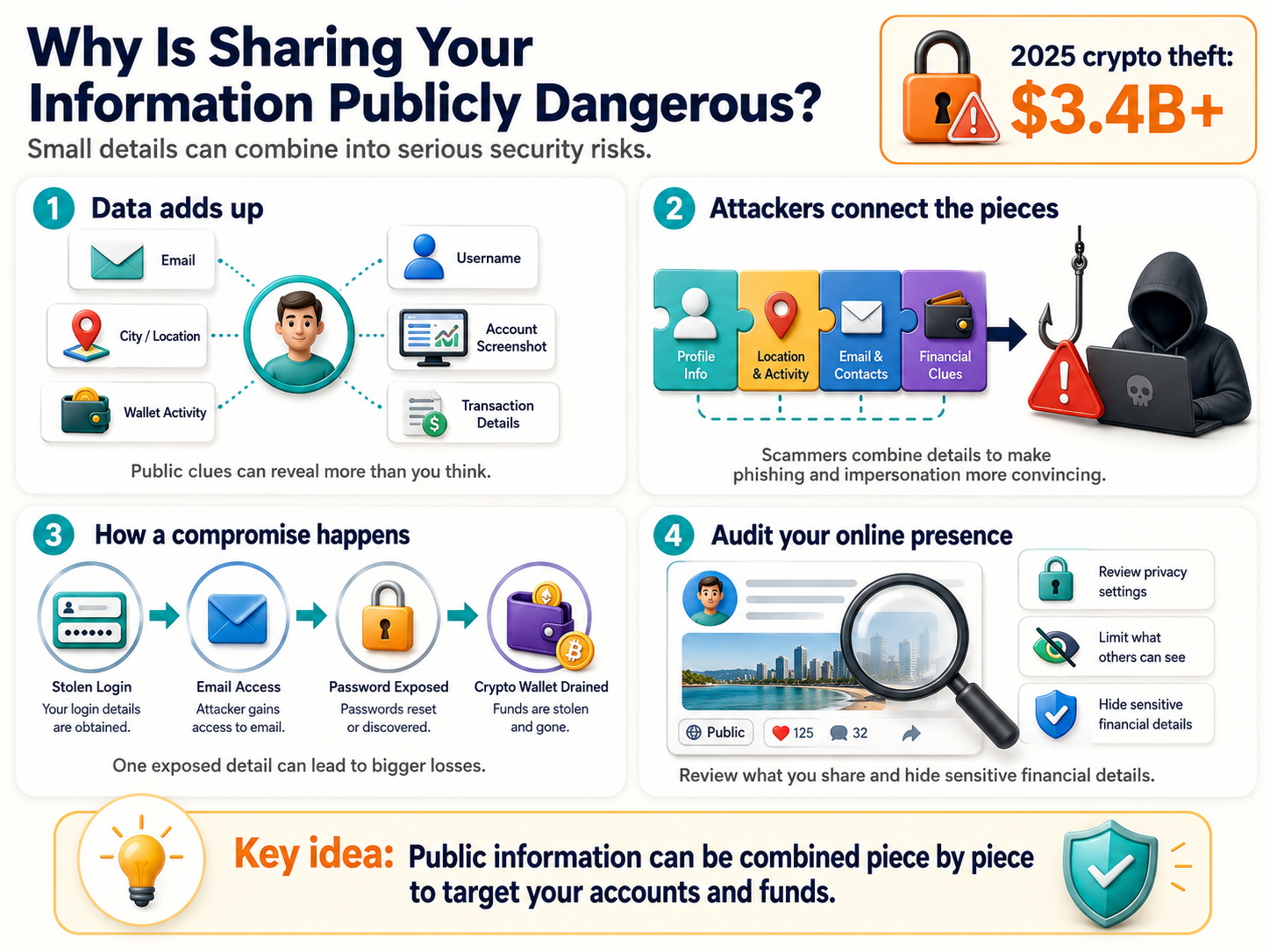
In 2025, crypto theft became more than $3.4 billion. This is why auditing your online presence is important. Let’s discuss what specific data is especially crucial to hide for anyone using digital financial tools.
What Personal Information Should You Never Post?
Any individual data fragments related to you can be combined into a profile. Attackers like DPRK hacking groups spend weeks gathering intelligence on a single target. Importantly, not only exchanges and crypto companies are subject to attacks. The number of personal wallet hack cases has increased to 44% of total stolen value in 2024.
Many trade cryptocurrency anonymously to remove any link to their identity. So, as an individual crypto user, keep your address, phone number, or email related to your financial accounts private. If possible, use a nickname on social media.
Never share your ID, driver’s license, or date of birth. Plus, hide your bank card details and debit card data. If you reveal these, you might become a prime target for the fraudsters. Even partial data can be used to authorize a fake account recovery or cause security issues.
What Wallet or Crypto Details Should Stay Private?
If you are using crypto assets, it’s likely that you have a wallet to store them. It has two keys. A private key is a secret code that allows you to access and manage your holdings. It must be kept secure because anyone who has the private key has control of the assets.
A public key, which is often a wallet address, is not a secret. However, publishing it can help others connect your identity with the on-chain transactions. This makes your financial history visible to everyone.
Hackers operate within long and complicated laundering cycles and move stolen funds through mixing services to obscure the trail. Then, they bridge the assets across different blockchains. If they obtain your private key information, your funds may disappear, and it will be difficult to determine where they went.
Overall, a list of crypto-related things you should never share includes:
- Seed phrases
- Private keys
- Passwords for accounts
- Recovery codes
- 2FA backup codes
- API keys
- Balances and transfer plans
Do not disclose anything that could let hackers log in, reset access, approve a transfer, or somehow negatively influence your wallet activity. Below we explain why these data chunks must remain entirely offline.
Seed Phrases and Private Keys
Your seed phrase that looks like a sequence of 12 or 24 words generated at wallet setup is your key to crypto. Your money is at risk once it is revealed.
In 2023, a Brazilian blockchain gamer lost $60,000 in crypto after revealing his MetaMask private key during a YouTube livestream. The following year, another streamer displayed his seed phrase, which viewers noticed and used to steal $100,000.
Keep your seed phrase offline in a safe place. It must not be sent to support, published, or shown in photos and videos. Many professionals recommend using a physical cold wallet to store your assets securely.
2FA Codes and OTPs
Multi-factor authentication setup codes, long-lived or reusable backup codes, and one-time passwords also must remain entirely private because they are equivalent to full access keys. Any attacker who gets them can bypass the second phone or biometric authentication factor like a fingerprint. They get total and irreversible authority.
Balances and Plans
Sharing your account balances or upcoming transactions, you may inadvertently draw the attention of fraudsters. They can get a chance to plan their attacks more effectively. If you publicly announce a substantial transaction, an attacker can project the timing of your withdrawal and scam you right when you are moving funds.
What Screenshots Are Riskier Than They Look?
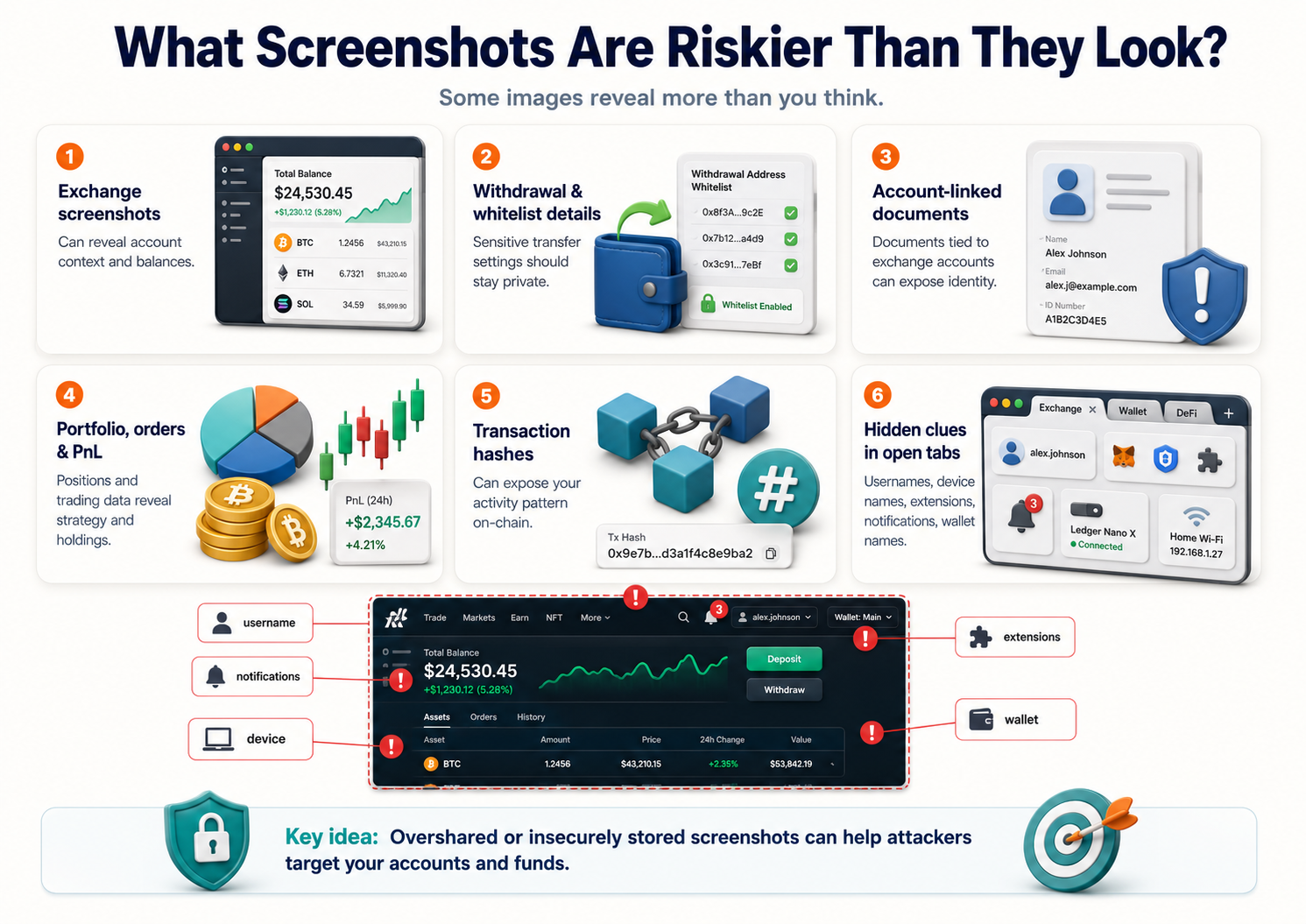
In addition to large balances, you should not publish as images a number of other things, namely:
- Exchange screenshots
- Withdrawal details and whitelist management access
- Documents linked to exchange accounts
- Screenshots of portfolio allocation, open orders, PnL
- Transaction hashes that expose your activity pattern
Screenshots with open tabs can accidentally include a username, device name, browser extensions, notifications, operating system versions, network status, addresses, or wallet names. Most unauthorized crypto withdrawals come from user issues like making this data public or insecure storage.
What Should You Avoid Sharing in Chats, Support Requests, and DMs?
Many common crypto scams are now related to social engineering. In January 2026, a crypto user fell victim to such an attack, handing his seed phrase over to the scammer impersonating Trezor support and losing more than $282 million.
Private messages and support team requests may not be safe. So do not trust texts, emails, or chats that ask for your personal information, passwords, or mobile payments data. Never share signed messages, especially anything that grants access or proves ownership, support tickets, case IDs, or dispute details.
Also, don’t click on a random link someone has sent you and log into your exchange unless you are certain you are on the correct site. Verify whether end-to-end encryption is used in the chat when discussing technical matters and choose topics carefully.
How Can You Share Proof Without Oversharing?
Imagine that your assets have grown in price. Now you want to share a screenshot showing your high wallet balance. Generally, it would be better to avoid this. This makes you a highly visible target. The amount of money taken in the biggest attacks is now 1,000 times greater than what is taken in an average incident. If already shared, it's advisable to delete posts.
However, if you absolutely have to publish an image, look to not only the main screen but also anything else around it and crop or censor it to where no valuable information is visible. Blur emails, phone numbers, notifications. Do not record the screen while a wallet is open.
What to Do Before Posting?
If your privacy boundaries drift, your exposure to threats grows. Often you won’t even notice it. But bringing the data associated with your crypto portfolio back to a completely private state has several advantages. It limits social engineering, reduces wallet clustering, protects your leverage, and improves custody discipline.
If information helps someone gain access, confirm an identity, see assets, or attack an account, it should not be published. So, before any post, screenshot, or message, ask yourself whether this detail could help a stranger cause harm.
Disclaimer: The content provided in this article is for educational and informational purposes only and should not be considered financial or investment advice. Interacting with blockchain, crypto assets, and Web3 applications involves risks, including the potential loss of funds. Venga encourages readers to conduct thorough research and understand the risks before engaging with any crypto assets or blockchain technologies. For more details, please refer to our terms of service.