

Table of Contents
So based on the title we know that stablecoins can be used for remittances, but what exactly are remittances and what are the benefits of using stablecoins for them? Let's find out!
Top Benefits of Stablecoins for Remittances — and the Real Problems to Consider
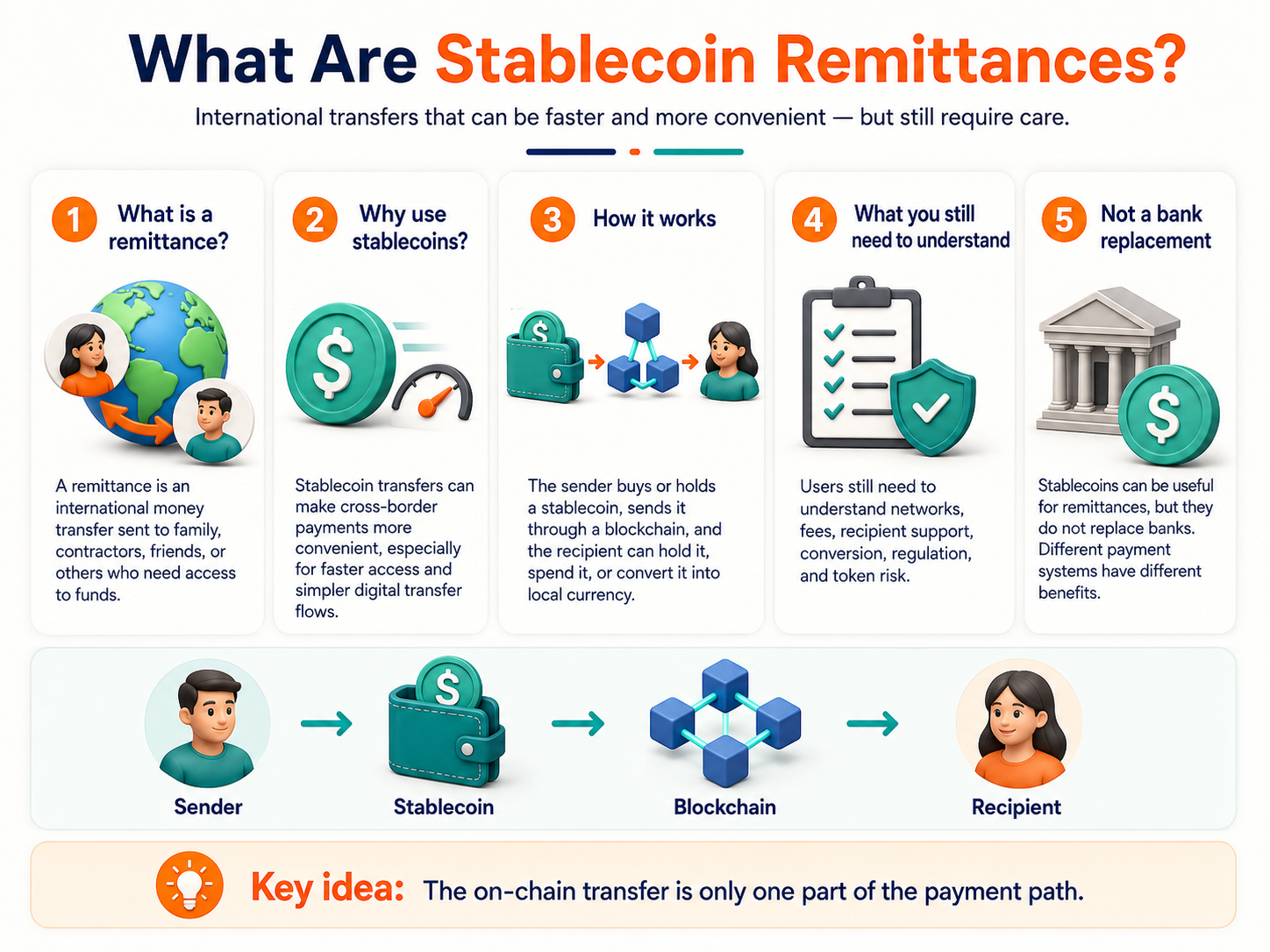
Remittances are international money transfers usually sent to family, contractors, friends, or people who need faster and cheaper access to funds. Stablecoins and stablecoin transactions can make cross-border transfers like remittances more convenient, but they should not be seen as a replacement for banks. With a stablecoin transfer, users still need to understand networks, fees, recipient support, conversion, regulation, and token risk. Just like there is information you need to know for banking remittances, there is information for stablecoin payment remittances as well. Different payment systems have different benefits.
What Are Stablecoin Remittances?
A stablecoin remittance is an international transfer using a stablecoin. The stablecoin is usually pegged to a fiat currency like the U.S. dollar. So how does it work exactly? The sender buys or holds a stablecoin, sends it through a blockchain, and the recipient holds, spends, or converts it into a local currency. However, the on-chain transfer is only one part of the payment path.
Why Are Stablecoins Used for Payments and Remittances?
There are a few main benefits to using stablecoins for remittances. The top benefits of stablecoins for remittances are:Stablecoins can be useful when traditional international transfers are slow, expensive, limited by banking hours, or routed through many intermediaries.
Now you don't need to think about breaking into the bank when it's off hours and you need to send a remittance. Just kidding about the breaking into the bank. You wouldn't do that, would you? But in all seriousness, it's a great benefit that stablecoins allow users to send money whenever they want, even if the bank is closed. Also, if you are looking for speed, stablecoins offer that as well. For cross-border payments, stablecoins offer faster settlement, clearer tracking, and more flexible movement of value.
Faster cross-border transfers
Stablecoins can reduce delivery time. They don't depend on business days, cut-off times and intermediary banks.
What if you want to send cross-border payments on a Saturday? With a traditional bank you would usually need to wait until Monday to start the payment. What if your family member is planning a birthday party and needs the money on Saturday or Sunday, but you can't send the money until Monday? I guess there won't be a clown at this year's birthday party with no money to pay him. The kids will be disappointed. However, with stablecoins, you wouldn't need to wait until Monday to send the payment because blockchains operate 24/7. Problem solved!With stablecoins, the cross-border payment isn't instant in every case, because speed still depends on the network, platform, and withdrawal method, but it is still an improvement from having to plan your cross-border, global payments around business days.
Lower friction and fewer intermediaries
Stablecoin rails can simplify the payment route for remittance companies, international payouts, freelancers, contractors, remote teams etc. There are often way fewer intermediaries with stablecoins. Unfortunately, this does not always mean zero fees, but it's still better with fewer intermediaries and often less headaches. With less intermediaries there are less potential problems than with other systems for sending remittances.
More predictable value than volatile crypto
Stablecoins are more practical for remittances than more volatile crypto assets like BTC and ETH. The sender and recipient need a more predictable amount. Imagine you are sending a remittance and when you send it, it is worth $500 and when the recipient receives it the volatility caused the price of the $500 of BTC to decrease to $450 but the recipient needed exactly $500 for a rent payment or something. This is no good. That is what would likely happen if remittances were sent with BTC or ETH or another volatile cryptocurrency. This is why stablecoins are the way to go for remittances. However, it's important to remember that a stable price does not remove issuer, liquidity, depeg, or network risks. For example, although rare, it is possible for stablecoins to depeg, or lose parity with the fiat currency or other underlying asset they are attached to, ultimately changing the price of the stablecoin slightly.
When Do Stablecoin Remittances Make Sense in Real Life?
Stablecoin remittances make sense when sending money between countries, paying contractors or freelancers, supporting family abroad, moving funds when and where banking access is limited, or using digital dollars in regions or countries with unstable local currencies. Using stablecoins makes the most sense when both the sender and recipient can access, use, or convert them. Not everyone has the access or ability to use or convert stablecoins, so they are not the perfect solution in every single case.
What Problems Do Stablecoin Remittances Not Automatically Solve?
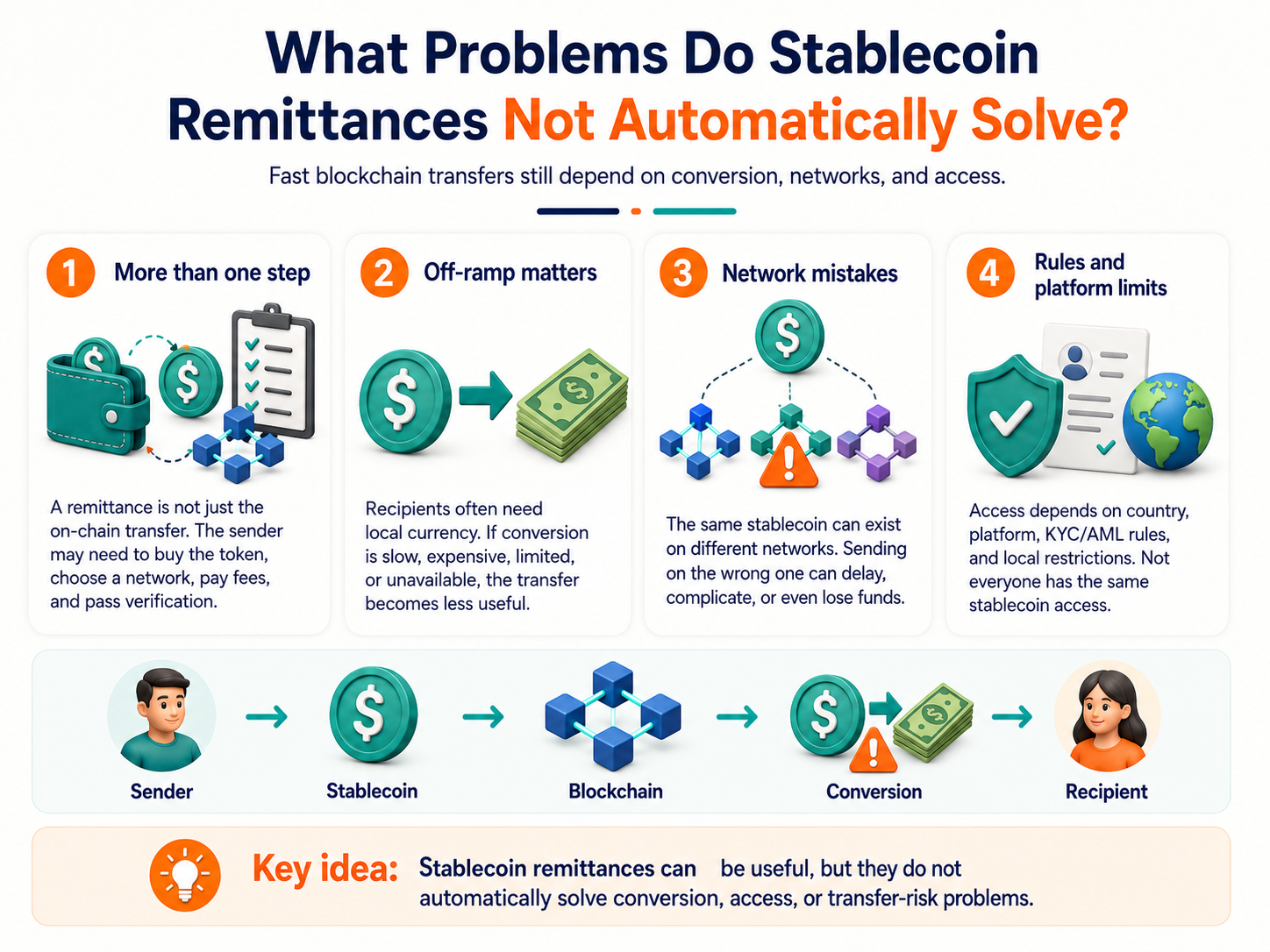
Even though blockchain transfers are usually fast, the complete payment journey can still have complications. The sender may need to buy the token, choose the right network, pay fees, pass verification, and find a way for the recipient to convert funds into local currency. Not everyone can easily convert stablecoins to their local currency.
Off-ramp and local currency conversion
Recipients of remittances often need their local currency, not tokens. If the costs of off-ramp options are too high, slow, limited, or unavailable, the benefit of fast transfers becomes less of a benefit. Sometimes a local currency is the only option for payment, and if off-ramp costs are high or not available, sending a remittance via stablecoins is useless. If they (the recipients) can't use the stablecoins but can't convert them to their local currency then they have nothing to pay for goods and services with.
Network choice and transfer mistakes
The thing about stablecoins is, the same stablecoin can exist on different networks. If the sender uses a network the recipient does not support, the transfer can be delayed, hard to recover, or in some cases even lost. Also, mistakes can be made in the transfer process that can cause the stablecoins to be lost.
Regulation and platform limits
Access to stablecoins and blockchains depends on the country, platform, KYC/AML rules, and local restrictions. Stablecoin infrastructure is global and exists internationally, but user access still depends on their location and the platform they are using. In this case, not everyone has the same access to stablecoins.
How Do Stablecoin Remittances Compare With Traditional Transfers?
Overall, traditional transfers are more familiar, while stablecoins are faster and more flexible in certain situations. Here's a table that shows Traditional Remittances VS. Stablecoins according to different factors. An X means it is usually the better option for that factor.
What Should Users Check Before Sending Stablecoins?
The user, in this case the sender, needs to be aware of the risks involved in sending stablecoins. The recipient should also be aware of these risks. Before sending stablecoins the sender should check the network, recipient support, fees, minimum amounts, conversion route, liquidity, platform limits, and whether a test transaction makes sense. In a lot of cases, it's a good idea to run a test transaction with a low amount of stablecoins to make sure everything works correctly before sending a larger amount. That way, if something is off, you only lose a small amount of stablecoins.
Risks to be aware of include depegging (discussed earlier), issuer risk, wrong network, phishing, wallet compromise, custody risk, and lack of chargeback. Remember, blockchain transactions cannot be reversed so once you send stablecoins, if something is wrong, you can lose your stablecoins forever. Also keep in mind that there are scammers who run phishing and wallet scams, which can cause your wallet to be compromised. In these cases, if you become a victim of a scam the scammers can often gain access to your stablecoins and once they gain access they can steal them. Make sure you are the only one who has access to your stablecoin wallets.
Conclusion: Are Stablecoins a Good Tool for Remittances?
Stablecoins can be useful for remittances when they reduce cost, speed, and complexity. However, this is not always the case depending on things like off-ramp costs etc. Users should evaluate the full route and the risks involved in sending stablecoins. Keep in mind that stablecoins are a payment tool, and do not guarantee a perfect payment experience. If you are trying to choose between using stablecoins for your remittances or a traditional remittance platform or bank and are having difficulties deciding between them, remember there are positives to both of them, take a step back, relax, and take a look at this cute smiling beaver.
Disclaimer: The content provided in this article is for educational and informational purposes only and should not be considered financial or investment advice. Interacting with blockchain, crypto assets, and Web3 applications involves risks, including the potential loss of funds. Venga encourages readers to conduct thorough research and understand the risks before engaging with any crypto assets or blockchain technologies. For more details, please refer to our terms of service.