

Table of Contents
Trying to break crypto down for your friends but get lost in all the tech lingo? You might not be the only one. Crypto can be a scary sounding place.
These "transactions" we are talking about have nothing to do with your card at the store. We are talking about how the blockchain shifts values from one point to another.
With crypto, a transaction is a digital and permanent record of ownership. It updates a massive, globally agreed upon ledger known as a blockchain.
Today, we are going to break down the purpose of crypto transactions and explain the inputs/outputs in simple terms.
What Is a Transaction in Crypto?
Every crypto transaction is basically a digital message. You’re sending a message with a command to the network.

In the message, you are telling the network to change the ownership of some crypto. You are basically telling the network that the crypto is no longer yours and has been transferred to the new address.
Next, the network has to approve the transaction. It’s accepted and added to the blockchain history if it fits all the rules.
Beginners seem to miss this part. Just remember that a crypto transaction is a verified record that everyone in the network has come to an agreement on.
What Are Inputs and Outputs?
Lets dive into more details of how crypto transactions work. There are two main parts to every transaction, inputs and outputs.

In simple terms, an input is the place from where the crypto is being sent. On the other hand, output is the place where the crypto is being sent to.
Let’s use an example everyone can understand because it works well here. Let’s say you only have a $10 bill in your wallet and want to buy a coffee that costs $6. The $10 bill is now your input in crypto terms.
The worker keeps $6 for the coffee and gives $4 back. These are the two outputs. One is the $6 being sent to the coffee shop and the other is the $4 being sent to your wallet.
Why Can One Transaction Have Several Inputs and Outputs?
This is where things can get a little tricky. Regular bank transfers have a straightforward cash flow (one goes in, one goes out, etc.). Crypto transactions are a bit more complex.

Picture this. A concert ticket costs $50. You want one, but have only three $20 bills.
This means you’ll have to pay with all three bills for one ticket. In other words, you have made a transaction with three separate inputs.
On the other hand, a single transaction can be split into multiple outputs to different recipients. An example of this could be a single transaction to pay out all employees in a company.
Remember that this is not weird. The blockchain doesn't only just move one coin from one person to another. It's organizing pieces of value.
What Does a Confirmation Actually Mean?
Confirmations are the network basically saying that the transaction is in its final stages. When someone wants to send a transaction, it is sent out to the network to be confirmed. After, the transaction is added to a block on the blockchain by a validator or a miner.
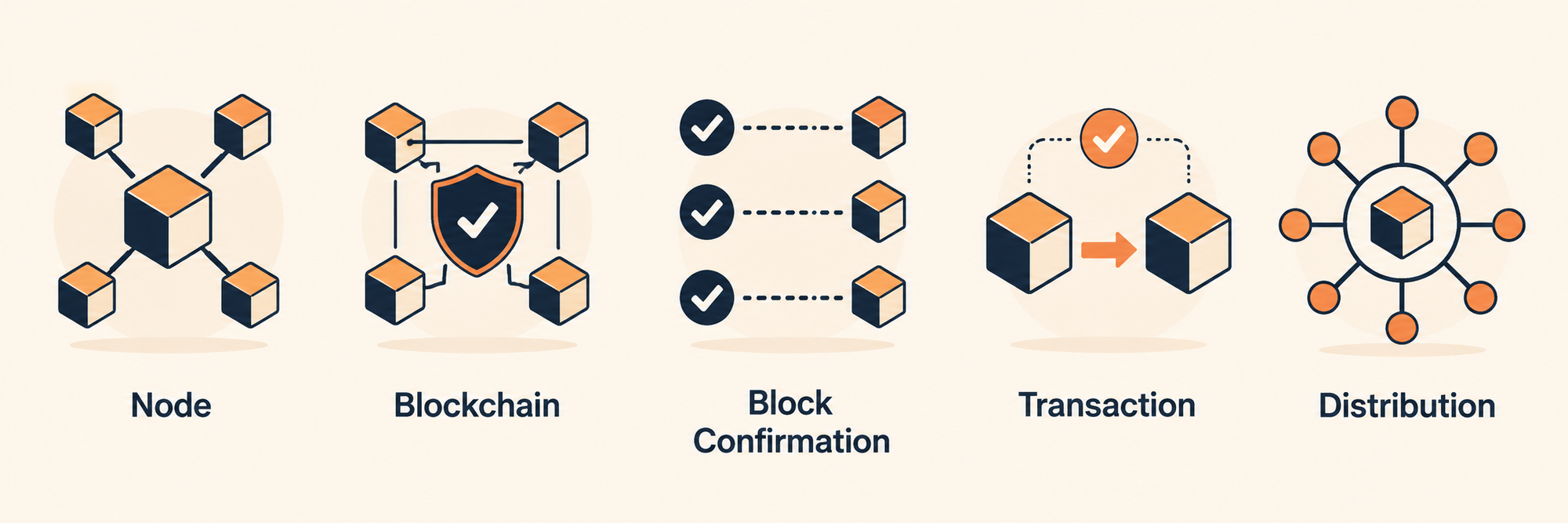
The transaction is confirmed for the first time when the block is added to the chain. For even more confirmation of the transaction, a validator adds another block to the chain after the first confirmation. The transaction is seen as settled the more confirmations it gets.
It is also worth noting that one confirmation might be enough for small payments. Some people think multiple confirmations are best for security when it comes to bigger transactions.
Also remember that different blockchains confirm transactions in different amounts of time. Some finalize transactions in a matter of seconds. Some in a matter of minutes. This could be because of network traffic or the blockchain design itself.
All in all, confirmations are like building a tower with bricks. Your transaction is a brick near the bottom. The more bricks stacked on top, the harder it becomes to remove your brick. Plus, the transaction gets more secured with every other brick that is added.
How Should You Read a Transaction Without Getting Lost?
Blockchain explorers give tons of information without explaining it. Let’s simplify things. Understanding crypto transactions is easy if this is how you think.
Check this three-step checklist to ignore the fluff the next time you see a transaction ID:
Spot the Inputs
This explains where the crypto is coming from and what pieces of value are being spent.
Spot the Outputs
Take a look at the destination where the crypto is going. Note other things too, like will there be change or how much will reach the recipient address.
Check the Confirmations
Next up, look at the status bar or the confirmation count. If it has multiple confirmations added you can rest easy knowing the deal is done.
Just these three steps are all most people need to know about crypto transactions.
Conclusion
In summary, the entire system is very simple under all the complicated addresses and transaction codes. It just means a value transfer in a system with structure.
Inputs show what was spent. Outputs show where the value has been sent. Confirmations show how the network has agreed to the transaction and how safe the transaction is.
The anxiety that blockchain brings starts to go away once you see transactions this way.
Disclaimer: The content provided in this article is for educational and informational purposes only and should not be considered financial or investment advice. Interacting with blockchain, crypto assets, and Web3 applications involves risks, including the potential loss of funds. Venga encourages readers to conduct thorough research and understand the risks before engaging with any crypto assets or blockchain technologies. For more details, please refer to our terms of service.