
Table of Contents
You've got money to invest. Do you put it to work now, or wait for a better moment to get in?
That's the whole debate between time in the market and timing the market, boiled down to one decision most investors face sooner or later.
This is about long-term investing, not short-term trading, whether that's a pension pot, an ISA (Individual Savings Account), or a crypto portfolio meant to be held for years rather than days. Nobody here is chasing next week's swing.
Neither approach removes market risk. That depends on a few things: your goals, how long you're investing for, and the risk you're actually comfortable carrying. It also depends on whether you'll need any of that cash before the picture has time to play out.
Two people turn up at a cold swimming pool. One wades in an inch at a time. The other jumps straight in and gets it over with. Same pool, same eventual soak, just a very different few minutes getting there.
Time in the Market vs Timing the Market: The Core Difference
Before getting into performance, it helps to separate the two ideas properly.
Time in the market is about how long you stay exposed to an asset. Timing the market is about picking the right moments to get in and out.
One approach tries to control duration. The other tries to control entry and exit points. That's the real difference, and it shapes everything else here.
What “Time in the Market” Means
Staying invested means riding out full market cycles rather than jumping in and out as sentiment shifts.
You reinvest returns as they come in, and you accept that short-term drawdowns are part of the path, not a signal to bail. Choosing to stay invested through a rough patch is, in a sense, the whole strategy.
That's different from buying once and never checking whether your portfolio still suits your situation. Staying invested isn't the same as ignoring it completely.
What “Timing the Market” Means
Timing the market means making calls based on a forecast: delaying entry, cutting exposure, or selling and buying back in once conditions look better. It's an active approach, and it demands being right more than once.
A complete market timing strategy needs rules for two separate decisions, not one. You have to know when to exit, and you have to know when to get back in.
Most people who attempt market timing only really plan for the first half.
Why Market Timing Requires Two Correct Decisions
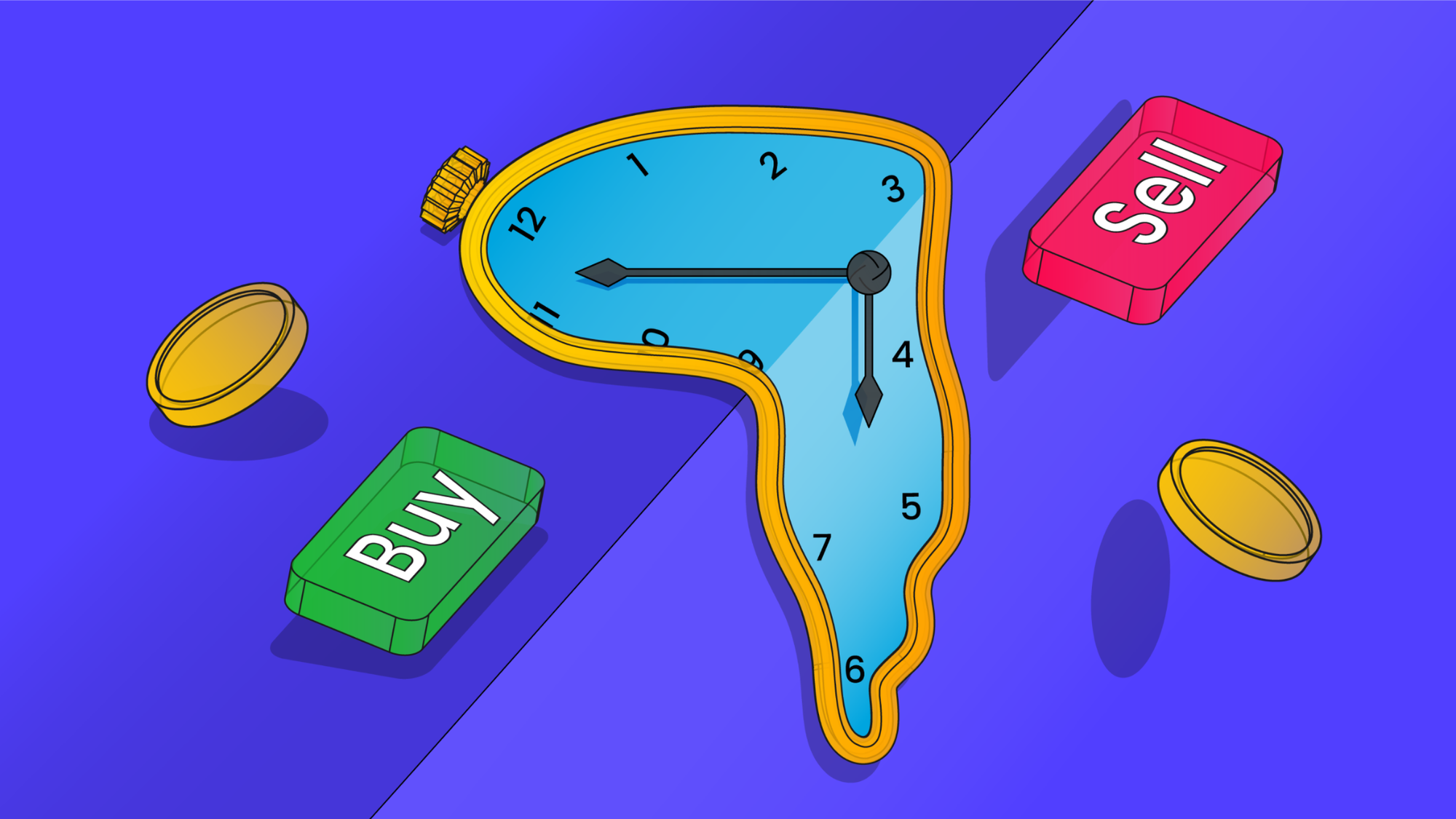
Avoiding a downturn is only half the job. You also need to re-enter before or during the recovery, and that's the part that trips people up.
Fear plays a role here. So does confirmation bias: once you've decided the market's heading lower, it's easy to keep finding reasons that back up that view.
Waiting for certainty is the trap. By the time a recovery feels safe to buy into, a decent chunk of the gains have usually already happened.
Picture how that plays out in practice: someone sells during a sharp drop, tells themselves they'll buy back in “once things settle down,” then watches the market climb for months without ever feeling like the right moment arrived. There usually isn't a clear signal, and by the time one shows up, most of the recovery is behind you.
What Long-Term Market Data Can and Cannot Prove
There's a fair amount of research comparing these two approaches, and it's worth taking seriously, though not as gospel.
Results depend heavily on which asset you're looking at, which period the study covers, what fees and taxes were factored in, and whether dividends or rewards were reinvested along the way.
None of the studies below guarantee anything about future returns. They show what's happened historically, in specific markets, over specific stretches of time.
One well-known example comes from Schwab's research team, comparing five hypothetical investors who each put the same amount into the market every year for two decades. The first had perfect timing, always buying at the year's lowest point. A second didn't try to time anything at all, simply buying on the first trading day of each year. Someone else spread contributions evenly across the year instead, a form of dollar-cost averaging, while another had consistently poor timing, buying at the year's peak every time. The last participant never invested a penny, holding cash throughout.
The perfect timer came out ahead, unsurprisingly. What's more interesting is how close second place was: the investor with no forecasting involved, who simply bought straight away each year, finished only a little behind. Even the investor with consistently poor timing beat the one who stayed in cash, by a wide margin. Sitting out entirely was the worst outcome of the five, by some distance.
The Cost of Missing the Best Days
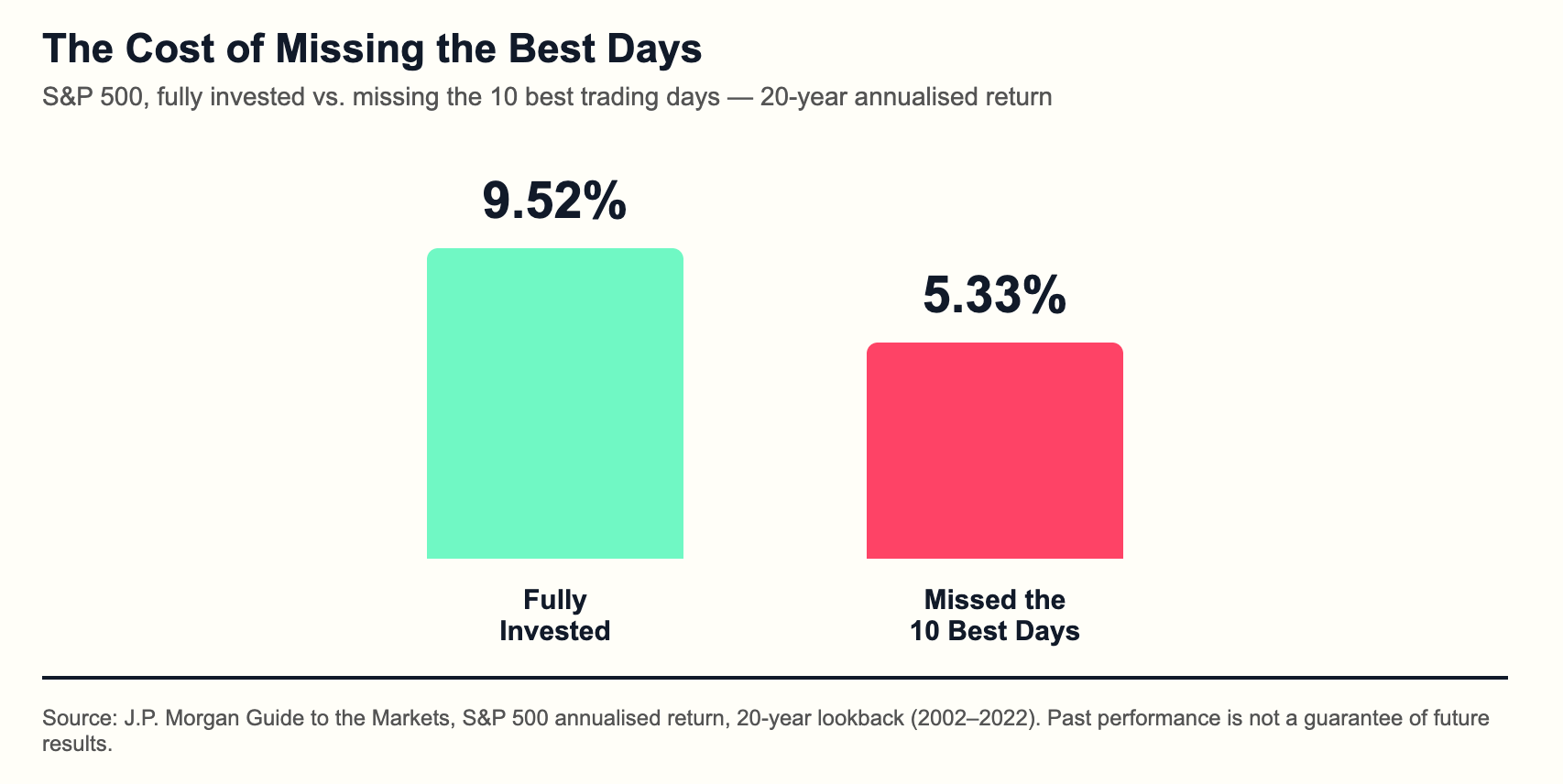
J.P. Morgan has tracked this for decades using the S&P 500, and the numbers are hard to ignore. Miss just the ten best trading days across a 20-year stretch, and the annualised return an investor earns by staying fully invested is roughly cut in half.
It sounds counterintuitive, but a small number of days can carry most of the long-term gain. Worse, the best and worst days tend to show up close together, often within a couple of weeks of each other.
This is the practical problem with timing markets: fear drives the sell decision, and confidence to buy back in rarely returns before the rebound has already happened. The best days, more often than not, arrive while everyone's still too nervous to act.
How Compounding Rewards Time
Returns can earn returns of their own, not just grow on the amount you originally put in. That's compounding, and it's a big part of why staying invested pays off over time.
Put £100 to work at a steady 8% a year and reinvest every year's return. After two decades, that pot is meaningfully bigger than what the same 8% would produce if calculated only on the original £100 each year, since every year's gain starts adding to the next year's base. Real markets, of course, never move in such a straight line. Treat the 8% purely as an illustration, not a forecast.
Time is the one ingredient compounding can't do without. Money that sits in the market longer simply gets more chances for that effect to build on itself. It's a solid reason on its own to stay invested rather than parking cash on the side, waiting for a better moment to arrive.
Why a Longer Horizon Changes the View of Volatility
Daily price swings look chaotic. Zoom out to a multi-year view, and a lot of that noise smooths itself out.
Look at the S&P 500 across different holding periods and a pattern shows up fast: roughly half of single days close positive. Over any 12-month window, that figure climbs to around four in five. Push out to a full multi-year business cycle and positive outcomes turn from likely into close to certain. What gets lost along the way is a lot of the market volatility that fills daily headlines: it simply stops being relevant at this scale.
More time in the market tends to help you ride out a drawdown, even a bad one. It can't make a concentrated position or an actually failing asset safe, though. Time doesn't fix bad diversification.
Lump Sum, DCA or Waiting in Cash?
Maybe you've just received a windfall. Maybe you're investing steadily out of monthly income instead. Either way, which approach actually fits?
Here's a quick comparison of the three main options.
When Lump-Sum Investing Matches the Logic of Time in the Market
Putting the full amount to work immediately gives your capital the maximum possible time in the market. That's the entire logic behind lump-sum investing.
There's a real risk of regret here too. Prices might drop right after you invest, and even a perfectly reasonable decision can suddenly feel like a bad one.
When Dollar-Cost Averaging Can Be a Behavioural Compromise
Dollar-cost averaging (DCA) works differently: instead of committing everything in one go, you invest a fixed amount at set intervals, whatever the market's doing at the time.
The appeal is discipline. You're not trying to pick a moment, you're just showing up on a schedule, which suits anyone who'd otherwise freeze or keep putting it off.
The cost is opportunity: if markets rise steadily while you're deploying, you'll pay a higher average price than if you'd invested the lump sum on day one. DCA doesn't guarantee a lower average cost. It's a smoothing tool, not a pricing edge.
When Holding Cash Is a Financial Need, Not Market Timing
There's a real difference between waiting for a better entry point and simply needing liquid cash.
Emergency funds, near-term spending, and money earmarked for something specific in the next year or two belong in cash, regardless of what the market's doing. That's not market timing. That's just planning.
Does the Same Logic Apply to Crypto?
Mostly, yes, with a few differences worth naming directly.
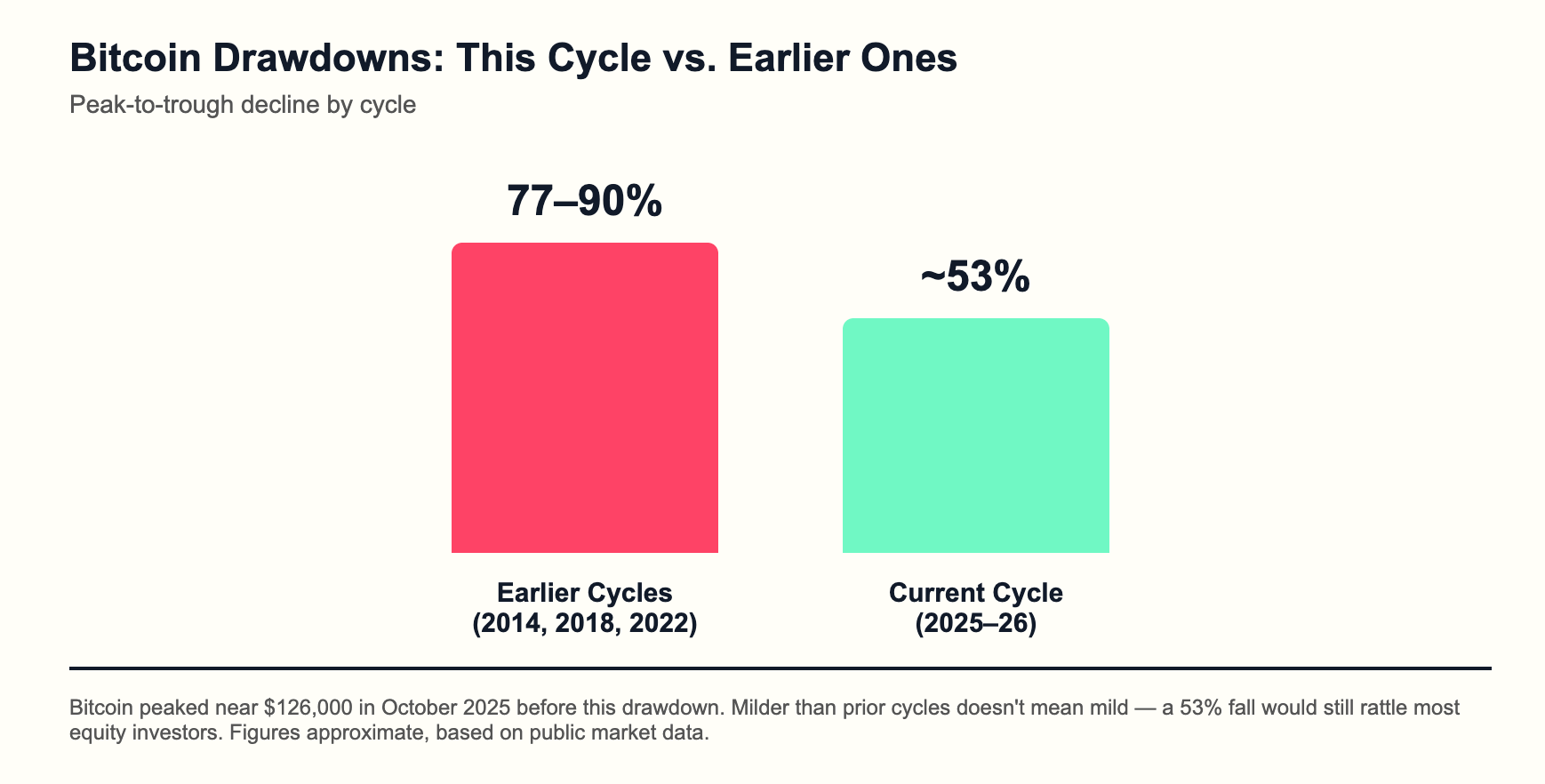
Crypto simply hasn't been around long enough to have equities' track record, and the swings are bigger in both directions. Bitcoin is a good example. It peaked near $126,000 in October 2025 and had more than halved within months. Compare that with earlier cycles, where peak-to-trough crashes ran from 77 to 90%, and this drawdown actually counts as one of the milder ones. Comparatively mild is still a swing that would rattle most equity investors.
There's also protocol risk and custody risk layered on top of ordinary market volatility, plus a real chance that any individual token simply never recovers. A diversified stock index and a single speculative token aren't playing by the same rules.
Staying invested in a broad, established asset over a long horizon is one thing. Holding one small-cap token and hoping time sorts it out is a different bet entirely, even if both get described the same way.
Time in the market still applies to crypto in principle, but it asks more of you upfront: understanding what you actually hold, and being honest that a handful of tokens from any given cycle simply won't be around for the next one.
A Decision Framework Without Predicting the Next Move
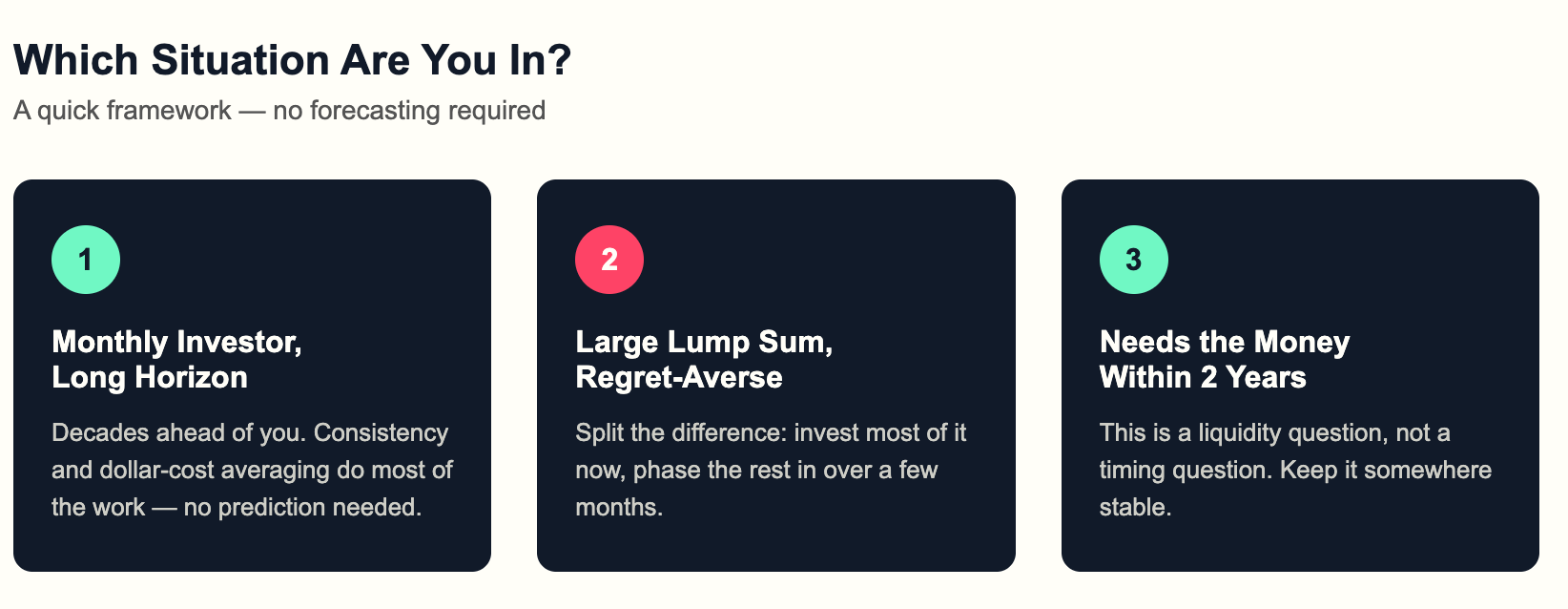
Rather than a generic checklist, here are three situations that map onto real decisions.
A monthly investor with decades ahead of them doesn't need to predict anything. Consistency and time do most of the work, and dollar-cost averaging suits the rhythm of a paycheque anyway. For this kind of long-term investing, the investment strategy is really just “keep showing up.”
Someone deploying a large lump sum who's worried about regret might split the difference: invest most of it now, phase in the rest over a few months. It won't optimise returns, but for long-term investing, an approach you can actually stick with often matters more than one that's theoretically perfect.
Someone who needs the money within two years shouldn't be asking about market timing at all. That's a liquidity question, not an investment strategy question, and the honest move is to keep it somewhere stable. Timing the market only makes sense as a question once the money is actually meant for the long haul.
Conclusion
Time in the market relies on duration and compounding. Timing the market relies on repeated forecasting, done correctly, twice, over and over.
Staying invested doesn't remove the need for judgement elsewhere. Asset quality, diversification, costs, and how much risk you can actually carry still matter just as much as how long you stay in.
Consistency tends to reduce the kind of behavioural mistakes that cost real money. That's not a promise about returns. It's simply a more honest way to think about the decision, and a decent reason on its own to stay invested rather than wait for a signal that may never come.
Disclaimer: The content provided in this article is for educational and informational purposes only and should not be considered financial or investment advice. Interacting with blockchain, crypto assets, and Web3 applications involves risks, including the potential loss of funds. Venga encourages readers to conduct thorough research and understand the risks before engaging with any crypto assets or blockchain technologies. For more details, please refer to our terms of service.