
Table of Contents
A Smart contract is a computer program stored on a blockchain that automatically carries out an agreement when certain conditions are met.
Smart contract risk is the possibility that vulnerabilities in a protocol’s code, permissions, or underlying logic could lead to an unexpected loss of funds.
We would set a realistic expectation which is: average users cannot replicate a full, expert-level code audit.
However, you do not need to be a senior smart contract auditor to protect your assets. By knowing where to look, you can verify key technical evidence, spot hidden control points, and significantly reduce your exposure to avoidable risk.

Smart Contract Risk Is Broader Than a Coding Bug
Having a flawless code is only one piece of the puzzle. A perfectly written function can still fail if it relies on a weak economic setup, a manipulated price feed, or an admin with too much power.
Full security will depend more than in just a perfect code, it will need the whole system to hold up together.
Implementation Bugs and Unexpected Contract Behaviour
Sometimes, the code itself may have bugs, like accounting errors or missed edge cases. Take a reentrancy attack. Imagine an ATM that gives you cash before updating your account balance. If you could hit "withdraw" fast enough, you could drain the machine before it registers the first transaction. Smart contracts can get tricked the exact same way.
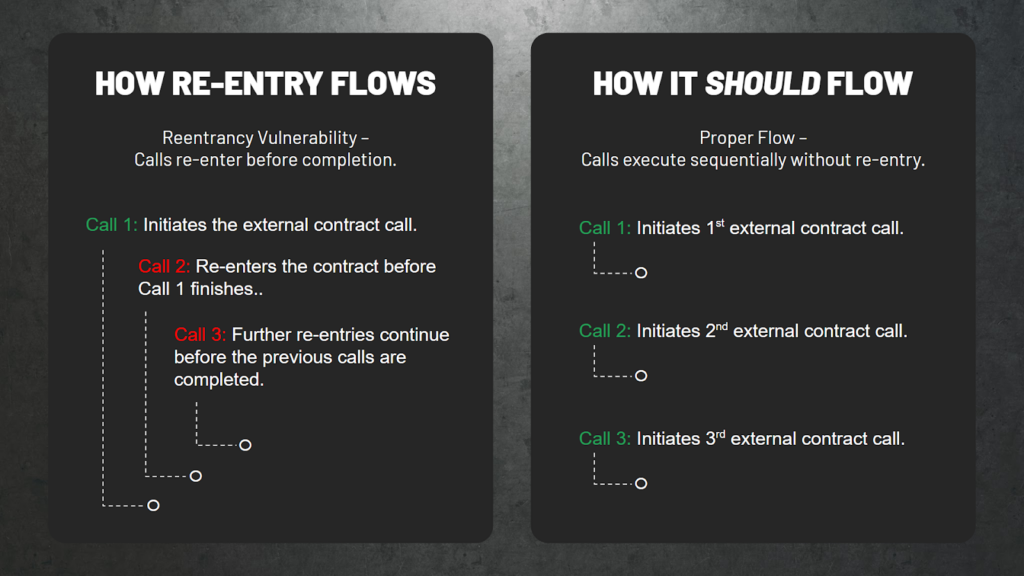
Reentrancy attack execution flow. Source: Ledger Academy
Economic Design and Incentive Failures
A DeFi protocol can execute its code exactly as designed and still suffer a major loss. The problem may not be a coding error, but a weakness in the protocol’s economic design.
For example, if a lending platform depends on a low-liquidity market to determine an asset’s price, an attacker may temporarily manipulate that price, use the inflated value as collateral, and borrow more than the asset is actually worth. The smart contract follows its rules correctly, the rules themselves were simply vulnerable to manipulation and that's what happened.
Privileged Access and Governance Decisions
Most protocols have admin controls to pause the system in emergencies or upgrade code. While these are great for stopping hacks, they are also central points of failure. If one person holds the keys or if there is no delay (timelock) on major changes a compromised admin can easily run off with the funds.
Dependencies Outside the Main Contract
DeFi is highly connected. Your deposit likely relies on price oracles, web front-ends, cross-chain bridges, and other integrated tokens. To gauge your risk, imagine a dependency map. You start with your deposit and trace every service, bridge, and oracle your money touches. If any single link in that chain breaks, your funds are at risk.
What a Smart Contract Audit Actually Tells You
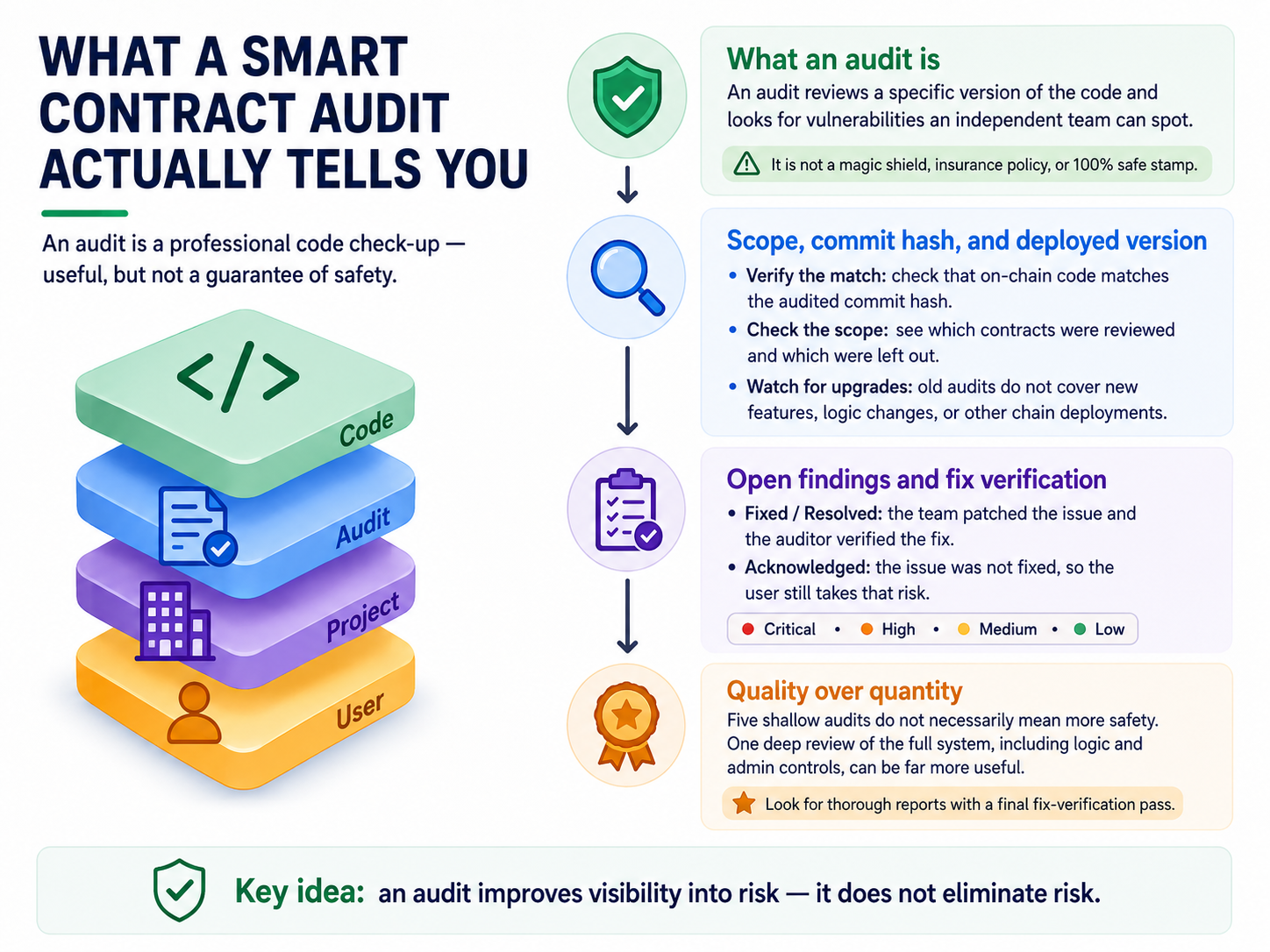
A smart contract audit is basically a professional code check-up. but don’t get too comfortable. It reviews a specific version of the code and looks for vulnerabilities an independent team can spot.
But an audit is not a magic shield, an insurance policy, or a “100% safe” stamp and you relax afterwards. The code can still change, new vulnerabilities can appear, and yes, things can still go very wrong.
Here is how to quickly read an audit report:
Scope, Commit Hash, and Deployed Version
An audit only covers a specific part of a code, identified by its git commit hash.
- Verify the match: Ensure the on-chain code matches the audited commit hash.
- Check the scope: Look at which contracts were actually reviewed and which were left out.
- Watch for upgrades: An old audit does not cover new features, logic upgrades, or deployments on different chains.
Open Findings and Fix Verification
Auditors label findings by severity (Critical, High, Medium, Low). The total number of bugs found is less important than how the team handled them:
- Fixed/Resolved: The team patched the code and the auditor verified the fix.
- Acknowledged: The team chose not to fix the issue, accepting the risk instead. These unresolved items are risks you take on as a user.
Quality Over Quantity
Don't be fooled by projects claiming 5+ Audits. Three surface-level checks on a simple token contract mean far less than one deep review covering the entire system's logic and admin controls. Always look for thorough reports with a final fix-verification pass.
A User-Level Evidence Trail for Evaluating a Protocol
Investigating a DeFi protocol goes way beyond proving code is 100% bug-free. It is gathering clear evidence from identity down to exit mechanics so you can spot avoidable risks.
Consider the following steps:
Confirm Domain, Network, and Contract Addresses
Phishing sites and spoofed tokens have accounted for huge losses in crypto. Connecting your wallet to a fake front-end or interacting with a look-alike contract yields the exact same outcome as a smart contract exploit: lost funds.
You can cross-check official contract addresses across multiple independent platforms (such as reputable block explorers, major token tracking sites, and official documentation).
However, verifying the domain and address only confirms you are talking to the real protocol. It tells you nothing about whether the code behind that address is actually secure.
Check Age, Usage, and Incident History in Context
Time in production and capital volume are strong real-world test signals, but they are double-edged swords also.
You can view total value locked (TVL), daily active transactions, how long contracts have run on-chain, and public records of past exploits or post-mortems.
But high TVL proves capital trusts the platform, but it also makes the protocol a lucrative target for attackers. Long operational history reduces the chance of simple bugs, but it does not protect against new upgrades, shifting market conditions, or subtle edge cases.
Read Audits, Bug Bounties, and Security Disclosures Together
No single security document tells the whole story nor gives you the complete view. They work best as a complete picture. Audits provide a static review, bug bounties offer continuous incentives for researchers, and past incident reports reveal how well the team handles pressure.
Map Upgradeability, Admin Keys, and Emergency Powers
Understanding who controls the protocol logic helps us evaluate counterparty and centralization risk.
You can check on-chain whether contract controls belong to a multisig (and its signer threshold), whether changes require a timelock delay, and if emergency pause features exist.
Timelocks give you time to exit, and multisigs distribute key custody, but neither guarantees safety. You cannot know if multisig signers are secretly controlled by the same entity or if governance will vote against user interests during a crisis.
Understand Withdrawal and Failure Procedures
Before depositing, you need to know how you get out if things go wrong.
You can review contract rules for emergency withdrawal functions, check if pausing locks user funds or only halts new deposits, and inspect treasury reserves or formal insurance coverage.
However,promises of "treasury bailouts" or protocol insurance pools are rarely legally binding. You cannot know if a treasury will hold enough liquid funds to cover a major loss or if governance will actually vote to make affected users whole.
Three Failure Paths a Non-Auditor Can Understand
You don't need to read line-by-line Solidity code to see how a protocol can fail. By tracing a few straightforward scenarios, you can easily connect the technical evidence like audits, price feeds, and timelocks to real-world risks.
An Upgrade Introduces a New Vulnerability
Let's imagine that a protocol has been operating safely for months. The team decides to release a performance update. Admin keys trigger an instant code upgrade without a delay.
However, the new code contains a fresh logic flaw that wasn't covered by the original audit. Within hours, an automated bot detects the flaw, drains the vault, and forces the team to emergency-pause all remaining withdrawals.
This is why version-specific audits and timelocks are so critical. If the protocol enforces a 72-hour timelock on upgrades, you have a 3-day window to review the proposed code changes (or simply withdraw your funds) before the un-audited update goes live.
An Oracle Error Triggers Bad Liquidations
To better understand this point lets say a user deposits $10,000 worth of collateral into a lending protocol to borrow $5,000 in stablecoins. The lending contract's code is mathematically flawless.
However, it relies on a price feed that gets its data from a low-liquidity exchange.
A large, temporary sell order on that exchange causes the oracle to briefly report that the collateral value dropped to $4,000. The protocol's automated liquidation engine instantly sells off the user's healthy collateral at a massive discount. Now that was a faulty feed.
Perfectly written lending logic cannot compensate for a faulty data feed. Checking whether a protocol uses decentralized, multi-source price oracles helps ensure your position won't get wiped out by a temporary pricing glitch on a single exchange.
A Composed Strategy Inherits External Failure
Another good example to explain this would be, a yield vault promises automated returns on stablecoin deposits. The vault code itself is simple, well-audited, and clean.
To generate yield, however, the vault automatically deposits your funds into a secondary lending market, which then routes the collateral into a third-party liquidity pool.
Then a vulnerability is exploited in that third-party liquidity pool. The loss cascades backward through the chain, leaving the top-level yield vault holding empty receipts.
In DeFi, you are exposed to the weakest link in the chain. An audit on the top-layer vault contract only covers the vault itself, it cannot protect your capital if the underlying protocols it plugs into collapse. You should always trace where your money actually goes.
Risk reduction or Staying Safe After You Deposit
Even after you've checked the audits and mapped out the risks, your job isn't quite finished. Real-world security is just as much about how you interact with the protocol as it is about the protocol's code.
Smart operational habits act like wearing a seatbelt: they reduce your exposure and protect you in a crash, but they can't turn unsafe code into safe code.
Here is how to minimize risk once you are ready to make a move.
Practice Proper Position Sizing
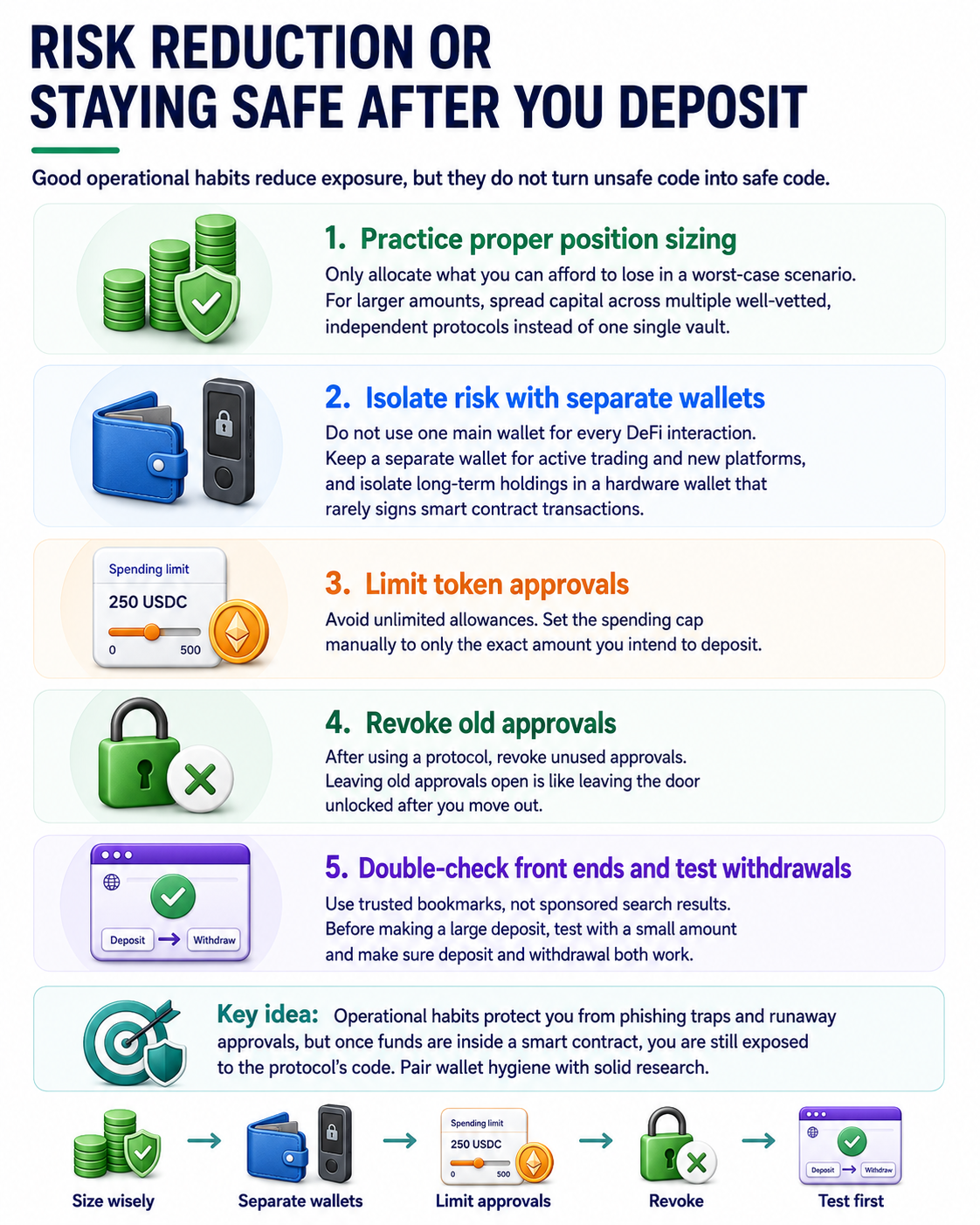
The simplest defense against protocol risk is controlling how much capital you put on the line. Never allocate more than you can comfortably afford to lose in a worst-case scenario.
If you want to deploy a large amount of capital, consider spreading it across multiple well-vetted, independent protocols rather than concentrating everything in a single vault.
Isolate Risk with Separate Wallets
Using one main wallet for every DeFi interaction exposes you to great danger. If you sign a malicious transaction or approve a compromised contract, your entire portfolio can be swept clean.
The smart move will be to keep a separate wallet with just enough funds for active trading and trying new platforms and another wallet for long-term holdings isolated on a hardware wallet that rarely signs smart contract transactions.
Limit and Revoke Token Approvals
When you interact with a DeFi protocol, it typically asks for permission to spend tokens from your wallet. Many app interfaces default to requesting an unlimited token allowance for convenience. Avoid them.
Instead, manually adjust the spending cap to match only the exact amount you intend to deposit.
Also, Once you're done using a protocol, use an allowance-revocation tool to lock the door behind you. Leaving open approvals on old contracts is like leaving your door unlocked after you move out, anyone can come in.
Double-Check Front Ends and Test Withdrawals
Exploits may not always happen on-chain. Attackers frequently hijack website domains or create fake look-alike front ends to steal funds.
Always access protocols via trusted bookmarks, never via sponsored search results. Before throwing in a big deposit, try a quick test drive. Deposit a small amount, let's say $5, hit withdraw, and make sure the exit hatch actually works.
It is also good to note that operational habits protect you from phishing traps and runaway approvals, but once your funds are inside a smart contract, you are at the mercy of its code.
Pair smart wallet hygiene with solid research, and you’ll navigate DeFi with way more confidence.
How to Interpret Red Flags Without Creating a Fake Score
It is simple to rate a protocol and say I give it a 7/10 safety rating but security doesn't work that way. A protocol can pass nine out of ten checks with flying colors, but if its single failure point is an unchecked admin key or an easily manipulated price feed, it can still be drained instantly.
Instead of relying on arbitrary scores, treat red flags as specific questions you need answered before depositing capital.
Conclusion
In short, smart risk does not end only in code bugs. It is a mix of code quality, who holds the admin keys, economic design, and outside connections.
You don't need to be a software auditor to protect your wallet. If you look for basic evidence, checking who controls the platform, and testing your exit path first, you can easily steer clear of the biggest traps.
No protocol is ever 100% risk-free, but asking these simple questions keeps you miles ahead of the crowd.
Disclaimer: The content provided in this article is for educational and informational purposes only and should not be considered financial or investment advice. Interacting with blockchain, crypto assets, and Web3 applications involves risks, including the potential loss of funds. Venga encourages readers to conduct thorough research and understand the risks before engaging with any crypto assets or blockchain technologies. For more details, please refer to our terms of service.