

Table of Contents
So what is liquid staking and what makes it different from native staking? Native staking can make assets unavailable while they secure a network. A liquid staking protocol issues a transferable token representing a claim on staked assets and rewards, but the token adds new dependencies. Liquid staking improves asset mobility, but it introduces dependencies that do not exist in native staking. Nobody likes to have something or someone dependent on them do they? Or maybe they do. Anyway, liquid staking has benefits but the drawback is the dependencies.
What Problem Did Liquid Staking Solve?
Liquid staking solved the problem of illiquidity and capital inefficiency in Proof-of-Stake blockchains by letting users trade or use a tokenized representation of their staked assets instead of leaving them frozen. As far as lockups are concerned, traditional staking requires coins to stay frozen for a long time while with liquid staking you can get a tradeable token immediately. Also, liquid staking lets you pool small amounts of money, doing away with high minimum coin amounts previously associated with staking.
Liquid staking also reduces the opportunity cost of staking by allowing you to take advantage of new opportunities. Finally, having a tradable receipt token made staked capital usable in in wallets, DEXs and lending protocols whereas previously this was not possible. However, it is important to keep in mind that liquidity is not guaranteed in every market condition.
How Liquid Staking Works Step by Step
Here is a diagram of how liquid staking actually works, step by step.
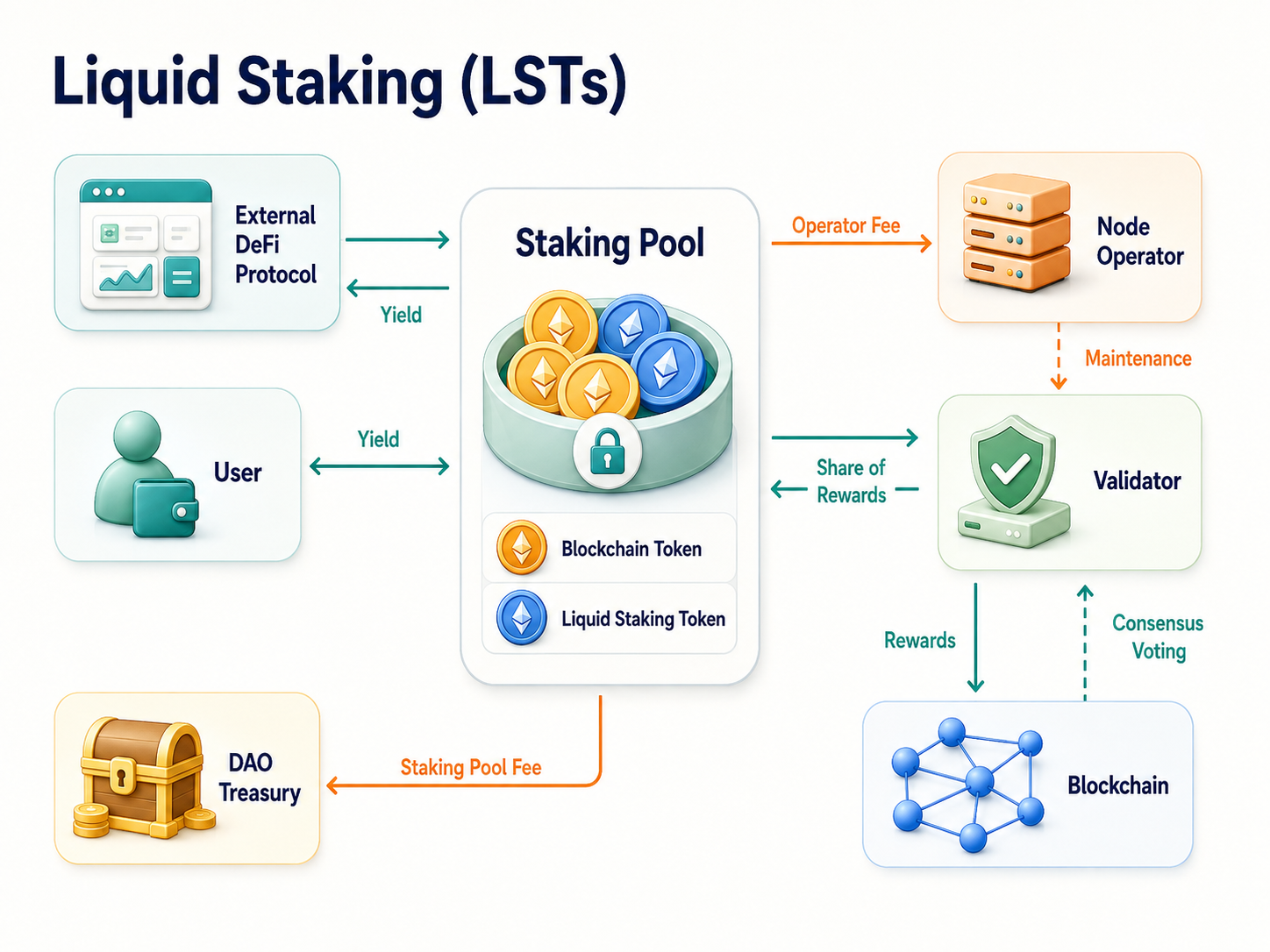
In simple terms the process goes like this:user -> staking protocol -> validators -> LST -> DeFi market -> redemption.
1. Depositing the Base Asset
The user deposits assets into a protocol that manages staking on behalf of participants. The assets are then delegated to validators and contribute to network security similar to native staking.
2. Receiving a Liquid Staking Token
Next the user receives an LST. An LST is not the original asset; it is a tokenised claim whose design and redemption rules are protocol-specific.
3. Accruing Rewards
The mechanic decides the accounting model. There are two different kinds. A rebasing LST gains more units over time. A value-accruing LST or reward-bearing token keeps units stable while its value or exchange rate rises. A Liquid Staking Token (LST) is received when staking through a liquid staking protocol.
4. Trading or Redeeming the LST
Selling a Liquid Staking Token (LST) on a secondary market allows an instant trade at market prices. Redeeming it through the protocol exchanges it at a fixed Net Asset Value (NAV) rate but requires the user to wait for a withdrawal period to be concluded.
Liquid Staking vs Native and Delegated Staking
Why Liquid Staking Changed the Market
Liquid staking allows users to earn rewards without locking their assets and continue to earn rather than having to wait for a lock-up period to end. Users receive liquid tokens that can be used across DeFi, allowing everyone to continue to use their tokens and maintain liquidity. Lock-up periods keep people temporarily unable to take part in the market, but liquid staking changed that, making a positive contribution to Decentralized Finance (DeFi). Everyone stays happy and active in the market! Yay!
Capital Efficiency and DeFi Collateral
An LST can continue reflecting staking rewards while being used as collateral or liquidity elsewhere. This means users can do more to contribute to the DeFi space and market and almost be in more than one place at a time, doing more than one thing. It's like magic, but not exactly. However, it's important to keep in mind that the second use creates a second layer of risk rather than a free duplicate return.
Lower Entry Barriers and Validator Aggregation
Pooled participation allows users to combine their staking resources to participate in the staking process together as a group. It's a great way for people new to DeFi to get involved with staking, creating a lower barrier to entry with a sort of team atmosphere. It's like how you don't want to play a sport like basketball all by yourself. So you join forces with other people to make the process more inviting and fun.
Professional validator operations involve a process where instead of regular users managing hardware, professionals manage it and deal with the technical tasks. Instead of each participant running a validator users contribute their tokens to a shared pool operated by a validator. The rewards from the validator are distributed among participants according to how much cryptocurrency they contributed. This process makes it easier for people to enter the market because they don't have to know how to manage hardware. They can leave that to the professionals and simply join a pool.
A New Source of Systemic Dependence
Lending markets, DEX pools and leveraged strategies can all depend on the same LST, making a depeg or contract incident spread beyond the staking protocol. This is possible in liquid staking because each platform can use the liquid staking token in different ways. However, this can make a depeg spread, adding a degree of risk.
Where the Yield Comes From
The yield comes from base network rewards, protocol fees and external DeFi incentives. It's important to use a simple yield stack and not add quoted APYs without checking whether rewards overlap or require leverage. Some rewards require leverage with you might not want to get yourself involved with due to the potential risks.
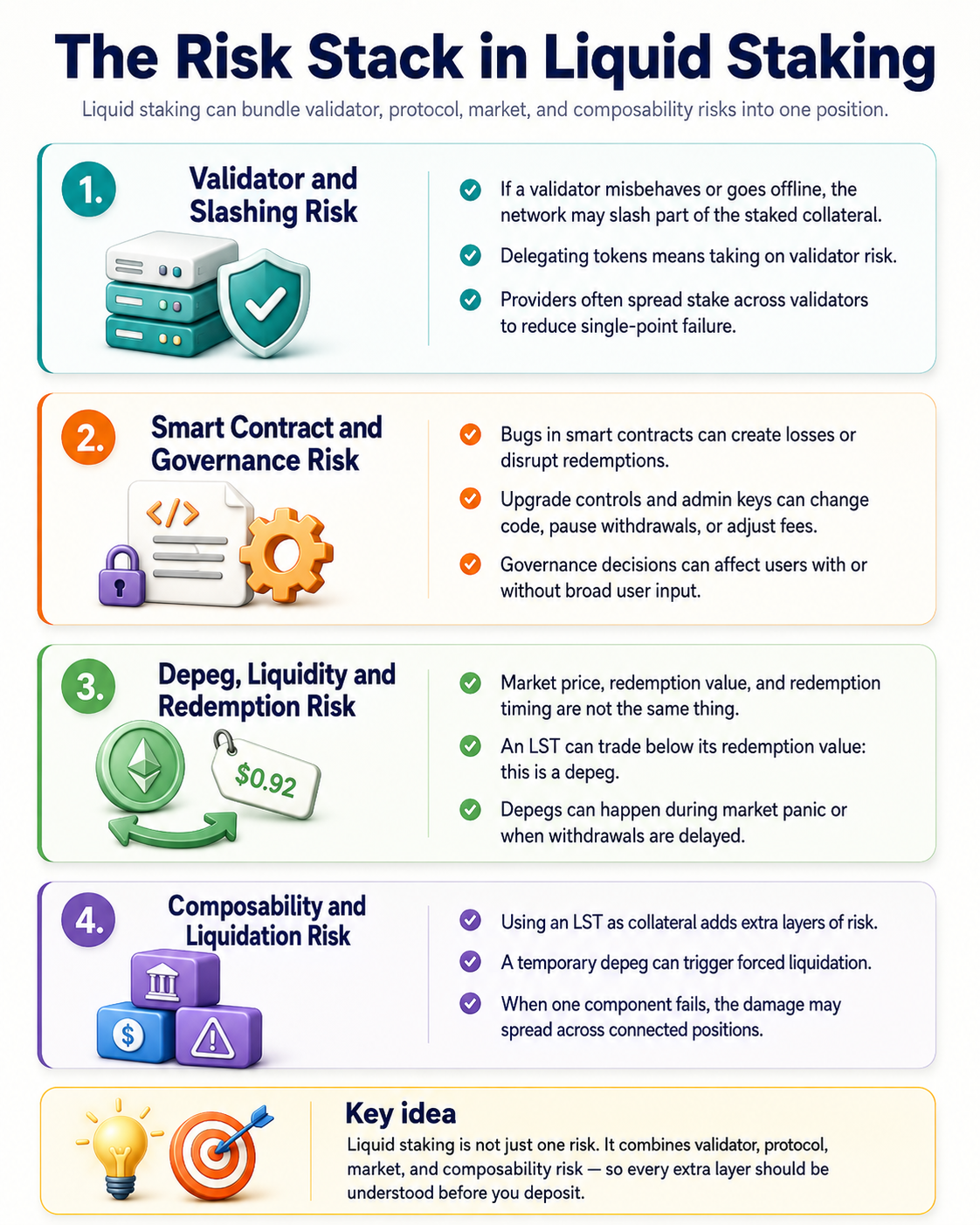
The Risk Stack in Liquid Staking
Here are some of the risks you can encounter in liquid staking.
Validator and Slashing Risk
Slashing risk involves a situation where a validator node misbehaves or goes offline. In this case the network can destroy some of the staked collateral. It's sort of like getting punished for stealing a cookie from the cookie jar. These are the risks that you decide to take on when delegating tokens to a validator. Providers distribute the exposure to limit the chance of a single point of failure situation.
Smart Contract and Governance Risk
Bugs in smart contracts can cause risk in liquid staking. Upgrade controls allow changes to a protocols smart contracts. They allow administrators to pause withdrawals and allow adjustments to be made to protocol commission rates, impacting overall fee amounts. Admin keys in liquid staking protocols allow admins to do things like update code and change fees. These protocol decisions can impact redemption and fees, and the decisions are often made by administrators with or without user input.
Depeg, Liquidity and Redemption Risk
Market price is the current cost to buy or sell an asset. Redemption value is the amount the issuer pays to the holder when the investment matures or is cashed-in. Redemption timing is the point in time when the cash-in can happen. These are all three different concepts from one another. When an LST trades below its redemption value it creates a depeg. This can happen due to market panic or other situations like delays with withdrawals.
Composability and Liquidation Risk
Borrowing against an LST can turn a temporary depeg into forced liquidation. This can be due to penalties or other situations that cause a user to be forced to liquidate their position. Also, if one component fails, the situation may not stay isolated.
How to Evaluate an LST Without Choosing a “Best” One
There are multiple observable dimensions that can help you evaluate liquid staking tokens (LSTs): redemption design, validator set, audits, admin controls, liquidity depth, concentration, fees, incident history and integrations.
When looking at redemption design, determine how redemptions are made and what could possibly go wrong with the design. Also, what fees do they have and do they have any history of negative incidents? Was there a depeg or even a forced liquidation event? Do the admins have so much control that it could possibly have a negative impact on your experience with the LST or cause problems for you as an investor? It's important to take all of this into consideration when evaluating an LST.
Conclusion
Liquid staking made staked positions transferable and composable. The benefit is flexibility; users can trade or use a tokenized representation of their staked assets instead of leaving them frozen. The cost is exposure to the LST, protocol, market liquidity and every DeFi layer added on top. Each of these components carries possible risks so it's important to keep that in mind. If you are thinking of getting into liquid staking or LSTs or you already have explored this space, let us know. We're always open to hearing your thoughts!
Disclaimer: The content provided in this article is for educational and informational purposes only and should not be considered financial or investment advice. Interacting with blockchain, crypto assets, and Web3 applications involves risks, including the potential loss of funds. Venga encourages readers to conduct thorough research and understand the risks before engaging with any crypto assets or blockchain technologies. For more details, please refer to our terms of service.