
Table of Contents
The first time you try to take out a crypto loan, you’ll be faced with a rude shock. You need to lock up $1,500 just to borrow $1,000? It genuinely feels backwards when you first encounter it.
Why on earth would anyone borrow money if they already have more than enough sitting right there in their digital wallet? But here’s why it’s an important part of crypto loans. An overcollateralized loan gives you instant liquidity today while letting you keep your hands on your original assets.
You still own them completely. If their price skyrockets tomorrow, you catch all of that glorious upside. That extra chunky layer of locked value gives the protocol a massive safety net. It acts as a financial safety net for wild swings. Let’s get into the details.
What Overcollateralization Means
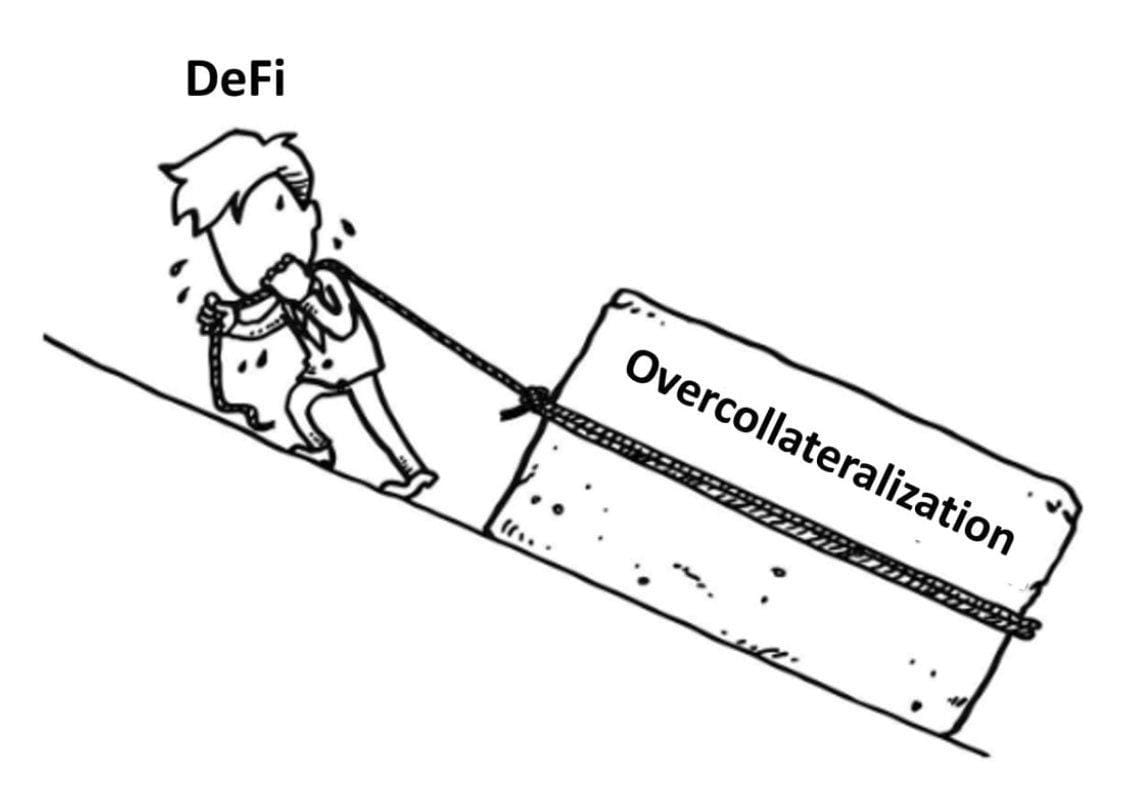
Overcollateralization is one of the latest buzzwords you see everywhere you turn in crypto. It’s actually a rather simple concept. An overcollateralized loan means your safety deposit is worth significantly more than the debt you take out.
You pledge a mountain of digital value to borrow a smaller hill of cash. You’ll often hear three terms thrown around. People talk about the collateral value, the debt value, and the collateralization ratio. They all measure the exact same balancing act of risk and reward.
In fact, saying a crypto loan is 150% collateralized means the exact same thing as saying it has a 66.7% LTV (or loan-to-value ratio). One simply looks at the setup from the perspective of your safety net. The other looks at it from the perspective of your debt burden.
Collateralization Ratio vs Loan-to-Value Ratio
Let’s look at the actual math behind these concepts. It’s surprisingly simple once you see the formulas side by side on the screen.
- Collateralization Ratio: (Collateral Value / Debt Value) × 100
- Loan-to-Value Ratio (LTV): (Debt Value / Collateral Value) × 100
Imagine you deposit $1,500 in Ethereum to borrow $1,000 in stablecoins for a quick trade. Your collateralization ratio in this scenario is exactly 150%. Conversely, your loan-to-value ratio sits at exactly 66.7%.
Here is a quick cheat sheet so you never mix them up again. A higher collateralization ratio is much safer. But a higher LTV is always riskier.
Why DeFi Uses Assets Instead of Credit Scores

In traditional banking, your personal reputation (credit score) pays the bills. Banks will check your salary history and your past debts. DeFi lending doesn’t care about any of that human element.
These lending protocols are completely permissionless by design. This means you interact with them entirely through a pseudonymous wallet address. There are no strict background checks like in traditional finance.
And there are absolutely no courtrooms to drag you into if you just refuse to pay. Everything relies on cold, hard, automatic enforcement through smart contracts.
You demand highly liquid crypto collateral upfront. If a borrower vanishes into thin air or their assets drop drastically in value, the protocol reacts. It simply sells the crypto collateral on the open market before the debt becomes totally undersecured.
How the Excess Collateral Becomes a Safety Buffer

Think of overcollateralization like the heavy-duty shock absorber on an off-road truck. With how volatile the crypto market can get, you desperately need room for the suspension to compress before you feel the impact of the uneven terrain.
When you open a crypto loan, you start with a wide gap between what you owe and what you deposited. But if prices suddenly crash, that comfortable gap shrinks fast. Here is how that crucial buffer breaks down visually for a borrower:
- Opening LTV: Your comfortable starting point when you take the loan. Cozy and safe.
- Maximum Borrowing LTV: The absolute limit of new debt you can draw against your deposit.
- Liquidation Zone: The red danger zone. If your buffer shrinks this far, the protocol hits the panic button.
- Bad-Debt Zone: The nightmare scenario where your debt exceeds your collateral. The protocol has failed its primary job.
Worked Example: A 150% Collateralized Position
Let’s say you deposit $1,500 worth of ETH collateral to mint a 1,000 USDT debt. Everything has been going great for a few weeks. Until ETH decides to drop 10% in value overnight. You are now left with $1,350 worth of ETH holding up your 1,000 USDT debt. You are sweating a little bit.
Then, a brutal 20% total drop hits the markets out of nowhere. You now have just $1,200 in ETH backing your 1,000 USDT debt. Your LTV is climbing dangerously high at this point. Interest is also quietly growing, adding to your debt in the background.
Finally, a devastating 30% crash pushes your crypto collateral down to $1,050 worth of ETH. You officially cross the dreaded red line. Liquidation. The lending protocol automatically triggers a sale of your assets. It then slaps you with a hefty penalty fee just to rub salt in the wound.
Overcollateralization and Liquidation Are One Mechanism

Overcollateralization and liquidation are basically twin gears grinding in the exact same financial machine. They cannot exist without each other. A protocol must begin aggressively selling your assets early enough to cover network slippage.
It also has to account for trading fees and sudden market gaps. On top of that, the system has to pay a financial bounty to outsiders. Liquidators are essentially third-party bots hunting for risky loans around the clock.
They demand a serious financial incentive to do the protocol’s dirty work. Your excess collateral is exactly what pays their salary during a liquidation event. Without that overcollateralization buffer, the liquidators wouldn’t even show up.
Why Collateral Requirements Differ by Asset
In DeFi not all digital assets are created equal. Smart contracts treat them very differently based on their history. A blue-chip coin like Ethereum, Solana, or BNB might only require a mild 120% collateralization ratio to borrow against.
A newer, highly speculative token might demand a 200% collateralization ratio or even more. The massive gap exists simply because of raw price volatility. Risk parameters are heavily influenced by market depth and how reliable the price oracles actually are.
If an asset has an ugly history of sudden depegs, the protocol places a higher collaterization ratio. A deep, heavily traded asset allows for higher borrowing power. This is because it’s remarkably easy to sell in a widespread market panic. A thin token? Not so much.
Overcollateralization in Lending vs Stablecoin Issuance
You’ll see this specific buffer concept pop up frequently in two main corners of the crypto universe. First, there is standard DeFi lending on platforms like Aave or Compound. You deposit a digital asset into a massive communal lending pool. You then borrow somebody else’s idle USDC directly from that pool.
Second, there is decentralized stablecoin issuance. You deposit that exact same crypto collateral into a special smart contract vault.
But instead of borrowing an existing token from another user, the protocol actively mints brand new crypto-backed stablecoins directly into your wallet. The liability source is completely different in these two scenarios.
One simply borrows from a peer. The other effectively prints fresh digital money into existence. But the core logic running under the hood? It is entirely identical.
Both systems strictly rely on heavy overcollateralization to keep their internal math solvent. If they stray from overcollateralization, they risk total systemic ruin within hours. DeFi lending simply cannot function without this fundamental rule.
Why Borrow If You Already Own More Than the Loan?
Have you ever wondered why you need to lock your $1,500 Bitcoin to get only a $1,000 loan? These are the main reasons people take up crypto loans.
- Gain access to liquid cash without actually selling your prized digital assets. This means you don’t trigger a painful taxable event. You also keep the long-term economic exposure to that specific asset’s growth.
- You can actively create a clever hedge or short exposure. If you strongly believe a specific token is going to crash, you can use your strong collateral to borrow that weak token. You sell it immediately for cash, and then buy it back much cheaper later to repay the crypto loan.
- You can loop your capital. You deliberately combine decentralized credit with another on-chain position to farm high yields.
The Cost of the Safety Buffer
Overcollateralization is a vital safety net that comes with some very serious baggage for the borrower. The biggest underlying issue is terrible capital efficiency.
By forcing you to lock up excess value, your money is literally just sitting there in a vault. It is doing absolutely nothing productive. The daily opportunity cost of poor capital efficiency is massive. You could be deploying those funds elsewhere.
Then, there’s the constant, looming threat of a forced sell-off ruining your day. Protecting the anonymous lenders inherently makes the overall position much riskier for the borrower. If your crypto collateral suffers from sudden, violent price volatility, you are constantly checking your phone in a panic.
You are willingly trading your mental peace of mind for instant liquidity. Improving capital efficiency remains the holy grail for most developers in this space.
What Happens When the Buffer Is Not Enough
Imagine a sudden market dip that causes your collateral to drop by 40%. Or the underlying blockchain gets so wildly congested that liquidators simply can’t push their rescue transactions through the network.
Maybe a decentralized oracle dramatically fails and feeds the wrong price data directly to the smart contract. Or worse, the automated auction to sell your seized assets finds absolutely zero willing buyers. The liquidity has completely dried up, leaving the protocol holding toxic bad debt.
While overcollateralization heavily reduces expected credit risk, it has limits. It absolutely cannot always guarantee complete solvency in every possible catastrophic market condition.
Alternatives That Use Less or No Upfront Collateral
Overcollaterization is not the zenith of DeFi. Brilliant developers are actively experimenting with the undercollateralized loan right now. Some of these experimental models rely heavily on off-chain identity. They blend traditional credit checks and real-world reputation seamlessly with blockchain rails.
Others use a system of delegated credit. In this model, a highly trusted institution legally vouches for an anonymous borrower to secure an undercollateralized loan.
We are also seeing a massive institutional push into real-world asset lending. By backing loans with tokenized real estate or government treasury bills, protocols can drastically improve their capital efficiency.
And then, naturally, there is the wild and chaotic world of the flash loan. You can literally borrow millions of dollars with a zero upfront deposit using a flash loan. However, you must pay the entire flash loan back in the exact same atomic blockchain transaction. If you fail, the flash loan simply reverses as if it never happened.
How a User Should Read a Collateral Requirement
Before you blindly lock up your hard-earned funds, you need to read the fine print carefully. Don’t just glance at the advertised interest rate and click accept.
Look closely at the maximum LTV. Find the exact liquidation threshold where your assets get forcibly sold. The liquidation threshold is arguably your most important number. If the market touches your liquidation threshold, your financial day is ruined.
Also, explicitly check the liquidation bonus. That’s the painful penalty fee you pay directly to the liquidator who ruthlessly crushes your position. Is it 5%? Is it 10%? That percentage wildly matters when your collateral is on the line.
Conclusion
At its core, overcollateralization is simply automated credit protection. It keeps the DeFi lending market working without traditional underwriting. It replaces the need for expensive lawyers, background checks, or aggressive collection agencies.
In return for severe capital lock-up and constant portfolio price risk, borrowers get fast, permissionless liquid cash. But that excess collateral creates the vital breathing room needed for a safe, orderly liquidation process without collapsing. Without it, DeFi lending as we know it would cease to exist.
Disclaimer: The content provided in this article is for educational and informational purposes only and should not be considered financial or investment advice. Interacting with blockchain, crypto assets, and Web3 applications involves risks, including the potential loss of funds. Venga encourages readers to conduct thorough research and understand the risks before engaging with any crypto assets or blockchain technologies. For more details, please refer to our terms of service.