

Table of Contents
Investing whenever you feel like it and pouring money into assets on impulse may not be the best strategy. It may bring a sense of freedom and instant gratification. But it carries risks. While trying to time the market, an investor may miss out on opportunities or choose a poor entry point. They may even distort the balance of their portfolio because they unintentionally increased the portion of aggressive volatile products.
Assessing market conditions every time is exhausting. Instead, you can invest on a predefined schedule. It removes the need to monitor prices, market sentiment, or news to select the right moment. Investing consistently is easier, as you just use the rules chosen in advance. You'll be less anxious and less doubtful.
Below we’ll explain how investing on a regular basis simplifies decision-making and why high returns are not guaranteed even if you spread the entry points over time. We’ll discuss market timing, the DCA method, as well as the benefits and drawbacks of automation.
What Is Investing Consistently?
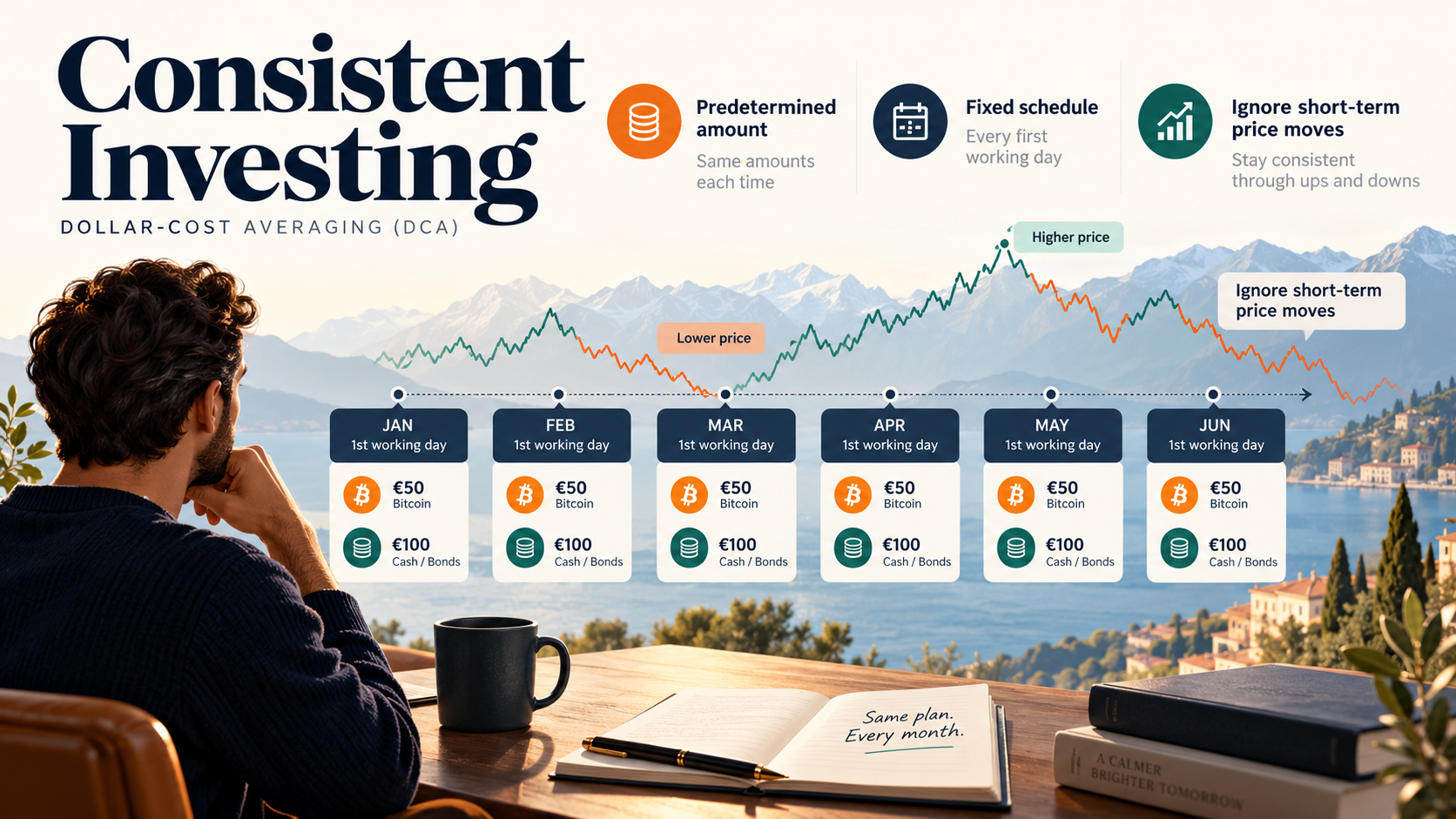
Buying stocks or cryptocurrencies several times per year is not enough to say that you invest consistently. You should contribute a predetermined amount of money regularly, following a set schedule. Your actions should be logical and recurring.
For example, you can invest €50 in Bitcoin and €100 in cash instruments or bonds on the first working day of every month. You should not take into account the current asset prices and short-term market trends. This is classic dollar-cost averaging (DCA), where amounts are equal and time intervals don’t change.
Why Does “I Feel Ready to Invest” Keep Changing?
Investors create plans and strategies that help them reach their goals. A good investment plan describes a relevant target, time horizon, acceptable risk level, asset allocation, and regularity of contributions. These define how much, for how long, and in what product classes you are willing to invest.
The plan is necessary for portfolio management. If you don't have one, you are likely to react emotionally to any market changes. When prices go up, you may feel greed and try to buy as many assets as you can, while when they fall, you may feel the urge of panic selling.
What’s more, without a plan, the moment when you’re “ready” is defined by external factors. You may postpone a contribution after a decline or invest more than usual after a sharp rise, which could disrupt your initial balance and hinder your ability to achieve goals. Historically, most actively managed portfolios rarely bring a positive alpha. So, the effort and stress involved in trying to keep track of everything and react quickly aren’t always worth it.
How Does a Schedule Simplify the Investment Decision?
Using an ever-changing emotional state as the main signal for entering the market can cause you to make bad investing decisions. And you don’t want this, right? To avoid mistakes that stem from acting based on fear, euphoria, regret, or overconfidence, you can adopt a timetable. Choose which products to invest in and how often.
As soon as the amount and frequency of contributions are set, you no longer need to predict future prices. Using the schedule, you shift your focus from trying to find the perfect time to enter the market to accumulating assets over time. Long-term buy-and-hold strategies tend to yield higher returns.
Can Regular Investing Reduce the Risk of a Bad Entry Point?
Whether investment consistency will reward you is another question to discuss, though. The promising returns are not inherent to regular contributions. You cannot avoid ill-timed entries and exits during rallies and corrections entirely (or you need to be very, very lucky). But what you can actually do is to average down the purchase prices.
If you invest cash in equal portions at regular intervals, you buy more products when the prices are lower and fewer when they are higher. Mathematically, your average purchase price decreases.
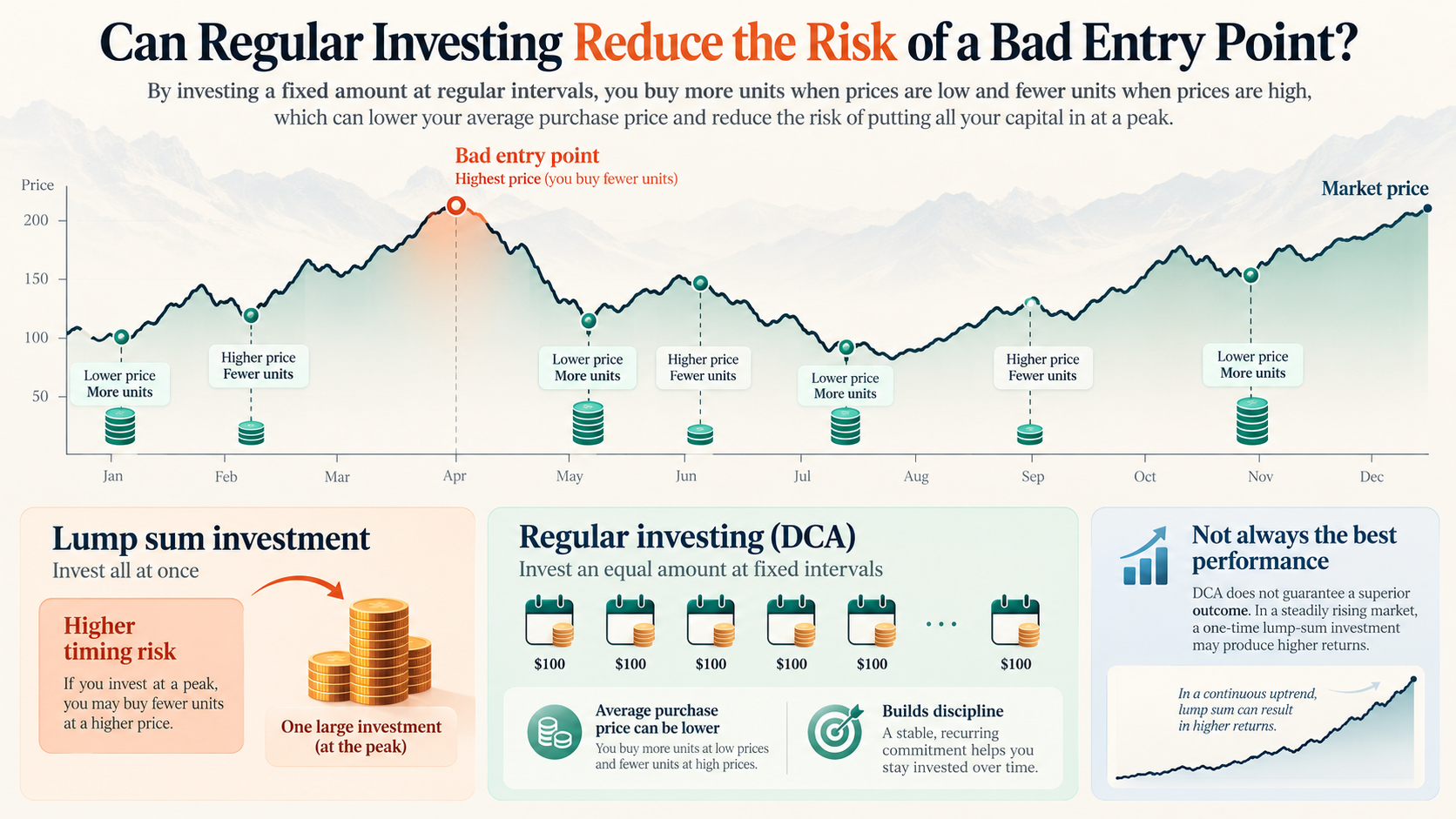
The fixed-cash-amount strategy mitigates the risk of investing a lump sum at a high price. It won’t be possible to invest all your capital at a market peak. You will take advantage of market downturns, buying products at a discount. Plus, a stable and predictable cash commitment can help you stay disciplined. However, the DCA method and its analogues do not offer a superior outcome. In a market with steady growth, this may yield a lower return compared to a one-time investment.
Practical Example: Regular Purchases in a Volatile Market
Here’s an example of how regular investments can look in practice. The table below uses a fictional crypto asset with fluctuating prices to illustrate how six equal monthly contributions reduce the possibility of a bad entry point.
As you can see, making regular investments does not mean you get the lowest possible purchase cost or the best return. However, you buy more units when the price decreases. So, your actual average cost is lower than the average market price.
In our example, by the 6th month, the token price reaches €8, and the portfolio’s value exceeds €2,000. To achieve this result, an investor didn’t have to manually time the absolute bottom or worry about price drops.
Is Making Regular Contributions the Same as Gradually Investing the Amount You Have?
When getting started, an investor may have one of two scenarios. Either they have a sum of money that they want to invest, or they don’t have that money but can set aside a portion of their salary.
- If an investor has, say, €2,400 available and chooses to invest it over a year, they divide the amount into installments. They’re deliberately delaying part of the investment. The remaining funds are held in reserve.
- If an investor doesn’t have the money but can invest €200 each month for twelve months, they will eventually invest €2,400 as well. The only difference is that they won’t intentionally delay contributions but use new cash flow as they earn it.
Why Can Waiting for the Perfect Time Be Difficult in Crypto?
Timing the crypto market is especially difficult because cryptocurrencies and derivatives are very volatile. Their prices swing substantially over short periods. Trading based on changing signals forces an investor to perform more trades, pay gas fees often, and likely feel FOMO.
Crypto markets operate 24/7. So, many price swings, crashes, and recoveries happen at night. Keeping an eye on them is practically impossible. If an investor waits for the dip, they may have to sit in front of price charts round the clock, and there’s no guarantee that it will pay off.
What Can Automation Solve and What Can It Not?
There are several principles of when to introduce automation into your investment processes. Firstly, automate what you already know how to do. If you’ve just learned how to place orders, it’s best to spend more time learning the mechanics, market trends, and features of the investment app. You need to understand what you’re doing before entrusting the routine to any algorithms.
Secondly, automation only makes sense if you know when, what, and in what amount you want to buy and if you really need it. The schedule should never dictate your strategy. It is a tool that may or may not be necessary to achieve investment goals. There’s no point in creating a timetable just for the sake of it. An unmonitored autopilot is a dangerous thing.
Lastly, an investor should not be afraid to deviate from the schedule. Of course, following a plan is praiseworthy and often more effective than investing chaotically. However, life isn’t exactly predictable. If unexpected expenses arise or your cash flow changes, for example, if you have a baby or find a new job, it’s okay to revise your contributions.
Automated trade execution can help you stay calm, but it cannot solve such issues as poor understanding of trading mechanisms, incorrect asset selection, and unforeseen life crises.
When Might Consistent Investing Not Be the Right Approach?
We would like to say, “Invest on a schedule and you’ll be a millionaire,” but that would be misleading. It doesn’t work for everyone. In some cases, repeated small transactions are inefficient. Scheduled investing might not be the right choice if:
- The contribution amounts are very small, and the fees eat up a large part of them;
- Deploying a lump sum suits your strategy better, and you’re willing to take the risk;
- You are not sure that the investment product is doing fine, not slowly dying;
- You have debts to pay, or the money is needed in the near future, etc.
So, treat sticking to a timetable as an effective remedy for emotional decision-making and as one of the many possible approaches. Flexible or rules-based contributions are sometimes more pragmatic. Compare the different methods and choose the one you consider suitable.
Disclaimer: The content provided in this article is for educational and informational purposes only and should not be considered financial or investment advice. Interacting with blockchain, crypto assets, and Web3 applications involves risks, including the potential loss of funds. Venga encourages readers to conduct thorough research and understand the risks before engaging with any crypto assets or blockchain technologies. For more details, please refer to our terms of service.