

Table of Contents
This week, football fans finally got their answer on who would win the 2026 Ballon d’Or, and, as always, there was a bit of drama and debate around the results. However, something interesting happened off the pitch.
Several Polymarket accounts predicted the exact top five before the ceremony and made nearly $200,000 in profit. Naturally, people have questions.
Quick Reminder
Polymarket is a prediction market where users can bet on the outcomes of almost any real-world event, from political elections to sporting competitions. Its transactions are publicly traceable on the Polygon blockchain, allowing anyone to examine betting activity, including amounts, timestamps and wallet addresses.
To make the bets, Polymarket uses USDC and shares representing the different possible outcomes. Their prices reflect the market’s implied probability, meaning that a share priced at $0.70 suggests a 70% chance of that outcome (according to the bettors), and a winning share pays out $1.
On the other hand, the Ballon d’Or is one of football’s most prestigious individual awards, recognising the best player of the year.
So, as you can imagine, people have been pretty active on Polymarket around it.
What Happened?
Just three days before the ceremony, on October 23, media outlet Upside reported suspicious betting activity across several Polymarket accounts.
Those accounts collectively wagered $264,000 on the same specific scenario for the Ballon d’Or top 5 ranking:
- Harry Kane
- Kylian Mbappé
- Lamine Yamal
- Rodri
- Lionel Messi
As blockchain transactions are public, the bets were traceable before the ceremony even began and open to public scrutiny. So, naturally, the situation raised questions and curiosity.
A second investigation published on October 28 by JDC added another layer to the story with an analysis of 150 wallets through Polymarket’s public API.
When taking a closer look, investigators noticed that kraben006, the first suspicious account identified, placed its first bets on Harry Kane to win the Ballon d’Or on October 1, just three days after the jury’s voting deadline had passed on September 28.
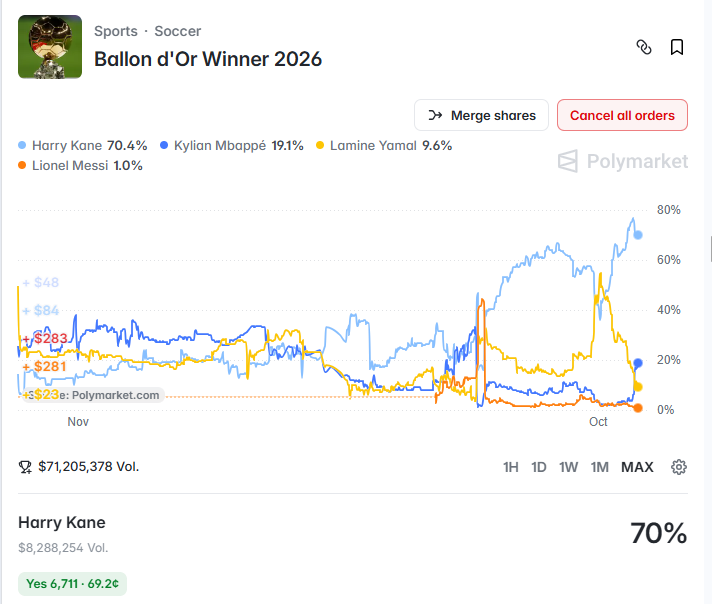
Shortly afterwards, Polymarket opened the market on whether Mbappé would finish above Yamal. That same account, alongside newly created ones, started betting on Mbappé, even though the market initially gave him relatively low chances of finishing ahead of the Spanish player.
Then, on October 9, the odds shifted significantly without any apparent news to explain the change. The probability of Mbappé finishing ahead of Yamal jumped from around 17.5% early on October 9 to 45% by midnight, and by October 22, the market had moved from strongly favouring Yamal to giving him just a 28% chance of finishing above Mbappé. The market for Kane winning the Ballon d’Or also increased from 54% to 64% on October 9, again without any clear news explaining these sudden changes.
On October 19, Polymarket opened the possibility of betting on players’ exact positions in the final ranking, and this is where the real fun began. That same night, the suspicious accounts started betting on the same five-player scenario.
There is an interesting detail here: kraben006 sold its existing position on Kane winning to bet on the exact top 5 ranking instead. This appears to be pretty odd as it was a considerably riskier strategy (unless, you already know the results).
What is also interesting is that 12 of the suspicious accounts had been created in October, with seven reportedly not betting on any other markets. Several accounts also placed bets shortly after being created.
The investigations additionally identified a recurring pattern as different accounts would bet for a few days before stopping, while another account continued the same strategy, which could suggest that multiple accounts were controlled by a single person.
Though, the entire activity was not limited only to accounts created shortly before the ceremony. Some of the largest positions were placed by wallets which entered the market between October 12 and 20, with two addresses accounting for approximately $46,000 in bets on the exact-position markets, and 16 of the 25 wallets identified by JDC only entered those markets on the day of the ceremony. This distinction matters because not every successful bettor (if any) necessarily had access to advanced information.
So, as you can imagine, once this whole situation was spotted, people became curious about what was happening behind the scenes and were waiting even more for the Ballon d’Or ranking to be revealed.
Time for the Results
Fake drumroll sounds… (yes, you have to imagine it).
The ranking was exactly as predicted!
On Monday, October 26, we got the official 2026 Ballon d’Or ranking. Harry Kane won the trophy, followed by Mbappé, Yamal, Rodri and Messi, in precisely the order mentioned previously.

By winning the related bets, the accounts reportedly made nearly $200,000 in profit on their combined $264,000 in stakes, without losing a single bet among the markets investigated.
Yeah, not too bad!
However, the reported profits vary depending on which wallets and markets are included in the analysis. Upside’s investigation focused on 12 suspicious accounts and nearly $200,000 in combined profits, while JDC separately identified 25 wallets that predicted the four positions behind Kane and analysed three wallets that made close to $90,000 in total. These figures describe different groups and shouldn’t be added together.
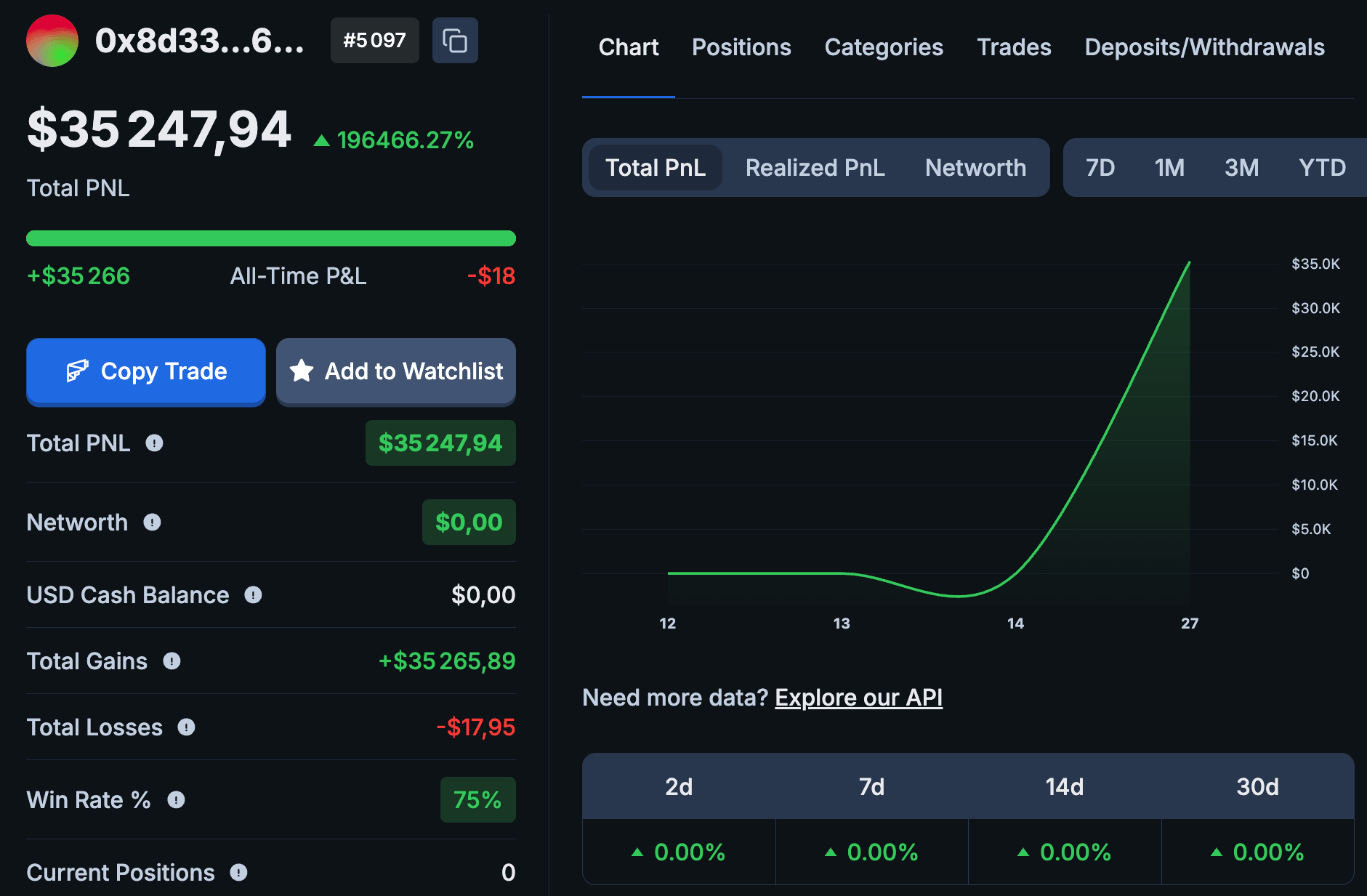
On top of this, the second investigation identified several particularly profitable wallets. One address, 0x8d33, reportedly made around $31,500 by betting heavily on Mbappé finishing above Yamal, but without trading on any other events. Another account, OuldLm3alem, reportedly made approximately $31,000 after placing several bets on the exact rankings and settling its positions shortly after the results, and a third wallet, 0xdd97e6, earned around $25,000. Together, these three wallets generated close to $90,000 in profits on Ballon d’Or markets alone.
So, Lucky Guess or Leaked Information?
Predicting the Ballon d’Or winner is one thing, but getting the entire top five right is another.
The accuracy of the predictions, the difficulty of getting this exact scenario right, the timing and the unusual betting patterns have raised concerns about possible insider information. And as you may know, this isn’t the first time that prediction markets have raised such concerns, although Polymarket prohibits trading based on certain confidential information obtained from people who are required to keep it secret.
However, as it does not require users to provide identity documents, it is difficult to establish who controls a particular wallet. The accounts’ owners remain unidentified, and there is no proof that confidential information was leaked or that the accounts belonged to the same person. The unusual activity is certainly worth investigating, but suspicious patterns alone don’t establish wrongdoing.
Maybe we should keep an eye out for those accounts, just in case they try their luck with predicting next year’s Champions League or Ballon d’Or.
Disclaimer: The content provided in this article is for educational and informational purposes only and should not be considered financial or investment advice. Interacting with blockchain, crypto assets, and Web3 applications involves risks, including the potential loss of funds. Venga encourages readers to conduct thorough research and understand the risks before engaging with any crypto assets or blockchain technologies. For more details, please refer to our terms of service.