
Table of Contents
DORA stands for the Digital Operational Resilience Act and it is a European Union law that entered into application on January 17th 2025. It can be simplified as a framework that expects regulated financial and crypto businesses to keep important digital services available, maintain or restore them when disruption occurs, and continuously control the ICT risks that could interrupt them.
DORA governs covered financial entities including credit institutions, payment service providers, investment firms, crypto-asset service providers, insurance companies, and ICT third-party service providers. If you operate in the EU financial sector, DORA likely governs your security operations.
How Do Availability, Continuity, and ICT Risk Control Fit Together?
These three concepts are all part of the same system, just like how you, your brother, and your sister are part of the same family. Availability concerns whether systems and data can be used when needed; continuity concerns keeping critical functions running or restoring them after disruption; ICT risk control covers the processes used to identify, prevent, monitor and manage technology risks. Here is a table outlining the different concepts, their simple meaning, an example for a crypto user, and the relevant DORA response so you can see how DORA works in action according to its different articles.
What Does Availability Mean for a Crypto User?
For a crypto user, availability under DORA means the platform works exactly when you need it.
It translates directly into four core functions you notice every day:
- Logging In: You can access your wallet, exchange, or dApp instantly without encountering timeouts or server errors.
- Viewing Accurate Information: Your asset balances, portfolio values, and live price feeds are up-to-date and never glitch or show stale data.
- Submitting Transactions: You can buy, sell, deposit, or withdraw crypto immediately without the system freezing or failing under heavy traffic.
- Accessing Critical Services: You can reliably use vital platform features, such as contacting emergency support, executing smart contracts, or retrieving account histories.
What Happens When Availability Breaks?
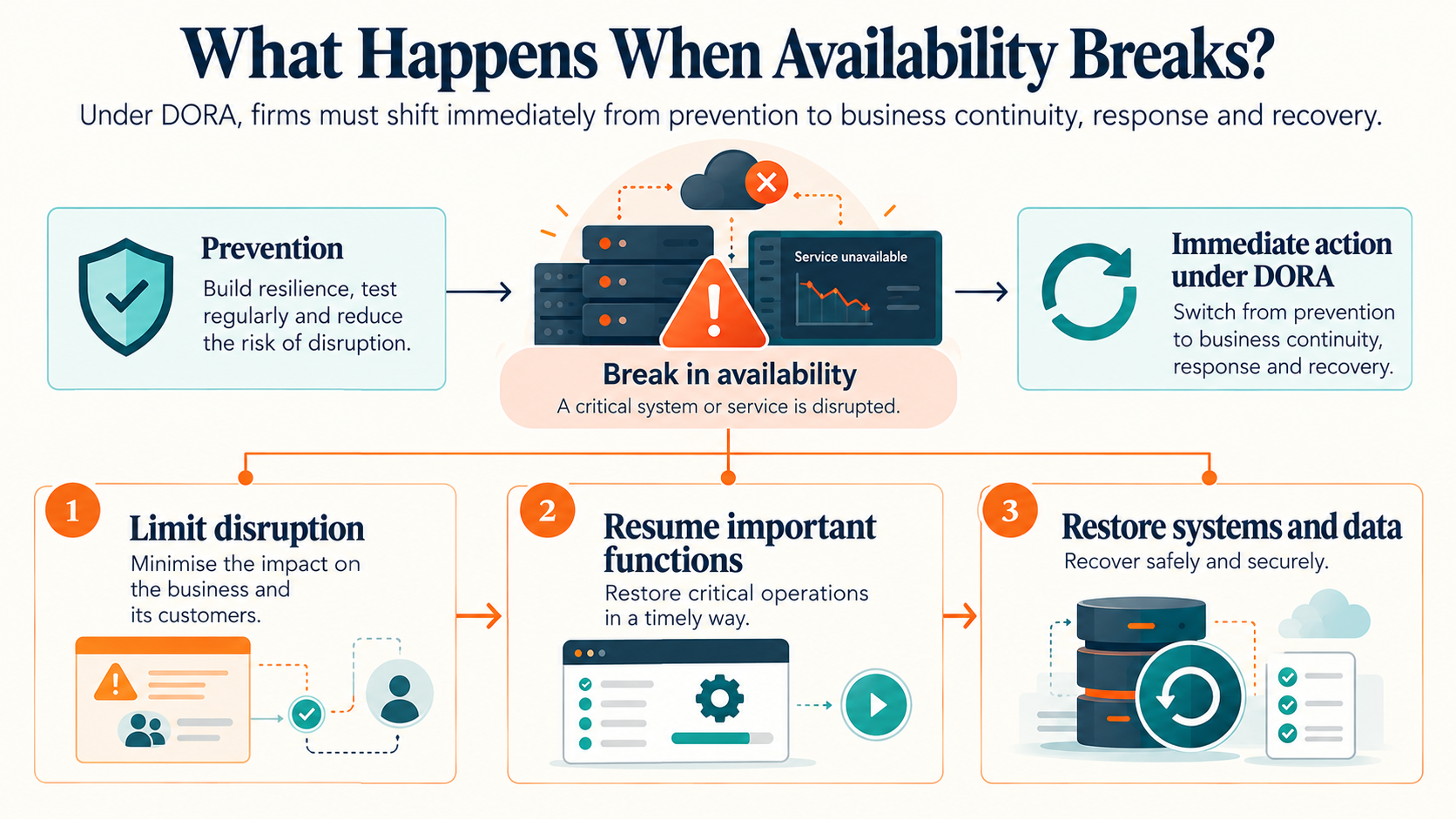
Under the Digital Operational Resilience Act (DORA), when availability breaks, covered entities must immediately shift from prevention to business continuity, response, and recovery.
Specifically, they are required to activate arrangements designed to:
- Limit disruption to the business and its customers.
- Resume important functions in a timely manner.
- Restore systems and data safely and securely.
What Does ICT Risk Control Mean Before an Outage Happens?
Resilience starts long before a system fails. ICT risk control means setting up your defenses before an outage happens, rather than just reacting once things break.
Instead of scrambling during a crisis, companies proactively protect themselves by mapping out assets, catching vulnerabilities early, and keeping a constant eye on their systems. It is the difference between having a fire code in place versus just calling the fire department when the building is already burning.
Why Is External Infrastructure Part of the Same Risk System?
Cloud infrastructure, software, data and other external ICT services can support critical functions even though the technology belongs to another company. DORA therefore treats third-party ICT dependency as part of the regulated entity's own ICT risk. Outsourcing technology does not mean outsourcing regulatory responsibility.
Which Regulated Crypto Services Does DORA Cover?
DORA applies to MiCA-authorised Crypto Asset Service Providers (CASPs) and issuers of Asset Referenced Tokens (ARTs), while other regulated entities involved in crypto services can fall within its scope through categories such as credit institutions or electronic money institutions.
Practical Example: An Outage Takes a Crypto Platform Offline
Scenario: NorthPeak Crypto is a fictional MiCA-authorised CASP. Its cloud provider has a regional outage.
Does DORA Mean a Service Should Never Go Down?
DORA does not guarantee zero downtime or eliminate cyberattacks, software failures, data problems or outages at third-party providers. Its practical purpose is to require regulated firms to prepare for disruption, control ICT risk, maintain critical functions where possible and recover in an organised way when prevention does not stop something bad from happening. It's like when your friend warns you not to drink another beer but then removes you from the bar if you fail to comply. That way you can recover in an organized way, just like DORA is designed to do.
Disclaimer: The content provided in this article is for educational and informational purposes only and should not be considered financial or investment advice. Interacting with blockchain, crypto assets, and Web3 applications involves risks, including the potential loss of funds. Venga encourages readers to conduct thorough research and understand the risks before engaging with any crypto assets or blockchain technologies. For more details, please refer to our terms of service.